Electric Meat Grinder
ProductOverview
An electric meat grinder is a powered kitchen machine that processes whole meat into uniform ground texture. The device uses a rotating helical auger housed in a cylindrical barrel to compress and propel meat forward at controlled speed, forcing it through a hardened-steel cutting plate perforated with apertures of varying size. The shearing action between the moving meat column and stationary cutting plate severs fibers into consistent particle size. Interchangeable dies allow selection of grinding coarseness (coarse 8–10 mm, medium 5–6 mm, fine 3–4 mm) without changing the core mechanism.
Electric grinders replaced manual hand-crank models in commercial kitchens and butcher shops by the mid-20th century, later entering home kitchens as compact versions. The advantage over blade-based food processors is that the auger-and-die mechanism avoids rapid heating and oxidation of the meat, preserving color and texture for sausage, burger, and pâté production. A 500 W motor can process 80–100 kg of beef per hour with proper die selection and temperature management.
The design is fundamentally a volumetric displacement pump where meat is the working fluid. The auger acts as a progressive-cavity screw, with pitch and helix angle chosen to maintain even flow and prevent jamming. Barrier forces come from die aperture restriction and friction in the barrel, creating backpressure that aids fiber severance. Most consumer models use worm gearboxes to step motor rpm down by 8:1 to 15:1, trading speed for the torque needed to grind tough connective tissue and bone.
How it works
When powered on, the motor drives the input shaft of the gearbox. Helical or spur gears reduce the speed to 200–400 rpm and apply a 8–15 times torque multiplier. The output shaft connects to the auger spine. As the auger rotates, its helical threads compact meat fed through the hopper and push it axially along the barrel toward the Cutting Plate and Die. When meat reaches the die (or Medium Die or Fine Die, depending on selected coarseness), it is sheared as it passes through apertures, emerging as ground meat particles.
The Barrel Cylinder is precision-bored to tight tolerances (typically ±0.05 mm) so the Auger Screw screw rotates with minimal radial clearance, typically 0.2–0.3 mm. Tighter clearance increases shear force; looser clearance reduces motor load but sacrifices cutting efficiency. The barrel is fitted with ball bearings at both ends to support the auger shaft and handle radial forces from meat pressure and rotation.
The Gearbox Assembly is usually a single-stage or two-stage reducer with helical gears running in oil. Helical gears are preferred for their smooth engagement and lower noise compared to spur gears. The gearbox also provides a convenient output interface; the barrel assembly bolts to the gearbox flange, and the hopper connects via a tapered or stepped bore to guide feed material.
Meat undergoes a state change within the barrel. Whole muscle fibers (60 mm–200 mm long, 10–100 micrometers in diameter) are compressed as the auger advances them, causing partial deformation and damage to the myofibrils. Upon passing through die apertures, remaining intact fibers are severed cleanly. The small particles (3–10 mm depending on die) have high surface area and are ready for binding into sausages or burgers, or for emulsification into pâtés.
Temperature control is passive in most electric grinders. Friction between the auger, barrel, and meat generates heat, typically raising meat temperature by 2–8 °C over a 10-minute grind. Some commercial units include water-jacket cooling or insulated barrels to slow temperature rise. Fast auger speed and small die apertures increase shear heating; grinders designed for sausage production often run 50–100 rpm to minimize heat.
Materials and Standards
Cutting plates and auger screws are hardened tool steel, typically AISI D2 or O1 grade, heat-treated to Rockwell hardness Rc 58–62. This resists wear from bone fragments and ensures clean cutting for thousands of hours. The Barrel Cylinder is usually stainless steel (304 or 316) for corrosion resistance and easy cleaning, or hardened carbon steel with nickel-chrome plating.
Ball bearings in the barrel support are typically deep-groove (ISO 6000 series, SKF or equivalent) rated for 5000–20000 hours at full load, depending on size and preload. The Gearbox Housing is aluminum or ductile iron with mineral oil ISO VG 32–68 for lubrication. Seals between components use elastomer o-rings, typically Nitrile (NBR) for food-contact surfaces or Buna-N for oil lubrication.
Safety and Maintenance
Electric grinders include guards (usually the Safety Housing and Guards) over rotating shafts and a feed restriction that prevents fingers from entering the hopper while the auger is running. Thermal cutouts at 130–150 °C protect the motor from overload. Most consumer models are designed for intermittent duty (maximum 10–15 minutes continuous operation per session) to avoid motor overheating.
Cleaning requires disassembly of the barrel, auger, and cutting plate. The dies and Die Ring Nut come off with a hand tool; the auger can be removed by unbolting it from the gearbox output. All components should be rinsed and dried immediately after use to prevent bacterial growth and rust on the cutting edges.
Maintenance intervals include annual inspection of bearing wear (listen for grinding noises), checking that the barrel bore is not scored, and topping up gearbox oil if the housing has a filler plug. Most consumer units are sealed and bearings are lubricated-for-life.
Electric Meat Grinder parts and their functions
7 top-level parts · 73 parts in total · full bill of materials below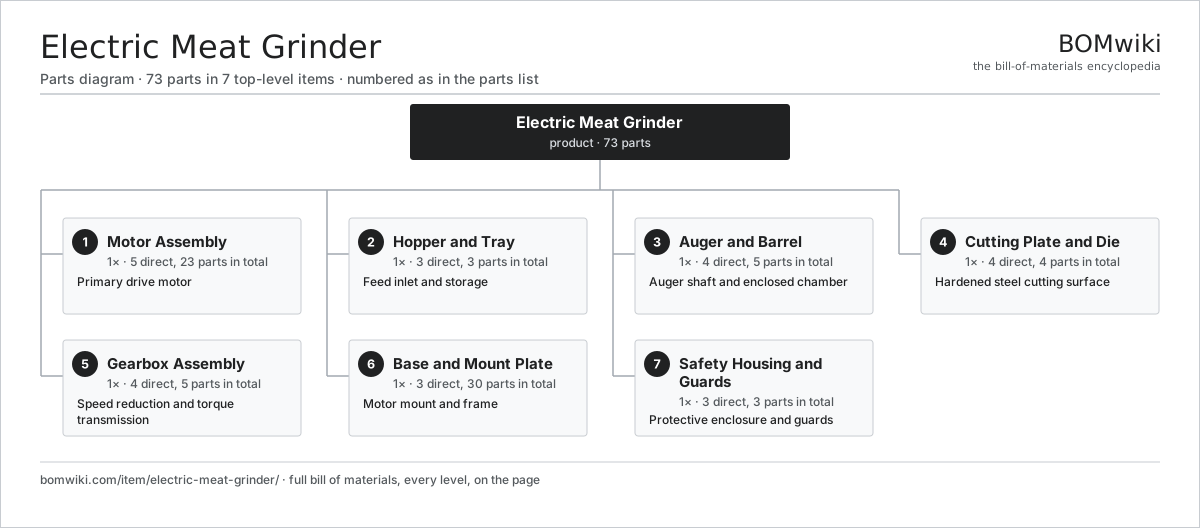
| # | Part | Qty | What it does |
|---|---|---|---|
| 1 | Motor Assembly 5 parts | 1× | Primary drive motor |
| 2 | Hopper and Tray 3 parts | 1× | Feed inlet and storage |
| 3 | Auger and Barrel 4 parts | 1× | Auger shaft and enclosed chamber |
| 4 | Cutting Plate and Die 4 parts | 1× | Hardened steel cutting surface |
| 5 | Gearbox Assembly 4 parts | 1× | Speed reduction and torque transmission |
| 6 | Base and Mount Plate 3 parts | 1× | Motor mount and frame |
| 7 | Safety Housing and Guards 3 parts | 1× | Protective enclosure and guards |
3D model
No 3D model yet. Have a CAD file of this? Add a 3D model. STL renders right on this page; STEP, FreeCAD, and OpenSCAD sources are welcome too (openly licensed, like all 3D models on BOMwiki).
Build & assembly graph
expand / collapse · shared sub-assemblies converge · links to related products · est. labourTap an assembly to expand/collapse · tap a part to open it · use “Open page” for any node · drag to pan, scroll to zoom.
Bill of materials for Electric Meat Grinder
7 top-level lines · 42 rows shown · 73 parts total · indented to 3 levels| # | Item / sub-assembly | Part no. | Qty/assy | Ext. qty | Parts | Type |
|---|---|---|---|---|---|---|
| 1 | Motor Assembly 5 parts | electric-meat-grinder-motor | 1× | 1 | 23 | assembly |
| 1.1 | Motor Housing | motor-housing | 1× | 1 | · | part |
| 1.2 | Copper Winding | copper-winding | 1× | 1 | · | part |
| 1.3 | Hall Sensor | hall-sensor | 1× | 1 | · | part |
| 1.4 | Rotor Assembly 4 parts | rotor-assembly | 1× | 1 | 19 | assembly |
| 1.4.1 | Rotor Shaft | rotor-shaft | 1× | 1 | · | part |
| 1.4.2 | Rotor Core | rotor-core | 1× | 1 | · | part |
| 1.4.3 | Neodymium Magnet | neodymium-magnet | 16× | 16 | · | part |
| 1.4.4 | Ball Bearing | ball-bearing | 1× | 1 | · | part |
| 1.5 | Fastener Set | fastener-set | 1× | 1 | · | part |
| 2 | Hopper and Tray 3 parts | electric-meat-grinder-hopper | 1× | 1 | 3 | assembly |
| 2.1 | Sheet Metal Panel | sheet-panel | 1× | 1 | · | part |
| 2.2 | Connector | connector | 1× | 1 | · | part |
| 2.3 | Fastener Set | fastener-set | 1× | 1 | · | part |
| 3 | Auger and Barrel 4 parts | electric-meat-grinder-auger-barrel | 1× | 1 | 5 | assembly |
| 3.1 | Auger Screw | electric-meat-grinder-auger | 1× | 1 | · | part |
| 3.2 | Barrel Cylinder | electric-meat-grinder-barrel-tube | 1× | 1 | · | part |
| 3.3 | Ball Bearing | ball-bearing | 2× | 2 | · | part |
| 3.4 | O-Ring Set | oring-set | 1× | 1 | · | part |
| 4 | Cutting Plate and Die 4 parts | electric-meat-grinder-cutting-plate | 1× | 1 | 4 | assembly |
| 4.1 | Coarse Die | electric-meat-grinder-die-coarse | 1× | 1 | · | part |
| 4.2 | Medium Die | electric-meat-grinder-die-medium | 1× | 1 | · | part |
| 4.3 | Fine Die | electric-meat-grinder-die-fine | 1× | 1 | · | part |
| 4.4 | Die Ring Nut | electric-meat-grinder-clamping-ring | 1× | 1 | · | part |
| 5 | Gearbox Assembly 4 parts | electric-meat-grinder-gearbox | 1× | 1 | 5 | assembly |
| 5.1 | Gearbox Housing | gearbox-housing | 1× | 1 | · | part |
| 5.2 | Helical Gear Pair | gear-pair | 1× | 1 | · | part |
| 5.3 | Ball Bearing | ball-bearing | 2× | 2 | · | part |
| 5.4 | O-Ring Set | oring-set | 1× | 1 | · | part |
| 6 | Base and Mount Plate 3 parts | electric-meat-grinder-baseplate | 1× | 1 | 30 | assembly |
| 6.1 | Sheet Metal Panel | sheet-panel | 1× | 1 | · | part |
| 6.2 | Seat Assembly 5 parts | seat-assembly | 4× | 4 | 7 | assembly |
| 6.2.1 | Seat Frame | seat-frame | 1× | 4 | · | part |
| 6.2.2 | Seat Foam | seat-foam | 2× | 8 | · | part |
| 6.2.3 | Seat Cover | seat-cover | 1× | 4 | · | part |
| 6.2.4 | Seat Motor | seat-motor | 2× | 8 | · | part |
| 6.2.5 | Seat Heater Mat | seat-heater | 1× | 4 | · | part |
| 6.3 | Fastener Set | fastener-set | 1× | 1 | · | part |
| 7 | Safety Housing and Guards 3 parts | electric-meat-grinder-housing | 1× | 1 | 3 | assembly |
| 7.1 | Sheet Metal Panel | sheet-panel | 1× | 1 | · | part |
| 7.2 | Connector | connector | 1× | 1 | · | part |
| 7.3 | Fastener Set | fastener-set | 1× | 1 | · | part |
Something wrong in this list? Report a problem with this BOM.
Related products
same domain, ranked by shared parts Home Pasta Extruder
82 parts · shares 16 with this page
Home Pasta Extruder
82 parts · shares 16 with this page
 Electric Citrus Juicer
67 parts · shares 14 with this page
Electric Citrus Juicer
67 parts · shares 14 with this page
 Electric Fondue Pot
43 parts · shares 9 with this page
Electric Fondue Pot
43 parts · shares 9 with this page
 Home Deep Fryer
53 parts · shares 8 with this page
Home Deep Fryer
53 parts · shares 8 with this page
 Crepe Maker
49 parts · shares 8 with this page
Crepe Maker
49 parts · shares 8 with this page
Sourcing: possible vendors
Browse the supplier directory → Prices, MOQ, and lead times are algorithmic estimates, not quotes, and not claims about these companies. Company mappings are curated by keyword; est. price band $20–$600. How estimates work| Vendor | HQ | Specialty | MOQ | Lead time |
|---|---|---|---|---|
|
🇦🇺Breville
breville.com ↗
|
Sydney, AU | Kitchen appliances | 2,000 units | 6–10 wks |
| groupeseb.com ↗ | Écully, FR | Cookware & small appliances | 2,000 units | 6–10 wks |
| hamiltonbeach.com ↗ | Glen Allen, US | Small appliances | 2,000 units | 6–10 wks |
| panasonic.com ↗ | Osaka, JP | Electronics & appliances | 2,000 units | 6–10 wks |
|
🇨🇳Midea
midea.com ↗
|
Foshan, CN | Home appliances | 2,000 units | 6–10 wks |
954-word article