Electric Moped
ProductOverview
The electric moped (e-moped or electric scooter for larger variants) is a compact, lightweight two-wheeled vehicle powered by an electric motor and rechargeable lithium-ion battery. Designed for short to medium-distance commuting (20–80 km range per charge), electric mopeds combine the convenience of motorized transport with zero tailpipe emissions and minimal operating costs. The vehicle is operated by standing or sitting on a flat platform, with handlebar steering, twist-grip throttle control, and hand-operated brakes.
Modern electric mopeds have become ubiquitous in urban environments as a last-mile transportation solution, displacing gasoline-powered scooters in many regions due to environmental regulations and operational economics. Commercial fleet operators deploy thousands of mopeds in dock-less rental schemes, while consumers purchase personal units for daily commutes.
A typical electric moped weighs 40–70 kg, travels 60–150 km per charge, and is capable of speeds up to 50–80 km/h, though many regions legally restrict speed to 25–45 km/h.
How it works
Electric Motor and Drivetrain
The motor is typically a brushless DC (BLDC) motor rated 3–5 kW nominal, producing peak power of 7–10 kW during acceleration. Hub-motor designs integrate the motor directly into the rear wheel hub, eliminating the need for a separate chain or belt transmission; the motor rotor is the wheel. Mid-drive designs mount the motor on the frame and couple it to the rear wheel via a belt or chain, similar to bicycle e-bikes.
Hub-motor mopeds are mechanically simpler, no chain maintenance, fewer moving parts, but the unsprung mass of the wheel increases vibration. Mid-drive designs distribute weight better and allow for mechanical regenerative braking, but require more complex gearing.
The motor is powered by the battery pack voltage (48V or 72V nominal) via a MOSFET-based pulse-width modulation (PWM) controller. The controller receives throttle input from the twist-grip potentiometer and translates it into a proportional PWM duty cycle, regulating motor current and torque. A typical moped can modulate power from zero to peak over a few milliseconds, providing smooth acceleration control.
Battery System
The battery pack typically consists of 48 individual 18650 lithium-ion cells (nominal voltage 3.7 V, capacity 2–3.5 Ah each) arranged in series-parallel configuration. A 48V pack uses 13 cells in series (12 × 3.7 = 48.1 V nominal); a 72V pack uses 20 cells in series (20 × 3.6 = 72 V nominal). Multiple parallel branches increase total capacity.
A battery management system (BMS) monitors each cell's voltage, temperature, and current. The BMS balances cell voltages during charging, preventing overcharge of any single cell (which would reduce lifespan), and disconnects the battery if faults are detected (over-temperature, over-current, short circuit).
Charging is via an external power supply connected to a charging port. Fast chargers (10–20 A) can fully charge a 60 Ah battery in 2–3 hours; slower chargers (5 A) require 6–8 hours. Some mopeds support DC fast charging (50+ A), enabling 30–50 minute recharge times at public charging stations.
Throttle and Control
Operator input is via a twist-grip throttle, similar to a motorcycle. Twisting the grip (0–90 degrees typically) rotates a potentiometer that outputs a voltage (0–5 V) to the controller. The controller interprets this as a torque demand (0–100% of maximum motor current) and adjusts PWM duty accordingly. Modern controllers include programmable throttle response curves, allowing riders to select aggressive or smooth acceleration characteristics.
Some mopeds include electronic acceleration limiting (gradually increasing throttle response over the first few seconds after power-on, preventing sudden lurching) and speed governors (electronic cutoffs at 45 km/h or higher speeds).
Braking System
Mopeds employ two independent braking systems:
Mechanical Friction Brakes: Disc brakes on one or both wheels (front and/or rear) use hydraulic or cable actuation to squeeze brake pads against rotating discs. Cable actuation is simpler and cheaper; hydraulic systems provide better modulation and all-weather reliability.
Regenerative Braking: The motor can operate in reverse, converting the moped's kinetic energy into electrical energy that charges the battery. Regenerative braking is engaged by reducing throttle input (coasting) or by pulling a dedicated regenerative brake lever. Regenerative braking reduces friction brake wear and extends range by 10–20%, but cannot provide maximum deceleration for emergency stops.
Most mopeds blend both systems: light braking uses regeneration; heavy braking engages mechanical brakes for sufficient stopping power.
Wheels and Tires
Tires are typically 12–14 inch pneumatic rubber, chosen for good cushioning and traction. Lower-cost mopeds may use solid tires or semi-pneumatic (partly inflated) options to eliminate puncture flats. Tire width ranges from 50–80 mm, balancing rolling resistance with cushioning and grip.
Wheel bearings are sealed ball races, selected for low rolling resistance. Wheel hubs contain either the motor (hub-motor models) or a brake rotor (mid-drive models).
Controller Electronics
The motor controller is a compact PCB (printed circuit board) mounted on the frame or inside a weatherproof enclosure. Key components include:
- MOSFET Array: High-current switching transistors (typically 20–100 A rated) that pulse the motor coils on and off, creating the rotating magnetic field.
- Hall-Effect Sensors: Three sensors detecting rotor magnetic pole positions, enabling the controller to commutate (switch) current to the correct coils at the right time.
- PWM Generator: Digital circuit generating a 15–20 kHz square wave with variable duty cycle.
- Battery Monitoring: Voltage divider measuring pack voltage; under-voltage cutoff prevents battery over-discharge.
- Status Display: LCD or LED screen showing speed, battery level, range estimate, fault codes, and more.
Steering and Geometry
The steering column connects the handlebars to a fork supporting the front wheel. Most mopeds use a direct fork design (no suspension) or minimal suspension (cartridge shocks), prioritizing simplicity and light weight. The geometry is typically aggressive (short wheelbase, steep head tube angle), creating responsive handling suitable for urban navigation.
The frame is usually aluminum or magnesium alloy, welded or cast, minimizing weight and corrosion.
Regulatory Landscape
Electric mopeds are classified differently in various regions:
- EU: Class L1e (max 50 cc equivalent, 50 km/h), L3e (50–250 cc equivalent, 130 km/h), etc. Class L1e requires minimal licensing and is treated as a motorized bicycle; L3e requires full motorcycle licensing and registration.
- USA: State-by-state variation; many states treat e-scooters as bicycles if they have pedals and motor under 750 W. Scooters without pedals are treated as motor vehicles, requiring licensing and insurance.
- China: Dominated by shared rental models; personal ownership is increasingly restricted in major cities due to congestion.
Regulations typically cap speed (25–50 km/h), power (250–750 W), and require lights, mirrors, and in some cases, pedals. Speed limiters are common, even if a moped is mechanically capable of 80 km/h, firmware limits it to 45 km/h to comply with regulations.
Market and Trends
The global electric moped market is dominated by shared rental fleets (Lime, Bird, Voi, etc.), where thousands of scooters are deployed in cities. Personal ownership is secondary, concentrated in Asia (China, Vietnam) and growing in Europe and North America.
Trends include:
- Larger Battery Packs: 72V batteries with 50+ Ah capacity enable 200+ km range, positioning e-mopeds as viable commuters rather than short-hop vehicles.
- Lightweight Materials: Carbon fiber frames and magnesium hubs reduce weight below 40 kg, improving speed and efficiency.
- Faster Charging: 50 A DC fast chargers reduce charge time to 30 minutes or less.
- Autonomous Features: GPS, Bluetooth connectivity, and mobile apps enable fleet tracking, geofencing, and maintenance alerts.
- Pedal Options: Some models add pedals to comply with regulatory definitions of motorized bicycles, enabling access to bike lanes and reduced licensing requirements.
Electric mopeds represent a rapidly evolving transportation category, balancing environmental benefit, user convenience, and regulatory compliance.
Electric Moped parts and their functions
9 top-level parts · 125 parts in total · full bill of materials below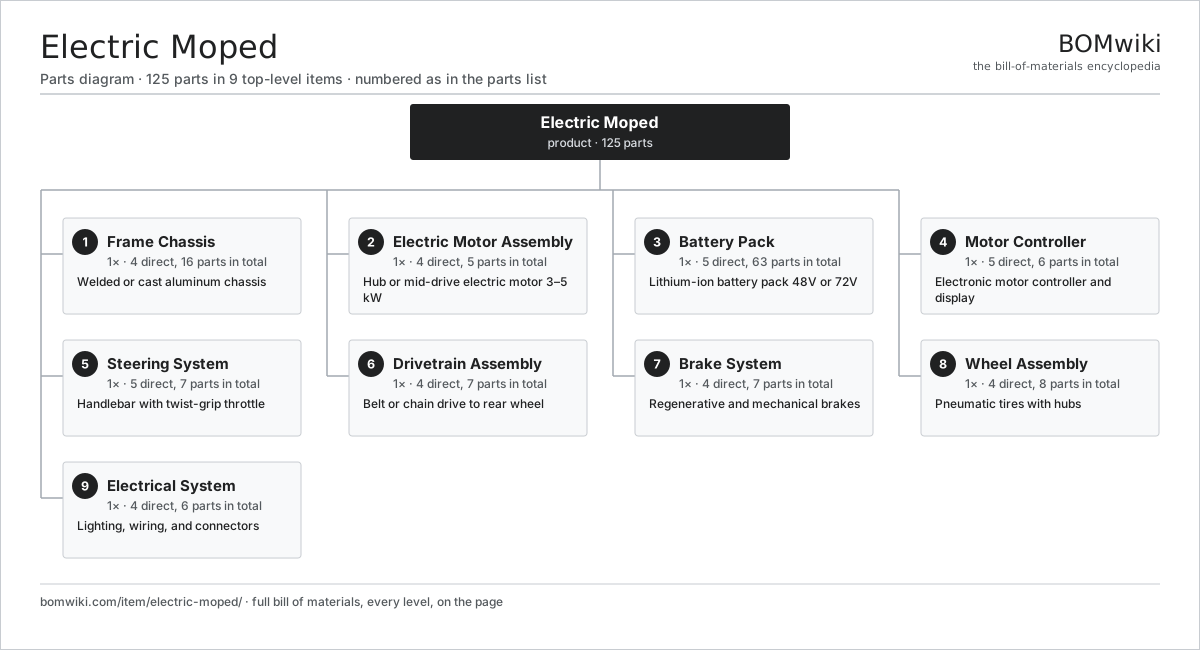
| # | Part | Qty | What it does |
|---|---|---|---|
| 1 | Frame Chassis 4 parts | 1× | Welded or cast aluminum chassis |
| 2 | Electric Motor Assembly 4 parts | 1× | Hub or mid-drive electric motor 3–5 kW |
| 3 | Battery Pack 5 parts | 1× | Lithium-ion battery pack 48V or 72V |
| 4 | Motor Controller 5 parts | 1× | Electronic motor controller and display |
| 5 | Steering System 5 parts | 1× | Handlebar with twist-grip throttle |
| 6 | Drivetrain Assembly 4 parts | 1× | Belt or chain drive to rear wheel |
| 7 | Brake System 4 parts | 1× | Regenerative and mechanical brakes |
| 8 | Wheel Assembly 4 parts | 1× | Pneumatic tires with hubs |
| 9 | Electrical System 4 parts | 1× | Lighting, wiring, and connectors |
3D model
No 3D model yet. Have a CAD file of this? Add a 3D model. STL renders right on this page; STEP, FreeCAD, and OpenSCAD sources are welcome too (openly licensed, like all 3D models on BOMwiki).
Build & assembly graph
expand / collapse · shared sub-assemblies converge · links to related products · est. labourTap an assembly to expand/collapse · tap a part to open it · use “Open page” for any node · drag to pan, scroll to zoom.
Bill of materials for Electric Moped
9 top-level lines · 48 rows shown · 125 parts total · indented to 3 levels| # | Item / sub-assembly | Part no. | Qty/assy | Ext. qty | Parts | Type |
|---|---|---|---|---|---|---|
| 1 | Frame Chassis 4 parts | electric-moped-frame | 1× | 1 | 16 | assembly |
| 1.1 | Main Tube | electric-moped-main-tube | 2× | 2 | · | part |
| 1.2 | Footrest Platform | electric-moped-footrest-platform | 1× | 1 | · | part |
| 1.3 | Battery Tray | electric-moped-battery-tray | 1× | 1 | · | part |
| 1.4 | Fastener Set | fastener-set | 12× | 12 | · | part |
| 2 | Electric Motor Assembly 4 parts | electric-moped-motor | 1× | 1 | 5 | assembly |
| 2.1 | Motor Stator | electric-moped-motor-stator | 1× | 1 | · | part |
| 2.2 | Motor Rotor | electric-moped-motor-rotor | 1× | 1 | · | part |
| 2.3 | Motor Bearing | electric-moped-motor-bearing | 2× | 2 | · | part |
| 2.4 | Motor Housing | electric-moped-motor-housing | 1× | 1 | · | part |
| 3 | Battery Pack 5 parts | electric-moped-battery | 1× | 1 | 63 | assembly |
| 3.1 | Li-ion Cell, 18650 | li-cell-18650 | 48× | 48 | · | part |
| 3.2 | Battery Module | electric-moped-battery-module | 4× | 4 | · | part |
| 3.3 | BMS Board | bms-board | 1× | 1 | · | part |
| 3.4 | Battery Connector | electric-moped-battery-connector | 2× | 2 | · | part |
| 3.5 | Fastener Set | fastener-set | 8× | 8 | · | part |
| 4 | Motor Controller 5 parts | electric-moped-controller | 1× | 1 | 6 | assembly |
| 4.1 | MOSFET Array | electric-moped-mosfet-array | 1× | 1 | · | part |
| 4.2 | Control PCB | electric-moped-control-pcb | 1× | 1 | · | part |
| 4.3 | Throttle Sensor | electric-moped-throttle-sensor | 1× | 1 | · | part |
| 4.4 | Display | electric-moped-display | 1× | 1 | · | part |
| 4.5 | Connector | electric-moped-connector | 2× | 2 | · | part |
| 5 | Steering System 5 parts | electric-moped-steering | 1× | 1 | 7 | assembly |
| 5.1 | Handlebar | electric-moped-handlebar | 1× | 1 | · | part |
| 5.2 | Stem | electric-moped-stem | 1× | 1 | · | part |
| 5.3 | Throttle Grip | electric-moped-throttle-grip | 1× | 1 | · | part |
| 5.4 | Brake Lever | electric-moped-brake-lever | 2× | 2 | · | part |
| 5.5 | Ball Bearing | ball-bearing | 2× | 2 | · | part |
| 6 | Drivetrain Assembly 4 parts | electric-moped-drivetrain | 1× | 1 | 7 | assembly |
| 6.1 | Motor Pulley | electric-moped-motor-pulley | 1× | 1 | · | part |
| 6.2 | Rear Pulley | electric-moped-rear-pulley | 1× | 1 | · | part |
| 6.3 | Drive Belt | drive-belt | 1× | 1 | · | part |
| 6.4 | Fastener Set | fastener-set | 4× | 4 | · | part |
| 7 | Brake System 4 parts | electric-moped-braking | 1× | 1 | 7 | assembly |
| 7.1 | Regen Circuit | electric-moped-regen-circuit | 1× | 1 | · | part |
| 7.2 | Mechanical Brake | electric-moped-mechanical-brake | 2× | 2 | · | part |
| 7.3 | Brake Rotor | electric-moped-brake-rotor | 2× | 2 | · | part |
| 7.4 | Brake Caliper | electric-moped-brake-caliper | 2× | 2 | · | part |
| 8 | Wheel Assembly 4 parts | electric-moped-wheels | 1× | 1 | 8 | assembly |
| 8.1 | Front Wheel | electric-moped-front-wheel | 1× | 1 | · | part |
| 8.2 | Rear Wheel | electric-moped-rear-wheel | 1× | 1 | · | part |
| 8.3 | Ball Bearing | ball-bearing | 4× | 4 | · | part |
| 8.4 | Tire | electric-moped-tire | 2× | 2 | · | part |
| 9 | Electrical System 4 parts | electric-moped-electrical | 1× | 1 | 6 | assembly |
| 9.1 | Wiring Harness | electric-moped-wiring-harness | 1× | 1 | · | part |
| 9.2 | LED Light | electric-moped-led-light | 3× | 3 | · | part |
| 9.3 | Charging Port | electric-moped-charging-port | 1× | 1 | · | part |
| 9.4 | Battery Charger | electric-moped-charger | 1× | 1 | · | part |
Something wrong in this list? Report a problem with this BOM.
Related products
same domain, ranked by shared parts Electric Motorcycle
1,278 parts · shares 2 with this page
Electric Motorcycle
1,278 parts · shares 2 with this page
 Electric Skateboard
215 parts · shares 2 with this page
Electric Trike
214 parts · shares 2 with this page
Electric Unicycle
176 parts · shares 2 with this page
Electric Skateboard
215 parts · shares 2 with this page
Electric Trike
214 parts · shares 2 with this page
Electric Unicycle
176 parts · shares 2 with this page
 Hoverboard
399 parts · shares 2 with this page
Hoverboard
399 parts · shares 2 with this page
Sourcing: possible vendors
Browse the supplier directory → Prices, MOQ, and lead times are algorithmic estimates, not quotes, and not claims about these companies. Company mappings are curated by keyword; est. price band $300–$15k. How estimates work| Vendor | HQ | Specialty | MOQ | Lead time |
|---|---|---|---|---|
| global.honda ↗ | Tokyo, JP | Motorcycles & power products | made to order | 10–16 wks |
| yamaha-motor.com ↗ | Iwata, JP | Motorcycles & marine | made to order | 10–16 wks |
| heromotocorp.com ↗ | New Delhi, IN | Motorcycle & scooter maker | made to order | 10–16 wks |
| bajajauto.com ↗ | Pune, IN | Two- & three-wheeler maker | made to order | 10–16 wks |
| harley-davidson.com ↗ | Milwaukee, US | Motorcycles | made to order | 10–16 wks |
1,305-word article