Electric Strike
ProductOverview
An electric strike is an electromechanical door-locking device installed in the door frame. It replaces or supplements the fixed strike plate on a standard cylindrical lockset, allowing an access control system to release the door latch electronically. The strike contains a spring-loaded catch (the keeper) that engages the projecting latch bolt on the door itself; when the solenoid is energized, it retracts the keeper, allowing the door to swing open despite the mechanical lock.
Electric strikes are the most cost-effective electronic door release mechanism and are found on millions of commercial and institutional doors. They integrate with electric controller boards that receive requests from card readers, keypads, or central servers. The two functional modes, fail-safe and fail-secure, determine building egress safety during power loss: fail-safe allows occupants to push the door open (life-safety), while fail-secure keeps it locked (security).
How it works
The solenoid assembly sits at the top of the strike body. When 24 VDC is applied across the coil terminals, current flows through the copper windings, generating a magnetic field that pulls the solenoid plunger (or armature) upward. This mechanical motion is coupled to a linkage that retracts the keeper mechanism, the spring-loaded catch that normally holds the door latch in the locked position.
As the keeper retracts, it disengages from the latch bolt on the door. The door operator can now push the door open with minimal force; the faceplate guides the latch bolt past the strike body without binding. Release typically occurs within 75–150 ms, fast enough to feel responsive to security personnel and slow enough that brief electrical noise does not trigger unintended releases.
The fail-safe module is the core safety feature. A mechanical mode selector lever allows installation personnel to choose between two behaviors:
- Fail-safe: The keeper catch is held retracted by a spring when power is removed; the door defaults to unlocked, enabling evacuation during a fire or power outage.
- Fail-secure: The keeper is held locked by spring tension, and a powered solenoid latch keeps it retracted only while energized; power loss locks the door, preventing unauthorized entry.
Building and fire codes mandate fail-safe strikes on all life-safety doors (stairwell exits, emergency exits). Fail-secure strikes are used on secure access points (server rooms, executive suites, evidence lockers) where intrusion risk outweighs evacuation risk.
Electrical integration
The controller board provides 24 VDC regulation, solenoid driving, and current limiting. A typical controller accepts a low-voltage dry-contact (door release signal) from a card reader or central server, closes a relay to energize the strike, and monitors solenoid current to detect mechanical jams or coil faults. Many controllers also drive a buzzer or LED indicator to give the user feedback that the strike was triggered.
Standard 24 VDC power supplies (used in access control systems) can serve multiple strikes through the controller boards. The wiring harness typically includes shielded twisted pair for the solenoid and a separate sense wire to monitor coil current; some advanced systems include a tamper switch that detects physical strike removal.
Installation and mechanical design
The strike body bolts directly to the door frame using mounting brackets; surface-mount strikes sit on the outside of the frame, while mortise strikes fit into a cavity cut into the frame. The faceplate must be aligned precisely with the latch bolt trajectory to avoid binding during extended use.
The keeper latch is rated for repeated impact loading from the door slamming. Standard keeper mechanisms withstand 100,000+ cycles of latch engagement and release. Heavy commercial use (high-traffic building entrance) may require reinforced keeper springs or hardened catch surfaces.
Environmental sealing is important for outdoor or wet-room installations. The housing encloses the solenoid and mechanism, with cable glands for weather protection. Stainless fasteners and sealing gaskets prevent rust and corrosion in humid climates.
Failure modes and diagnostics
The most common failure is a stuck keeper latch, caused by dirt or corrosion jamming the catch. This prevents the door from opening even when the solenoid is energized. Many controllers monitor solenoid current; a sustained high current indicates mechanical jam. A secondary mechanical latch or manual override may be required on life-safety doors so that building occupants can always exit.
Solenoid coil burnout occurs if the strike remains energized for extended periods (beyond the intermittent duty rating). Some installations add a hold time limit to the controller to prevent this: the controller energizes the strike for a fixed duration (usually 0.5–2 seconds) then de-energizes, allowing the door operator to push through. Holding the strike locked after the door is open drains battery in backup power scenarios and overheats the coil.
Electrical noise and transient voltage spikes on 24 VDC lines can cause false releases. The controller board typically includes filtering and transient suppression to prevent nuisance trips from nearby relay switching or lightning surges.
Electric Strike parts and their functions
8 top-level parts · 23 parts in total · full bill of materials below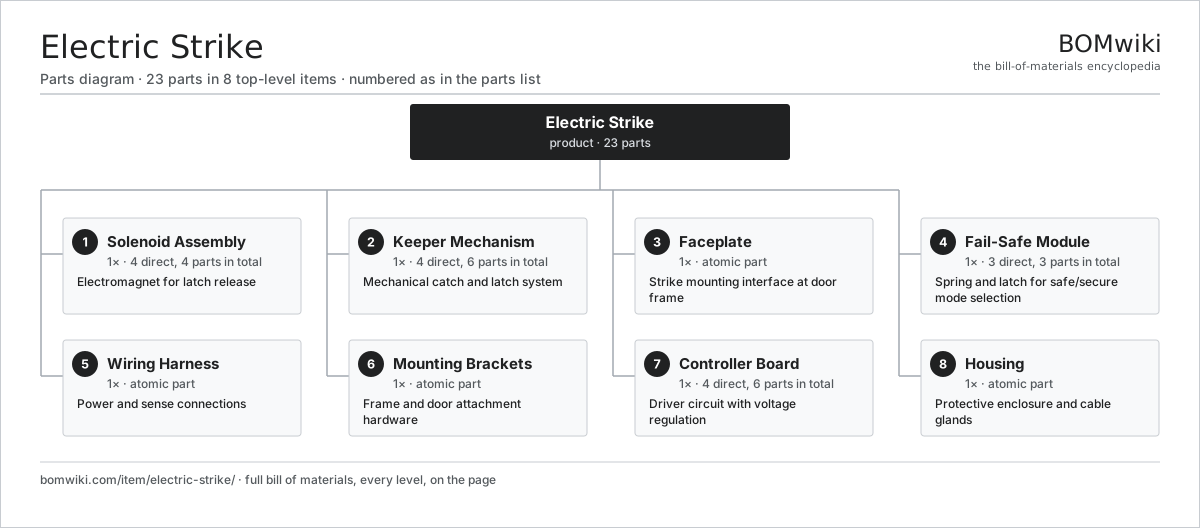
| # | Part | Qty | What it does |
|---|---|---|---|
| 1 | Solenoid Assembly 4 parts | 1× | Electromagnet for latch release |
| 2 | Keeper Mechanism 4 parts | 1× | Mechanical catch and latch system |
| 3 | Faceplate | 1× | Strike mounting interface at door frame |
| 4 | Fail-Safe Module 3 parts | 1× | Spring and latch for safe/secure mode selection |
| 5 | Wiring Harness | 1× | Power and sense connections |
| 6 | Mounting Brackets | 1× | Frame and door attachment hardware |
| 7 | Controller Board 4 parts | 1× | Driver circuit with voltage regulation |
| 8 | Housing | 1× | Protective enclosure and cable glands |
3D model
No 3D model yet. Have a CAD file of this? Add a 3D model. STL renders right on this page; STEP, FreeCAD, and OpenSCAD sources are welcome too (openly licensed, like all 3D models on BOMwiki).
Build & assembly graph
expand / collapse · shared sub-assemblies converge · links to related products · est. labourTap an assembly to expand/collapse · tap a part to open it · use “Open page” for any node · drag to pan, scroll to zoom.
Bill of materials for Electric Strike
8 top-level lines · 23 rows shown · 23 parts total · indented to 3 levels| # | Item / sub-assembly | Part no. | Qty/assy | Ext. qty | Parts | Type |
|---|---|---|---|---|---|---|
| 1 | Solenoid Assembly 4 parts | electric-strike-solenoid-assembly | 1× | 1 | 4 | assembly |
| 1.1 | Copper Winding | copper-winding | 1× | 1 | · | part |
| 1.2 | Motor Housing | motor-housing | 1× | 1 | · | part |
| 1.3 | Neodymium Magnet | neodymium-magnet | 1× | 1 | · | part |
| 1.4 | Connector | connector | 1× | 1 | · | part |
| 2 | Keeper Mechanism 4 parts | electric-strike-keeper-mechanism | 1× | 1 | 6 | assembly |
| 2.1 | Coil Spring | coil-spring | 2× | 2 | · | part |
| 2.2 | Sheet Metal Panel | sheet-panel | 2× | 2 | · | part |
| 2.3 | Fastener Set | fastener-set | 1× | 1 | · | part |
| 2.4 | O-Ring Set | oring-set | 1× | 1 | · | part |
| 3 | Faceplate | electric-strike-faceplate | 1× | 1 | · | part |
| 4 | Fail-Safe Module 3 parts | electric-strike-fail-safe-module | 1× | 1 | 3 | assembly |
| 4.1 | Coil Spring | coil-spring | 1× | 1 | · | part |
| 4.2 | Sheet Metal Panel | sheet-panel | 1× | 1 | · | part |
| 4.3 | Fastener Set | fastener-set | 1× | 1 | · | part |
| 5 | Wiring Harness | electric-strike-wiring-harness | 1× | 1 | · | part |
| 6 | Mounting Brackets | electric-strike-mounting-brackets | 1× | 1 | · | part |
| 7 | Controller Board 4 parts | electric-strike-controller-board | 1× | 1 | 6 | assembly |
| 7.1 | Bare PCB | pcb-bare | 1× | 1 | · | part |
| 7.2 | Power MOSFET | mosfet | 2× | 2 | · | part |
| 7.3 | SMD Passive (R/C/L) | smd-passives | 1× | 1 | · | part |
| 7.4 | Connector | connector | 2× | 2 | · | part |
| 8 | Housing | electric-strike-housing | 1× | 1 | · | part |
Something wrong in this list? Report a problem with this BOM.
Used in 1 assembly
Related products
same domain, ranked by shared parts Mantrap Interlock Portal
82 parts · shares 16 with this page
Mantrap Interlock Portal
82 parts · shares 16 with this page
 Automatic Sliding Door
390 parts · shares 5 with this page
Automatic Sliding Door
390 parts · shares 5 with this page
 Magnetic Lock
24 parts · shares 7 with this page
Magnetic Lock
24 parts · shares 7 with this page
 Access Control Panel
52 parts · shares 5 with this page
Access Control Panel
52 parts · shares 5 with this page
 Electronic Key Cabinet
92 parts · shares 5 with this page
Electronic Key Cabinet
92 parts · shares 5 with this page
 Glass Break Detector
19 parts · shares 5 with this page
Glass Break Detector
19 parts · shares 5 with this page
Sourcing: possible vendors
Browse the supplier directory → Prices, MOQ, and lead times are algorithmic estimates, not quotes, and not claims about these companies. Company mappings are curated by keyword; est. price band $50–$10k. How estimates work| Vendor | HQ | Specialty | MOQ | Lead time |
|---|---|---|---|---|
| assaabloy.com ↗ | Stockholm, SE | Locks & access | 1,000 units | 8–12 wks |
|
🇺🇸Allegion
allegion.com ↗
|
Dublin, US | Security products (Schlage) | 1,000 units | 8–12 wks |
| dormakaba.com ↗ | Rümlang, CH | Access & door systems | 1,000 units | 8–12 wks |
| honeywell.com ↗ | Charlotte, US | Building & safety tech | 1,000 units | 8–12 wks |
| hikvision.com ↗ | Hangzhou, CN | Surveillance & security | 1,000 units | 8–12 wks |
868-word article