Electric Typewriter
ProductOverview
The electric typewriter is an advancement over manual models that harnesses a small AC motor and solenoid circuits to drive the striking mechanism, paper feed, and ribbon advance. Unlike manual machines, the operator depresses a key with minimal force, and electromechanical relays translate that keystroke into synchronized pulses that accelerate the hammer, advance the ribbon, and index the rotating daisy wheel or golf ball. The result is a typing speed of 65–120 words per minute with consistent, crisp impressions on paper.
Electric typewriters dominated office work from the 1960s through the 1980s, and many remain in use for specialized document creation where a hard copy and mechanical simplicity are valued. The technology bridges manual typewriters and word processors: it retains the tactile, single-keystroke-to-character mapping of mechanical writing but eliminates fatigue and enables richer automation features such as automatic centering, margin setting, and tabulation.
How it works
Keystroke Flow: When a key is pressed, its leaf switch closes a circuit on the keyboard PCB. The control module detects this closure and energizes two solenoids in parallel: one pulls the hammer forward to strike, the other (or a clutch) indexes the element shaft one position. Meanwhile, a third relay energizes the ribbon motor for a brief pulse to advance fresh inked fabric into position.
Motor and Drive: The motor assembly runs continuously at a steady speed (or cycles on demand, depending on the model). A belt couples the motor to a series of cams and clutches. These cams control the timing of solenoid pulses so that by the time the hammer fires, the correct character is positioned under the strike point. The bearings in both motor and typehead rotate smoothly, minimizing mechanical noise and friction loss.
Character Rotation: The daisy wheel or golf ball rotates under stepper-like control. A solenoid pulse or pawl mechanism advances the element by exactly one character position. The motor provides continuous rotational drive through a lead screw or cam follower, but the solenoid gate permits the striker to fire only when the correct character is indexed.
Paper Feed: After each keystroke (or manually via a lever), the carriage advances the paper vertically. A separate motor or clutch drives the line feed sprocket, which engages perforations or friction-grips the paper to move it forward by one line height (typically 1/6 inch for single-spacing). At the end of a page, the carriage automatically returns to the left margin (hard stop), ready for a new line.
Ribbon Mechanism: The ribbon mechanism maintains a fresh inked surface in front of the strike point. After each keystroke, the ribbon motor advances the spool by a small increment. If the ribbon reaches the end of its travel, a mechanical reversing arm or sensor flips the direction, so the ribbon feeds in the opposite direction, effectively doubling its usable length.
Control Electronics: The power control module is the nervous system. It houses a relay set that switches motor and solenoid currents on and off in precise sequence. Early models used mechanical relays; later ones integrated solid-state drivers. The 120V AC wall power is stepped down to 24V DC for logic and solenoid coil circuits, ensuring safe low-voltage operation of the keyboard circuit.
Mechanical Reliability
Electric typewriters are renowned for their durability because the mechanism is entirely mechanical and electrical, with no microprocessor or software. A bearing or cam wear may require lubrication, and the seals around the motor and solenoid prevent dust ingress. The copper windings in the motor are rated for continuous duty at 50–60 Hz for decades. The fasteners use nylon-locking inserts to prevent vibration-induced loosening during years of constant striking.
Legacy and Modern Use
Though displaced by computers and laser printers, electric typewriters remain valued by authors, journalists, and document control specialists who prefer the absence of digital distractions and the permanence of a physical carbon-backed or impact-printed document. Many government agencies and legal offices retain them for official records. Repair and restoration of models from the 1970s–1980s (particularly daisy-wheel and golf-ball machines) has become a niche hobby, with readily available springs, bearings, and ribbon cartridges.
Electric Typewriter parts and their functions
7 top-level parts · 47 parts in total · full bill of materials below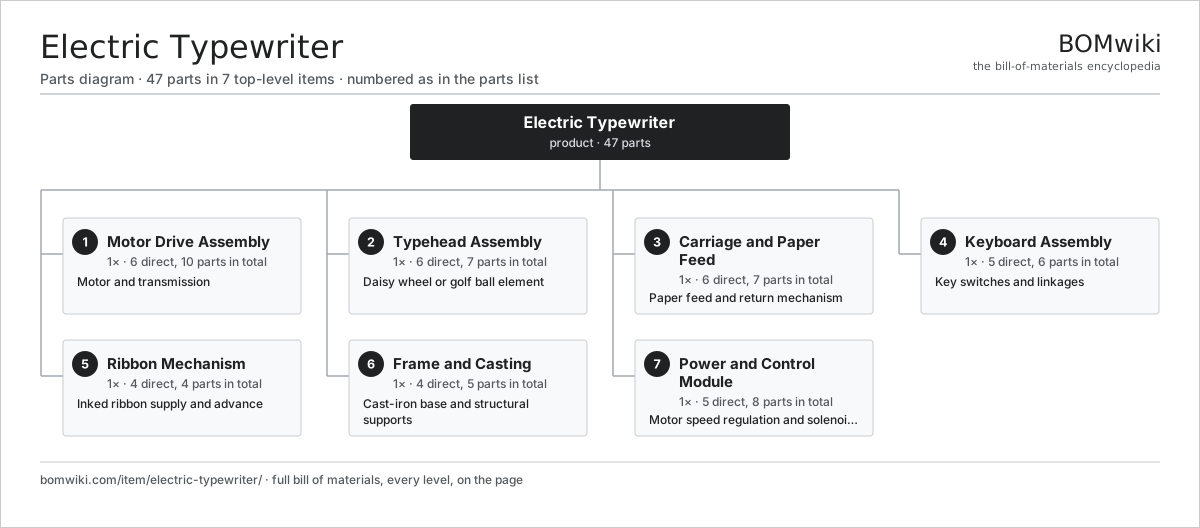
| # | Part | Qty | What it does |
|---|---|---|---|
| 1 | Motor Drive Assembly 6 parts | 1× | Motor and transmission |
| 2 | Typehead Assembly 6 parts | 1× | Daisy wheel or golf ball element |
| 3 | Carriage and Paper Feed 6 parts | 1× | Paper feed and return mechanism |
| 4 | Keyboard Assembly 5 parts | 1× | Key switches and linkages |
| 5 | Ribbon Mechanism 4 parts | 1× | Inked ribbon supply and advance |
| 6 | Frame and Casting 4 parts | 1× | Cast-iron base and structural supports |
| 7 | Power and Control Module 5 parts | 1× | Motor speed regulation and solenoid drivers |
3D model
No 3D model yet. Have a CAD file of this? Add a 3D model. STL renders right on this page; STEP, FreeCAD, and OpenSCAD sources are welcome too (openly licensed, like all 3D models on BOMwiki).
Build & assembly graph
expand / collapse · shared sub-assemblies converge · links to related products · est. labourTap an assembly to expand/collapse · tap a part to open it · use “Open page” for any node · drag to pan, scroll to zoom.
Bill of materials for Electric Typewriter
7 top-level lines · 43 rows shown · 47 parts total · indented to 3 levels| # | Item / sub-assembly | Part no. | Qty/assy | Ext. qty | Parts | Type |
|---|---|---|---|---|---|---|
| 1 | Motor Drive Assembly 6 parts | electric-typewriter-motor-drive | 1× | 1 | 10 | assembly |
| 1.1 | Motor Housing | motor-housing | 1× | 1 | · | part |
| 1.2 | Copper Winding | copper-winding | 2× | 2 | · | part |
| 1.3 | Drive Belt | drive-belt | 1× | 1 | · | part |
| 1.4 | Ball Bearing | ball-bearing | 4× | 4 | · | part |
| 1.5 | Fastener Set | fastener-set | 1× | 1 | · | part |
| 1.6 | Relay | relay | 1× | 1 | · | part |
| 2 | Typehead Assembly 6 parts | electric-typewriter-typehead | 1× | 1 | 7 | assembly |
| 2.1 | Daisy Wheel Element | electric-typewriter-daisy-wheel | 1× | 1 | · | part |
| 2.2 | Hammer Striker | electric-typewriter-hammer | 1× | 1 | · | part |
| 2.3 | Element Rotation Shaft | electric-typewriter-element-shaft | 1× | 1 | · | part |
| 2.4 | Ball Bearing | ball-bearing | 2× | 2 | · | part |
| 2.5 | Solenoid Coil | solenoid | 1× | 1 | · | part |
| 2.6 | Fastener Set | fastener-set | 1× | 1 | · | part |
| 3 | Carriage and Paper Feed 6 parts | electric-typewriter-carriage | 1× | 1 | 7 | assembly |
| 3.1 | Platen Roller | electric-typewriter-platen | 1× | 1 | · | part |
| 3.2 | Paper Support Bail | electric-typewriter-paper-support | 1× | 1 | · | part |
| 3.3 | Line Feed Sprocket | electric-typewriter-line-feed-wheel | 1× | 1 | · | part |
| 3.4 | Ball Bearing | ball-bearing | 2× | 2 | · | part |
| 3.5 | Drive Belt | drive-belt | 1× | 1 | · | part |
| 3.6 | Fastener Set | fastener-set | 1× | 1 | · | part |
| 4 | Keyboard Assembly 5 parts | electric-typewriter-keyboard | 1× | 1 | 6 | assembly |
| 4.1 | Key Switch Set | electric-typewriter-key-set | 1× | 1 | · | part |
| 4.2 | Bare PCB | pcb-bare | 1× | 1 | · | part |
| 4.3 | Connector | connector | 2× | 2 | · | part |
| 4.4 | Wire Bundle | wire-bundle | 1× | 1 | · | part |
| 4.5 | Fastener Set | fastener-set | 1× | 1 | · | part |
| 5 | Ribbon Mechanism 4 parts | electric-typewriter-ribbon-system | 1× | 1 | 4 | assembly |
| 5.1 | Ribbon Drive Motor | electric-typewriter-ribbon-motor | 1× | 1 | · | part |
| 5.2 | Ribbon Spools | electric-typewriter-ribbon-spool-pair | 1× | 1 | · | part |
| 5.3 | Ribbon Tension Arm | electric-typewriter-ribbon-tension | 1× | 1 | · | part |
| 5.4 | Fastener Set | fastener-set | 1× | 1 | · | part |
| 6 | Frame and Casting 4 parts | electric-typewriter-frame-assembly | 1× | 1 | 5 | assembly |
| 6.1 | Sheet Metal Panel | sheet-panel | 1× | 1 | · | part |
| 6.2 | Fastener Set | fastener-set | 2× | 2 | · | part |
| 6.3 | O-Ring Set | oring-set | 1× | 1 | · | part |
| 6.4 | Connector | connector | 1× | 1 | · | part |
| 7 | Power and Control Module 5 parts | electric-typewriter-power-control | 1× | 1 | 8 | assembly |
| 7.1 | Bare PCB | pcb-bare | 1× | 1 | · | part |
| 7.2 | Relay | relay | 3× | 3 | · | part |
| 7.3 | Power Supply | power-supply | 1× | 1 | · | part |
| 7.4 | Connector | connector | 2× | 2 | · | part |
| 7.5 | Fastener Set | fastener-set | 1× | 1 | · | part |
Something wrong in this list? Report a problem with this BOM.
Related products
same domain, ranked by shared parts Key Cutting Machine
63 parts · shares 5 with this page
Key Cutting Machine
63 parts · shares 5 with this page
 Pneumatic Tube Station
201 parts · shares 7 with this page
Pneumatic Tube Station
201 parts · shares 7 with this page
 Guillotine Paper Cutter
261 parts · shares 6 with this page
Guillotine Paper Cutter
261 parts · shares 6 with this page
 Money Counting Machine
102 parts · shares 4 with this page
Produce Misting System
137 parts · shares 4 with this page
Money Counting Machine
102 parts · shares 4 with this page
Produce Misting System
137 parts · shares 4 with this page
Sourcing: possible vendors
Browse the supplier directory → Prices, MOQ, and lead times are algorithmic estimates, not quotes, and not claims about these companies. Company mappings are curated by keyword; est. price band $50–$15k. How estimates work| Vendor | HQ | Specialty | MOQ | Lead time |
|---|---|---|---|---|
|
🇯🇵Canon
canon.com ↗
|
Tokyo, JP | Imaging & optics | 500 units | 8–12 wks |
|
🇯🇵Ricoh
ricoh.com ↗
|
Tokyo, JP | Office imaging | 500 units | 8–12 wks |
|
🇺🇸Xerox
xerox.com ↗
|
Norwalk, US | Printers & copiers | 500 units | 8–12 wks |
|
🇯🇵Epson
epson.com ↗
|
Suwa, JP | Printers & projectors | 500 units | 8–12 wks |
|
🇯🇵Brother
brother.com ↗
|
Nagoya, JP | Printers & sewing | 500 units | 8–12 wks |
780-word article