Electric Wok
ProductOverview
An electric wok packages the bowl, burner and temperature control of wok cooking into a single countertop appliance. The cooking vessel is the Wok Bowl Assembly, a die-cast aluminum bowl around 35 cm across with a Nonstick Coating on its inner surface and a resistance element cast or clamped against its underside. Because the heat source is bonded to the metal rather than applied by a flame, the bowl is usually flat-bottomed and thicker-walled than a carbon-steel wok, trading the violent localized heat of a gas burner for steadier, thermostated heat across the lower third of the bowl.
The defining component is the Temperature Probe Control, the same detachable probe-thermostat architecture used in electric skillets. The probe plugs into the Probe Socket on the bowl side; pulling it out leaves the bowl with no live parts, so the whole vessel can go in the sink. UL and IEC appliance standards treat this immersibility as a design requirement, which is why the socket pins and element terminations are sealed against the casting.
How it works
Mains power enters through the Cord Set into the probe body. Inside, the Bimetal Thermostat sits in series with the element: a snap-action bimetal disc that opens above the setpoint and recloses a few degrees below it. The Temperature Dial preloads the disc spring to move that switching point anywhere from a warming setting near 90 degrees C up to about 220 degrees C for stir-frying. The Sensing Tube, held against the bowl casting by a Coil Spring, conducts bowl temperature into the probe so the thermostat tracks the metal rather than the surrounding air. A Pilot Lamp wired across the element shows when power is flowing; the lamp cycling on and off is the visible signature of the thermostat regulating.
The Heating Element itself is a tubular sheathed resistance heater of roughly 1500 W (about 2000 W on 230 V markets), pressed into a channel in the Die-Cast Bowl Shell by the Element Clamp Plate. Heat conducts through the casting and spreads up the bowl walls, with the aluminum's high conductivity evening out the element's serpentine pattern. A Thermal Fuse in series with the element opens permanently if the thermostat fails closed, and an Insulation Pad plus the Heat Shield in the Base Assembly keep the underside cool enough for a countertop.
Cooking behavior
Stir-frying depends on surface temperature more than on flame drama. At the 200-220 degrees C top settings the nonstick surface sears meat and triggers Maillard browning, while the thermostat prevents the overshoot that burns oil past its smoke point. The duty cycle matters: a 1500 W element recovers more slowly than a restaurant wok burner when cold food drops the bowl temperature, so electric woks favor smaller batches. The deep bowl shape still gives the wok's characteristic gradient, hot at the bottom for searing and cooler up the Side Handle flanks for holding finished food.
The Lid Assembly extends the appliance beyond stir-frying. With the Tempered Glass Dome in place and the dial set low, the wok steams, braises and simmers; the Steam Vent bleeds enough vapor to stop condensation rattling the glass, and the Lid Rim Band protects the tempered edge. Many households use the appliance as much as a deep electric skillet as a wok.
Construction and safety
The bowl sits on the Base Shell, a heat-resistant ring with four Rubber Foot pads that keep the assembly stable during vigorous tossing. All element wiring is terminated at the ceramic Element Terminal Block and routed through a Wire Bundle rated for the local hot-zone temperature. The cord set uses a Strain Relief Grommet grommet at the probe entry and a grounded Mains Plug; cord length is deliberately short, around one meter, so a snagged cord tips the plug out rather than pulling a wok of hot oil off the counter.
Service items follow the usual small-appliance pattern. The thermal fuse is the most common failure after a thermostat sticks; the nonstick coating is the usual end-of-life item, degrading after a few years of metal-utensil use; and the neon pilot lamp dims long before anything electrical actually fails. The probe control, being detachable, is often sold as a separate spare and interchanges across skillet and wok models from the same maker.
Electric Wok parts and their functions
8 top-level parts · 34 parts in total · full bill of materials below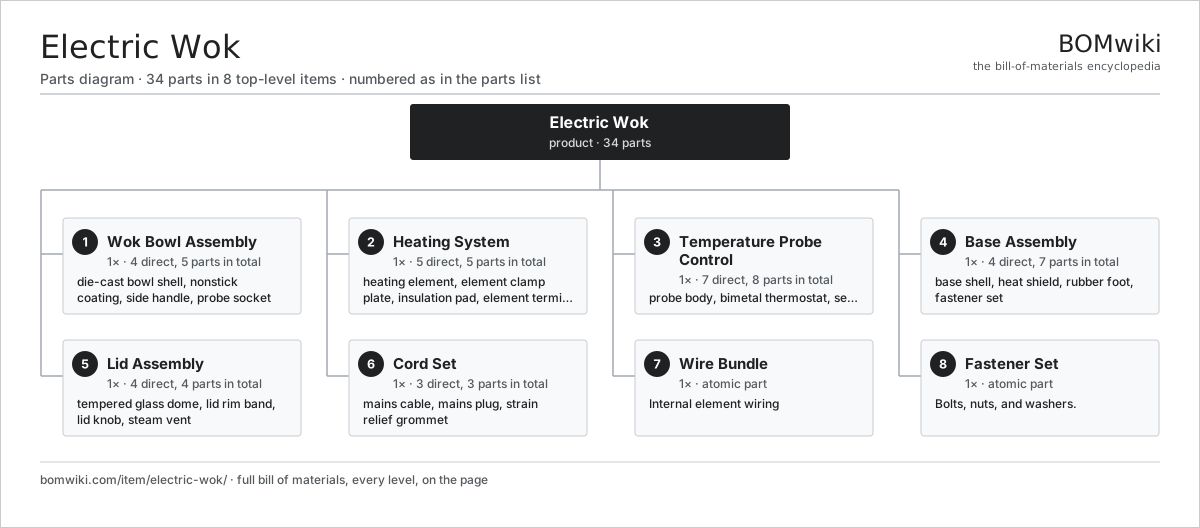
| # | Part | Qty | What it does |
|---|---|---|---|
| 1 | Wok Bowl Assembly 4 parts | 1× | Die-cast aluminum cooking vessel with a nonstick interior and the socket that receives the temperature probe. |
| 2 | Heating System 5 parts | 1× | Sheathed resistance element clamped against the bowl underside with its safety fuse and terminations. |
| 3 | Temperature Probe Control 7 parts | 1× | Detachable probe that plugs into the bowl socket, senses bowl temperature and cycles element power through a bimetal thermostat. |
| 4 | Base Assembly 4 parts | 1× | Stand that supports the hot bowl above the countertop and shields the element wiring. |
| 5 | Lid Assembly 4 parts | 1× | Domed tempered-glass cover for steaming, braising and splash control. |
| 6 | Cord Set 3 parts | 1× | Detachable mains lead between the wall outlet and the probe control. |
| 7 | Wire Bundle | 1× | Internal element wiring |
| 8 | Fastener Set | 1× | Bolts, nuts, and washers. |
3D model
No 3D model yet. Have a CAD file of this? Add a 3D model. STL renders right on this page; STEP, FreeCAD, and OpenSCAD sources are welcome too (openly licensed, like all 3D models on BOMwiki).
Build & assembly graph
expand / collapse · shared sub-assemblies converge · links to related products · est. labourTap an assembly to expand/collapse · tap a part to open it · use “Open page” for any node · drag to pan, scroll to zoom.
Bill of materials for Electric Wok
8 top-level lines · 35 rows shown · 34 parts total · indented to 3 levels| # | Item / sub-assembly | Part no. | Qty/assy | Ext. qty | Parts | Type |
|---|---|---|---|---|---|---|
| 1 | Wok Bowl Assembly 4 parts | electric-wok-bowl | 1× | 1 | 5 | assembly |
| 1.1 | Die-Cast Bowl Shell | electric-wok-bowl-shell | 1× | 1 | · | part |
| 1.2 | Nonstick Coating | electric-wok-nonstick-coating | 1× | 1 | · | part |
| 1.3 | Side Handle | electric-wok-side-handle | 2× | 2 | · | part |
| 1.4 | Probe Socket | electric-wok-probe-socket | 1× | 1 | · | part |
| 2 | Heating System 5 parts | electric-wok-heating | 1× | 1 | 5 | assembly |
| 2.1 | Heating Element | heating-element | 1× | 1 | · | part |
| 2.2 | Element Clamp Plate | electric-wok-element-clamp | 1× | 1 | · | part |
| 2.3 | Insulation Pad | electric-wok-insulation-pad | 1× | 1 | · | part |
| 2.4 | Element Terminal Block | electric-wok-terminal-block | 1× | 1 | · | part |
| 2.5 | Thermal Fuse | thermal-fuse | 1× | 1 | · | part |
| 3 | Temperature Probe Control 7 parts | electric-wok-probe-control | 1× | 1 | 8 | assembly |
| 3.1 | Probe Body | electric-wok-probe-body | 1× | 1 | · | part |
| 3.2 | Bimetal Thermostat | electric-wok-bimetal-thermostat | 1× | 1 | · | part |
| 3.3 | Sensing Tube | electric-wok-sensing-tube | 1× | 1 | · | part |
| 3.4 | Temperature Dial | electric-wok-temp-dial | 1× | 1 | · | part |
| 3.5 | Pilot Lamp | electric-wok-pilot-lamp | 1× | 1 | · | part |
| 3.6 | Coil Spring | coil-spring | 1× | 1 | · | part |
| 3.7 | Connector | connector | 2× | 2 | · | part |
| 4 | Base Assembly 4 parts | electric-wok-base | 1× | 1 | 7 | assembly |
| 4.1 | Base Shell | electric-wok-base-shell | 1× | 1 | · | part |
| 4.2 | Heat Shield | electric-wok-heat-shield | 1× | 1 | · | part |
| 4.3 | Rubber Foot | electric-wok-foot | 4× | 4 | · | part |
| 4.4 | Fastener Set | fastener-set | 1× | 1 | · | part |
| 5 | Lid Assembly 4 parts | electric-wok-lid | 1× | 1 | 4 | assembly |
| 5.1 | Tempered Glass Dome | electric-wok-lid-dome | 1× | 1 | · | part |
| 5.2 | Lid Rim Band | electric-wok-lid-rim | 1× | 1 | · | part |
| 5.3 | Lid Knob | electric-wok-lid-knob | 1× | 1 | · | part |
| 5.4 | Steam Vent | electric-wok-steam-vent | 1× | 1 | · | part |
| 6 | Cord Set 3 parts | electric-wok-cord-set | 1× | 1 | 3 | assembly |
| 6.1 | Mains Cable | electric-wok-cord | 1× | 1 | · | part |
| 6.2 | Mains Plug | electric-wok-plug | 1× | 1 | · | part |
| 6.3 | Strain Relief Grommet | electric-wok-strain-relief | 1× | 1 | · | part |
| 7 | Wire Bundle | wire-bundle | 1× | 1 | · | part |
| 8 | Fastener Set | fastener-set | 1× | 1 | · | part |
Something wrong in this list? Report a problem with this BOM.
Related products
same domain, ranked by shared parts Bread Machine
162 parts · shares 2 with this page
Bread Machine
162 parts · shares 2 with this page
 Capsule Coffee Machine
123 parts · shares 2 with this page
Contact Grill
96 parts · shares 2 with this page
Capsule Coffee Machine
123 parts · shares 2 with this page
Contact Grill
96 parts · shares 2 with this page
 Countertop Convection Oven
77 parts · shares 2 with this page
Countertop Convection Oven
77 parts · shares 2 with this page
 Electric Grill
34 parts · shares 2 with this page
Electric Grill
34 parts · shares 2 with this page
Sourcing: possible vendors
Browse the supplier directory → Prices, MOQ, and lead times are algorithmic estimates, not quotes, and not claims about these companies. Company mappings are curated by keyword; est. price band $20–$600. How estimates work| Vendor | HQ | Specialty | MOQ | Lead time |
|---|---|---|---|---|
|
🇦🇺Breville
breville.com ↗
|
Sydney, AU | Kitchen appliances | 2,000 units | 6–10 wks |
| groupeseb.com ↗ | Écully, FR | Cookware & small appliances | 2,000 units | 6–10 wks |
| hamiltonbeach.com ↗ | Glen Allen, US | Small appliances | 2,000 units | 6–10 wks |
| panasonic.com ↗ | Osaka, JP | Electronics & appliances | 2,000 units | 6–10 wks |
|
🇨🇳Midea
midea.com ↗
|
Foshan, CN | Home appliances | 2,000 units | 6–10 wks |
765-word article