Dental Electroforming Unit
ProductOverview
Electroforming is an electrochemical process for depositing metal ions (dissolved in solution) onto a wax or resin pattern, building up a precise metal replica layer-by-layer. Unlike conventional casting (which involves a mold and pour), electroforming directly copies the pattern surface without dimensional loss to mold shrinkage or metal shrinkage.
The electroforming unit consists of a Plating Bath Assembly containing a metal salt solution (e.g., copper sulfate for copper plating), a DC Power Supply and Rectifier DC power supply, a replaceable metal Metal Anode Assembly, and a Pattern Cathode Holder fixture holding the pattern. When current flows, metal ions migrate from anode to cathode, plating out as a pure metal shell on the pattern surface.
For dental work, electroforming is used to create precise metal copings, posts, and frameworks. A wax or 3D-printed resin pattern is suspended as the cathode. Copper or silver is plated for 30 minutes to 4 hours, building a 50–200 micron metal shell. The metal-coated pattern is then removed and either used directly (if thin-walled) or used as a core for further processing (casting, soldering, electroplating with a contrasting metal).
How It Works
Electrolyte Preparation. The Plating Tank holds a plating solution, typically copper sulfate (CuSO₄) for copper, silver nitrate (AgNO₃) for silver, or gold cyanide (KAu(CN)₂) for gold. The solution contains metal ions, a supporting electrolyte (sulfuric acid, for conductivity), and additives (brighteners, wetting agents, stress relievers). The Bath Heater warms the solution to 40–60°C, optimizing ion mobility and conductivity.
Pattern Preparation. The wax or resin pattern is cleaned (removing dust and grease), mounted on the Cathode Support Frame, and suspended in the bath by a Cathode Contact Wire wire (gold or platinum, chosen to minimize electrical resistance). The pattern must be entirely submerged and positioned 25–50 mm from the Anode Metal Plate.
Current Application. The DC Power Supply and Rectifier is switched on, applying 6–18 V DC across the bath. Electrons flow from the negative terminal (attached to the pattern cathode) to the positive terminal (attached to the anode). This electrical potential drives electrochemical reactions:
At the cathode (pattern surface): ''' M²⁺ + 2e⁻ → M(metal) '''
At the anode: ''' M(metal) → M²⁺ + 2e⁻ '''
The anode dissolves, maintaining metal ion concentration. Metal ions travel through the electrolyte and plate out on the cathode (pattern). The Monitoring Display displays current (typically 0.1–0.5 A) and voltage (typically 2–10 V across the bath).
Plating Kinetics. Deposition rate depends on current density (current per unit area of pattern):
''' Deposition rate = (Current × Molar mass of metal) / (Faraday constant × electrons per ion) '''
For copper at 100 mA onto a 1 cm² pattern:
- Current density = 100 mA / 1 cm² = 0.1 A/dm² (very low, gentle)
- Plating rate ≈ 5–10 microns per hour (fine-grained, strong coating)
At higher current density (1–5 A/dm²):
- Plating rate ≈ 50+ microns per hour (faster but coarser grain)
Dental work uses low current densities for fine-grained, stress-free coatings.
Coating Build-Up. As plating continues, metal thickness increases. The Solution Agitation System system (paddle or pump) stirs the solution, ensuring uniform ion distribution and preventing local depletion. Without agitation, high current density areas (sharp edges) plate much faster than flat areas, creating non-uniform thickness.
Termination. After the desired thickness is reached (typically 50–200 microns, requiring 30 minutes to 4 hours depending on pattern size and current), the rectifier is switched off. The pattern, now covered with a cohesive metal shell, is removed from the bath and rinsed in distilled water.
Post-Processing. The metal coating is inspected for porosity, voids, or thin spots. Small defects are often acceptable; large voids are grounds for scrapping the pattern. The pattern is then either:
- Used directly as a thin metal shell (for very delicate copings)
- Electroplated with a contrasting metal (e.g., gold flash over copper for esthetic appearance)
- Used as a mandrel for further electroforming (building successive layers)
- Cast in a conventional mold to create a thicker metal structure
Electroforming vs. Electroplating
These terms are often used interchangeably, but technically:
- Electroforming: Building metal onto a removable pattern (wax, plastic) to copy its shape
- Electroplating: Depositing metal onto an existing conductive substrate (metal, metalized plastic) for surface finishing or property enhancement
In dentistry, the distinction is blurred, many labs use both simultaneously: electroform copper onto a wax pattern, then electroplate gold over the copper for final esthetics.
Metal Selection
Copper (CuSO₄ solution):
- Low cost, excellent ductility, good electrical conductivity
- Plating rate 10–50 μm/hr at 0.5–5 A/dm²
- Drawback: Copper tarnishes; typically used as an undercoat, not final surface
- Dental use: Mandrel for resin buildup, core for further electroplating
Silver (AgNO₃ solution):
- Higher cost, very good electrical and thermal conductivity
- Plating rate 5–20 μm/hr
- Risk: Silver migration and dendrite growth in plating solution; requires careful temperature and current control
- Dental use: Rare; sometimes used for high-esthetic copings due to white color
Gold (KAu(CN)₂ solution):
- Highest cost, excellent esthetics, biocompatible
- Plating rate 2–10 μm/hr at very low current density (0.1–1 A/dm²)
- Cyanide toxicity requires strict ventilation and waste handling
- Dental use: Final surface layer for full-gold copings and posts; typically electroplated over copper or silver undercoat
Solution Maintenance
Plating solutions degrade over time:
- Metal ion depletion: As anode dissolves and cathode plates, if anode is too small or current is excessive, the anode cannot supply enough ions. Solution resistivity increases, voltage climbs, and plating stops.
- Organic contamination: Dust, sweat, and product degradation accumulate. The Charcoal Filter Column removes these via activated carbon filtration.
- Temperature rise: Current flowing through solution resistance generates Joule heat. The Bath Heater system must have both heating and (optionally) cooling capability.
Professional labs perform:
- Monthly chemical analysis (metal ion concentration, pH, conductivity)
- Continuous or periodic filtration through Solution Maintenance System
- Quarterly solution replacement after 500–2000 hours of use
Safety Considerations
Some plating solutions (especially gold and silver cyanide) are hazardous:
- Cyanide toxicity: Acute exposure causes respiratory failure. Labs require secondary containment, eyewash stations, and personnel training.
- Electrical hazard: 18 V DC at 0.5 A across the bath is not directly lethal, but negligence with submerged electrodes can cause contact burns.
- Hydrogen evolution: At high current density, hydrogen gas is evolved at the cathode (competing reaction). Accumulation risks explosion in closed systems.
Safety measures:
- Stainless steel or plastic-lined tanks (no bare steel, which corrodes)
- Fume hoods for cyanide solutions (though DC plating produces minimal fume vs. AC electroplating)
- Grounded secondary containment tray beneath unit
- GFCI-protected circuits
- Personal protective equipment (gloves, apron, eyewear)
Integration Points
- Input: Wax or 3D-resin patterns from Dental 3D Printer or manual wax modeling
- Output: Metal-coated copings, posts, or frameworks ready for soldering, assembly, or direct use
- Related: Electroformed copings are often paired with porcelain fused to metal (PFM) restorations via Dental Porcelain Furnace firing
Electroforming is a high-skill, specialized process used mainly in high-end labs and academic centers. Many labs outsource electroforming to specialized service bureaus.
Historical Note
Electroforming was standard in prosthodontics from the 1960s–1990s before CAD/CAM milling and 3D printing. It is experiencing a resurgence in labs pursuing ultra-precision frameworks and bio-mimetic designs. The ability to plate onto any wax shape (no mill path constraints) makes electroforming appealing for complex anatomies.
Dental Electroforming Unit parts and their functions
6 top-level parts · 26 parts in total · full bill of materials below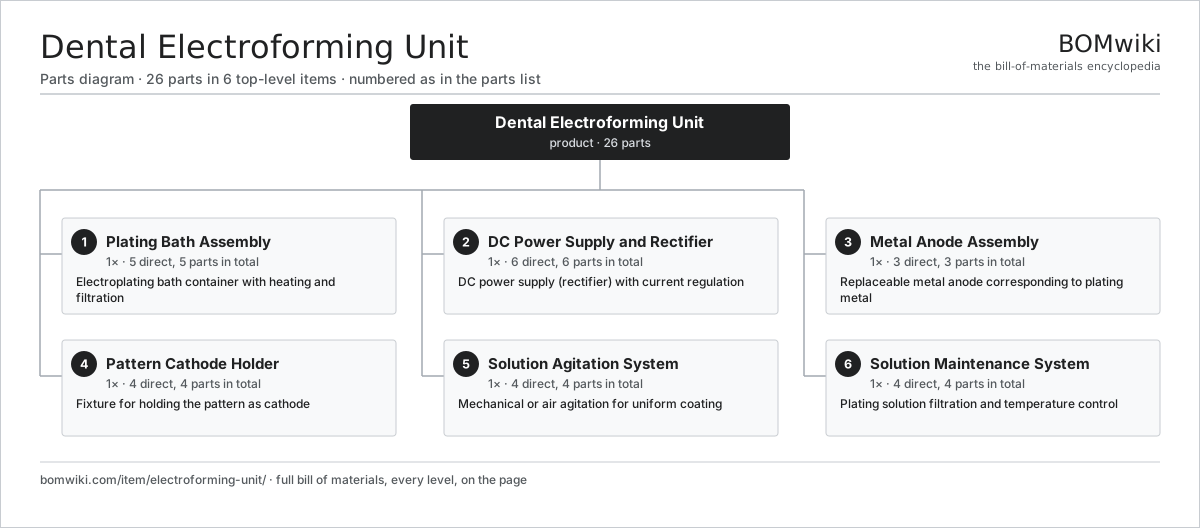
| # | Part | Qty | What it does |
|---|---|---|---|
| 1 | Plating Bath Assembly 5 parts | 1× | Electroplating bath container with heating and filtration |
| 2 | DC Power Supply and Rectifier 6 parts | 1× | DC power supply (rectifier) with current regulation |
| 3 | Metal Anode Assembly 3 parts | 1× | Replaceable metal anode corresponding to plating metal |
| 4 | Pattern Cathode Holder 4 parts | 1× | Fixture for holding the pattern as cathode |
| 5 | Solution Agitation System 4 parts | 1× | Mechanical or air agitation for uniform coating |
| 6 | Solution Maintenance System 4 parts | 1× | Plating solution filtration and temperature control |
3D model
No 3D model yet. Have a CAD file of this? Add a 3D model. STL renders right on this page; STEP, FreeCAD, and OpenSCAD sources are welcome too (openly licensed, like all 3D models on BOMwiki).
Build & assembly graph
expand / collapse · shared sub-assemblies converge · links to related products · est. labourTap an assembly to expand/collapse · tap a part to open it · use “Open page” for any node · drag to pan, scroll to zoom.
Bill of materials for Dental Electroforming Unit
6 top-level lines · 32 rows shown · 26 parts total · indented to 3 levels| # | Item / sub-assembly | Part no. | Qty/assy | Ext. qty | Parts | Type |
|---|---|---|---|---|---|---|
| 1 | Plating Bath Assembly 5 parts | electroforming-unit-bath | 1× | 1 | 5 | assembly |
| 1.1 | Plating Tank | electroforming-unit-bath-tank | 1× | 1 | · | part |
| 1.2 | Bath Heater | electroforming-unit-bath-heating | 1× | 1 | · | part |
| 1.3 | Cathode Hook | electroforming-unit-bath-cathode-hook | 1× | 1 | · | part |
| 1.4 | Anode Holder Frame | electroforming-unit-bath-anode-holder | 1× | 1 | · | part |
| 1.5 | Temperature Controller | electroforming-unit-bath-thermostat | 1× | 1 | · | part |
| 2 | DC Power Supply and Rectifier 6 parts | electroforming-unit-rectifier | 1× | 1 | 6 | assembly |
| 2.1 | Isolation Transformer | electroforming-unit-rectifier-transformer | 1× | 1 | · | part |
| 2.2 | Rectifier Bridge | electroforming-unit-rectifier-diodes | 1× | 1 | · | part |
| 2.3 | Output Filter Capacitor | electroforming-unit-rectifier-filter | 1× | 1 | · | part |
| 2.4 | Current Regulator | electroforming-unit-rectifier-regulator | 1× | 1 | · | part |
| 2.5 | Monitoring Display | electroforming-unit-rectifier-meter | 1× | 1 | · | part |
| 2.6 | Main Power Switch | electroforming-unit-rectifier-switch | 1× | 1 | · | part |
| 3 | Metal Anode Assembly 3 parts | electroforming-unit-anode | 1× | 1 | 3 | assembly |
| 3.1 | Anode Metal Plate | electroforming-unit-anode-plate | 1× | 1 | · | part |
| 3.2 | Anode Terminal | electroforming-unit-anode-connection | 1× | 1 | · | part |
| 3.3 | Anode Surface | electroforming-unit-anode-area | 1× | 1 | · | part |
| 4 | Pattern Cathode Holder 4 parts | electroforming-unit-cathode | 1× | 1 | 4 | assembly |
| 4.1 | Cathode Support Frame | electroforming-unit-cathode-frame | 1× | 1 | · | part |
| 4.2 | Cathode Contact Wire | electroforming-unit-cathode-contact | 1× | 1 | · | part |
| 4.3 | Cathode Cable | electroforming-unit-cathode-lead | 1× | 1 | · | part |
| 4.4 | Height Adjustment Mechanism | electroforming-unit-cathode-positioning | 1× | 1 | · | part |
| 5 | Solution Agitation System 4 parts | electroforming-unit-agitation | 1× | 1 | 4 | assembly |
| 5.1 | Agitation Motor | electroforming-unit-agitation-motor | 1× | 1 | · | part |
| 5.2 | Stirrer Paddle | electroforming-unit-agitation-paddle | 1× | 1 | · | part |
| 5.3 | Recirculation Pump | electroforming-unit-agitation-pump | 1× | 1 | · | part |
| 5.4 | Inert Gas Inlet | electroforming-unit-agitation-air-sparger | 1× | 1 | · | part |
| 6 | Solution Maintenance System 4 parts | electroforming-unit-filtration | 1× | 1 | 4 | assembly |
| 6.1 | Plating Solution Filter | electroforming-unit-filtration-filter | 1× | 1 | · | part |
| 6.2 | Circulation Pump | electroforming-unit-filtration-pump | 1× | 1 | · | part |
| 6.3 | Charcoal Filter Column | electroforming-unit-filtration-charcoal | 1× | 1 | · | part |
| 6.4 | Bath Cooler (Optional) | electroforming-unit-filtration-cooler | 1× | 1 | · | part |
Something wrong in this list? Report a problem with this BOM.
Sourcing: possible vendors
Browse the supplier directory → Prices, MOQ, and lead times are algorithmic estimates, not quotes, and not claims about these companies. Company mappings are curated by keyword; est. price band $200–$200k. How estimates work| Vendor | HQ | Specialty | MOQ | Lead time |
|---|---|---|---|---|
| dentsplysirona.com ↗ | Charlotte, US | Dental equipment | 100 units | 10–16 wks |
|
🇺🇸Envista
envistaco.com ↗
|
Brea, US | Dental (KaVo, Nobel) | 100 units | 10–16 wks |
|
🇫🇮Planmeca
planmeca.com ↗
|
Helsinki, FI | Dental units & imaging | 100 units | 10–16 wks |
|
🇺🇸A-dec
a-dec.com ↗
|
Newberg, US | Dental chairs & delivery | 100 units | 10–16 wks |
|
🇺🇸Midmark
midmark.com ↗
|
Versailles, US | Medical & veterinary equipment | 100 units | 10–16 wks |
1,234-word article