Electroless Plating Line
ProductOverview
Electroless plating (EN) is a chemical deposition process where metal ions in solution are reduced to metal metal and deposited onto a part surface without passing electric current. Unlike electroplating, which requires electrodes and DC power, electroless plating relies on a chemical reducing agent (typically hypophosphite for nickel plating) that donates electrons, reducing dissolved nickel or copper ions to metal atoms that bond to the substrate. The Electroless Plating Line is a series of heated chemical tanks where parts progress through activation (catalytic nucleation), immersion in the plating bath, and rinsing stages. Electroless plating is unmatched for coating complex geometries: threads, blind holes, internal cavities, and assemblies all receive uniform coating because the chemistry works at every surface without line-of-sight limitations.
The process begins with the Activation Tank. A palladium-based catalyst (palladium chloride in hydrochloric acid, or tin/palladium dual-layer systems) is deposited on the part surface by immersion in the Activation Vessel stainless tank (300 L). The palladium provides nucleation sites where the subsequent nickel reduction can initiate. Parts are immersed for 2–5 minutes; the Activation Circulation Pump pump agitates to ensure complete wetting. An Palladium Meter electrochemical probe monitors palladium concentration (0.1–1 g/L), alerting the operator when replenishment is needed.
After activation, parts are immediately rinsed in the first Rinse Tank tank to remove excess palladium and acid, preventing contamination of the plating bath. The Rinse Vessel (200 L) is fed by a Rinse Pump centrifugal pump spraying deionized water. A DI Water Filter 1 micron cartridge on the DI water inlet prevents particulates from entering the rinse tank.
The Plating Tank Assembly is the core of the system. A large, thermally insulated Plating Vessel (500 L, 316L stainless steel) contains the active plating solution. For electroless nickel (EN) plating, the bath consists of:
- Nickel sulfate (5–8 g/L Ni²⁺)
- Sodium hypophosphite (20–40 g/L, the reducing agent)
- Stabilizers (lead acetate, thiourea, or proprietary compounds to control reactivity)
- Complexing agents and buffers maintaining pH 8.5–9.5
When a palladium-catalyzed part is immersed in this bath, the chemistry is:
- Ni²⁺ + H₂PO₂⁻ + H₂O → Ni + H₂PO₃⁻ + 2H⁺ (over palladium catalyst)
Nickel and phosphorus deposit together, typically 5–12% phosphorus by weight in the coating. Higher phosphorus content yields higher hardness and corrosion resistance.
The bath temperature must be carefully controlled. The Temperature Control System system maintains 70–80°C (±2°C) using dual methods. Two Plating Heater electric cartridge heaters (6 kW each, 12 kW total) provide heating via a Temperature Controller PID controller. A Water Chiller 12 kW refrigerated chiller removes heat by circulating cool water through a jacket embedded in the Plating Vessel. A Cooling Pump vane pump maintains 50 L/min cooling flow. The Insulation Blanket fiberglass insulation reduces ambient heat loss, stabilizing setpoint achievement.
A Main Circulation Pump high-volume pump (100 L/min @ 2 bar) continuously recirculates plating bath through a Main Filter Cartridge 20 micron cartridge filter, removing suspended metals and organic decomposition products that accumulate during operation. The filtration loop also serves as the path for the pH Controller, which measures bath pH and doses either NaOH (base) or formic acid to maintain 8.5–9.5 setpoint. Stable pH is critical: too low (< 8.5) and deposition slows; too high (> 9.5) and the bath becomes unstable, dumping metals as oxides.
The Chemical Dispenser System system automates bath replenishment. Three Dispenser Pump peristaltic pumps meter nickel sulfate, hypophosphite, and stabilizer from Chemical Container bulk reservoirs into the bath based on analytical feedback. A Concentration Sensor ICP or atomic absorption analyzer measures nickel ion concentration (and optionally, phosphorus or other elements). The PLC compares measured concentration to setpoint and adjusts the nickel pump rate to maintain 5–8 g/L. Similarly, hypophosphite concentration is monitored and dosed to maintain 20–40 g/L. This automation is critical because bath composition directly affects deposition rate and coating properties.
Coating thickness is measured non-destructively via Thickness Monitor. An XRF Gauge X-ray fluorescence portable gauge measures thickness (0–500 µm range, ±5% accuracy) by analyzing the characteristic X-ray fluorescence of nickel. The XRF is calibrated using Calibration Standard Foil NIST-traceable foil standards (e.g., 10 µm, 25 µm, 50 µm nickel foil). The operator checks part thickness at regular intervals; if coating is below setpoint, immersion time is extended. If above, parts are withdrawn early.
After immersion and coating, parts proceed to a second Rinse Tank deionized water rinse to remove bath residue. The Drain Strainer 100 micron mesh in the drain line prevents fine particles from entering the sump.
In aerospace, electroless nickel coatings prevent aluminum and magnesium corrosion. Engine casings, landing gear bushings, and hydraulic lines all use 5–25 µm EN for salt-spray durability. Helicopter rotor hubs and fuselage fasteners rely on EN for fatigue strength improvement (the coating relieves stress concentration at sharp edges). Electronics manufacturers use EN on connector substrates and circuit board vias for solderability and corrosion protection. Medical device makers apply EN to stainless steel implants and instruments for biocompatibility and ease of sterilization. Optical systems use EN on brass aperture rings and lens barrels to reduce reflectance and improve appearance.
The key advantage of electroless plating is uniform coating on complex geometries: blind holes, recesses, internal channels all receive full thickness without electrical line-of-sight problems. The key disadvantage is cost (EN chemicals are 3–5x more expensive per liter than electroplate baths) and slow deposition (10–30 µm/h vs. 1–5 µm/min for electroplating). Electroless is thus chosen only when geometry or property requirements justify the cost.
How it works
- A part (machined aluminum, magnesium, steel, or composite substrate) is prepared: degreased, rinsed, and dried.
- The part is immersed in the Activation Tank Activation Vessel. The palladium chloride bath (3–5 min immersion) deposits a catalytic palladium layer on all surfaces.
- The part is rinsed in the first Rinse Tank deionized water bath, removing activation residue.
- The part is immediately loaded onto a basket and immersed in the hot Plating Tank Assembly. The Plating Vessel contains the active EN bath at 70–80°C (maintained by Plating Heater heaters and Water Chiller cooling).
- As the part is lowered into the bath, palladium catalyst on the surface activates the redox reaction: Ni²⁺ + H₂PO₂⁻ → Ni + H₂PO₃⁻ (over palladium). Nickel atoms deposit and bond to the part, forming a continuously growing coating.
- The Main Circulation Pump continuously recirculates bath through the Main Filter Cartridge 20 micron filter, removing suspended metal oxides and organic byproducts that accumulate.
- The pH Controller monitors bath pH; if pH drifts below 8.5 (reducing deposition rate), the controller doses NaOH base. If pH rises above 9.5 (risking bath instability), the controller doses acid.
- Immersion time depends on desired coating thickness. For 10 µm EN, immersion is approximately 20–30 minutes at 70–80°C and nominal bath concentration. For 25 µm, 60+ minutes.
- Throughout immersion, the Concentration Sensor ICP analyzer samples the bath periodically. If nickel concentration drops below 5 g/L, the Dispenser Pump nickel pump is energized, metering nickel sulfate from the Chemical Container reservoir. Similarly, hypophosphite and stabilizer are dosed to maintain bath chemistry.
- After the desired immersion time, the part is lifted from the plating bath. The Thickness Monitor XRF gauge measures coating thickness. If thickness is within ±5% of setpoint, the part is approved.
- The part is immersed in the second Rinse Tank deionized water rinse tank for 2–5 minutes, removing plating bath residue. The Rinse Pump spray ensures complete wetting.
- The part is removed and air-dried (or dried in a low-temperature oven to prevent water spotting).
- If a higher hardness coating is required (600–700 HV vs. as-plated 450–550 HV), the part is heat-treated at 300–400°C for 1–2 hours, causing internal stress relief and phosphorus precipitation that hardens the coating.
- The electroless-plating-line-bath-vessel temperature, pH, and chemical concentration are continuously monitored. Annual tank cleaning (draining, filter replacement, wall inspection) prevents sludge buildup.
Electroless Plating Line parts and their functions
7 top-level parts · 39 parts in total · full bill of materials below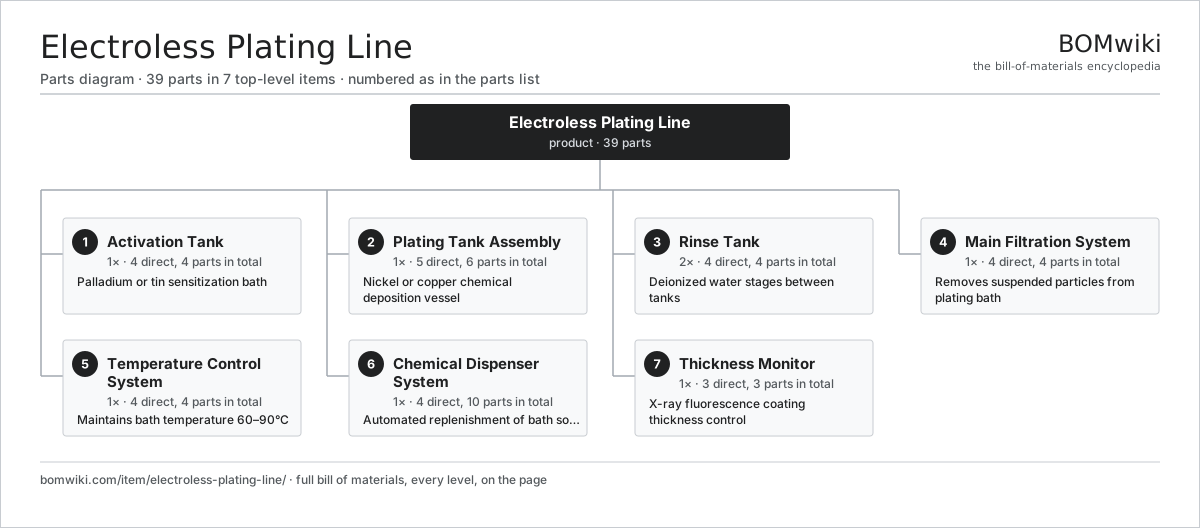
| # | Part | Qty | What it does |
|---|---|---|---|
| 1 | Activation Tank 4 parts | 1× | Palladium or tin sensitization bath |
| 2 | Plating Tank Assembly 5 parts | 1× | Nickel or copper chemical deposition vessel |
| 3 | Rinse Tank 4 parts | 2× | Deionized water stages between tanks |
| 4 | Main Filtration System 4 parts | 1× | Removes suspended particles from plating bath |
| 5 | Temperature Control System 4 parts | 1× | Maintains bath temperature 60–90°C |
| 6 | Chemical Dispenser System 4 parts | 1× | Automated replenishment of bath solutions |
| 7 | Thickness Monitor 3 parts | 1× | X-ray fluorescence coating thickness control |
3D model
No 3D model yet. Have a CAD file of this? Add a 3D model. STL renders right on this page; STEP, FreeCAD, and OpenSCAD sources are welcome too (openly licensed, like all 3D models on BOMwiki).
Build & assembly graph
expand / collapse · shared sub-assemblies converge · links to related products · est. labourTap an assembly to expand/collapse · tap a part to open it · use “Open page” for any node · drag to pan, scroll to zoom.
Bill of materials for Electroless Plating Line
7 top-level lines · 35 rows shown · 39 parts total · indented to 3 levels| # | Item / sub-assembly | Part no. | Qty/assy | Ext. qty | Parts | Type |
|---|---|---|---|---|---|---|
| 1 | Activation Tank 4 parts | electroless-plating-line-activation-tank | 1× | 1 | 4 | assembly |
| 1.1 | Activation Vessel | electroless-plating-line-activation-vessel | 1× | 1 | · | part |
| 1.2 | Activation Heater | electroless-plating-line-activation-heater | 1× | 1 | · | part |
| 1.3 | Activation Circulation Pump | electroless-plating-line-activation-circulation | 1× | 1 | · | part |
| 1.4 | Palladium Meter | electroless-plating-line-activation-sensor | 1× | 1 | · | part |
| 2 | Plating Tank Assembly 5 parts | electroless-plating-line-plating-tank | 1× | 1 | 6 | assembly |
| 2.1 | Plating Vessel | electroless-plating-line-plating-vessel | 1× | 1 | · | part |
| 2.2 | Plating Heater | electroless-plating-line-plating-heater | 2× | 2 | · | part |
| 2.3 | Main Circulation Pump | electroless-plating-line-circulation-pump-main | 1× | 1 | · | part |
| 2.4 | pH Controller | electroless-plating-line-ph-controller | 1× | 1 | · | part |
| 2.5 | Main Filter Cartridge | electroless-plating-line-filter-main | 1× | 1 | · | part |
| 3 | Rinse Tank 4 parts | electroless-plating-line-rinse-tanks | 2× | 2 | 4 | assembly |
| 3.1 | Rinse Vessel | electroless-plating-line-rinse-vessel | 1× | 2 | · | part |
| 3.2 | Rinse Pump | electroless-plating-line-rinse-pump | 1× | 2 | · | part |
| 3.3 | DI Water Filter | electroless-plating-line-di-water-filter | 1× | 2 | · | part |
| 3.4 | Drain Strainer | electroless-plating-line-drain-strainer | 1× | 2 | · | part |
| 4 | Main Filtration System 4 parts | electroless-plating-line-filtration | 1× | 1 | 4 | assembly |
| 4.1 | Main Filter Housing | electroless-plating-line-filter-housing-main | 1× | 1 | · | part |
| 4.2 | 20µm Filter Cartridge | electroless-plating-line-filter-cartridge-20um | 1× | 1 | · | part |
| 4.3 | Bypass Check Valve | electroless-plating-line-bypass-check | 1× | 1 | · | part |
| 4.4 | Pressure Gauge | electroless-plating-line-pressure-gauge | 1× | 1 | · | part |
| 5 | Temperature Control System 4 parts | electroless-plating-line-heating-cooling | 1× | 1 | 4 | assembly |
| 5.1 | Water Chiller | electroless-plating-line-water-chiller | 1× | 1 | · | part |
| 5.2 | Cooling Pump | electroless-plating-line-pump-cooler | 1× | 1 | · | part |
| 5.3 | Temperature Controller | electroless-plating-line-temp-controller | 1× | 1 | · | part |
| 5.4 | Insulation Blanket | electroless-plating-line-insulation-blanket | 1× | 1 | · | part |
| 6 | Chemical Dispenser System 4 parts | electroless-plating-line-chemical-dispenser | 1× | 1 | 10 | assembly |
| 6.1 | Dispenser Pump | electroless-plating-line-dispenser-pump | 3× | 3 | · | part |
| 6.2 | Chemical Container | electroless-plating-line-chemical-containers | 3× | 3 | · | part |
| 6.3 | Flow Meter | electroless-plating-line-flow-meters | 3× | 3 | · | part |
| 6.4 | Concentration Sensor | electroless-plating-line-concentration-sensor | 1× | 1 | · | part |
| 7 | Thickness Monitor 3 parts | electroless-plating-line-thickness-monitor | 1× | 1 | 3 | assembly |
| 7.1 | XRF Gauge | electroless-plating-line-xrf-unit | 1× | 1 | · | part |
| 7.2 | XRF Sample Holder | electroless-plating-line-sample-holder | 1× | 1 | · | part |
| 7.3 | Calibration Standard Foil | electroless-plating-line-calibration-standard | 1× | 1 | · | part |
Something wrong in this list? Report a problem with this BOM.
Sourcing: possible vendors
Browse the supplier directory → Prices, MOQ, and lead times are algorithmic estimates, not quotes, and not claims about these companies. Company mappings are curated by keyword; est. price band $5k–$2M. How estimates work| Vendor | HQ | Specialty | MOQ | Lead time |
|---|---|---|---|---|
| atlascopco.com ↗ | Stockholm, SE | Compressors & industrial | 10 units | 12–20 wks |
|
🇦🇹Andritz
andritz.com ↗
|
Graz, AT | Process plants & machinery | 10 units | 12–20 wks |
| buhlergroup.com ↗ | Uzwil, CH | Food & materials processing | 10 units | 12–20 wks |
| gea.com ↗ | Düsseldorf, DE | Process technology | 10 units | 12–20 wks |
| mhi.com ↗ | Tokyo, JP | Heavy machinery | 10 units | 12–20 wks |
1,493-word article