Electronic Rodent Trap
ProductOverview
An electronic rodent trap is a battery-powered device that delivers a controlled electric shock to kill rodents (mice and rats) instantly. Unlike snap traps or spring mechanisms, which rely on kinetic energy, electronic traps use a high-voltage pulse generated from low battery voltage through a step-up converter. The rodent enters a dark tunnel to reach bait and completes a circuit by touching both electrodes, triggering a capacitor discharge that stops the heart.
The trap consists of a plastic housing with a narrow tunnel passage, a pair of closely spaced contact electrodes, a low-voltage high-voltage converter, a sensing circuit, a battery pack, and an automatic reset mechanism. A status LED indicates armed/fired state. The design is safe for humans (high voltage but very low total energy) and requires no moving parts or complicated setup.
How it works
Four to eight AA or C cells in the Battery Pack provide 4.5–9 V DC to the High-Voltage Generator, which boosts this to 3000–6000 V across the Contact Plates. The boost is achieved with a Flyback Transformer driven at 50–100 kHz by a Boost Switching Transistor. A Storage Capacitor accumulates the stepped-up voltage; a High-Voltage Rectifier converts the high-voltage AC output to DC charging the capacitor.
When the trap is armed, the Sensing Circuit is active and waiting. A rodent, attracted by bait in the Bait Chamber, enters through the tunnel and touches both the Positive Electrode and Negative Electrode simultaneously. The current flow is immediately detected by the Sense Comparator on the sensing board, which triggers the Trigger Relay to discharge the capacitor through the rodent's body.
The discharge is brief (0.1–0.5 seconds) but carries enough current (20–100 mA) to stop the heart. Once the pulse completes, the Sensing Circuit signals the Logic Timer to disable the trigger for 10–30 seconds, allowing the capacitor to recharge while preventing accidental re-discharge. The Reset Mechanism mechanically or electromagnetically re-arms the trap for the next cycle.
A Status LED illuminates to show trap status: green when armed and ready, red or off after a discharge. The operator checks the Inspection Door to inspect the trap and remove the dead rodent.
Advantages and limitations
Electronic traps kill instantly and humanely, leaving the body intact for disposal. They require no moving parts subject to mechanical wear and function reliably in most conditions. The main limitation is battery life: a set of eight AA cells typically lasts for 50–150 kills before voltage sag causes failure to generate sufficient killing voltage.
Electronic traps are most effective in tight, dark spaces (basements, walls, enclosed storage) where rodents naturally travel and bait remains protected from weather. They are less reliable in bright areas or outdoors, where rodents are less likely to enter the tunnel or rain can compromise the electrical contacts.
Electronic Rodent Trap parts and their functions
8 top-level parts · 31 parts in total · full bill of materials below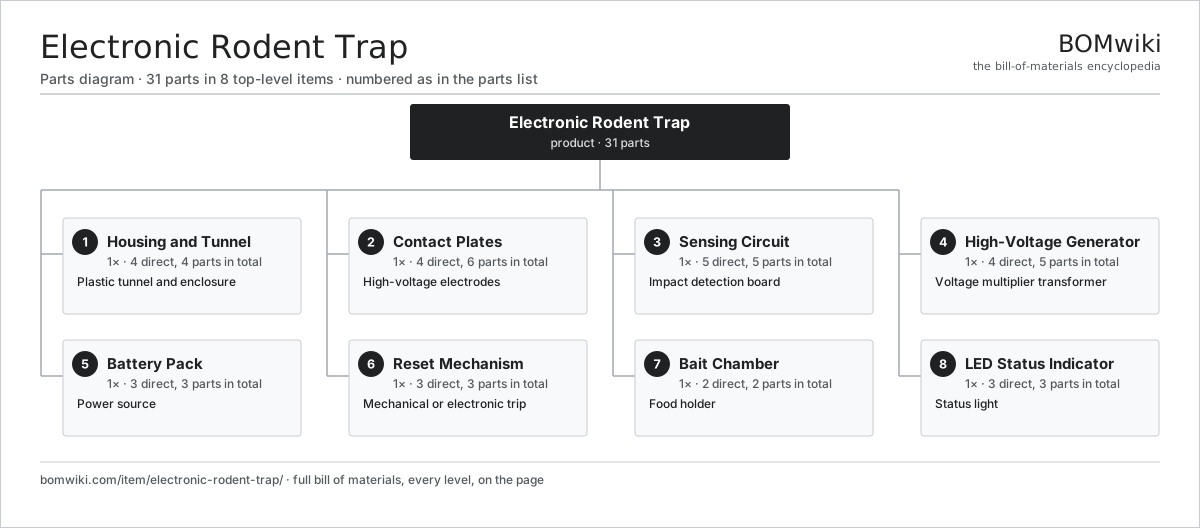
| # | Part | Qty | What it does |
|---|---|---|---|
| 1 | Housing and Tunnel 4 parts | 1× | Plastic tunnel and enclosure |
| 2 | Contact Plates 4 parts | 1× | High-voltage electrodes |
| 3 | Sensing Circuit 5 parts | 1× | Impact detection board |
| 4 | High-Voltage Generator 4 parts | 1× | Voltage multiplier transformer |
| 5 | Battery Pack 3 parts | 1× | Power source |
| 6 | Reset Mechanism 3 parts | 1× | Mechanical or electronic trip |
| 7 | Bait Chamber 2 parts | 1× | Food holder |
| 8 | LED Status Indicator 3 parts | 1× | Status light |
3D model
No 3D model yet. Have a CAD file of this? Add a 3D model. STL renders right on this page; STEP, FreeCAD, and OpenSCAD sources are welcome too (openly licensed, like all 3D models on BOMwiki).
Build & assembly graph
expand / collapse · shared sub-assemblies converge · links to related products · est. labourTap an assembly to expand/collapse · tap a part to open it · use “Open page” for any node · drag to pan, scroll to zoom.
Bill of materials for Electronic Rodent Trap
8 top-level lines · 36 rows shown · 31 parts total · indented to 3 levels| # | Item / sub-assembly | Part no. | Qty/assy | Ext. qty | Parts | Type |
|---|---|---|---|---|---|---|
| 1 | Housing and Tunnel 4 parts | electronic-rodent-trap-housing | 1× | 1 | 4 | assembly |
| 1.1 | Outer Shell | electronic-rodent-trap-outer-shell | 1× | 1 | · | part |
| 1.2 | Tunnel Liner | electronic-rodent-trap-tunnel-liner | 1× | 1 | · | part |
| 1.3 | Inspection Door | electronic-rodent-trap-cover-door | 1× | 1 | · | part |
| 1.4 | Fastener Set | fastener-set | 1× | 1 | · | part |
| 2 | Contact Plates 4 parts | electronic-rodent-trap-contact-plates | 1× | 1 | 6 | assembly |
| 2.1 | Positive Electrode | electronic-rodent-trap-positive-plate | 1× | 1 | · | part |
| 2.2 | Negative Electrode | electronic-rodent-trap-negative-plate | 1× | 1 | · | part |
| 2.3 | Plate Insulator | electronic-rodent-trap-plate-insulator | 2× | 2 | · | part |
| 2.4 | Plate Wire Post | electronic-rodent-trap-plate-connector | 2× | 2 | · | part |
| 3 | Sensing Circuit 5 parts | electronic-rodent-trap-sensing-circuit | 1× | 1 | 5 | assembly |
| 3.1 | Bare PCB | pcb-bare | 1× | 1 | · | part |
| 3.2 | SMD Passive (R/C/L) | smd-passives | 1× | 1 | · | part |
| 3.3 | Sense Comparator | electronic-rodent-trap-sense-comparator | 1× | 1 | · | part |
| 3.4 | Logic Timer | electronic-rodent-trap-logic-chip | 1× | 1 | · | part |
| 3.5 | Trigger Relay | electronic-rodent-trap-relay | 1× | 1 | · | part |
| 4 | High-Voltage Generator 4 parts | electronic-rodent-trap-hv-generator | 1× | 1 | 5 | assembly |
| 4.1 | Flyback Transformer | electronic-rodent-trap-flyback-transformer | 1× | 1 | · | part |
| 4.2 | Boost Switching Transistor | electronic-rodent-trap-boost-mosfet | 1× | 1 | · | part |
| 4.3 | Storage Capacitor | electronic-rodent-trap-storage-capacitor | 2× | 2 | · | part |
| 4.4 | High-Voltage Rectifier | electronic-rodent-trap-rectifier-diode | 1× | 1 | · | part |
| 5 | Battery Pack 3 parts | electronic-rodent-trap-battery-pack | 1× | 1 | 3 | assembly |
| 5.1 | 12 V Battery | lv-battery | 1× | 1 | · | part |
| 5.2 | Battery Holder | electronic-rodent-trap-battery-holder | 1× | 1 | · | part |
| 5.3 | Battery Switch | electronic-rodent-trap-battery-switch | 1× | 1 | · | part |
| 6 | Reset Mechanism 3 parts | electronic-rodent-trap-reset-mechanism | 1× | 1 | 3 | assembly |
| 6.1 | Reset Spring | electronic-rodent-trap-reset-spring | 1× | 1 | · | part |
| 6.2 | Trigger Lever Arm | electronic-rodent-trap-trigger-lever | 1× | 1 | · | part |
| 6.3 | Solenoid Re-arming | electronic-rodent-trap-solenoid-reset | 1× | 1 | · | part |
| 7 | Bait Chamber 2 parts | electronic-rodent-trap-bait-chamber | 1× | 1 | 2 | assembly |
| 7.1 | Bait Cup | electronic-rodent-trap-bait-cup | 1× | 1 | · | part |
| 7.2 | Bait Guard | electronic-rodent-trap-bait-cover | 1× | 1 | · | part |
| 8 | LED Status Indicator 3 parts | electronic-rodent-trap-led-indicator | 1× | 1 | 3 | assembly |
| 8.1 | Status LED | electronic-rodent-trap-status-led | 1× | 1 | · | part |
| 8.2 | LED Resistor | electronic-rodent-trap-led-resistor | 1× | 1 | · | part |
| 8.3 | LED Lens | electronic-rodent-trap-led-lens | 1× | 1 | · | part |
Something wrong in this list? Report a problem with this BOM.
Related products
same domain, ranked by shared parts Electric Fence Energizer
37 parts · shares 3 with this page
 Thermal Mosquito Fogger
32 parts · shares 1 with this page
 Tow-Behind Leaf Vacuum Loader
65 parts · shares 1 with this page
 Zero-Turn Mower
109 parts · shares 1 with this page
Backpack Power Sprayer
66 parts · shares 2 with this page
 Greenhouse Heater
50 parts · shares 2 with this page
Sourcing: possible vendors
Browse the supplier directory → Prices, MOQ, and lead times are algorithmic estimates, not quotes, and not claims about these companies. Company mappings are curated by keyword; est. price band $80–$5k. How estimates work| Vendor | HQ | Specialty | MOQ | Lead time |
|---|---|---|---|---|
| husqvarna.com ↗ | Stockholm, SE | Outdoor power products | 500 units | 8–14 wks |
|
🇩🇪STIHL
stihl.com ↗
|
Waiblingen, DE | Chainsaws & outdoor power | 500 units | 8–14 wks |
|
🇺🇸Toro
thetorocompany.com ↗
|
Bloomington, US | Turf & outdoor equipment | 500 units | 8–14 wks |
| powerequipment.honda.com ↗ | Tokyo, JP | Engines & outdoor power | 500 units | 8–14 wks |
|
🇨🇳Chervon
chervongroup.com ↗
|
Nanjing, CN | Power tools (EGO, SKIL) | 500 units | 8–14 wks |
533-word article