EMG/NCS Machine
ProductOverview
Electromyography (EMG) and nerve conduction studies (NCS) assess neuromuscular pathology by measuring electrical activity in muscles and peripheral nerves. The system combines electrical stimulation (evoking compound muscle action potentials), needle-electrode recording (detecting individual motor unit action potentials), and analysis software for calculating conduction velocities, distal latencies, and motor-unit recruitment patterns. Neurologists and physiatrists use EMG/NCS to diagnose peripheral neuropathy, motor neuron disease, neuromuscular junction disorders (myasthenia gravis), myopathy, and acute radiculopathy.
Nerve conduction studies (NCS)
Nerve conduction studies measure the speed and amplitude of action potentials traveling along motor or sensory nerves. The Nerve Stimulator Unit delivers supramaximal electrical pulses (constant-current, 0–50 mA, 0.1–1 ms duration) percutaneously to activate all nerve fibers simultaneously. Surface Surface Electrode Pair electrodes recording over the muscle detect the resulting compound muscle action potential (CMAP); latency (time from stimulus to response onset) and amplitude (peak-to-peak voltage) are measured. By stimulating at two sites along the same nerve, conduction velocity is calculated as distance divided by latency difference. Normal median sensorimotor conduction is 50–70 m/s; demyelinating disease (Guillain-Barré, Charcot-Marie-Tooth type I) slows conduction to <40 m/s, while axonal loss (axonal neuropathy, motor neuron disease) reduces amplitude without slowing conduction.
Needle electromyography
Needle EMG records the electrical signatures of individual motor units (a motor neuron plus all muscle fibers it innervates). The Concentric Needle Electrode or Monopolar Needle Electrode is inserted into muscle; as the patient gently contracts, motor unit action potentials (MUAPs) appear as biphasic or triphasic spikes 100–1,000 µV amplitude, 3–15 ms duration. The EMG Amplifier Box amplifies these micro-voltages 1,000×–10,000× and filters the 100 Hz–10 kHz band to emphasize MUAP transients while attenuating baseline drift and low-frequency movement artifact. In normal muscle, MUAPs recruit synchronously with increasing effort (recruitment frequency); in myopathy, too many small-amplitude MUAPs fire at low frequency (early recruitment), while in motor neuron disease, few giant MUAPs fire at high frequency (reduced recruitment). Spontaneous activity at rest, fibrillation potentials (1–2 Hz positive sharp waves <1 ms duration) or fasciculations (brief motor-unit discharges without volitional contraction), indicates denervation or muscle disease.
Electrical safety and artifact management
The Patient Return Pad disperses stimulation current over a large body surface area to prevent skin burns and localized tissue damage. The Stim Artifact Blanking Circuit circuit blanks recording channels 200 µs during stimulation, preventing the large stimulus artifact (>>10 mV) from saturating the amplifier and obscuring the smaller CMAP response. High-impedance needle electrodes generate electrical noise readily; shielded cables and low-noise amplifier input stages minimize 50/60 Hz powerline contamination.
Software analysis and measurement
The Acquisition PC software displays recorded waveforms in real-time and allows offline analysis. For nerve conduction studies, software identifies the CMAP peak and baseline crossings to measure latency (in ms) and amplitude (in mV); multiple measurements at different stimulation sites are tabulated to calculate conduction velocity and assess proximal vs. distal conduction block. For needle EMG, analysis modules detect individual MUAPs using threshold-crossing algorithms; motor-unit action potential duration, amplitude, and number of phases are computed. Recruitment analysis measures MUAP firing rate vs. force output: normal muscles transition from low-frequency single-unit firing to high-frequency full-interference pattern; myopathic muscles fill the trace quickly with small-amplitude potentials (early recruitment), while neurogenic muscles recruit few potentials at high frequency (delayed recruitment).
Clinical interpretation workflow
A patient with foot numbness and weakness undergoes nerve conduction studies. The technician places surface electrodes over the tibialis anterior muscle, applies supramaximal stimulation to the deep peroneal nerve at the knee and ankle, and records compound muscle action potentials. Latency from ankle stimulus to CMAP onset is 4 ms (normal <5 ms), while latency from knee stimulus is 12 ms (normal <15 ms); conduction velocity = distance 30 cm / (12 − 4) ms = 37.5 m/s (normal >40 m/s). The slowed conduction suggests demyelination (e.g., Charcot-Marie-Tooth 1A or acquired demyelinating neuropathy). Next, needle EMG is performed: concentric needle inserted into tibialis anterior records at rest (normal silence, no fibrillations) and mild effort (5–10 motor units visible). Motor units show normal duration (8–12 ms) and normal recruitment frequency (increasing effort fires more units at higher rate). The pattern is consistent with demyelinating peripheral neuropathy without acute denervation or myopathy.
Repetitive stimulation and safety studies
For suspected neuromuscular junction pathology (myasthenia gravis, Lambert-Eaton syndrome), trains of stimuli are delivered at 2–3 Hz for 1 second; the CMAP amplitude is compared between stimulus 1 and stimulus 5. In myasthenia, CMAP amplitude decreases >10% (neuromuscular blockade), while in Lambert-Eaton, CMAP increases >100% (facilitation). Some protocols require high-frequency stimulation (50 Hz for 1 second) followed by post-tetanic potentiation measurements.
Typical clinical session
A patient with suspected carpal tunnel syndrome attends the EMG lab. The technician stimulates the median nerve at the wrist and records compound muscle action potential at the thenar muscle; distal latency is 5.2 ms (normal <4.5 ms). Stimulation at the elbow shows latency 9.8 ms; conduction velocity across the forearm = 50 m/s (normal >50 m/s), so slowing is focal at the wrist (carpal tunnel site). Next, needle EMG examines the abductor pollicis brevis muscle: at rest, normal silence; mild effort produces normal-duration, normal-amplitude motor units with normal recruitment. The findings confirm median neuropathy at the wrist (carpal tunnel) without motor neuron disease or myopathy. The technician performs testing in 30–45 minutes; the neurologist reviews and interprets the same day.
EMG/NCS Machine parts and their functions
6 top-level parts · 29 parts in total · full bill of materials below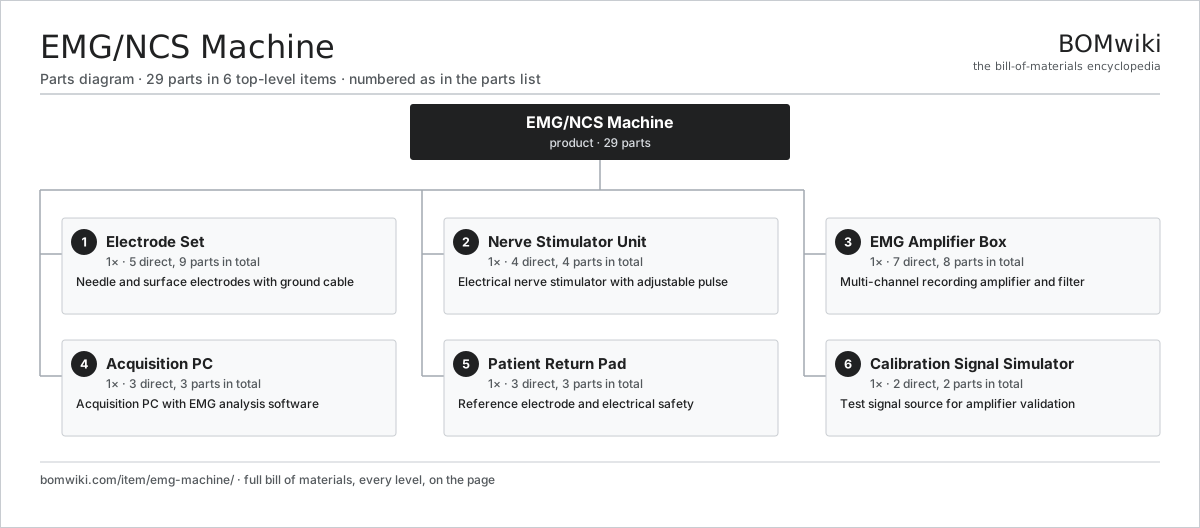
| # | Part | Qty | What it does |
|---|---|---|---|
| 1 | Electrode Set 5 parts | 1× | Needle and surface electrodes with ground cable |
| 2 | Nerve Stimulator Unit 4 parts | 1× | Electrical nerve stimulator with adjustable pulse |
| 3 | EMG Amplifier Box 7 parts | 1× | Multi-channel recording amplifier and filter |
| 4 | Acquisition PC 3 parts | 1× | Acquisition PC with EMG analysis software |
| 5 | Patient Return Pad 3 parts | 1× | Reference electrode and electrical safety |
| 6 | Calibration Signal Simulator 2 parts | 1× | Test signal source for amplifier validation |
3D model
No 3D model yet. Have a CAD file of this? Add a 3D model. STL renders right on this page; STEP, FreeCAD, and OpenSCAD sources are welcome too (openly licensed, like all 3D models on BOMwiki).
Build & assembly graph
expand / collapse · shared sub-assemblies converge · links to related products · est. labourTap an assembly to expand/collapse · tap a part to open it · use “Open page” for any node · drag to pan, scroll to zoom.
Bill of materials for EMG/NCS Machine
6 top-level lines · 30 rows shown · 29 parts total · indented to 3 levels| # | Item / sub-assembly | Part no. | Qty/assy | Ext. qty | Parts | Type |
|---|---|---|---|---|---|---|
| 1 | Electrode Set 5 parts | emg-machine-electrode-set | 1× | 1 | 9 | assembly |
| 1.1 | Concentric Needle Electrode | emg-machine-concentric-needle | 3× | 3 | · | part |
| 1.2 | Monopolar Needle Electrode | emg-machine-monopolar-needle | 2× | 2 | · | part |
| 1.3 | Surface Electrode Pair | emg-machine-surface-electrode-pair | 2× | 2 | · | part |
| 1.4 | Ground Reference Lead | emg-machine-ground-lead | 1× | 1 | · | part |
| 1.5 | Needle Autoclave Tray | emg-machine-needle-sterilizer | 1× | 1 | · | part |
| 2 | Nerve Stimulator Unit 4 parts | emg-machine-stimulator-unit | 1× | 1 | 4 | assembly |
| 2.1 | Stimulator Constant-Current Driver | emg-machine-stim-amplifier | 1× | 1 | · | part |
| 2.2 | Stimulation Probe | emg-machine-stim-probe | 1× | 1 | · | part |
| 2.3 | Stimulator Cable | emg-machine-stim-cable | 1× | 1 | · | part |
| 2.4 | Rechargeable Battery | emg-machine-stim-battery | 1× | 1 | · | part |
| 3 | EMG Amplifier Box 7 parts | emg-machine-amplifier-box | 1× | 1 | 8 | assembly |
| 3.1 | Input Amplifier Stage | emg-machine-input-amp-stage | 1× | 1 | · | part |
| 3.2 | Analog Filter Module | emg-machine-analog-filter | 1× | 1 | · | part |
| 3.3 | ADC Module | emg-machine-adc-module | 1× | 1 | · | part |
| 3.4 | USB Interface Module | emg-machine-usb-interface | 1× | 1 | · | part |
| 3.5 | Stim Artifact Blanking Circuit | emg-machine-stim-isolation | 1× | 1 | · | part |
| 3.6 | Power Supply | power-supply | 1× | 1 | · | part |
| 3.7 | Connector | connector | 2× | 2 | · | part |
| 4 | Acquisition PC 3 parts | emg-machine-acq-pc | 1× | 1 | 3 | assembly |
| 4.1 | Acquisition PC Unit | emg-machine-pc-cpu | 1× | 1 | · | part |
| 4.2 | Clinical Display | emg-machine-display | 1× | 1 | · | part |
| 4.3 | Digitizer Interface | emg-machine-amplifier-interface | 1× | 1 | · | part |
| 5 | Patient Return Pad 3 parts | emg-machine-patient-return-pad | 1× | 1 | 3 | assembly |
| 5.1 | Foam Substrate | emg-machine-foam-backing | 1× | 1 | · | part |
| 5.2 | Silver Chloride Plate | emg-machine-agcl-plate | 1× | 1 | · | part |
| 5.3 | Return Current Lead | emg-machine-return-lead | 1× | 1 | · | part |
| 6 | Calibration Signal Simulator 2 parts | emg-machine-calibration-simulator | 1× | 1 | 2 | assembly |
| 6.1 | Signal Generator | emg-machine-signal-gen | 1× | 1 | · | part |
| 6.2 | Test Cable | emg-machine-test-cable | 1× | 1 | · | part |
Something wrong in this list? Report a problem with this BOM.
Related products
same domain, ranked by shared parts Anesthesia Machine
562 parts · shares 1 with this page
Anesthesia Machine
562 parts · shares 1 with this page
 Apheresis Machine
199 parts · shares 1 with this page
Apheresis Machine
199 parts · shares 1 with this page
 Autorefractor
513 parts · shares 1 with this page
Autorefractor
513 parts · shares 1 with this page
 Blood Bank Refrigerator
79 parts · shares 1 with this page
Blood Gas Analyzer
386 parts · shares 1 with this page
Blood Bank Refrigerator
79 parts · shares 1 with this page
Blood Gas Analyzer
386 parts · shares 1 with this page
 Blood/Fluid Warmer
28 parts · shares 1 with this page
Blood/Fluid Warmer
28 parts · shares 1 with this page
Sourcing: possible vendors
Browse the supplier directory → Prices, MOQ, and lead times are algorithmic estimates, not quotes, and not claims about these companies. Company mappings are curated by keyword; est. price band $500–$3M. How estimates work| Vendor | HQ | Specialty | MOQ | Lead time |
|---|---|---|---|---|
| gehealthcare.com ↗ | Chicago, US | Medical imaging & devices | 100 units | 12–20 wks |
| siemens-healthineers.com ↗ | Erlangen, DE | Medical systems | 100 units | 12–20 wks |
|
🇳🇱Philips
philips.com ↗
|
Amsterdam, NL | Health technology | 100 units | 12–20 wks |
| medtronic.com ↗ | Minneapolis, US | Medical devices | 100 units | 12–20 wks |
|
🇨🇳Mindray
mindray.com ↗
|
Shenzhen, CN | Medical devices | 100 units | 12–20 wks |
943-word article