Enameling Kiln
ProductOverview
An enameling kiln is a compact electric furnace used to fuse glass enamels onto metal jewelry, decorative objects, and fine craft. Unlike large ceramic or glass studios, which house kilns firing at 2000–2500 °F for extended periods, an enameling kiln operates at 1500–1800 °F for short bursts (5–15 minutes), making it ideal for tabletop work in studios, classrooms, and workshops.
The Chamber is a small, heavily insulated box, typically 10 × 8 × 8 inches internal volume. Electric Heating Elements in the top and sides heat the interior rapidly. A thermostat maintains setpoint. The Door Assembly opens for quick access to load and unload work.
This simplicity and efficiency made enameling kilns ubiquitous in art studios and jewelry schools by the mid-20th century. Even today, a $200–500 tabletop enameling kiln can produce work equivalent to professional studios costing 100 times as much. The key is understanding firing temperature, ramp rate, and the behavior of different enamels under heat.
The Glass Enamel Process
Enameling is the ancient art of fusing glass (enamel) to a metal surface. The metal (copper, silver, steel, or gold) is first cleaned and sometimes coated with a base layer of opaque enamel (called a ''counter-enamel'' on the back to prevent warping from thermal stress). The artist then applies layers of colored enamel powders, each typically 1–2 mm thick.
The Chamber is preheated to setpoint (usually 1500–1700 °F depending on the enamel melting point). The metal piece is placed on a ceramic Kiln Shelf or trivet inside the kiln. The enamel powder melts, flows, and fuses to the metal surface in 3–5 minutes. When fired to the correct "orange peel" texture (properly melted but not overfired), the enamel is smooth, glossy, and permanently bonded.
Multiple layers can be applied and fired sequentially: each firing must be below the melting point of the previous layer to avoid causing it to reflow. This requires careful temperature control and knowledge of the specific enamels being used.
Chamber Design and Insulation
The Chamber is designed for rapid heating and cool efficiency. The Outer Shell is thin steel or aluminum, serving only as a protective barrier. The real work is done by the Inner Lining, ceramic fiber board or refractory brick, which contains and reflects heat. The Insulation Fill between them (typically 2–3 inches of ceramic fiber blanket) reduces radiant loss to less than 5% of input power.
This efficient design has a cost: the Outer Shell remains warm (150–200 °F) even during firing, safe to touch briefly but not suitable for prolonged skin contact. The Floor Grate is the surface where the enameled piece rests; it must be ceramic or high-silica steel to avoid contamination of the enamel from iron.
The Vent Opening is essential: as water and organic binders in the enamel burn off during heating, steam must escape. Without adequate venting, moisture can be trapped in the enamel surface, creating a cloudy or bubbled finish (a defect called ''pinholing''). The hole also allows the chamber to cool by convection once power is cut.
Heating Elements and Electrical System
The Heating Elements are nichrome wire coils (typically 0.5–1 kW each in top and sides). Nichrome is chosen for its high-temperature stability (up to 2200 °F continuous), resistance to oxidation, and consistent resistivity (predictable power output). The coils are spaced on ceramic insulators to prevent direct contact with the Inner Lining, which would cause localized overheating and damage.
Electrical power (120V or 240V single-phase) is routed through a relay or contactor controlled by a thermostat. The thermostat reads an internal temperature sensor (usually a thermocouple or resistance bulb) and cycles the relay on and off to maintain the setpoint. High-quality kilns use a proportional or PID controller for finer regulation; economy models use simple bimetallic thermostats that cycle more coarsely.
An optional Timer can automatically shut off the kiln after a set firing time (e.g., 10 minutes), a convenience feature for repeatability and preventing overfiring.
Temperature Control and Firing Practice
The Pyrometer displays the chamber temperature continuously, typically as an analog dial or LED readout. For lead-based enamels (now largely phased out due to toxicity), firing at 1400–1500 °F is standard. For cadmium-free modern enamels, 1600–1700 °F is typical; borosilicate enamels require 1800+ °F.
The operator must learn the ''overfiring threshold'' of their chosen enamels: a few degrees too hot and the surface becomes glossy and glassy, losing definition and possibly running off edges. A few degrees too cool and the surface remains grainy, indicating incomplete melting. This is determined empirically by test firings and experience.
The typical workflow is:
- Clean and counter-enamel the back of the metal piece.
- Preheat the kiln to working temperature (10–20 minutes with the door closed).
- Apply the top enamel layer to the front.
- Place the piece on the Kiln Shelf and slide into the kiln.
- Watch through the door opening (often a small port) as the enamel surface transitions from dull to glossy (3–5 minutes).
- Remove the piece with a long-handled fork or tongs.
- Allow to cool naturally on a ceramic trivet (never quench, which causes thermal shock and cracking).
For fine detail work, artists use a larger kiln or perform multiple firings, each at the correct temperature for that layer.
Shelf Wear and Maintenance
The Kiln Shelf is the consumable that wears fastest. Repeated thermal cycling and contact with melted enamel cause it to gradually weaken and crack. A shelf typically lasts 2–5 years of regular use before requiring replacement. Some artists coat the shelf with a kiln wash (a clay-based suspension) to protect it and allow easier piece removal, extending shelf life.
The heating elements have a finite lifespan: nichrome gradually oxidizes and becomes brittle, especially if the kiln temperature exceeds design limits or if the elements are frequently cycled on and off. Typical element life is 3–7 years with normal use. When an element breaks (open circuit), that zone loses heating power and the kiln becomes uneven or unable to reach temperature. Replacement requires disassembly and careful rewiring.
The insulation blanket gradually degrades from repeated heating cycles, becoming denser and losing insulating value. It may last 10–20 years but is not typically replaced; instead, kilns are often retired when insulation efficiency drops noticeably.
Studio vs. Industrial Kilns
Tabletop enameling kilns (2–3 kW) are suited for individual artists and small studios, firing one or two pieces at a time. Industrial operations use larger kilns (6–10 kW) with multiple internal shelves, firing dozens of pieces simultaneously. These large kilns are front-loaders with conveyor options; they occupy significant floor space and require dedicated 240V service.
Specialized ''ramp-and-soak'' controllers available for high-end enameling kilns allow programmable temperature profiles: slow ramp-up to avoid thermal shock, hold at temperature for precise firing time, and slow cool-down to relieve stress. This is especially valuable for thick enamels or precious-metal work where thermal stress control is critical.
Safety Considerations
Enameling involves melting glass, which releases potentially hazardous fumes, especially if certain older enamels (lead-based or cadmium-based) are used. Modern enamels are lead-free and cadmium-free, but adequate ventilation is still essential. A simple range hood or open window nearby is sufficient for tabletop work. Never enamel in a sealed room.
The elements and shell can reach 200+ °F; burns are possible from casual contact. Studio practice is to treat the kiln as a danger zone when operating: long sleeves, long hair pulled back, and no loose clothing that could catch fire. Piece removal is always done with long-handled tools, never bare hands.
Historical Context and Artistry
Enameling is among the oldest decorative techniques, dating back to ancient Mesopotamia and Egypt. Medieval European enameling reached extraordinary sophistication, particularly in the Limoges tradition. The electric kiln democratized enameling: before the 20th century, enamelers relied on charcoal furnaces or alcohol lamps, making the process labor-intensive and imprecise. The tabletop electric enameling kiln (developed mid-20th century) transformed the craft into an accessible studio art, now taught in hundreds of universities and art schools worldwide.
Enameling Kiln parts and their functions
8 top-level parts · 35 parts in total · full bill of materials below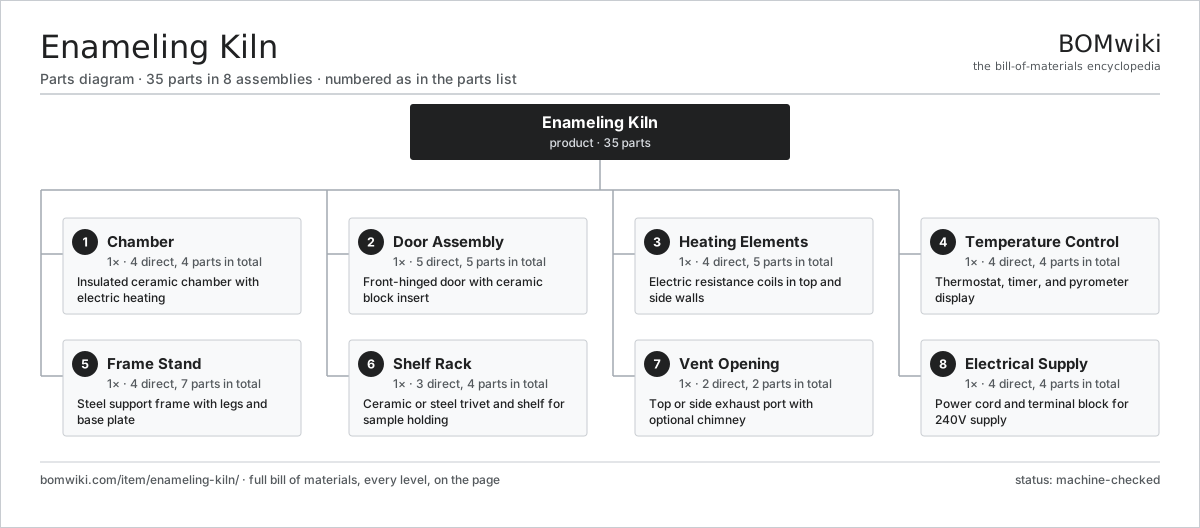
| # | Part | Qty | What it does |
|---|---|---|---|
| 1 | Chamber 4 parts | 1× | Insulated ceramic chamber with electric heating |
| 2 | Door Assembly 5 parts | 1× | Front-hinged door with ceramic block insert |
| 3 | Heating Elements 4 parts | 1× | Electric resistance coils in top and side walls |
| 4 | Temperature Control 4 parts | 1× | Thermostat, timer, and pyrometer display |
| 5 | Frame Stand 4 parts | 1× | Steel support frame with legs and base plate |
| 6 | Shelf Rack 3 parts | 1× | Ceramic or steel trivet and shelf for sample holding |
| 7 | Vent Opening 2 parts | 1× | Top or side exhaust port with optional chimney |
| 8 | Electrical Supply 4 parts | 1× | Power cord and terminal block for 240V supply |
3D model
No 3D model yet. Have a CAD file of this? Add a 3D model — STL renders right on this page; STEP, FreeCAD, and OpenSCAD sources are welcome too (openly licensed, like all 3D models on BOMwiki).
Build & assembly graph
expand / collapse · shared sub-assemblies converge · links to related products · est. labourTap an assembly to expand/collapse · tap a part to open it · use “Open page” for any node · drag to pan, scroll to zoom.
Bill of materials for Enameling Kiln
8 top-level lines · 38 rows shown · 35 parts total · indented to 3 levels| # | Item / sub-assembly | Part no. | Qty/assy | Ext. qty | Parts | Type |
|---|---|---|---|---|---|---|
| 1 | Chamber 4 parts | enameling-kiln-chamber | 1× | 1 | 4 | assembly |
| 1.1 | Outer Shell | enameling-kiln-outer-shell | 1× | 1 | · | part |
| 1.2 | Inner Lining | enameling-kiln-inner-lining | 1× | 1 | · | part |
| 1.3 | Floor Grate | enameling-kiln-floor-grate | 1× | 1 | · | part |
| 1.4 | Insulation Fill | enameling-kiln-insulation-fill | 1× | 1 | · | part |
| 2 | Door Assembly 5 parts | enameling-kiln-door-assembly | 1× | 1 | 5 | assembly |
| 2.1 | Door Frame | enameling-kiln-door-frame | 1× | 1 | · | part |
| 2.2 | Door Block | enameling-kiln-door-block | 1× | 1 | · | part |
| 2.3 | Door Hinge | enameling-kiln-door-hinge | 1× | 1 | · | part |
| 2.4 | Door Latch | enameling-kiln-door-latch | 1× | 1 | · | part |
| 2.5 | Door Gasket | enameling-kiln-door-gasket | 1× | 1 | · | part |
| 3 | Heating Elements 4 parts | enameling-kiln-heating-elements | 1× | 1 | 5 | assembly |
| 3.1 | Top Element | enameling-kiln-element-top | 1× | 1 | · | part |
| 3.2 | Side Element | enameling-kiln-element-side | 1× | 1 | · | part |
| 3.3 | Element Support | enameling-kiln-element-support | 2× | 2 | · | part |
| 3.4 | Electrical Bus | enameling-kiln-electrical-bus | 1× | 1 | · | part |
| 4 | Temperature Control 4 parts | enameling-kiln-temperature-control | 1× | 1 | 4 | assembly |
| 4.1 | Thermostat | enameling-kiln-thermostat | 1× | 1 | · | part |
| 4.2 | Relay Switch | enameling-kiln-relay-switch | 1× | 1 | · | part |
| 4.3 | Timer | enameling-kiln-timer | 1× | 1 | · | part |
| 4.4 | Pyrometer | enameling-kiln-pyrometer | 1× | 1 | · | part |
| 5 | Frame Stand 4 parts | enameling-kiln-frame-stand | 1× | 1 | 7 | assembly |
| 5.1 | Base Frame | enameling-kiln-base-frame | 1× | 1 | · | part |
| 5.2 | Feet | enameling-kiln-feet | 4× | 4 | · | part |
| 5.3 | Side Shelf | enameling-kiln-side-shelf | 1× | 1 | · | part |
| 5.4 | Fastener Set | fastener-set | 1× | 1 | · | part |
| 6 | Shelf Rack 3 parts | enameling-kiln-shelf-rack | 1× | 1 | 4 | assembly |
| 6.1 | Kiln Shelf | enameling-kiln-shelf | 1× | 1 | · | part |
| 6.2 | Trivet Support | enameling-kiln-trivet-support | 2× | 2 | · | part |
| 6.3 | Rack Alternative | enameling-kiln-rack-alternative | 1× | 1 | · | part |
| 7 | Vent Opening 2 parts | enameling-kiln-vent-opening | 1× | 1 | 2 | assembly |
| 7.1 | Vent Hole | enameling-kiln-vent-hole | 1× | 1 | · | part |
| 7.2 | Vent Chimney | enameling-kiln-vent-chimney | 1× | 1 | · | part |
| 8 | Electrical Supply 4 parts | enameling-kiln-electrical-supply | 1× | 1 | 4 | assembly |
| 8.1 | Power Cord | enameling-kiln-power-cord | 1× | 1 | · | part |
| 8.2 | Terminal Block | enameling-kiln-terminal-block | 1× | 1 | · | part |
| 8.3 | On/Off Switch | enameling-kiln-on-off-switch | 1× | 1 | · | part |
| 8.4 | Circuit Breaker | enameling-kiln-circuit-breaker | 1× | 1 | · | part |
Sourcing: possible vendors
Prices, MOQ, and lead times are algorithmic estimates, not quotes, and not claims about these companies. Company mappings are curated by keyword; est. price band $5k–$2M. How estimates work| Vendor | HQ | Specialty | MOQ | Lead time |
|---|---|---|---|---|
| atlascopco.com ↗ | Stockholm, SE | Compressors & industrial | 10 units | 12–20 wks |
|
🇦🇹Andritz
andritz.com ↗
|
Graz, AT | Process plants & machinery | 10 units | 12–20 wks |
| buhlergroup.com ↗ | Uzwil, CH | Food & materials processing | 10 units | 12–20 wks |
| gea.com ↗ | Düsseldorf, DE | Process technology | 10 units | 12–20 wks |
| mhi.com ↗ | Tokyo, JP | Heavy machinery | 10 units | 12–20 wks |
1,438-word article