Engine Hoist
ProductOverview
An engine hoist is a mobile hydraulic lifting machine used to remove powerplants from vehicles for repair or rebuild. The Main Frame & Legs is a triangular base on four Caster Wheels & Mounting that spreads the load across the floor; a central Vertical Column supports the Boom & Hook Assembly, which rotates and tilts to position the lifting hook over the engine. The Hydraulic Lift Cylinder, a double-acting cylinder, lifts by mechanical advantage, with the boom arm acting as a lever. Manual pumping of the Hand Pump & Valve Block generates pressure that extends the cylinder, raising the boom.
Engine hoists are essential in automotive service; they eliminate the need for overhead crane infrastructure in small shops and allow precise positioning around tight engine bays. The Load Leveler / Spreader Bar distributes lift force across three engine mounting points, keeping the engine level and stable during removal.
Frame and stability
The Main Frame & Legs is a welded steel structure with three or four legs that spread outward, creating a stable footprint 1.5–2 m wide. Cross-Braces running diagonally between the legs resist racking and torsion. The weight distribution is critical: once the boom is raised and swung outward, the center of gravity moves away from the Vertical Column, creating a cantilever moment. The base must be wide enough that this moment does not tip the machine. Softer shop floors can cause tipping if the base legs punch through; some models include a Leg Extension Spreader spreader bar that widens the footprint on soft ground.
The Vertical Column is a vertical steel tube that acts both as a guide for the hydraulic cylinder attachment and as a structural post. The cylinder rod end is pin-connected to the boom arm at some distance down the column, not at the top, so the boom lifts with a mechanical advantage (a 2:1 advantage is typical). This means the boom rise is half the cylinder extension, but the lifting force is doubled.
Hydraulic lift mechanism
The Hydraulic Lift Cylinder is a double-acting cylinder rated 3–5 tons. When the Hand Pump & Valve Block is stroked, fluid enters the cylinder head end, pushing the Piston Rod outward and lifting the boom. A manual Directional Control Valve routes fluid flow: pushing the valve lever forward opens a passage from pump to the cylinder head, extending the rod and raising the boom; pulling the lever backward opens the return path and allows the boom to lower under gravity.
The Pressure Relief Valve valve in the pump system limits maximum pressure to 2,000–3,500 psi, protecting hoses and seals. The Pump Handle / Lever provides mechanical advantage: a longer handle reduces the effort needed per stroke but requires more strokes to reach full height. Two-speed pumps shift between a long stroke (fast low-pressure motion) and a short stroke (slow high-pressure lifting) as pressure rises.
The hydraulic fluid is ISO VG 46 mineral oil, stored in a Fluid Reservoir integral to the pump unit. The Suction Strainer prevents contamination from entering the system. Dirty fluid causes spool valves to stick and reduces seal life dramatically, so hose and fluid cleanliness are critical maintenance items.
Boom and rotation
The Boom & Hook Assembly is a steel tube arm, typically 1.2–1.5 m long, that pivots at the column. A Boom Pivot Pin allows the boom to tilt up and down; a Rotation Bearing Collar on the column allows it to rotate 360° horizontally. This two-degree-of-freedom motion lets the operator position the hook precisely over the engine mounting points.
The Lifting Hook is a forged steel hook rated for the machine capacity, usually 4–6 tons on a 3-ton-capacity hoist (a safety margin). Some hoists feature a clevis pin instead of a hook, allowing the attachment of a strap or shackle. The Boom Angle Limiter are adjustable bolts that set a maximum boom angle, preventing the operator from lifting the boom past vertical, which could destabilize the machine.
Load leveler and lifting points
Engines are typically mounted at three or four points: two on the bell housing and one or two on the engine block. If all lift force is applied at a single point (the hook), the engine tilts and can foul on the frame or transmission. The Load Leveler / Spreader Bar (also called a spreader bar) is a rigid Spreader Beam with three attachment points connected by Grade 80 Chain to the main hoist hook. The chains can be adjusted by moving quick-release Adjustable Pins along the spreader beam, allowing the operator to shift the balance point to match the engine's center of gravity.
On modern vehicles, engines are heavier at the transmission end; adjusting the spreader to move the lift point rearward keeps the engine level. Some spreader bars include a Load Indicator Bracket for an electronic load indicator, allowing the operator to see the per-chain load and balance the lift in real time.
Casters and mobility
Four swivel Caster Wheels & Mounting allow the hoist to be rolled around the shop. Each caster is rated 1.5 tons, giving the hoist total mobility capacity of 6 tons (shared across four wheels). Two of the four casters have Caster Brake brakes, typically foot-operated, that lock them in place while the hoist is lifted or being worked on. Locking two diagonally opposite casters prevents the hoist from rolling when the boom is extended or weight is being lifted.
The wheels are typically 200 mm solid polyurethane or pneumatic rubber. Polyurethane is common in shops because pneumatic tires can puncture and require maintenance. The Swivel Head on each wheel is ball-bearing, allowing full 360° rotation for tight maneuvering in confined shop spaces.
Hoses and hydraulic circuit
The Pressure Hose carries pump output at high pressure (up to 4,000 psi) to the cylinder inlet; it is twin-braid reinforced rubber, typically 1/2 inch diameter with crimped fittings. The Return Hose is larger (3/4 inch) to allow efficient backflow as the boom lowers; it operates at low pressure (a few hundred psi).
Quick-disconnect Quick Couplers allow the hose assembly to be unplugged from the pump unit, making it possible to replace a damaged hose in the field. Hose Clamp clamps secure both hoses to the frame, keeping them away from hot engine surfaces and pinch points.
Control and operation
The Directional Control Valve is a manual spool valve with a lever that the operator rocks forward (raise) or backward (lower). In the neutral (center) position, the spool blocks all flow and the boom holds position. As the lever moves, the spool shifts to open passages from pump to cylinder head (raising) or from cylinder to tank (lowering). Some hoists add a Gauge Port for attaching a pressure gauge, allowing diagnosis of pump or relief valve issues.
Modern engine hoists may include electronic controls with solenoid-operated directional valves and pressure transducers, but manual operation remains the standard because it requires no power and offers intuitive tactile feedback to the operator. The manual Pump Handle / Lever is pumped continuously to raise the boom; the operator feels resistance increase as pressure rises, which signals that the load is approaching rated capacity.
Engine Hoist parts and their functions
8 top-level parts · 112 parts in total · full bill of materials below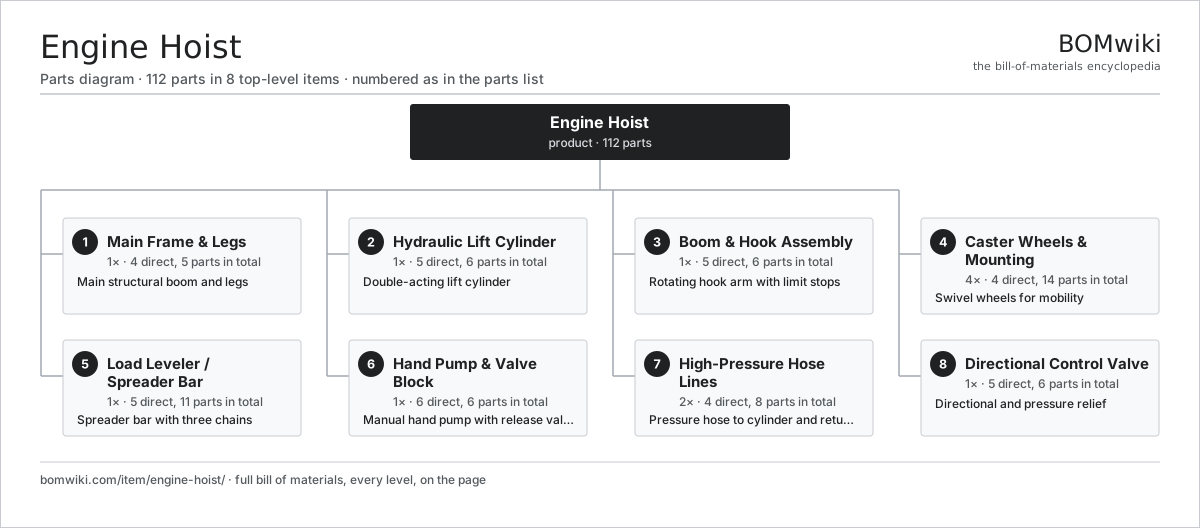
| # | Part | Qty | What it does |
|---|---|---|---|
| 1 | Main Frame & Legs 4 parts | 1× | Main structural boom and legs |
| 2 | Hydraulic Lift Cylinder 5 parts | 1× | Double-acting lift cylinder |
| 3 | Boom & Hook Assembly 5 parts | 1× | Rotating hook arm with limit stops |
| 4 | Caster Wheels & Mounting 4 parts | 4× | Swivel wheels for mobility |
| 5 | Load Leveler / Spreader Bar 5 parts | 1× | Spreader bar with three chains |
| 6 | Hand Pump & Valve Block 6 parts | 1× | Manual hand pump with release valve |
| 7 | High-Pressure Hose Lines 4 parts | 2× | Pressure hose to cylinder and return |
| 8 | Directional Control Valve 5 parts | 1× | Directional and pressure relief |
3D model
No 3D model yet. Have a CAD file of this? Add a 3D model. STL renders right on this page; STEP, FreeCAD, and OpenSCAD sources are welcome too (openly licensed, like all 3D models on BOMwiki).
Build & assembly graph
expand / collapse · shared sub-assemblies converge · links to related products · est. labourTap an assembly to expand/collapse · tap a part to open it · use “Open page” for any node · drag to pan, scroll to zoom.
Bill of materials for Engine Hoist
8 top-level lines · 46 rows shown · 112 parts total · indented to 3 levels| # | Item / sub-assembly | Part no. | Qty/assy | Ext. qty | Parts | Type |
|---|---|---|---|---|---|---|
| 1 | Main Frame & Legs 4 parts | engine-hoist-frame | 1× | 1 | 5 | assembly |
| 1.1 | Base Frame | engine-hoist-base-frame | 1× | 1 | · | part |
| 1.2 | Vertical Column | engine-hoist-vertical-column | 1× | 1 | · | part |
| 1.3 | Cross-Brace | engine-hoist-cross-brace | 2× | 2 | · | part |
| 1.4 | Leg Extension Spreader | engine-hoist-leg-extension | 1× | 1 | · | part |
| 2 | Hydraulic Lift Cylinder 5 parts | engine-hoist-hydraulic-ram | 1× | 1 | 6 | assembly |
| 2.1 | Cylinder Barrel | engine-hoist-cylinder-barrel | 1× | 1 | · | part |
| 2.2 | Piston Rod | engine-hoist-piston-rod | 1× | 1 | · | part |
| 2.3 | Piston | engine-hoist-piston-head | 1× | 1 | · | part |
| 2.4 | Hydraulic Port | engine-hoist-cylinder-port | 2× | 2 | · | part |
| 2.5 | Rod End Ball Joint | engine-hoist-rod-end-bearing | 1× | 1 | · | part |
| 3 | Boom & Hook Assembly 5 parts | engine-hoist-boom-assembly | 1× | 1 | 6 | assembly |
| 3.1 | Boom Arm Tube | engine-hoist-boom-tube | 1× | 1 | · | part |
| 3.2 | Boom Pivot Pin | engine-hoist-boom-pin | 1× | 1 | · | part |
| 3.3 | Lifting Hook | engine-hoist-boom-hook | 1× | 1 | · | part |
| 3.4 | Boom Angle Limiter | engine-hoist-boom-limit-stops | 2× | 2 | · | part |
| 3.5 | Rotation Bearing Collar | engine-hoist-boom-rotation-collar | 1× | 1 | · | part |
| 4 | Caster Wheels & Mounting 4 parts | engine-hoist-casters | 4× | 4 | 14 | assembly |
| 4.1 | Caster Wheel | engine-hoist-caster-wheel | 4× | 16 | · | part |
| 4.2 | Swivel Head | engine-hoist-caster-swivel | 4× | 16 | · | part |
| 4.3 | Caster Bracket | engine-hoist-caster-mount-bracket | 4× | 16 | · | part |
| 4.4 | Caster Brake | engine-hoist-caster-lock | 2× | 8 | · | part |
| 5 | Load Leveler / Spreader Bar 5 parts | engine-hoist-load-leveler | 1× | 1 | 11 | assembly |
| 5.1 | Spreader Beam | engine-hoist-spreader-beam | 1× | 1 | · | part |
| 5.2 | Grade 80 Chain | engine-hoist-leveler-chain | 3× | 3 | · | part |
| 5.3 | Adjustable Pin | engine-hoist-leveler-pin | 3× | 3 | · | part |
| 5.4 | Chain Shackle | engine-hoist-hook-connector | 3× | 3 | · | part |
| 5.5 | Load Indicator Bracket | engine-hoist-load-cell-bracket | 1× | 1 | · | part |
| 6 | Hand Pump & Valve Block 6 parts | engine-hoist-hydraulic-pump | 1× | 1 | 6 | assembly |
| 6.1 | Pump Housing | engine-hoist-pump-body | 1× | 1 | · | part |
| 6.2 | Pump Piston | engine-hoist-pump-piston | 1× | 1 | · | part |
| 6.3 | Fluid Reservoir | engine-hoist-pump-reservoir | 1× | 1 | · | part |
| 6.4 | Pump Handle / Lever | engine-hoist-pump-handle | 1× | 1 | · | part |
| 6.5 | Suction Strainer | engine-hoist-pump-suction-filter | 1× | 1 | · | part |
| 6.6 | Pressure Relief Valve | engine-hoist-pressure-relief | 1× | 1 | · | part |
| 7 | High-Pressure Hose Lines 4 parts | engine-hoist-hose-lines | 2× | 2 | 8 | assembly |
| 7.1 | Pressure Hose | engine-hoist-pressure-hose | 1× | 2 | · | part |
| 7.2 | Return Hose | engine-hoist-return-hose | 1× | 2 | · | part |
| 7.3 | Quick Coupler | engine-hoist-hose-coupler | 4× | 8 | · | part |
| 7.4 | Hose Clamp | engine-hoist-hose-support | 2× | 4 | · | part |
| 8 | Directional Control Valve 5 parts | engine-hoist-control-valve | 1× | 1 | 6 | assembly |
| 8.1 | Valve Cavity | engine-hoist-valve-body | 1× | 1 | · | part |
| 8.2 | Directional Spool | engine-hoist-valve-spool | 1× | 1 | · | part |
| 8.3 | Centering Spring | engine-hoist-valve-spring | 1× | 1 | · | part |
| 8.4 | Spool Seal | engine-hoist-valve-seals | 2× | 2 | · | part |
| 8.5 | Gauge Port | engine-hoist-pressure-gauge-port | 1× | 1 | · | part |
Something wrong in this list? Report a problem with this BOM.
Sourcing: possible vendors
Browse the supplier directory → Prices, MOQ, and lead times are algorithmic estimates, not quotes, and not claims about these companies. Company mappings are curated by keyword; est. price band $500–$50k. How estimates work| Vendor | HQ | Specialty | MOQ | Lead time |
|---|
1,264-word article