Engine Run Stand
ProductOverview
An engine run stand is a mobile test platform for automotive engines removed from vehicles. It mounts the engine vertically on vibration-damping rubber bushings, supplies fuel and coolant circulation, and captures exhaust gases, allowing mechanics to verify engine condition and function before reinstallation. A bank of instruments monitors oil pressure, coolant temperature, and RPM in real time.
Unlike a simple hoist or strap, a run stand is a complete mini-ecosystem: the fuel system routes gasoline from a tank to the carburetor or injectors; the cooling system circulates water to reject combustion heat; and the exhaust system safely vents unburned hydrocarbons outside the building. This allows an engine to idle, rev, and run under load without being trapped in a vehicle, making it ideal for post-rebuild verification, diagnostics, and component testing.
Professional engine rebuilders use run stands as mandatory: before releasing a freshly rebuilt engine, they fire it up on the stand to verify cold-start, idle quality, oil pressure response, and charging system output. Mechanics use them to test salvage engines before installation. The stand costs thousands of dollars but saves time by preventing the frustration of installing a bad engine in a vehicle.
Framework and engine mounting
The structural frame is welded C-channel steel with cross-bracing for rigidity. The mounting bracket bolts the engine block to the frame through rubber vibration isolators, which absorb engine shake and prevent the entire stand from oscillating at idle frequencies. Most stands orient the engine upright (same as in the vehicle) so that draining coolant and oil works as expected.
The upper mounting plates contact the engine's existing block bosses (typically three bolt holes on an inline engine), while lower plates connect to the stand frame. Adjustable bracket slots allow fine positioning of the engine centerline to ensure that pulleys align with accessories like alternators or water pumps. The isolation bushings are natural rubber (Shore A 50) to reduce vibration transmission to the frame and shop floor; this reduces noise by 10–15 dB compared to a rigidly bolted stand.
Cooling and thermal management
Because the engine is not in a vehicle, there is no forward airflow from motion. The cooling system must actively reject all combustion heat via an aluminum radiator core (24" × 16") and electric fan. The water pump is a 12V DC centrifugal pump rated 20 gallons per minute, circulating coolant from the block's outlet, through the radiator, and back to the inlet.
A 180°F wax-pellet thermostat maintains optimal operating temperature, bypassing coolant back to the pump block when the engine is cold to speed warm-up. The electric fan (48V DC brushless, 3000 CFM) runs continuously during engine operation but is thermostat-controlled, idle speed at cool idle, full speed if coolant exceeds 95°C. The fan shroud concentrates airflow through the core to maximize cooling efficiency.
Capacity is typically sufficient for sustained running at high idle (1500–2000 rpm) and brief rev cycles to 4000 rpm. Prolonged wide-open-throttle testing requires a larger radiator or auxiliary cooling; most shops add a second radiator on heavy-duty stands. The silicone hoses are color-coded (inlet red, outlet blue) and routed away from moving parts to prevent abrasion and rupture.
Fuel system and carburetor supply
The fuel system mimics a vehicle's supply to the carburetor or fuel injection. A 15 gallon tank holds test fuel; a 12V DC electric pump (50 gpm rated) draws fuel from the tank and pressurizes it to 4–6 psi via a pressure regulator. The fuel filter (10 micron) removes any sediment or water contamination.
A fuel level gauge lets the operator monitor consumption during long test runs. The return line from the regulator feeds any excess fuel back to the tank, avoiding pressure buildup. The braided fuel lines use quick-disconnect couplings, allowing a carbureted or fuel-injected engine to be swapped in minutes, disconnect fuel, coolant, and electrical connectors, unbolt the engine, and replace with another.
Some stands include a carburetor adapter plate that accepts any 4-bolt flange carburetor, simplifying fuel line routing. On fuel-injected engines, the stand may supply fuel to the injector rail directly, or to a mechanical fuel pressure regulator that simulates the vehicle's system. The tank is always grounded to the engine block via a braided ground strap, ensuring a complete electrical circuit for the fuel pump motor.
Exhaust and ventilation
Unburned hydrocarbons and noxious gases must be vented outside. The exhaust system begins at the header (a 4-into-1 manifold that merges cylinders), routes through a collector ring, and then through a 3" flexible stainless hose to a muffler can. The muffler reduces noise by about 15 dB (from ~110 dB to ~95 dB at 3000 rpm).
A rubber vent hose extends the muffler outlet through a wall or into a ductwork system, discharging outside the building. This is critical, an unvented stand in a closed shop will accumulate carbon monoxide and nitrogen oxides, creating a serious health hazard within minutes. Many shops plumb the muffler outlet to a flexible hose clipped to a ceiling duct that vents to a high point on the building roof.
The header and flex pipe should be insulated with high-temperature wrap to reduce radiant heat in the shop and prevent accidental burns. Exhaust temperature at the muffler inlet is typically 600–800°F, so all routing must keep the hot surfaces away from hoses, fuel lines, and operator reach.
Instrumentation and gauges
The gauge panel displays real-time data: oil pressure (0–100 psi Bourdon tube gauge), coolant temperature (40–120°C liquid-filled gauge), and RPM (digital tachometer triggered by ignition pulse). A voltmeter (0–16V) monitors alternator and battery output, confirming the charging system is functioning.
Three indicator lights warn of conditions: red for low oil pressure (below 20 psi at idle), yellow for high coolant temperature (above 105°C), and green for alternator charging active. These lights are wired directly to the oil pressure switch, thermostat switch, and alternator field output, so they require no software, purely electrical logic.
A panel housing (aluminum frame, 18" × 12") mounts all gauges at operator eye level. Some shops add a data-logging module to capture oil pressure, temperature, and RPM over time on a USB drive, allowing post-test analysis of engine stability.
Electrical and control systems
The wiring harness connects the test engine to the stand's electrical system. A heavy-gauge starter cable (2/0 AWG) runs from a 12V auxiliary battery to the engine starter motor. The alternator cable (4 AWG) carries charging current back to the battery. A braided ground strap bonds the engine block to the frame to eliminate ground loops.
The control station includes a key-operated kill switch that cuts ignition and fuel pump simultaneously, a mechanical throttle pedal for operator control, and a red push-button emergency stop that de-energizes the fuel pump relay and kills ignition instantly. A 24V power supply energizes the gauge panel and control logic.
The sensor connectors (oil pressure, coolant temperature, alternator) are weather-sealed to prevent corrosion. Spark plug wires are pre-routed with suppression clips to minimize radio-frequency interference, important if the stand is used indoors near communication antennas.
Safety and operational practices
An engine run stand is a contained test environment but still presents hazards: hot exhaust, spinning parts, toxic fumes, and 12V electrical shock. The stand is typically guarded with a plexiglass shield around the engine to prevent contact with rotating belts and pulleys. The kill switch is always mounted where the operator stands, not somewhere requiring a reach across the engine.
Before starting, the operator verifies that all coolant and oil drain plugs are tight, exhaust vent hose is routed outside, and fuel lines are secure. Cold-start procedures often require bleeding air from the fuel system (on mechanical fuel injection) and priming the water pump. Most run tests begin at idle (800–1000 rpm), confirming oil pressure rises above 20 psi within 5 seconds of startup; if it doesn't, the engine is shut down immediately.
The stand is never left running unattended. Test cycles typically last 5–15 minutes, with the operator monitoring all gauges and listening for abnormal noises (bearing knock, pinging, valve train rattle). A properly rebuilt engine should idle smoothly, rev cleanly, and hold steady oil pressure across the RPM range. Any anomaly triggers engine shutdown and investigation.
Engine Run Stand parts and their functions
8 top-level parts · 74 parts in total · full bill of materials below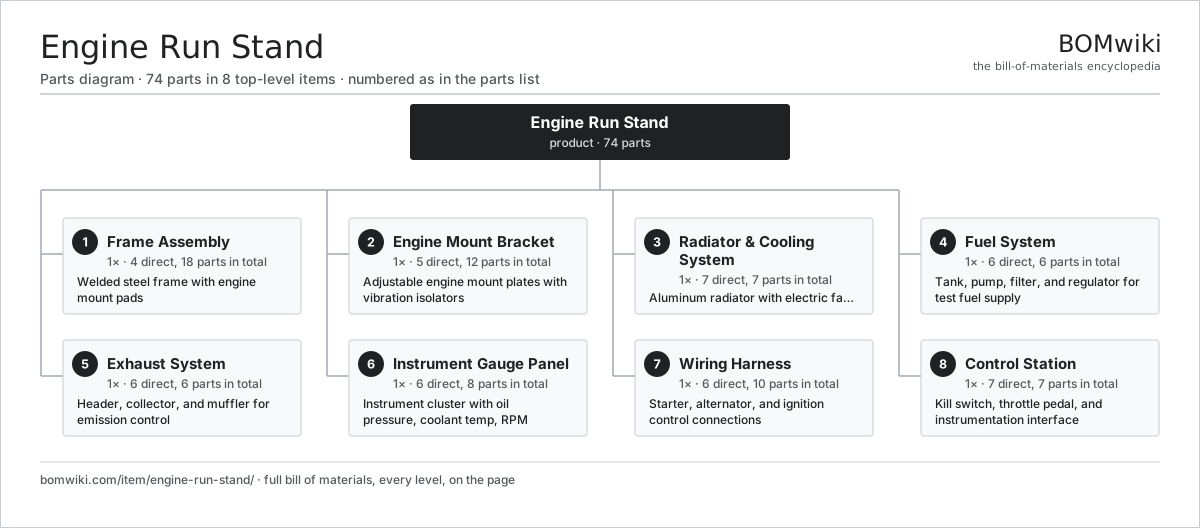
| # | Part | Qty | What it does |
|---|---|---|---|
| 1 | Frame Assembly 4 parts | 1× | Welded steel frame with engine mount pads |
| 2 | Engine Mount Bracket 5 parts | 1× | Adjustable engine mount plates with vibration isolators |
| 3 | Radiator & Cooling System 7 parts | 1× | Aluminum radiator with electric fan and thermostat |
| 4 | Fuel System 6 parts | 1× | Tank, pump, filter, and regulator for test fuel supply |
| 5 | Exhaust System 6 parts | 1× | Header, collector, and muffler for emission control |
| 6 | Instrument Gauge Panel 6 parts | 1× | Instrument cluster with oil pressure, coolant temp, RPM |
| 7 | Wiring Harness 6 parts | 1× | Starter, alternator, and ignition control connections |
| 8 | Control Station 7 parts | 1× | Kill switch, throttle pedal, and instrumentation interface |
3D model
No 3D model yet. Have a CAD file of this? Add a 3D model. STL renders right on this page; STEP, FreeCAD, and OpenSCAD sources are welcome too (openly licensed, like all 3D models on BOMwiki).
Build & assembly graph
expand / collapse · shared sub-assemblies converge · links to related products · est. labourTap an assembly to expand/collapse · tap a part to open it · use “Open page” for any node · drag to pan, scroll to zoom.
Bill of materials for Engine Run Stand
8 top-level lines · 55 rows shown · 74 parts total · indented to 3 levels| # | Item / sub-assembly | Part no. | Qty/assy | Ext. qty | Parts | Type |
|---|---|---|---|---|---|---|
| 1 | Frame Assembly 4 parts | engine-run-stand-frame | 1× | 1 | 18 | assembly |
| 1.1 | Main Rail | engine-run-stand-frame-main-rail | 2× | 2 | · | part |
| 1.2 | Cross Member | engine-run-stand-frame-cross-member | 4× | 4 | · | part |
| 1.3 | Gusset Plate | engine-run-stand-frame-gusset | 8× | 8 | · | part |
| 1.4 | Caster Pad | engine-run-stand-frame-caster-pad | 4× | 4 | · | part |
| 2 | Engine Mount Bracket 5 parts | engine-run-stand-engine-mount-bracket | 1× | 1 | 12 | assembly |
| 2.1 | Upper Mount Plate | engine-run-stand-mount-plate-upper | 2× | 2 | · | part |
| 2.2 | Lower Mount Plate | engine-run-stand-mount-plate-lower | 2× | 2 | · | part |
| 2.3 | Vibration Isolator | engine-run-stand-mount-isolator | 4× | 4 | · | part |
| 2.4 | Mount Bolt | engine-run-stand-mount-bolt-kit | 2× | 2 | · | part |
| 2.5 | Adjust Bracket | engine-run-stand-mount-adjust-bracket | 2× | 2 | · | part |
| 3 | Radiator & Cooling System 7 parts | engine-run-stand-radiator-cooling | 1× | 1 | 7 | assembly |
| 3.1 | Radiator Core | engine-run-stand-radiator-core | 1× | 1 | · | part |
| 3.2 | Electric Fan Motor | engine-run-stand-radiator-electric-fan | 1× | 1 | · | part |
| 3.3 | Fan Shroud | engine-run-stand-radiator-shroud | 1× | 1 | · | part |
| 3.4 | Thermostat | engine-run-stand-radiator-thermostat | 1× | 1 | · | part |
| 3.5 | Water Pump | engine-run-stand-radiator-pump | 1× | 1 | · | part |
| 3.6 | Hose Kit | engine-run-stand-radiator-hose-kit | 1× | 1 | · | part |
| 3.7 | Pressure Cap | engine-run-stand-radiator-cap | 1× | 1 | · | part |
| 4 | Fuel System 6 parts | engine-run-stand-fuel-system | 1× | 1 | 6 | assembly |
| 4.1 | Fuel Tank | engine-run-stand-fuel-tank | 1× | 1 | · | part |
| 4.2 | Fuel Pump | engine-run-stand-fuel-pump | 1× | 1 | · | part |
| 4.3 | Fuel Filter | engine-run-stand-fuel-filter | 1× | 1 | · | part |
| 4.4 | Fuel Regulator | engine-run-stand-fuel-regulator | 1× | 1 | · | part |
| 4.5 | Fuel Gauge | engine-run-stand-fuel-gauge | 1× | 1 | · | part |
| 4.6 | Fuel Line | engine-run-stand-fuel-line-kit | 1× | 1 | · | part |
| 5 | Exhaust System 6 parts | engine-run-stand-exhaust-system | 1× | 1 | 6 | assembly |
| 5.1 | Header | engine-run-stand-exhaust-header | 1× | 1 | · | part |
| 5.2 | Collector | engine-run-stand-exhaust-collector | 1× | 1 | · | part |
| 5.3 | Flex Pipe | engine-run-stand-exhaust-flex-pipe | 1× | 1 | · | part |
| 5.4 | Muffler | engine-run-stand-exhaust-muffler | 1× | 1 | · | part |
| 5.5 | Vent Hose | engine-run-stand-exhaust-vent-hose | 1× | 1 | · | part |
| 5.6 | Clamp Kit | engine-run-stand-exhaust-clamp-kit | 1× | 1 | · | part |
| 6 | Instrument Gauge Panel 6 parts | engine-run-stand-gauge-panel | 1× | 1 | 8 | assembly |
| 6.1 | Panel Housing | engine-run-stand-gauge-panel-housing | 1× | 1 | · | part |
| 6.2 | Oil Pressure Gauge | engine-run-stand-gauge-oil-pressure | 1× | 1 | · | part |
| 6.3 | Coolant Temp Gauge | engine-run-stand-gauge-coolant-temp | 1× | 1 | · | part |
| 6.4 | Tachometer | engine-run-stand-gauge-rpm-meter | 1× | 1 | · | part |
| 6.5 | Voltmeter | engine-run-stand-gauge-voltage | 1× | 1 | · | part |
| 6.6 | Indicator Light | engine-run-stand-gauge-light-indicator | 3× | 3 | · | part |
| 7 | Wiring Harness 6 parts | engine-run-stand-wiring-harness | 1× | 1 | 10 | assembly |
| 7.1 | Starter Cable | engine-run-stand-harness-starter-cable | 1× | 1 | · | part |
| 7.2 | Alternator Cable | engine-run-stand-harness-alternator-cable | 1× | 1 | · | part |
| 7.3 | Ground Strap | engine-run-stand-harness-ground-strap | 2× | 2 | · | part |
| 7.4 | Spark Wires | engine-run-stand-harness-ignition-wires | 1× | 1 | · | part |
| 7.5 | Sensor Connector | engine-run-stand-harness-sensor-connectors | 4× | 4 | · | part |
| 7.6 | Tie Clip | engine-run-stand-harness-tie-down | 1× | 1 | · | part |
| 8 | Control Station 7 parts | engine-run-stand-control-station | 1× | 1 | 7 | assembly |
| 8.1 | Control Box | engine-run-stand-control-enclosure | 1× | 1 | · | part |
| 8.2 | Kill Switch | engine-run-stand-control-kill-switch | 1× | 1 | · | part |
| 8.3 | Throttle Pedal | engine-run-stand-control-throttle-pedal | 1× | 1 | · | part |
| 8.4 | Main Contactor | engine-run-stand-control-battery-isolator | 1× | 1 | · | part |
| 8.5 | Fuel Pump Relay | engine-run-stand-control-fuel-pump-relay | 1× | 1 | · | part |
| 8.6 | Power Supply | engine-run-stand-control-gauge-power | 1× | 1 | · | part |
| 8.7 | Emergency Stop | engine-run-stand-control-emergency-button | 1× | 1 | · | part |
Something wrong in this list? Report a problem with this BOM.
Sourcing: possible vendors
Browse the supplier directory → Prices, MOQ, and lead times are algorithmic estimates, not quotes, and not claims about these companies. Company mappings are curated by keyword; est. price band $500–$50k. How estimates work| Vendor | HQ | Specialty | MOQ | Lead time |
|---|
1,676-word article