Engine Stand
ProductOverview
An engine stand is a rotating work fixture that holds a removed engine at waist-height, allowing the technician to work on all sides without bending, crawling, or struggling with awkward positions. The Engine Mounting Arms bolt to the engine's three original mounting points (bell housing boss and block ears), supporting the full weight. The Rotating Head Assembly allows 360-degree rotation, so the technician can spin the engine to access spark plugs, valve covers, oil pan, and intake manifolds with minimal repositioning.
Engine stands are essential for rebuilds, overhauls, and detailed disassembly work. They reduce fatigue, improve work quality, and eliminate the risk of dropping the engine during inspection or repair.
Frame and base structure
The Base Frame is a welded rectangular steel frame, typically 0.8–1.2 m on each side, providing stability against the cantilevered moment of a heavy engine mounted on the Rotating Head Assembly. Diagonal Braces prevent frame racking when the engine is rotated.
Four Swivel Caster Wheels allow the entire stand to be rolled around the shop. Two casters have Caster Brakes that lock via foot pedal, preventing the stand from rolling when the engine is being worked on or rotated.
The Spindle Bearing Housing is a cast iron or steel bearing housing bolted to the center of the frame. This housing supports the Spindle Shaft, which rotates on precision bearings.
Spindle and rotation
The Spindle Shaft is a 25–35 mm diameter steel shaft running vertically through the bearing housing. At the top, it connects to the Spindle Flange, a plate with Arm Mounting Lugs where the three Engine Mounting Arms bolt on.
The Spindle Bearings (typically ball or angular contact types) support the shaft and the weight of the engine. Quality bearing design is critical; cheap stands use sleeve or plain bearings that wear quickly and develop play, causing the engine to wobble.
Rotation can be manual (the operator rotates the engine by hand, friction is high initially but decreases as the operator accelerates) or assisted by an optional Rotation Handle, a geared handle that provides mechanical advantage. Heavy engines (800+ kg) benefit from a gear ratio of 3:1 or 4:1, reducing the torque required to start rotation.
A Rotation Lock / Brake (typically a friction brake or pawl) holds the engine in position when the operator stops rotating. The lock is engaged by pulling a lever; the engine cannot slip or drift downward.
Mounting arms and engine interface
Three Engine Mounting Arms support the engine at its three original mounting points. Each arm is a steel tube (30–40 mm diameter) with multiple bolt holes along its length. Quick-pin or sliding-collar Connectors allow the arms to be quickly adjusted to match different engine bell-housing boss patterns and block ear spacing.
Each arm is fitted with a Contact Pad, rubber or nylon, to prevent marring the engine casting. The operator bolts the stand arms to the engine using the original engine mounting holes (M10 or M12 studs typically), distributing the load across three points for stable support.
Properly balanced, the engine should require minimal rotation effort and should not drift. Unbalanced mounting causes the engine to drag on the rotation lock and wear bearings prematurely.
Height adjustment
The Height Adjustment Mechanism mechanism allows the technician to position the engine at comfortable working height. A Screw Jack under the spindle, driven by a Crank Handle, raises or lowers the entire head assembly. Typical pitch is 50 mm per crank turn, allowing 0.8–1.8 m height range.
The Adjustment Lock Nut locks the screw position to prevent drift from vibration or accidental rotation.
Optional counterweight system
On heavy engines (800+ kg), manually rotating the stand can be tiring. A Counterweight Balance System with a large Balancer (or pneumatic cylinder) is mounted opposite the spindle on the frame. As the engine weight pulls down, the spring or air pressure pushes up on the opposite side, partially balancing the load.
The Balance Adjuster allows the operator to dial in the exact counterweight pressure so that the engine feels neutrally balanced, slight rotation effort gets it spinning, but gravity does not cause free-fall.
This is particularly valuable for V-8 engines and other large-displacement powerplants where one-handed rotation otherwise requires significant force.
Work organization
While not part of the core stand structure, the base frame is often fitted with magnetic parts dishes, socket organizers, and work trays to keep fasteners and small components organized during disassembly. These accessories prevent dropped items and reduce search time for the correct bolt or gasket.
Typical working height and ergonomics
The stand's height adjustment ensures that the engine's working surface (spark plug holes, valve cover bolts, etc.) is at approximately 1.0–1.2 m above the floor. This allows the technician to work at a comfortable height, minimizing bending and overhead reaching. Engine pan work is often done by tilting the head slightly on the stand or by rotating the engine to bring the pan upward.
Stability and safety
Modern stands are designed so that the center of gravity of the loaded stand (frame + engine) remains within the caster footprint even as the engine is rotated. However, the operator should avoid aggressively spinning a heavily loaded stand, as excessive angular momentum can cause tipping if the engine is swung too far to the side.
The Rotation Lock / Brake is essential for safety; it prevents accidental rotation and protects against a catastrophic drop if a mounting bolt comes loose during work.
Engine Stand parts and their functions
7 top-level parts · 119 parts in total · full bill of materials below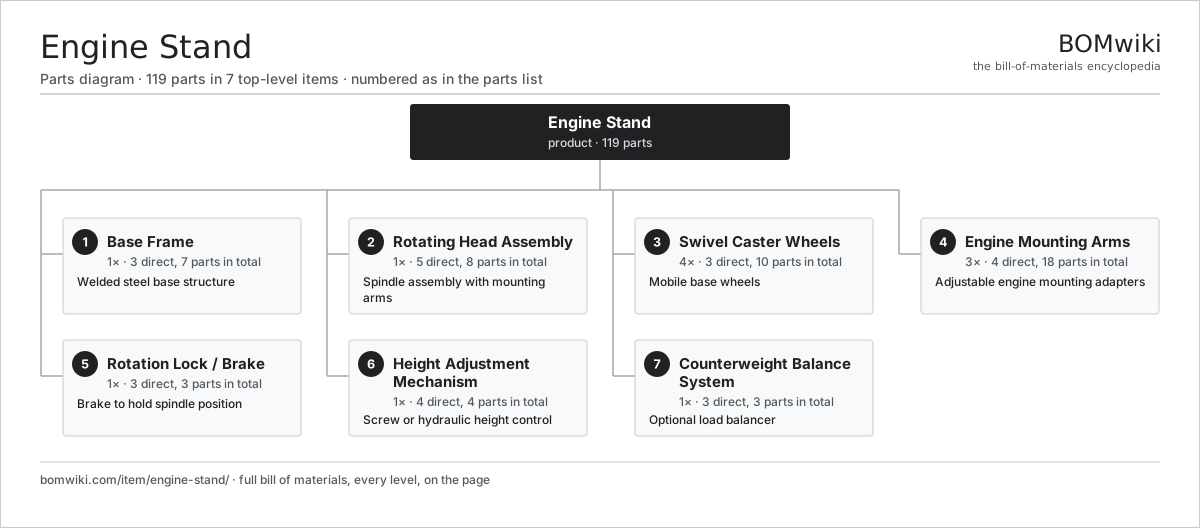
| # | Part | Qty | What it does |
|---|---|---|---|
| 1 | Base Frame 3 parts | 1× | Welded steel base structure |
| 2 | Rotating Head Assembly 5 parts | 1× | Spindle assembly with mounting arms |
| 3 | Swivel Caster Wheels 3 parts | 4× | Mobile base wheels |
| 4 | Engine Mounting Arms 4 parts | 3× | Adjustable engine mounting adapters |
| 5 | Rotation Lock / Brake 3 parts | 1× | Brake to hold spindle position |
| 6 | Height Adjustment Mechanism 4 parts | 1× | Screw or hydraulic height control |
| 7 | Counterweight Balance System 3 parts | 1× | Optional load balancer |
3D model
No 3D model yet. Have a CAD file of this? Add a 3D model. STL renders right on this page; STEP, FreeCAD, and OpenSCAD sources are welcome too (openly licensed, like all 3D models on BOMwiki).
Build & assembly graph
expand / collapse · shared sub-assemblies converge · links to related products · est. labourTap an assembly to expand/collapse · tap a part to open it · use “Open page” for any node · drag to pan, scroll to zoom.
Bill of materials for Engine Stand
7 top-level lines · 32 rows shown · 119 parts total · indented to 3 levels| # | Item / sub-assembly | Part no. | Qty/assy | Ext. qty | Parts | Type |
|---|---|---|---|---|---|---|
| 1 | Base Frame 3 parts | engine-stand-frame | 1× | 1 | 7 | assembly |
| 1.1 | Frame Tubing | engine-stand-frame-tube | 4× | 4 | · | part |
| 1.2 | Diagonal Brace | engine-stand-diagonal-brace | 2× | 2 | · | part |
| 1.3 | Spindle Bearing Housing | engine-stand-spindle-mount | 1× | 1 | · | part |
| 2 | Rotating Head Assembly 5 parts | engine-stand-rotating-head | 1× | 1 | 8 | assembly |
| 2.1 | Spindle Shaft | engine-stand-spindle-shaft | 1× | 1 | · | part |
| 2.2 | Spindle Bearing | engine-stand-spindle-bearing | 2× | 2 | · | part |
| 2.3 | Spindle Flange | engine-stand-spindle-flange | 1× | 1 | · | part |
| 2.4 | Arm Mounting Lug | engine-stand-arm-bracket | 3× | 3 | · | part |
| 2.5 | Rotation Handle | engine-stand-rotation-gear | 1× | 1 | · | part |
| 3 | Swivel Caster Wheels 3 parts | engine-stand-casters | 4× | 4 | 10 | assembly |
| 3.1 | Caster Wheel | engine-stand-caster-wheel | 4× | 16 | · | part |
| 3.2 | Swivel Head | engine-stand-caster-swivel | 4× | 16 | · | part |
| 3.3 | Caster Brake | engine-stand-caster-brake | 2× | 8 | · | part |
| 4 | Engine Mounting Arms 4 parts | engine-stand-mounting-arms | 3× | 3 | 18 | assembly |
| 4.1 | Arm Tube | engine-stand-arm-tube | 3× | 9 | · | part |
| 4.2 | Connector | engine-stand-arm-connector | 3× | 9 | · | part |
| 4.3 | Mounting Bolt | engine-stand-arm-bolt | 9× | 27 | · | part |
| 4.4 | Contact Pad | engine-stand-arm-pad | 3× | 9 | · | part |
| 5 | Rotation Lock / Brake 3 parts | engine-stand-rotation-lock | 1× | 1 | 3 | assembly |
| 5.1 | Lock Pad | engine-stand-lock-pad | 1× | 1 | · | part |
| 5.2 | Lock Handle | engine-stand-lock-handle | 1× | 1 | · | part |
| 5.3 | Lock Spring | engine-stand-lock-spring | 1× | 1 | · | part |
| 6 | Height Adjustment Mechanism 4 parts | engine-stand-height-adjust | 1× | 1 | 4 | assembly |
| 6.1 | Screw Jack | engine-stand-screw-jack | 1× | 1 | · | part |
| 6.2 | Adjustment Screw | engine-stand-adjust-screw | 1× | 1 | · | part |
| 6.3 | Adjustment Lock Nut | engine-stand-adjust-nut | 1× | 1 | · | part |
| 6.4 | Crank Handle | engine-stand-hand-crank | 1× | 1 | · | part |
| 7 | Counterweight Balance System 3 parts | engine-stand-counterweight-system | 1× | 1 | 3 | assembly |
| 7.1 | Balancer | engine-stand-spring-or-air | 1× | 1 | · | part |
| 7.2 | Air Line | engine-stand-hose-assembly | 1× | 1 | · | part |
| 7.3 | Balance Adjuster | engine-stand-balance-control | 1× | 1 | · | part |
Something wrong in this list? Report a problem with this BOM.
Sourcing: possible vendors
Browse the supplier directory → Prices, MOQ, and lead times are algorithmic estimates, not quotes, and not claims about these companies. Company mappings are curated by keyword; est. price band $500–$50k. How estimates work| Vendor | HQ | Specialty | MOQ | Lead time |
|---|
971-word article