Engine Starter Motor
ProductOverview
A starter motor is a heavy-duty electrical machine that briefly crank-rotates an internal combustion engine at sufficient speed (typically 100–200 rpm) to enable combustion and self-sustaining operation. Starting an automotive engine is energy-intensive: the engine's compression ratio (8:1 to 12:1) and mechanical inertia require peak torque of 200–600 N·m applied to the crankshaft, a task the small starter motor accomplishes through aggressive gear reduction (10:1 to 20:1) and massive current draw (100–200A for 10–15 seconds).
The starter motor is a series-wound DC motor, fundamentally different from the alternator. In series motors, the field coil and armature share the same current path; as motor load (cranking resistance) increases, the field flux strengthens proportionally, generating enormous torque at high current. This makes the series motor ideal for starting duty but unsuitable for continuous running. A solenoid relay controls engagement and disengagement; a Bendix drive mechanism couples the small starter pinion to the large flywheel ring gear inertially, engaging automatically and disengaging once the engine fires.
How It Works
The ignition switch (turned to the START position) energizes the Solenoid Shift Mechanism coil at 12V. The solenoid is a simple electromagnet: 500–1000 turns of copper wire wound around a soft-iron plunger. When energized, the magnetic field pulls the plunger forward (a stroke of 30–40 mm).
The plunger accomplishes two actions simultaneously: (1) it closes the Main Power Contactor, a heavy-current electrical switch connecting the 12V battery directly to the Main Motor Body; and (2) via the Engagement Linkage Rod, it pushes the Bendix Drive Screw, which inertially launches the Starter Pinion Gear outward into mesh with the engine's engine-flywheel ring gear.
Once the main contactor closes, 100–200A flows from the battery through the Field Coil Windings (in series with the rotor armature) and back to ground. The field coils generate a strong magnetic field, and the armature (rotor) begins spinning. The Planetary Reduction Gearset (typically a 15:1 reduction) steps the motor speed down from ~6000 rpm to ~400 rpm on the output shaft. This massive speed reduction torque-multiplies the motor's output: 200 N·m motor torque becomes 3000 N·m (or more) at the flywheel.
The Starter Pinion Gear (10–15 teeth) now drives the engine's engine-flywheel ring gear (150–170 teeth) at a further 10:1 reduction. The combined 15:1 × 10:1 = 150:1 ratio translates the starter motor's high-speed, low-torque output into low-speed, massive-torque rotation of the engine crankshaft.
The Overrunning Clutch in the Bendix drive is a one-way sprag clutch. As long as the pinion is rotating slower than the ring gear (i.e., the motor is driving the engine), the clutch transmits torque. But the moment the engine fires and accelerates past the starter motor speed (typically 50–100 milliseconds into the crank), the ring gear suddenly overruns the pinion. The one-way clutch disengages immediately, preventing the now-faster engine from whipping the starter backward, which would destroy it.
Simultaneously, a Solenoid Return Spring releases the plunger when the ignition switch is released, withdrawing the pinion from mesh and opening the main contactor. Current flow ceases. The starter motor coasts down in a second or two.
Electrical Characteristics
The series DC motor produces torque proportional to current and field flux: T ∝ I × Φ. At 12V and 150A initial inrush current, the motor armature resistance is typically 0.08–0.1 Ω, so initial back-EMF is very low, the motor appears almost as a short circuit to the battery. This is why starter circuits require heavy battery and cable: even a small drop in voltage during starting is disastrous.
As the motor accelerates from 0 rpm, back-EMF (voltage) rises linearly with speed. Back-EMF = k × ω, where ω is angular velocity. By the time the engine begins to turn, the motor may reach 4000–6000 rpm, at which point back-EMF reaches 9–10V, and current falls to 50–100A. Once the engine fires and its own combustion pressure accelerates it rapidly, the motor cannot keep pace and disengages.
A fully discharged battery (10.5V) can still start an engine, but barely, current drops to 80–100A, and cranking speed falls below the 100 rpm minimum for combustion. Cold engines (high viscosity oil) require higher cranking torque; the current draw may saturate at 200+ A until battery voltage collapses or the engine turns fast enough.
Mechanical Design and Durability
The Main Shaft Assembly is high-strength alloy steel. The Rotor Armature is a segmented iron core with 6–8 copper coils wound in closed slots, creating a low-loss rotor. The Commutator Segment Ring is a segmented cylinder of copper, with 0.5 mm mica insulation between segments. As the rotor spins, carbon brushes (held by springs) slide across the commutator, switching current from one coil to the next at the exact moment the magnetic field in that coil reaches peak flux.
Timing is critical: if brushes contact between commutator segments, arcing occurs and torque drops. If timing is late, back-EMF builds and efficiency falls. Brush wear is the primary failure mode; after 50,000–150,000 start cycles, brushes may wear down by 5–10 mm, and contact resistance rises, reducing cranking capability.
The Bendix drive is a brilliant mechanism: as the motor spins the Bendix Drive Screw (a helical screw, M10×1.5 pitch typical), the pinion gear threads outward on the screw shaft due to inertia (the screw tries to accelerate, but the pinion, having mass and moving in a magnetic field, lags slightly). A Engagement Shock Spring compresses as the pinion nears the ring gear, absorbing the shock of engagement. Once fully meshed, the pinion and screw rotate together, and torque is transmitted.
Variants and Modern Features
Planetary reduction gearsets have largely replaced Bendix drive on modern starters, offering more reliable engagement and lower noise. A planetary system uses a sun gear (driven by motor), planet gears, and a ring gear to achieve smooth, shock-free reduction.
High-torque starters for diesel engines (with higher compression) employ 24V systems and may deliver 200A+ current, generating 500–800 N·m cranking torque.
Integrated starter-generators on hybrid vehicles combine starting and energy recovery: they start the engine and also function as an alternator during coasting, smoothing acceleration and recovering braking energy.
Starter systems are moving toward DC-DC buck converters that maintain 12V to the starter even if the 48V main bus sags during cold starting, improving cold-start reliability on modern electrified vehicles.
Engine Starter Motor parts and their functions
8 top-level parts · 30 parts in total · full bill of materials below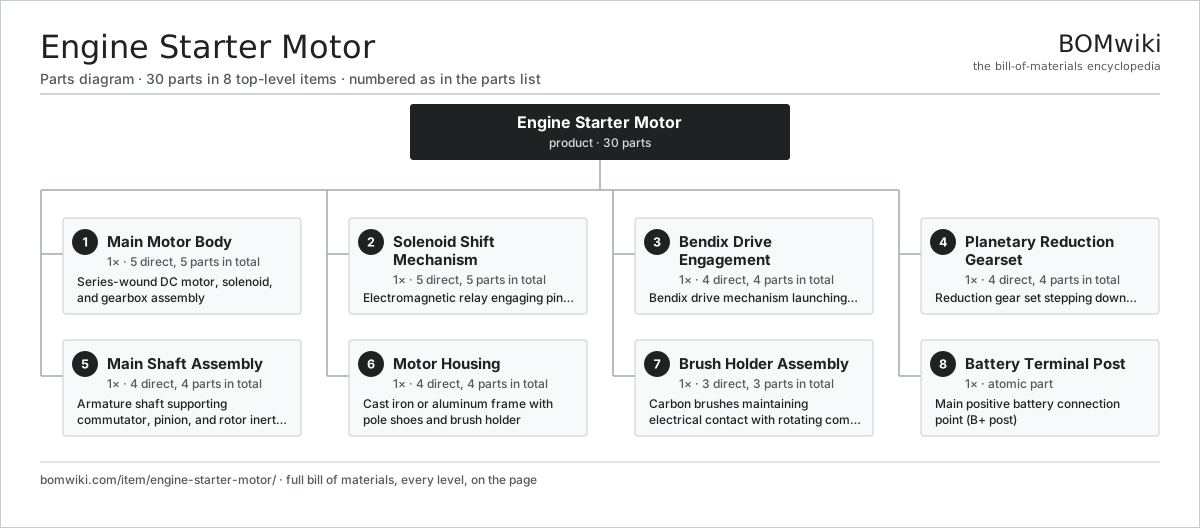
| # | Part | Qty | What it does |
|---|---|---|---|
| 1 | Main Motor Body 5 parts | 1× | Series-wound DC motor, solenoid, and gearbox assembly |
| 2 | Solenoid Shift Mechanism 5 parts | 1× | Electromagnetic relay engaging pinion gear and closing main battery circuit |
| 3 | Bendix Drive Engagement 4 parts | 1× | Bendix drive mechanism launching pinion gear into flywheel ring gear |
| 4 | Planetary Reduction Gearset 4 parts | 1× | Reduction gear set stepping down motor speed 10:1 to 20:1 for torque multiplication |
| 5 | Main Shaft Assembly 4 parts | 1× | Armature shaft supporting commutator, pinion, and rotor inertia |
| 6 | Motor Housing 4 parts | 1× | Cast iron or aluminum frame with pole shoes and brush holder |
| 7 | Brush Holder Assembly 3 parts | 1× | Carbon brushes maintaining electrical contact with rotating commutator |
| 8 | Battery Terminal Post | 1× | Main positive battery connection point (B+ post) |
3D model
No 3D model yet. Have a CAD file of this? Add a 3D model. STL renders right on this page; STEP, FreeCAD, and OpenSCAD sources are welcome too (openly licensed, like all 3D models on BOMwiki).
Build & assembly graph
expand / collapse · shared sub-assemblies converge · links to related products · est. labourTap an assembly to expand/collapse · tap a part to open it · use “Open page” for any node · drag to pan, scroll to zoom.
Bill of materials for Engine Starter Motor
8 top-level lines · 37 rows shown · 30 parts total · indented to 3 levels| # | Item / sub-assembly | Part no. | Qty/assy | Ext. qty | Parts | Type |
|---|---|---|---|---|---|---|
| 1 | Main Motor Body 5 parts | engine-starter-motor-main-assembly | 1× | 1 | 5 | assembly |
| 1.1 | Rotor Armature | engine-starter-armature | 1× | 1 | · | part |
| 1.2 | Field Coil Windings | engine-starter-field-coils | 1× | 1 | · | part |
| 1.3 | Soft-Iron Pole Shoes | engine-starter-pole-shoes | 1× | 1 | · | part |
| 1.4 | Commutator Segment Ring | engine-starter-commutator | 1× | 1 | · | part |
| 1.5 | Motor Yoke Frame | engine-starter-yoke | 1× | 1 | · | part |
| 2 | Solenoid Shift Mechanism 5 parts | engine-starter-solenoid | 1× | 1 | 5 | assembly |
| 2.1 | Solenoid Winding | engine-starter-solenoid-coil | 1× | 1 | · | part |
| 2.2 | Solenoid Plunger | engine-starter-plunger | 1× | 1 | · | part |
| 2.3 | Main Power Contactor | engine-starter-main-contactor | 1× | 1 | · | part |
| 2.4 | Solenoid Return Spring | engine-starter-solenoid-return-spring | 1× | 1 | · | part |
| 2.5 | Engagement Linkage Rod | engine-starter-engagement-rod | 1× | 1 | · | part |
| 3 | Bendix Drive Engagement 4 parts | engine-starter-pinion-drive | 1× | 1 | 4 | assembly |
| 3.1 | Starter Pinion Gear | engine-starter-pinion-gear | 1× | 1 | · | part |
| 3.2 | Bendix Drive Screw | engine-starter-drive-screw | 1× | 1 | · | part |
| 3.3 | Engagement Shock Spring | engine-starter-drive-spring | 1× | 1 | · | part |
| 3.4 | Overrunning Clutch | engine-starter-overrunning-clutch | 1× | 1 | · | part |
| 4 | Planetary Reduction Gearset 4 parts | engine-starter-planetary-gearbox | 1× | 1 | 4 | assembly |
| 4.1 | Planetary Sun Gear | engine-starter-sun-gear | 1× | 1 | · | part |
| 4.2 | Planet Gears | engine-starter-planet-gears | 1× | 1 | · | part |
| 4.3 | Internal Ring Gear | engine-starter-ring-gear | 1× | 1 | · | part |
| 4.4 | Planet Carrier | engine-starter-carrier | 1× | 1 | · | part |
| 5 | Main Shaft Assembly 4 parts | engine-starter-motor-shaft | 1× | 1 | 4 | assembly |
| 5.1 | Main Drive Shaft | engine-starter-shaft-body | 1× | 1 | · | part |
| 5.2 | Front Shaft Bearing | engine-starter-shaft-bearing-front | 1× | 1 | · | part |
| 5.3 | Rear Shaft Bearing | engine-starter-shaft-bearing-rear | 1× | 1 | · | part |
| 5.4 | Ball Bearing | ball-bearing | 1× | 1 | · | part |
| 6 | Motor Housing 4 parts | engine-starter-housing | 1× | 1 | 4 | assembly |
| 6.1 | Yoke Casting | engine-starter-main-casting | 1× | 1 | · | part |
| 6.2 | Commutator End Bell | engine-starter-commutator-endbell | 1× | 1 | · | part |
| 6.3 | Engine Mount Flange | engine-starter-mounting-flange | 1× | 1 | · | part |
| 6.4 | Fastener Set | fastener-set | 1× | 1 | · | part |
| 7 | Brush Holder Assembly 3 parts | engine-starter-brush-set | 1× | 1 | 3 | assembly |
| 7.1 | Carbon Brushes | engine-starter-brush-carbon | 1× | 1 | · | part |
| 7.2 | Brush Pressure Springs | engine-starter-brush-springs | 1× | 1 | · | part |
| 7.3 | Brush Holder Plate | engine-starter-brush-holder-plate | 1× | 1 | · | part |
| 8 | Battery Terminal Post | engine-starter-terminal-stud | 1× | 1 | · | part |
Something wrong in this list? Report a problem with this BOM.
Sourcing: possible vendors
Browse the supplier directory → Prices, MOQ, and lead times are algorithmic estimates, not quotes, and not claims about these companies. Company mappings are curated by keyword; est. price band $8k–$90k. How estimates work| Vendor | HQ | Specialty | MOQ | Lead time |
|---|---|---|---|---|
|
🇯🇵Toyota
global.toyota ↗
|
Toyota City, JP | Automaker | made to order | 16–28 wks |
| volkswagen-group.com ↗ | Wolfsburg, DE | Automaker | made to order | 16–28 wks |
| gm.com ↗ | Detroit, US | Automaker | made to order | 16–28 wks |
| hyundai.com ↗ | Seoul, KR | Automaker | made to order | 16–28 wks |
|
🇨🇳BYD
byd.com ↗
|
Shenzhen, CN | EV & battery manufacturer | made to order | 16–28 wks |
1,123-word article