Erhu
ProductOverview
The erhu is the violin of Chinese traditional music, but with a radically different construction. Instead of a fingerboard and frets, the player's fingers float above the strings in open air, sliding freely without a tactile reference. Instead of a hollow wooden soundboard and back like a violin, the erhu has a wooden chamber with a thin skin face, often python, that vibrates freely. And instead of four strings in different registers like a violin, the erhu has two strings very close together, with the bow passing between them.
The result is an instrument of extraordinary expressive range: microtonal pitch bending, vibrato, double stops, and rapid ornamentation are all accessible. But it is also unforgiving: a slight finger error produces an audible pitch waver, and the pitch reference comes entirely from muscle memory and the ear. Learning erhu takes patience; mastery takes years.
Resonator and sound generation
The Resonator is a shallow wooden chamber, often hexagonal (symbolizing the union of heaven and earth in some interpretations, though the hexagon is also simply practical for construction). It is roughly 8 cm in diameter, made of lightweight softwood like paulownia or parasol tree. The front face is stretched with Skin Face, traditionally python skin, now often synthetic snakeskin or membrane. This membrane vibrates in response to the string vibrations, directly transmitting the bow motion to the air.
Unlike a European violin, which has a wooden soundboard of specific thickness and wood properties (spruce) tuned to support overtone resonance, the erhu's skin face is acoustically ''transparent'': it vibrates at the string frequencies with minimal filtering. This gives the erhu its characteristic tone, less full-bodied sustain than a violin, but more direct control of articulation and vibrato. The player hears and feels the strings' exact vibration state; every bow pressure, angle, and speed is immediately audible.
The Back Plate and wooden body are sealed, creating a small air chamber. A Sound Port, a small hole in the back, tunes the Helmholtz resonance, adjusting the warmth or brightness of the overall tone.
Neck, strings, and bridge
The Neck-Post Assembly is a single wooden staff rising vertically ~30 cm from the resonator, topped with a wooden or horn Peg Block bored with two sockets. This post has no fingerboard: the player's left hand floats free above the neck, the finger pads pressing the strings sideways against the imaginary projection of the post. This requires extraordinary dexterity: the player must know the exact position and distance of the second string without seeing it, and maintain consistent pressure while sliding and vibrating.
The Strings are two steel wires (modern instruments) or silk (traditional), typically ~0.6 mm diameter, tuned about a fifth apart, often D4 and A4, though players and traditions vary. The strings lie across a small String Bridge and rise vertically to the pegs. Because there is no fingerboard, there is nothing to damp the strings; the sound comes entirely from direct bow-string coupling and resonator amplification.
The bow and playing technique
The Bow is a wooden stick of bamboo or hardwood, roughly 70 cm long, fitted with a pressed-flat ribbon of rosin-coated horsehair. The bow passes between the two strings, held vertically. The player grips the Bow Handle with the right hand and draws the bow upward or downward, alternating like a fiddle player. The Bow Tension screw adjusts the horsehair tightness, controlling the response and tone.
Playing position is unique: the erhu rests vertically on the player's left knee or between the thighs, not under the chin like a violin. The left hand floats beside the neck post, fingers pressing the strings to change pitch, while the right hand bows. The left-hand technique is entirely finger-based: the player's first finger can reach higher notes by stretching, or lower notes by compressing. There is no fixed position or fret reference, so the player must develop an internal map of pitch distances through years of practice.
Common techniques include continuous portamento (sliding between pitches without discrete ''steps''), rapid vibrato by rolling the finger left-right against the string, double stops (playing two strings simultaneously with the bow), and tremolo (rapid up-down bow motion). The erhu can also imitate speech and vocal ornaments, a hallmark of its repertoire.
Tuning and maintenance
The Tuning Pegs are traditional friction pegs, wooden and slightly conical, wound with string and turned to adjust tension. Tuning is done by ear and requires knowledge of standard pitch references. The Fine Tuners on the tailpiece allow fast, small adjustments during play or between pieces, without having to re-tension the pegs.
The strings eventually wear or fray, requiring replacement every 6 months to a few years depending on play intensity. The Skin Face is delicate: it can crack in very dry climates or loosen in humidity. Replacing the skin requires removing it carefully, stretching new material, and gluing it back, a specialized skill.
The wooden body can warp or crack if exposed to extreme temperature or humidity swings. Traditional players may treat the wood with oil to protect it, and all players maintain relatively stable environmental conditions around their instruments.
Tuning standards and repertoire
Regional and performance contexts vary the tuning. Some players use D4–A4 (the standard), others use D4–G4 (a fourth) or A4–E5. The inner string (player's left in holding position) carries the melody; the outer string is often sympathetic (unplayed, vibrating in response) or occasionally bowed for harmony.
The erhu repertoire encompasses folk melodies, operatic passages, and virtuosic solo pieces. A typical recital includes slow, expressive pieces (allowing luxurious vibrato and portamento) and fast showpieces (testing the player's speed and articulation). The erhu's tone is instantly recognizable across all styles: plaintive and soaring when played softly, incisive and cutting when played loudly, always capable of the microtonal inflection and emotional nuance that define Chinese musical expression.
Erhu parts and their functions
6 top-level parts · 29 parts in total · full bill of materials below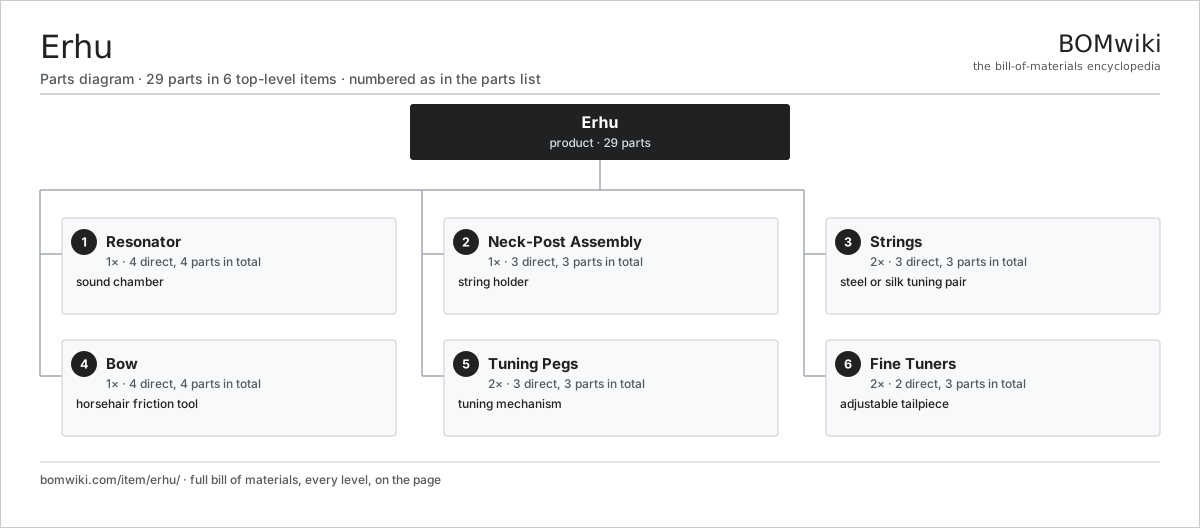
| # | Part | Qty | What it does |
|---|---|---|---|
| 1 | Resonator 4 parts | 1× | sound chamber |
| 2 | Neck-Post Assembly 3 parts | 1× | string holder |
| 3 | Strings 3 parts | 2× | steel or silk tuning pair |
| 4 | Bow 4 parts | 1× | horsehair friction tool |
| 5 | Tuning Pegs 3 parts | 2× | tuning mechanism |
| 6 | Fine Tuners 2 parts | 2× | adjustable tailpiece |
3D model
No 3D model yet. Have a CAD file of this? Add a 3D model. STL renders right on this page; STEP, FreeCAD, and OpenSCAD sources are welcome too (openly licensed, like all 3D models on BOMwiki).
Build & assembly graph
expand / collapse · shared sub-assemblies converge · links to related products · est. labourTap an assembly to expand/collapse · tap a part to open it · use “Open page” for any node · drag to pan, scroll to zoom.
Bill of materials for Erhu
6 top-level lines · 25 rows shown · 29 parts total · indented to 3 levels| # | Item / sub-assembly | Part no. | Qty/assy | Ext. qty | Parts | Type |
|---|---|---|---|---|---|---|
| 1 | Resonator 4 parts | erhu-resonator | 1× | 1 | 4 | assembly |
| 1.1 | Wooden Body | erhu-wooden-body | 1× | 1 | · | part |
| 1.2 | Skin Face | erhu-skin-face | 1× | 1 | · | part |
| 1.3 | Back Plate | erhu-back-plate | 1× | 1 | · | part |
| 1.4 | Sound Port | erhu-sound-port | 1× | 1 | · | part |
| 2 | Neck-Post Assembly 3 parts | erhu-neck-post | 1× | 1 | 3 | assembly |
| 2.1 | Neck Staff | erhu-neck-staff | 1× | 1 | · | part |
| 2.2 | Bridge Support | erhu-bridge-support | 1× | 1 | · | part |
| 2.3 | Neck Heel | erhu-neck-heel | 1× | 1 | · | part |
| 3 | Strings 3 parts | erhu-strings | 2× | 2 | 3 | assembly |
| 3.1 | Inner String | erhu-inner-string | 1× | 2 | · | part |
| 3.2 | Outer String | erhu-outer-string | 1× | 2 | · | part |
| 3.3 | String Bridge | erhu-string-bridge | 1× | 2 | · | part |
| 4 | Bow 4 parts | erhu-bow | 1× | 1 | 4 | assembly |
| 4.1 | Bow Stick | erhu-bow-stick | 1× | 1 | · | part |
| 4.2 | Horsehair Ribbon | erhu-horsehair-ribbon | 1× | 1 | · | part |
| 4.3 | Bow Handle | erhu-bow-handle | 1× | 1 | · | part |
| 4.4 | Bow Tension | erhu-bow-tension | 1× | 1 | · | part |
| 5 | Tuning Pegs 3 parts | erhu-pegs | 2× | 2 | 3 | assembly |
| 5.1 | Inner Peg | erhu-peg-inner | 1× | 2 | · | part |
| 5.2 | Outer Peg | erhu-peg-outer | 1× | 2 | · | part |
| 5.3 | Peg Block | erhu-peg-block | 1× | 2 | · | part |
| 6 | Fine Tuners 2 parts | erhu-fine-tuners | 2× | 2 | 3 | assembly |
| 6.1 | Tailpiece Block | erhu-tailpiece-block | 1× | 2 | · | part |
| 6.2 | Fine Tuner Screw | erhu-fine-tuner-screw | 2× | 4 | · | part |
Something wrong in this list? Report a problem with this BOM.
Sourcing: possible vendors
Browse the supplier directory → Prices, MOQ, and lead times are algorithmic estimates, not quotes, and not claims about these companies. Company mappings are curated by keyword; est. price band $50–$5k. How estimates work| Vendor | HQ | Specialty | MOQ | Lead time |
|---|---|---|---|---|
| yamaha.com ↗ | Hamamatsu, JP | Audio & instruments | 200 units | 8–14 wks |
|
🇺🇸Fender
fender.com ↗
|
Los Angeles, US | Guitars & amps | 200 units | 8–14 wks |
|
🇺🇸Gibson
gibson.com ↗
|
Nashville, US | Guitars | 200 units | 8–14 wks |
|
🇯🇵Roland
roland.com ↗
|
Hamamatsu, JP | Electronic instruments | 200 units | 8–14 wks |
| steinway.com ↗ | New York, US | Pianos | 200 units | 8–14 wks |
996-word article