Escalator Step Cleaner
ProductOverview
Escalator steps cannot be cleaned by ordinary floor machines. The tread is not flat: it is a field of parallel grooves roughly 9 mm apart and 10 mm deep, designed to mesh with the comb plate at each landing. Dirt, grease from the step chain, and metal dust from the guides pack into those grooves where mops and rotary scrubbers simply skate over the top. An escalator step cleaner is a purpose-built machine that parks on a stopped escalator, registers itself against a step, and cleans the grooves directly with profile-matched brushes, metered detergent, and wet vacuum recovery.
The machine spans one step on an aluminium Frame, located fore-aft by adjustable Step Locator Foot feet bearing on the step riser. Cleaning the whole escalator is iterative: the machine cleans one step across its full width, the operator jogs the escalator one step on inspection control, and the cycle repeats, typically 45 to 60 seconds per step and 1.5 to 2.5 hours for a full rise.
How it works
Three subsystems act on each step in sequence.
First, the Detergent System wets the tread. A diaphragm Dosing Pump draws from the 25 L Solution Tank through an in-line Solution Filter and feeds the Spray Bar, whose flat-fan nozzles lay an even band of solution at 0.5–2 L/min. The rate is deliberately low-moisture: an escalator pit contains the drive machinery and, frequently, electrical gear, so flooding the step is not an option. A float Tank Level Sensor stops dosing when the tank runs dry.
Second, the Brush System scrubs. Two counter-rotating Groove Brush Roller rollers carry bristle rows spaced to the 9 mm groove pitch, so the tufts reach the groove floor instead of riding the ridges. The 750 W Brush Motor spins them at about 650 rpm through a Drive Belt train, and the calibrated Brush Height Adjuster sets bristle penetration, enough to work the groove bottom, not so much that the bristles buckle and sweep the ridges instead. Counter-rotation balances the lateral reaction forces that would otherwise walk the machine across the step.
Third, the Vacuum Recovery System extracts. A 1.2 kW wet Blower Motor pulls the loosened slurry through the Suction Bar, whose slots align with the grooves directly behind the brushes, into the 25 L Recovery Tank. A Float Shutoff closes the air path before a full tank can reach the motor, an Exhaust Demister strips droplets from the exhaust, and the Drain Hose empties the tank at a slop sink. The recovered liquid is an emulsion of detergent, chain grease, and steel dust, and it is the reason recovery, not brushing, defines how clean the steps look afterwards.
Traverse and control
The brush head does not span the full step; it covers a section and the Traverse Drive indexes it across. A Servo Motor drives the Traverse Carriage along a cross-rail on polyurethane Guide Roller wheels at up to 12 m/min, with an Encoder reporting position and Limit Switch stops at each end of travel. The Program Control Unit sequences the whole per-step cycle, spray, scrub, extract, traverse, repeat, counts steps cleaned on its display, and signals when to jog the escalator. The Mode Selector offers a dry pre-sweep pass for loose grit, the full wet cycle, and a vacuum-only pass for drying. A latching Emergency Stop cuts motor power independently of the controller.
Power comes from a landing outlet over a 20 m Power Cord with an in-line RCD, mandatory for a wet machine standing on a steel staircase. The escalator itself must be locked out on inspection control throughout; the machine has no interface to the escalator drive and relies on procedure, barriers at both landings, and the operator's key control.
Maintenance and economics
Brush rollers wear to the adjuster limit in roughly 40–60 escalators. Nozzles and the solution filter clog on hard water and rinse clean weekly. The commercial case for the machine is labour: manual groove cleaning with hand brushes runs 8–12 person-hours per escalator, against 2 with the machine, which is why metro operators and airports run dedicated units on a nightly rota.
Escalator Step Cleaner parts and their functions
7 top-level parts · 124 parts in total · full bill of materials below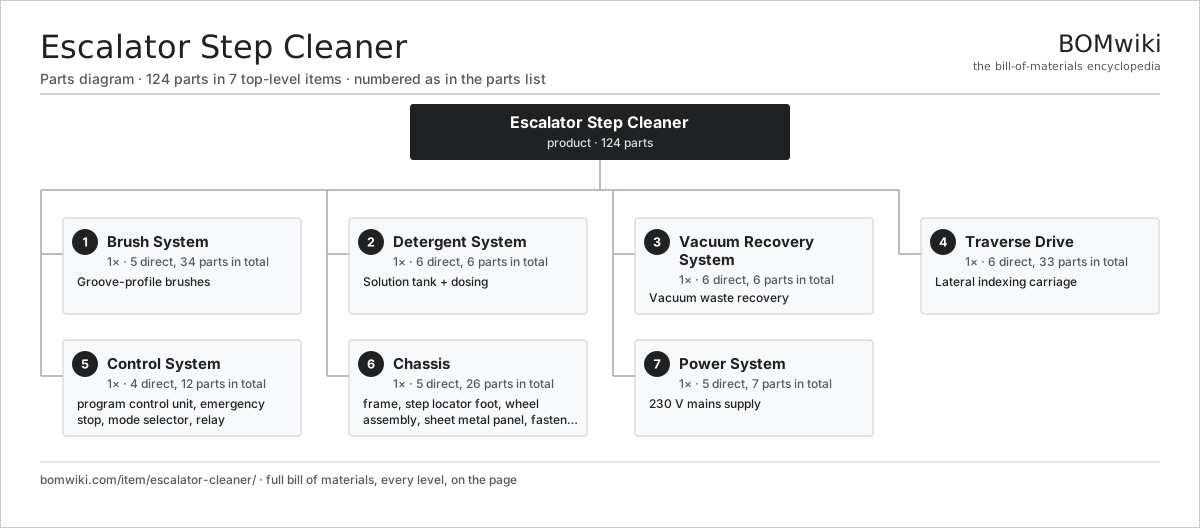
| # | Part | Qty | What it does |
|---|---|---|---|
| 1 | Brush System 5 parts | 1× | Groove-profile brushes |
| 2 | Detergent System 6 parts | 1× | Solution tank + dosing |
| 3 | Vacuum Recovery System 6 parts | 1× | Vacuum waste recovery |
| 4 | Traverse Drive 6 parts | 1× | Lateral indexing carriage |
| 5 | Control System 4 parts | 1× | Program controller that sequences spray, brush, traverse, and vacuum stages per step and counts steps cleaned. |
| 6 | Chassis 5 parts | 1× | Aluminium frame that spans one escalator step, locates against the step riser, and rolls on transport wheels between jobs. |
| 7 | Power System 5 parts | 1× | 230 V mains supply |
3D model
No 3D model yet. Have a CAD file of this? Add a 3D model. STL renders right on this page; STEP, FreeCAD, and OpenSCAD sources are welcome too (openly licensed, like all 3D models on BOMwiki).
Build & assembly graph
expand / collapse · shared sub-assemblies converge · links to related products · est. labourTap an assembly to expand/collapse · tap a part to open it · use “Open page” for any node · drag to pan, scroll to zoom.
Bill of materials for Escalator Step Cleaner
7 top-level lines · 62 rows shown · 124 parts total · indented to 3 levels| # | Item / sub-assembly | Part no. | Qty/assy | Ext. qty | Parts | Type |
|---|---|---|---|---|---|---|
| 1 | Brush System 5 parts | escalator-cleaner-brush-system | 1× | 1 | 34 | assembly |
| 1.1 | Groove Brush Roller | escalator-cleaner-groove-brush | 2× | 2 | · | part |
| 1.2 | Brush Motor 4 parts | escalator-cleaner-brush-motor | 1× | 1 | 25 | assembly |
| 1.2.1 | Stator Assembly 3 parts + deeper › | stator-assembly | 1× | 1 | 3 | assembly |
| 1.2.2 | Rotor Assembly 4 parts + deeper › | rotor-assembly | 1× | 1 | 19 | assembly |
| 1.2.3 | Motor Housing | motor-housing | 1× | 1 | · | part |
| 1.2.4 | Ball Bearing | ball-bearing | 2× | 2 | · | part |
| 1.3 | Brush Height Adjuster | escalator-cleaner-brush-height-adjuster | 1× | 1 | · | part |
| 1.4 | Drive Belt | drive-belt | 2× | 2 | · | part |
| 1.5 | Ball Bearing | ball-bearing | 4× | 4 | · | part |
| 2 | Detergent System 6 parts | escalator-cleaner-detergent-system | 1× | 1 | 6 | assembly |
| 2.1 | Solution Tank | escalator-cleaner-solution-tank | 1× | 1 | · | part |
| 2.2 | Dosing Pump | escalator-cleaner-dosing-pump | 1× | 1 | · | part |
| 2.3 | Spray Bar | escalator-cleaner-spray-bar | 1× | 1 | · | part |
| 2.4 | Solution Filter | escalator-cleaner-solution-filter | 1× | 1 | · | part |
| 2.5 | Tank Level Sensor | escalator-cleaner-level-sensor | 1× | 1 | · | part |
| 2.6 | O-Ring Set | oring-set | 1× | 1 | · | part |
| 3 | Vacuum Recovery System 6 parts | escalator-cleaner-recovery-system | 1× | 1 | 6 | assembly |
| 3.1 | Blower Motor | blower-motor | 1× | 1 | · | part |
| 3.2 | Recovery Tank | escalator-cleaner-recovery-tank | 1× | 1 | · | part |
| 3.3 | Suction Bar | escalator-cleaner-suction-bar | 1× | 1 | · | part |
| 3.4 | Float Shutoff | escalator-cleaner-float-shutoff | 1× | 1 | · | part |
| 3.5 | Drain Hose | escalator-cleaner-drain-hose | 1× | 1 | · | part |
| 3.6 | Exhaust Demister | escalator-cleaner-demister | 1× | 1 | · | part |
| 4 | Traverse Drive 6 parts | escalator-cleaner-traverse-drive | 1× | 1 | 33 | assembly |
| 4.1 | Servo Motor 4 parts | servo-motor | 1× | 1 | 24 | assembly |
| 4.1.1 | Stator Assembly 3 parts + deeper › | stator-assembly | 1× | 1 | 3 | assembly |
| 4.1.2 | Rotor Assembly 4 parts + deeper › | rotor-assembly | 1× | 1 | 19 | assembly |
| 4.1.3 | Encoder | encoder | 1× | 1 | · | part |
| 4.1.4 | Motor Housing | motor-housing | 1× | 1 | · | part |
| 4.2 | Helical Gear Pair | gear-pair | 1× | 1 | · | part |
| 4.3 | Traverse Carriage | escalator-cleaner-carriage | 1× | 1 | · | part |
| 4.4 | Guide Roller | escalator-cleaner-guide-roller | 4× | 4 | · | part |
| 4.5 | Limit Switch | escalator-cleaner-limit-switch | 2× | 2 | · | part |
| 4.6 | Encoder | encoder | 1× | 1 | · | part |
| 5 | Control System 4 parts | escalator-cleaner-controls | 1× | 1 | 12 | assembly |
| 5.1 | Program Control Unit 5 parts | escalator-cleaner-control-unit | 1× | 1 | 7 | assembly |
| 5.1.1 | Bare PCB | pcb-bare | 1× | 1 | · | part |
| 5.1.2 | Microcontroller | mcu | 1× | 1 | · | part |
| 5.1.3 | LCD Panel | lcd-panel | 1× | 1 | · | part |
| 5.1.4 | SMD Passive (R/C/L) | smd-passives | 1× | 1 | · | part |
| 5.1.5 | Connector | connector | 3× | 3 | · | part |
| 5.2 | Emergency Stop | escalator-cleaner-estop | 1× | 1 | · | part |
| 5.3 | Mode Selector | escalator-cleaner-mode-selector | 1× | 1 | · | part |
| 5.4 | Relay | relay | 3× | 3 | · | part |
| 6 | Chassis 5 parts | escalator-cleaner-chassis | 1× | 1 | 26 | assembly |
| 6.1 | Frame | escalator-cleaner-frame | 1× | 1 | · | part |
| 6.2 | Step Locator Foot | escalator-cleaner-step-locator | 2× | 2 | · | part |
| 6.3 | Wheel Assembly 5 parts | wheel-assembly | 2× | 2 | 9 | assembly |
| 6.3.1 | Alloy Wheel | alloy-wheel | 1× | 2 | · | part |
| 6.3.2 | Tire | tire | 1× | 2 | · | part |
| 6.3.3 | TPMS Sensor | tpms-sensor | 1× | 2 | · | part |
| 6.3.4 | Lug Nut | lug-nut | 5× | 10 | · | part |
| 6.3.5 | Valve Stem | valve-stem | 1× | 2 | · | part |
| 6.4 | Sheet Metal Panel | sheet-panel | 3× | 3 | · | part |
| 6.5 | Fastener Set | fastener-set | 2× | 2 | · | part |
| 7 | Power System 5 parts | escalator-cleaner-power | 1× | 1 | 7 | assembly |
| 7.1 | Power Cord | escalator-cleaner-power-cord | 1× | 1 | · | part |
| 7.2 | Power Supply | power-supply | 1× | 1 | · | part |
| 7.3 | Thermal Fuse | thermal-fuse | 2× | 2 | · | part |
| 7.4 | Wire Bundle | wire-bundle | 2× | 2 | · | part |
| 7.5 | Relay | relay | 1× | 1 | · | part |
Something wrong in this list? Report a problem with this BOM.
Related products
same domain, ranked by shared parts Floor Stripping Machine
94 parts · shares 19 with this page
Floor Stripping Machine
94 parts · shares 19 with this page
 Robotic Pool Cleaner
145 parts · shares 18 with this page
Orbital Floor Machine
95 parts · shares 18 with this page
Robotic Pool Cleaner
145 parts · shares 18 with this page
Orbital Floor Machine
95 parts · shares 18 with this page
Sourcing: possible vendors
Browse the supplier directory → Prices, MOQ, and lead times are algorithmic estimates, not quotes, and not claims about these companies. Company mappings are curated by keyword; est. price band $50–$1.5k. How estimates work| Vendor | HQ | Specialty | MOQ | Lead time |
|---|---|---|---|---|
| sharkninja.com ↗ | Needham, US | Floorcare & kitchen | 1,000 units | 8–12 wks |
|
🇬🇧Dyson
dyson.com ↗
|
Malmesbury, GB | Vacuums & hair care | 1,000 units | 8–12 wks |
|
🇺🇸Bissell
bissell.com ↗
|
Grand Rapids, US | Floorcare | 1,000 units | 8–12 wks |
|
🇺🇸iRobot
irobot.com ↗
|
Bedford, US | Robot vacuums | 1,000 units | 8–12 wks |
|
🇩🇪Kärcher
karcher.com ↗
|
Winnenden, DE | Cleaning equipment | 1,000 units | 8–12 wks |
750-word article