Espresso Grinder
ProductOverview
An espresso grinder is a precision coffee mill optimized to produce the extremely fine, uniform particle size required for espresso brewing (0.5–2 mm gap between conical Stator Burr and Rotor Burr). Unlike blade grinders, which produce jagged, inconsistent fragments, burr grinders force whole beans between two hardened-steel conical surfaces rotating at high speed. The resulting ground coffee is uniform in size, allowing water to extract flavor evenly during espresso pulling.
The operator fills the Hopper Bin with whole roasted beans, selects a dose (9 g, 12 g, etc.) via the Dose Adjustment Dial, and presses Power Button. The AC Motor spins the Rotor Burr at ≈1000 rpm. Beans gravity-feed from the hopper through the Feed Tube, are drawn between the burrs, and are pulverized to fine powder. The Dosing Timer PCB counts motor rotations and automatically stops grinding after 6–10 seconds (depending on dose), then engages the Output Solenoid Valve solenoid to cut the flow. Ground coffee falls through the Ground Coffee Chute into the operator's portafilter basket, which can be weighed to confirm the exact dose.
The espresso-grinder-adjustment-dial, with 36 clicks over a 1.8 mm range, fine-tunes the Burr Spacing Collar gap. Tighter gaps produce finer powder (longer pull time); wider gaps produce coarser powder (faster pull). The grinder comes calibrated for espresso but can be adjusted for Americano, pour-over, or Turkish (ultra-fine) grinds by rotating the dial.
How it works
Setup. The operator unscraps the Hopper Cap and pours room-temperature roasted beans into the Hopper Bin (capacity ≈220 g). They replace the cap to keep beans fresh and dust-free. They select a dose by rotating the Dose Adjustment Dial to the 9 g, 12 g, or 15 g setting. The Dosing Timer PCB stores this selection internally.
Grinding initiation. The operator places their portafilter (a metal basket holder used in espresso machines) under the Ground Coffee Chute and presses Power Button. The Motor Relay energizes, applying 230 V AC to the AC Motor.
Motor operation. The AC Motor (110 W) begins spinning at no-load speed ≈1400 rpm. As beans enter the burr region, the grinding torque load increases and the motor slip-ring regulation (inherent to AC induction motors) causes speed to drop to approximately 1000 rpm. The Flexible Coupling (flexible elastomer) transmits this torque to the Rotor Axle, which rotates the Rotor Burr against the fixed Stator Burr.
Bean grinding. Beans drop from the hopper via gravity through the Feed Tube. The Vibrating Chute (powered by a small coin-cell vibration motor) gently oscillates to prevent beans from jamming in the feed tube. Once beans reach the burr entrance, the rotating Rotor Burr (conical, hardened steel at 65–68 HRC) shears them against the fixed Stator Burr. The gap between the burrs is set to 0.5–2 mm via the adjustment screw, which moves the Burr Spacing Collar collar. At 1000 rpm and fine gap, beans are reduced to powder in approximately 6–10 seconds, depending on dose weight.
The particle size is extremely uniform: over 95% of powder falls within the espresso range (0.5–2 mm), with <1% very fine (fines below 50 µm) and <2% oversized (overs above 200 µm). This uniformity ensures even water contact and flavor extraction during pulling.
Dosing stop. The Dosing Timer PCB MCU counts motor cycles. Each rotor revolution grinds a fixed mass of coffee (≈0.1–0.2 g depending on bean density and gap). After counting the number of revolutions equivalent to the selected dose (e.g., 90 revolutions ≈ 9 g), the board de-energizes the Motor Relay, cutting power to the motor. Simultaneously, the board energizes a 24 V solenoid (the Output Solenoid Valve), which closes a pinch valve in the Ground Coffee Chute, preventing any remaining ground coffee from falling. The grind is complete.
Adjustment (fine-tuning). If the espresso extracts too quickly (gushing), the operator rotates the espresso-grinder-adjustment-dial one click finer (clockwise). This tightens the gap by moving the Burr Spacing Collar via the precision-threaded Fine Adjustment Screw (0.8 mm pitch, so one click = 0.05 mm gap change). If extraction is too slow (channeling, sour taste), they turn the dial one click coarser (counter-clockwise). A Lock Ring collar then locks the dial to prevent accidental changes during grinding.
All electrical components receive 230 V AC via the Power Cord. The Mains Plug has a 5 A thermal breaker; a Thermal Fuse (5 A) at the input of the control board provides secondary protection. A AC/DC Transformer (230 V primary to 24 V secondary, 20 VA) powers the Output Solenoid Valve solenoid and the MCU control logic.
Espresso Grinder parts and their functions
8 top-level parts · 60 parts in total · full bill of materials below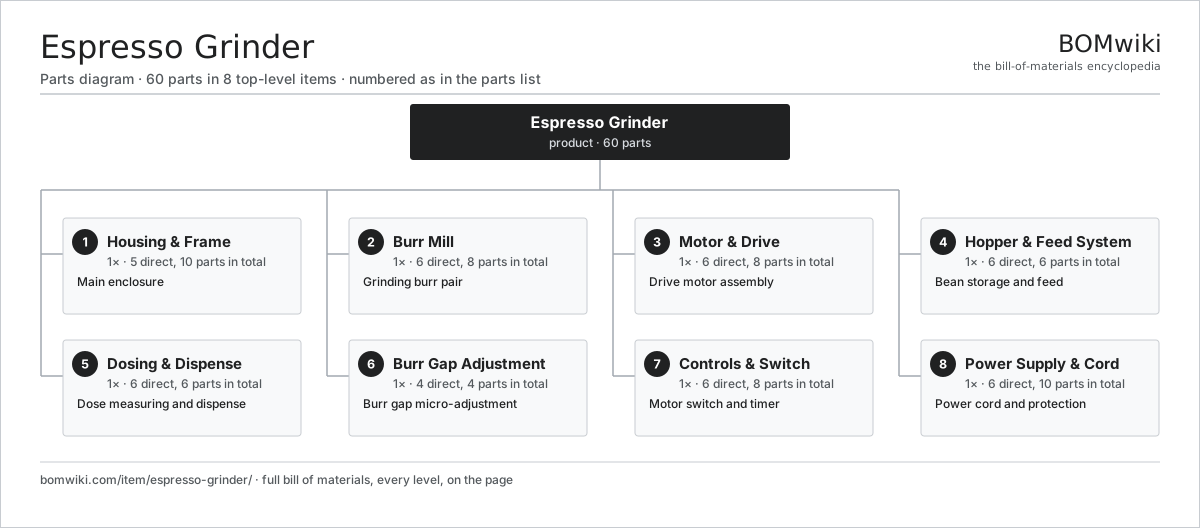
| # | Part | Qty | What it does |
|---|---|---|---|
| 1 | Housing & Frame 5 parts | 1× | Main enclosure |
| 2 | Burr Mill 6 parts | 1× | Grinding burr pair |
| 3 | Motor & Drive 6 parts | 1× | Drive motor assembly |
| 4 | Hopper & Feed System 6 parts | 1× | Bean storage and feed |
| 5 | Dosing & Dispense 6 parts | 1× | Dose measuring and dispense |
| 6 | Burr Gap Adjustment 4 parts | 1× | Burr gap micro-adjustment |
| 7 | Controls & Switch 6 parts | 1× | Motor switch and timer |
| 8 | Power Supply & Cord 6 parts | 1× | Power cord and protection |
3D model
No 3D model yet. Have a CAD file of this? Add a 3D model. STL renders right on this page; STEP, FreeCAD, and OpenSCAD sources are welcome too (openly licensed, like all 3D models on BOMwiki).
Build & assembly graph
expand / collapse · shared sub-assemblies converge · links to related products · est. labourTap an assembly to expand/collapse · tap a part to open it · use “Open page” for any node · drag to pan, scroll to zoom.
Bill of materials for Espresso Grinder
8 top-level lines · 53 rows shown · 60 parts total · indented to 3 levels| # | Item / sub-assembly | Part no. | Qty/assy | Ext. qty | Parts | Type |
|---|---|---|---|---|---|---|
| 1 | Housing & Frame 5 parts | espresso-grinder-housing | 1× | 1 | 10 | assembly |
| 1.1 | Upper Case | espresso-grinder-upper-case | 1× | 1 | · | part |
| 1.2 | Lower Case | espresso-grinder-lower-case | 1× | 1 | · | part |
| 1.3 | Motor Mount Base | espresso-grinder-motor-base | 1× | 1 | · | part |
| 1.4 | Anti-Vibration Foot | espresso-grinder-rubber-feet | 4× | 4 | · | part |
| 1.5 | Fastener Set | fastener-set | 3× | 3 | · | part |
| 2 | Burr Mill 6 parts | espresso-grinder-burrs | 1× | 1 | 8 | assembly |
| 2.1 | Stator Burr | espresso-grinder-stator-burr | 1× | 1 | · | part |
| 2.2 | Rotor Burr | espresso-grinder-rotor-burr | 1× | 1 | · | part |
| 2.3 | Rotor Axle | espresso-grinder-burr-axle | 1× | 1 | · | part |
| 2.4 | Burr Spacing Collar | espresso-grinder-burr-spacer | 1× | 1 | · | part |
| 2.5 | Ball Bearing | ball-bearing | 2× | 2 | · | part |
| 2.6 | O-Ring Set | oring-set | 2× | 2 | · | part |
| 3 | Motor & Drive 6 parts | espresso-grinder-motor | 1× | 1 | 8 | assembly |
| 3.1 | AC Motor | espresso-grinder-ac-motor | 1× | 1 | · | part |
| 3.2 | Flexible Coupling | espresso-grinder-motor-coupling | 1× | 1 | · | part |
| 3.3 | Motor Mounting Bracket | espresso-grinder-motor-mount-bracket | 1× | 1 | · | part |
| 3.4 | Ball Bearing | ball-bearing | 2× | 2 | · | part |
| 3.5 | Connector | connector | 2× | 2 | · | part |
| 3.6 | Wire Bundle | wire-bundle | 1× | 1 | · | part |
| 4 | Hopper & Feed System 6 parts | espresso-grinder-hopper | 1× | 1 | 6 | assembly |
| 4.1 | Hopper Bin | espresso-grinder-hopper-container | 1× | 1 | · | part |
| 4.2 | Hopper Cap | espresso-grinder-hopper-cap | 1× | 1 | · | part |
| 4.3 | Feed Tube | espresso-grinder-feed-tube | 1× | 1 | · | part |
| 4.4 | Vibrating Chute | espresso-grinder-vibrating-chute | 1× | 1 | · | part |
| 4.5 | Vibration Motor | espresso-grinder-chute-motor | 1× | 1 | · | part |
| 4.6 | Connector | connector | 1× | 1 | · | part |
| 5 | Dosing & Dispense 6 parts | espresso-grinder-dosing | 1× | 1 | 6 | assembly |
| 5.1 | Dose Adjustment Dial | espresso-grinder-dose-wheel | 1× | 1 | · | part |
| 5.2 | Electronic Timer | espresso-grinder-dose-timer | 1× | 1 | · | part |
| 5.3 | Ground Coffee Chute | espresso-grinder-output-chute | 1× | 1 | · | part |
| 5.4 | Output Solenoid Valve | espresso-grinder-output-valve | 1× | 1 | · | part |
| 5.5 | Solenoid | espresso-grinder-solenoid | 1× | 1 | · | part |
| 5.6 | Connector | connector | 1× | 1 | · | part |
| 6 | Burr Gap Adjustment 4 parts | espresso-grinder-adjustment | 1× | 1 | 4 | assembly |
| 6.1 | Fine Adjustment Screw | espresso-grinder-adjustment-screw | 1× | 1 | · | part |
| 6.2 | Adjustment Dial | espresso-grinder-adjuster-dial | 1× | 1 | · | part |
| 6.3 | Lock Ring | espresso-grinder-adjuster-locking | 1× | 1 | · | part |
| 6.4 | Threaded Spacer | espresso-grinder-fine-threads | 1× | 1 | · | part |
| 7 | Controls & Switch 6 parts | espresso-grinder-controls | 1× | 1 | 8 | assembly |
| 7.1 | Power Button | espresso-grinder-power-switch | 1× | 1 | · | part |
| 7.2 | Dosing Timer PCB | espresso-grinder-control-board | 1× | 1 | · | part |
| 7.3 | Motor Relay | espresso-grinder-motor-relay | 1× | 1 | · | part |
| 7.4 | Led Indicator | espresso-grinder-led-indicator | 1× | 1 | · | part |
| 7.5 | Microcontroller | mcu | 1× | 1 | · | part |
| 7.6 | Connector | connector | 3× | 3 | · | part |
| 8 | Power Supply & Cord 6 parts | espresso-grinder-power | 1× | 1 | 10 | assembly |
| 8.1 | Power Cord | espresso-grinder-power-cord | 1× | 1 | · | part |
| 8.2 | Mains Plug | espresso-grinder-plug | 1× | 1 | · | part |
| 8.3 | AC/DC Transformer | espresso-grinder-transformer | 1× | 1 | · | part |
| 8.4 | Thermal Fuse | thermal-fuse | 1× | 1 | · | part |
| 8.5 | Wire Bundle | wire-bundle | 2× | 2 | · | part |
| 8.6 | Connector | connector | 4× | 4 | · | part |
Something wrong in this list? Report a problem with this BOM.
Related products
same domain, ranked by shared parts Home Coffee Roaster
88 parts · shares 3 with this page
Home Ice Cream Maker
75 parts · shares 3 with this page
Home Coffee Roaster
88 parts · shares 3 with this page
Home Ice Cream Maker
75 parts · shares 3 with this page
 Home Pasta Extruder
82 parts · shares 3 with this page
Hot Dog Roller Grill
81 parts · shares 3 with this page
Home Pasta Extruder
82 parts · shares 3 with this page
Hot Dog Roller Grill
81 parts · shares 3 with this page
 Milk Frother
56 parts · shares 3 with this page
Milk Frother
56 parts · shares 3 with this page
 Soy Milk Maker
66 parts · shares 3 with this page
Soy Milk Maker
66 parts · shares 3 with this page
Sourcing: possible vendors
Browse the supplier directory → Prices, MOQ, and lead times are algorithmic estimates, not quotes, and not claims about these companies. Company mappings are curated by keyword; est. price band $20–$600. How estimates work| Vendor | HQ | Specialty | MOQ | Lead time |
|---|---|---|---|---|
|
🇦🇺Breville
breville.com ↗
|
Sydney, AU | Kitchen appliances | 2,000 units | 6–10 wks |
| groupeseb.com ↗ | Écully, FR | Cookware & small appliances | 2,000 units | 6–10 wks |
| hamiltonbeach.com ↗ | Glen Allen, US | Small appliances | 2,000 units | 6–10 wks |
| panasonic.com ↗ | Osaka, JP | Electronics & appliances | 2,000 units | 6–10 wks |
|
🇨🇳Midea
midea.com ↗
|
Foshan, CN | Home appliances | 2,000 units | 6–10 wks |
852-word article