Exhaust Extraction System
ProductOverview
The exhaust extraction system is a critical health and safety tool in automotive service shops, capturing toxic exhaust fumes (carbon monoxide, nitrogen oxides, particulates) directly from vehicle tailpipes and venting them safely outside. Modern emission standards have made exhaust more complex: diesel engines produce nitrogen oxides and soot, gasoline engines emit unburned hydrocarbons and CO, and hybrid/electric vehicles generate less traditional exhaust but still produce thermal and particulate matter during operation. Prolonged exposure to exhaust in an enclosed shop is linked to respiratory illness, headaches, and reduced cognitive performance. The Exhaust Extraction System is mandatory in modern automotive shops in most jurisdictions, with occupational health standards (OSHA, ACGIH) specifying maximum exposure limits and requiring mechanical ventilation.
The system consists of a Spring-Return Hose Reel mounted on the shop ceiling or wall, housing 40–80 feet of flexible Flexible Extraction Hose with a quick-connect tailpipe adapter. A technician pulls the hose toward the vehicle and inserts the adapter into the tailpipe, then activates the Centrifugal Blower Fan (powered by a Electric Fan Drive Motor). The fan draws exhaust vapor through the hose and routes it through rigid Ducting and Venting System to a Exhaust Damper Flap on the shop exterior, completely eliminating exhaust from the indoor work area.
How it Works
The technician drives the vehicle into the service bay and positions the car. Using the Hose Guide and Swivel, they pull the Flexible Extraction Hose from the ceiling reel, uncoiling it toward the tailpipe. They select the appropriate Tailpipe Adapter Set (available in round 2.5", 3", 4" sizes and oval shapes) and insert it snugly into the tailpipe, securing it with a friction fit or slight twisting motion.
The technician then energizes the Speed and Power Control Unit power switch. The Electric Fan Drive Motor spins up to ~1,800 rpm, driving the Impeller Wheel centrifugal impeller. The fan develops negative pressure (typically -0.3 to -0.8 inches of water column) in the hose, drawing warm exhaust vapor from the tailpipe. The vapor travels through the Hose Tubing (rated 150°C transient temperature, with conductive inner layer to prevent static buildup) and connects to the building's main Ducting and Venting System.
The rigid Ductwork Pipe (6–10 inch diameter) routes the exhaust vertically or horizontally to the building exterior. A Exhaust Damper Flap at the duct outlet opens under extraction flow, venting exhaust outside, and spring-closes when the fan shuts down, preventing cold outside air from back-flowing into the shop and disrupting heating/cooling systems.
If the system is equipped with an optional Particulate and Odor Filter Stage (Optional), the exhaust passes through a Particulate Filter Cartridge (HEPA media) and Activated Carbon Odor Filter (activated charcoal), removing particulate soot and odors before atmospheric discharge. This is particularly valuable in busy diesel repair shops or urban areas where neighbors might complain about visible exhaust plumes.
Design Considerations
Shop layout determines extraction effectiveness. The hose should be positioned as close as possible to the tailpipe (within 6 inches) to maximize capture and minimize general shop ventilation loss. If the hose is too far or too loose, uncontrolled exhaust escapes into the bay air. The Spring-Return Hose Reel spring mechanism should return the hose smoothly, encouraging technicians to consistently retrieve and stow the hose (rather than leaving it pooled on the floor, a trip hazard).
The system's fan capacity must match the vehicle population and shop bay count. A single-bay shop might use a 300–500 CFM system, while a 4-bay shop might need 1,000 CFM divided among bays or a larger central unit. Undersizing leads to poor capture; oversizing wastes energy and increases noise.
Noise Management
Uncontrolled extraction fan noise reaches 80–85 dB at full speed, disruptive to shop productivity and worker hearing. Many modern systems include a Variable Frequency Drive (Variable Frequency Drive) that reduces motor speed to 50–70% when full extraction is not needed, cutting noise to 65–70 dB and reducing electrical draw by 30–40%. Some systems include occupancy sensors, automatically powering down the fan when no vehicles are idling in the bay.
Maintenance and Service Life
The Fan Bearing Assembly sealed bearings are rated for 10,000+ hours continuous operation; at 8 hours/day, 5 days/week, that equals 5+ years before bearing replacement is likely. The Electric Fan Drive Motor windings are typically good for 10+ years in normal shop conditions. The Hose Tubing degrades from UV and thermal cycling; replacement every 3–5 years is typical, especially in shops with high vehicle volume.
The Exhaust Damper Flap spring may weaken over time; if outside air begins back-flowing into the shop when the fan is off, damper replacement is indicated. The Particulate Filter Cartridge and Activated Carbon Odor Filter (if equipped) are consumables, requiring replacement every 50–200 operating hours depending on shop volume and exhaust load.
Compliance and Standards
The system must meet local building codes and OSHA ventilation standards. Most jurisdictions require the ductwork to terminate at least 10 feet horizontally from operable windows and doors, preventing exhaust re-entry. Shop documentation should include fan capacity certification and annual inspection records, demonstrating compliance with occupational health regulations.
Exhaust Extraction System parts and their functions
7 top-level parts · 23 parts in total · full bill of materials below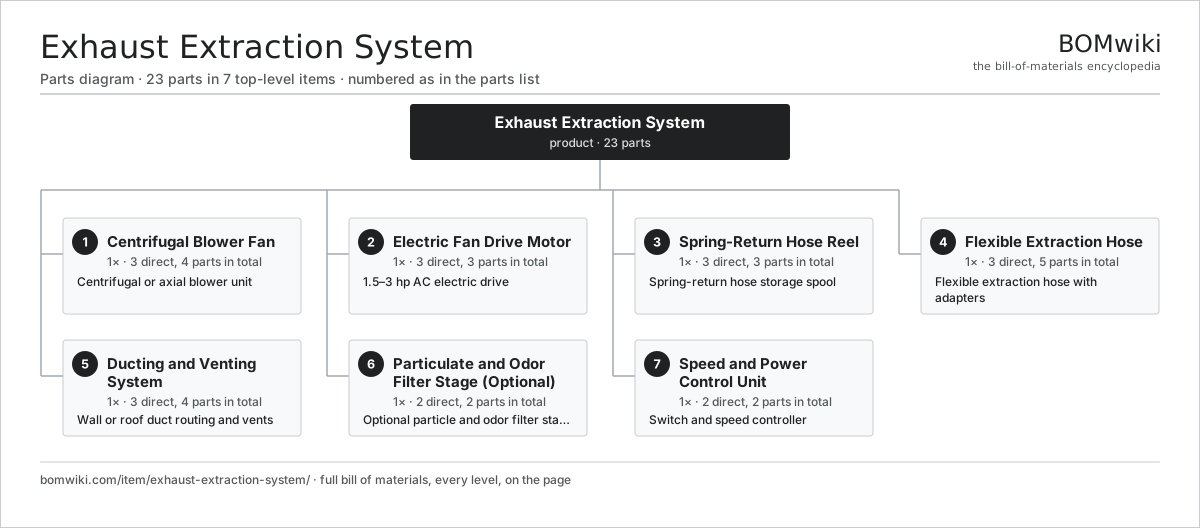
| # | Part | Qty | What it does |
|---|---|---|---|
| 1 | Centrifugal Blower Fan 3 parts | 1× | Centrifugal or axial blower unit |
| 2 | Electric Fan Drive Motor 3 parts | 1× | 1.5–3 hp AC electric drive |
| 3 | Spring-Return Hose Reel 3 parts | 1× | Spring-return hose storage spool |
| 4 | Flexible Extraction Hose 3 parts | 1× | Flexible extraction hose with adapters |
| 5 | Ducting and Venting System 3 parts | 1× | Wall or roof duct routing and vents |
| 6 | Particulate and Odor Filter Stage (Optional) 2 parts | 1× | Optional particle and odor filter stage |
| 7 | Speed and Power Control Unit 2 parts | 1× | Switch and speed controller |
3D model
No 3D model yet. Have a CAD file of this? Add a 3D model. STL renders right on this page; STEP, FreeCAD, and OpenSCAD sources are welcome too (openly licensed, like all 3D models on BOMwiki).
Build & assembly graph
expand / collapse · shared sub-assemblies converge · links to related products · est. labourTap an assembly to expand/collapse · tap a part to open it · use “Open page” for any node · drag to pan, scroll to zoom.
Bill of materials for Exhaust Extraction System
7 top-level lines · 26 rows shown · 23 parts total · indented to 3 levels| # | Item / sub-assembly | Part no. | Qty/assy | Ext. qty | Parts | Type |
|---|---|---|---|---|---|---|
| 1 | Centrifugal Blower Fan 3 parts | exhaust-extraction-fan | 1× | 1 | 4 | assembly |
| 1.1 | Impeller Wheel | exhaust-extraction-fan-wheel | 1× | 1 | · | part |
| 1.2 | Fan Scroll Housing | exhaust-extraction-fan-housing | 1× | 1 | · | part |
| 1.3 | Fan Bearing Assembly | exhaust-extraction-fan-bearing | 2× | 2 | · | part |
| 2 | Electric Fan Drive Motor 3 parts | exhaust-extraction-motor | 1× | 1 | 3 | assembly |
| 2.1 | Motor Stator Winding | exhaust-extraction-motor-stator | 1× | 1 | · | part |
| 2.2 | Motor Rotor Assembly | exhaust-extraction-motor-rotor | 1× | 1 | · | part |
| 2.3 | Motor Coupling | exhaust-extraction-motor-coupling | 1× | 1 | · | part |
| 3 | Spring-Return Hose Reel 3 parts | exhaust-extraction-hose-reel | 1× | 1 | 3 | assembly |
| 3.1 | Reel Drum Core | exhaust-extraction-reel-drum | 1× | 1 | · | part |
| 3.2 | Reel Return Spring | exhaust-extraction-reel-spring | 1× | 1 | · | part |
| 3.3 | Hose Guide and Swivel | exhaust-extraction-reel-guide | 1× | 1 | · | part |
| 4 | Flexible Extraction Hose 3 parts | exhaust-extraction-hose | 1× | 1 | 5 | assembly |
| 4.1 | Hose Tubing | exhaust-extraction-hose-tubing | 1× | 1 | · | part |
| 4.2 | Hose Coupler | exhaust-extraction-hose-couplers | 2× | 2 | · | part |
| 4.3 | Tailpipe Adapter Set | exhaust-extraction-hose-adapters | 2× | 2 | · | part |
| 5 | Ducting and Venting System 3 parts | exhaust-extraction-ducting | 1× | 1 | 4 | assembly |
| 5.1 | Ductwork Pipe | exhaust-extraction-duct-pipe | 1× | 1 | · | part |
| 5.2 | Exhaust Damper Flap | exhaust-extraction-wall-damper | 1× | 1 | · | part |
| 5.3 | Duct Mounting Clamp | exhaust-extraction-duct-clamps | 2× | 2 | · | part |
| 6 | Particulate and Odor Filter Stage (Optional) 2 parts | exhaust-extraction-filter | 1× | 1 | 2 | assembly |
| 6.1 | Particulate Filter Cartridge | exhaust-extraction-filter-cartridge | 1× | 1 | · | part |
| 6.2 | Activated Carbon Odor Filter | exhaust-extraction-carbon-insert | 1× | 1 | · | part |
| 7 | Speed and Power Control Unit 2 parts | exhaust-extraction-control-unit | 1× | 1 | 2 | assembly |
| 7.1 | Power Switch | exhaust-extraction-power-switch | 1× | 1 | · | part |
| 7.2 | Variable Frequency Drive | exhaust-extraction-vfd | 1× | 1 | · | part |
Something wrong in this list? Report a problem with this BOM.
Sourcing: possible vendors
Browse the supplier directory → Prices, MOQ, and lead times are algorithmic estimates, not quotes, and not claims about these companies. Company mappings are curated by keyword; est. price band $0.50–$100. How estimates work| Vendor | HQ | Specialty | MOQ | Lead time |
|---|
876-word article