Building Maintenance Unit (Facade Cradle)
ProductOverview
A building maintenance unit (BMU) is the roof crane that tall buildings carry for their own upkeep: a traveling, slewing jib machine that lowers a two-person cradle down the facade for window cleaning, sealant work, and glass replacement. Unlike temporary suspended scaffolds, a BMU is permanent plant, designed with the building, sized to its facade geometry, and certified under EN 1808. The machine divides into the Roof Car traveling the roof, the Jib Assembly projecting over the parapet, twin Hoist Winch winches, and the Suspended Cradle the crew rides in.
Roof car and track
The Roof Car runs the building perimeter on the Roof Track System, crane-profile rails on height-adjustable Rail Support pedestals that carry loads into the roof structure through waterproofed anchors, curved to follow the parapet and spliced with Rail Joint fishplates. Two Travel Drive wheel units move the car at about 10 m/min between drops; End Stop buffers bound the travel. The car's Car Chassis carries Counterweight Block ballast sized for three times overturn safety with the cradle fully loaded at maximum reach, the governing load case is the jib tip, not the dead weight. Power follows the car on a Cable Reel.
Smaller buildings substitute a stationary davit or monorail; the traveling roof car is what lets one machine serve every facade of a tower.
Jib and slewing
The Jib Boom places the rope suspension points beyond the parapet. It luffs on the Luffing Cylinder from a parked position (folded below the parapet line, invisible from the street, usually an architectural requirement) to its working angle, and a Telescope Section driven by a Ball Screw extends reach over setbacks and balconies. Each suspension rope turns downward over a Head Sheave at the tip. The whole upper works rotates on the Slewing Assembly assembly: a Slewing Ring, a large-diameter geared ball bearing, with the Slew Drive pinion walking around its teeth, the angle tracked by an Encoder so the control system can enforce facade-specific exclusion zones.
Hoisting and the cradle
Each end of the cradle hangs from its own Hoist Winch: a helically grooved Hoist Drum storing the full facade height of 9 mm Suspension Rope (minimum 8:1 factor of safety), driven by a Hoist Motor brake gearmotor at about 9 m/min, with a Rope Guide follower forcing even spooling. Alongside each working rope runs a normally unloaded Safety Rope.
The Suspended Cradle itself is an aluminum platform, 2–3 m long and rated 240 kg, enclosed by a Guardrail Set set with toe boards. Ropes terminate at a Suspension Stirrup yoke at each end; Facade Roller buffers let it rest against the glass without marking, and Restraint Pin units engage mullion guides or facade eyebolts so wind cannot peel the cradle away from the wall, EN 1808 requires restraint above certain drop heights. The crew drives from the Cradle Control Panel, with commands carried to the roof car over the Radio Link.
Safety systems
The safety case assumes single failures everywhere. If a working rope parts or a hoist runs away, the Fall Arrester on that end grips the safety rope, a centrifugal or overspeed-triggered grab, tested at every annual inspection. An Overload Cell in each rope path blocks hoisting above 125 percent of rated load; the Tilt Sensor stops both hoists if the cradle goes more than about 14 degrees out of level (the scenario that historically dumped crews from suspended scaffolds); and the roof Anemometer inhibits work above the 12.7 m/s wind limit. Total power failure leaves the crew with the Manual Descent Device on each hoist, a manual brake release for controlled gravity descent to the ground or a safe level.
Supervision runs through the Control System PLC in the PLC Cabinet on the turret, which interlocks every motion: no slewing or travel while the cradle hangs below parapet level on most installations, no luffing under load, and motion inhibits from every sensor in the safety chain.
Operation and inspection
A cleaning cycle is methodical: park the car at a drop position, slew and luff the jib to the facade line, lower the crew, work the drop, then travel to the next. A full curtain-wall tower takes weeks per circuit, which is why the machine is permanent. EN 1808 and national rules impose the maintenance regime, daily pre-use checks, periodic rope examinations with discard criteria from ISO 4309, annual load tests, and rope replacement typically every few years regardless of visible wear.
Building Maintenance Unit (Facade Cradle) parts and their functions
8 top-level parts · 159 parts in total · full bill of materials below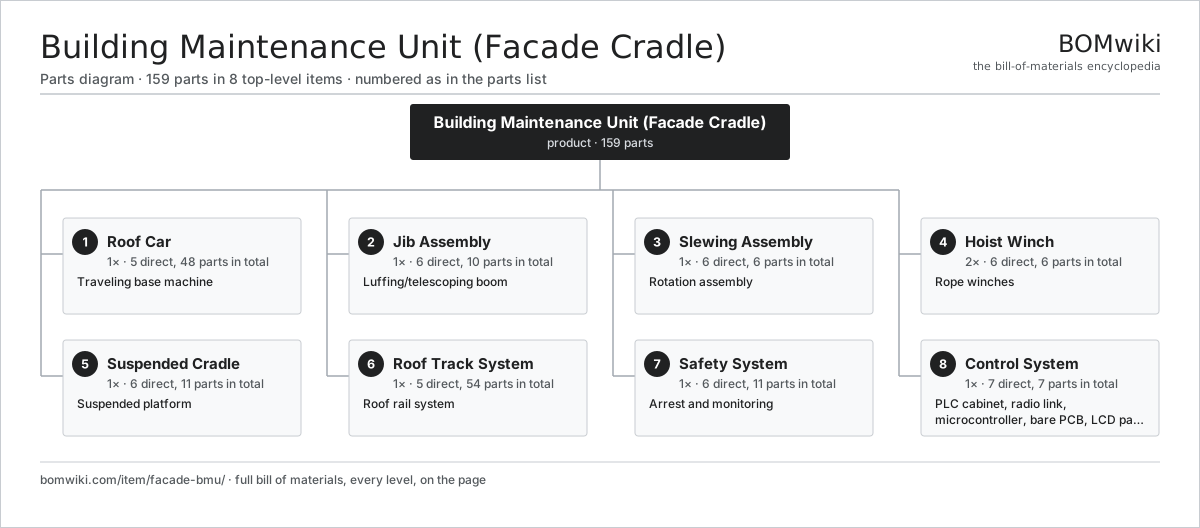
| # | Part | Qty | What it does |
|---|---|---|---|
| 1 | Roof Car 5 parts | 1× | Traveling base machine |
| 2 | Jib Assembly 6 parts | 1× | Luffing/telescoping boom |
| 3 | Slewing Assembly 6 parts | 1× | Rotation assembly |
| 4 | Hoist Winch 6 parts | 2× | Rope winches |
| 5 | Suspended Cradle 6 parts | 1× | Suspended platform |
| 6 | Roof Track System 5 parts | 1× | Roof rail system |
| 7 | Safety System 6 parts | 1× | Arrest and monitoring |
| 8 | Control System 7 parts | 1× | PLC-based control with roof-car and cradle stations and motion interlocking. |
3D model
No 3D model yet. Have a CAD file of this? Add a 3D model. STL renders right on this page; STEP, FreeCAD, and OpenSCAD sources are welcome too (openly licensed, like all 3D models on BOMwiki).
Build & assembly graph
expand / collapse · shared sub-assemblies converge · links to related products · est. labourTap an assembly to expand/collapse · tap a part to open it · use “Open page” for any node · drag to pan, scroll to zoom.
Bill of materials for Building Maintenance Unit (Facade Cradle)
8 top-level lines · 60 rows shown · 159 parts total · indented to 3 levels| # | Item / sub-assembly | Part no. | Qty/assy | Ext. qty | Parts | Type |
|---|---|---|---|---|---|---|
| 1 | Roof Car 5 parts | facade-bmu-roof-car | 1× | 1 | 48 | assembly |
| 1.1 | Car Chassis | facade-bmu-chassis | 1× | 1 | · | part |
| 1.2 | Counterweight Block | facade-bmu-counterweight | 8× | 8 | · | part |
| 1.3 | Travel Drive | facade-bmu-travel-drive | 2× | 2 | · | part |
| 1.4 | Wheel Assembly 5 parts | wheel-assembly | 4× | 4 | 9 | assembly |
| 1.4.1 | Alloy Wheel | alloy-wheel | 1× | 4 | · | part |
| 1.4.2 | Tire | tire | 1× | 4 | · | part |
| 1.4.3 | TPMS Sensor | tpms-sensor | 1× | 4 | · | part |
| 1.4.4 | Lug Nut | lug-nut | 5× | 20 | · | part |
| 1.4.5 | Valve Stem | valve-stem | 1× | 4 | · | part |
| 1.5 | Cable Reel | facade-bmu-cable-reel | 1× | 1 | · | part |
| 2 | Jib Assembly 6 parts | facade-bmu-jib | 1× | 1 | 10 | assembly |
| 2.1 | Jib Boom | facade-bmu-boom | 1× | 1 | · | part |
| 2.2 | Telescope Section | facade-bmu-telescope-section | 1× | 1 | · | part |
| 2.3 | Luffing Cylinder | facade-bmu-luffing-cylinder | 1× | 1 | · | part |
| 2.4 | Head Sheave | facade-bmu-head-sheave | 2× | 2 | · | part |
| 2.5 | Ball Bearing | ball-bearing | 4× | 4 | · | part |
| 2.6 | Ball Screw | ball-screw | 1× | 1 | · | part |
| 3 | Slewing Assembly 6 parts | facade-bmu-slewing | 1× | 1 | 6 | assembly |
| 3.1 | Slewing Ring | facade-bmu-slew-ring | 1× | 1 | · | part |
| 3.2 | Turret | facade-bmu-turret | 1× | 1 | · | part |
| 3.3 | Slew Drive | facade-bmu-slew-drive | 1× | 1 | · | part |
| 3.4 | Helical Gear Pair | gear-pair | 1× | 1 | · | part |
| 3.5 | Gearbox Housing | gearbox-housing | 1× | 1 | · | part |
| 3.6 | Encoder | encoder | 1× | 1 | · | part |
| 4 | Hoist Winch 6 parts | facade-bmu-hoist | 2× | 2 | 6 | assembly |
| 4.1 | Hoist Drum | facade-bmu-hoist-drum | 1× | 2 | · | part |
| 4.2 | Hoist Motor | facade-bmu-hoist-motor | 1× | 2 | · | part |
| 4.3 | Suspension Rope | facade-bmu-suspension-rope | 1× | 2 | · | part |
| 4.4 | Safety Rope | facade-bmu-safety-rope | 1× | 2 | · | part |
| 4.5 | Rope Guide | facade-bmu-rope-guide | 1× | 2 | · | part |
| 4.6 | Oil Seal | oil-seal | 1× | 2 | · | part |
| 5 | Suspended Cradle 6 parts | facade-bmu-cradle | 1× | 1 | 11 | assembly |
| 5.1 | Cradle Frame | facade-bmu-cradle-frame | 1× | 1 | · | part |
| 5.2 | Guardrail Set | facade-bmu-guardrail | 1× | 1 | · | part |
| 5.3 | Suspension Stirrup | facade-bmu-stirrup | 2× | 2 | · | part |
| 5.4 | Facade Roller | facade-bmu-facade-roller | 4× | 4 | · | part |
| 5.5 | Restraint Pin | facade-bmu-restraint-pin | 2× | 2 | · | part |
| 5.6 | Cradle Control Panel | facade-bmu-cradle-panel | 1× | 1 | · | part |
| 6 | Roof Track System 5 parts | facade-bmu-track | 1× | 1 | 54 | assembly |
| 6.1 | Track Rail | facade-bmu-rail | 12× | 12 | · | part |
| 6.2 | Rail Support | facade-bmu-rail-support | 24× | 24 | · | part |
| 6.3 | Rail Joint | facade-bmu-rail-joint | 12× | 12 | · | part |
| 6.4 | End Stop | facade-bmu-end-stop | 4× | 4 | · | part |
| 6.5 | Fastener Set | fastener-set | 2× | 2 | · | part |
| 7 | Safety System 6 parts | facade-bmu-safety | 1× | 1 | 11 | assembly |
| 7.1 | Fall Arrester | facade-bmu-fall-arrester | 2× | 2 | · | part |
| 7.2 | Overload Cell | facade-bmu-overload-cell | 2× | 2 | · | part |
| 7.3 | Tilt Sensor | facade-bmu-tilt-sensor | 1× | 1 | · | part |
| 7.4 | Anemometer | facade-bmu-anemometer | 1× | 1 | · | part |
| 7.5 | Manual Descent Device | facade-bmu-descent-device | 2× | 2 | · | part |
| 7.6 | Relay | relay | 3× | 3 | · | part |
| 8 | Control System 7 parts | facade-bmu-controls | 1× | 1 | 7 | assembly |
| 8.1 | PLC Cabinet | facade-bmu-plc-cabinet | 1× | 1 | · | part |
| 8.2 | Radio Link | facade-bmu-radio-link | 1× | 1 | · | part |
| 8.3 | Microcontroller | mcu | 1× | 1 | · | part |
| 8.4 | Bare PCB | pcb-bare | 1× | 1 | · | part |
| 8.5 | LCD Panel | lcd-panel | 1× | 1 | · | part |
| 8.6 | Power Supply | power-supply | 1× | 1 | · | part |
| 8.7 | Wire Bundle | wire-bundle | 1× | 1 | · | part |
Something wrong in this list? Report a problem with this BOM.
Related products
same domain, ranked by shared parts Wheelchair Platform Lift
89 parts · shares 4 with this page
Wheelchair Platform Lift
89 parts · shares 4 with this page
 Moving Walkway
1,050 parts · shares 6 with this page
Residential Stair Lift
143 parts · shares 5 with this page
Pneumatic Vacuum Elevator
122 parts · shares 4 with this page
Moving Walkway
1,050 parts · shares 6 with this page
Residential Stair Lift
143 parts · shares 5 with this page
Pneumatic Vacuum Elevator
122 parts · shares 4 with this page
 Boat Lift
102 parts · shares 5 with this page
Boat Lift
102 parts · shares 5 with this page
Sourcing: possible vendors
Browse the supplier directory → Prices, MOQ, and lead times are algorithmic estimates, not quotes, and not claims about these companies. Company mappings are curated by keyword; est. price band $10k–$200k. How estimates work| Vendor | HQ | Specialty | MOQ | Lead time |
|---|---|---|---|---|
|
🇺🇸Otis
otis.com ↗
|
Farmington, US | Elevators & escalators | 20 units | 14–24 wks |
| schindler.com ↗ | Ebikon, CH | Elevators & escalators | 20 units | 14–24 wks |
|
🇫🇮KONE
kone.com ↗
|
Espoo, FI | Elevators & escalators | 20 units | 14–24 wks |
| tkelevator.com ↗ | Düsseldorf, DE | Elevators | 20 units | 14–24 wks |
| mitsubishielectric.com ↗ | Tokyo, JP | Elevators & electronics | 20 units | 14–24 wks |
818-word article