Fan Filter Unit
ProductOverview
A fan filter unit (FFU) is the standard cleanroom air supply device, combining a blower fan, HEPA or ULPA filter, and flow diffuser into one sealed module that mounts directly into the cleanroom ceiling or wall. Each FFU supplies filtered laminar or turbulent air directly to its assigned area, creating and maintaining the contamination control required for semiconductor fabrication, pharmaceutical manufacturing, electronics assembly, or hospital operating rooms. An ISO Class 5 cleanroom (semiconductor fab) might have one 1200 × 600 FFU per 10–15 m² of floor area, running continuously during production.
The unit is self-contained: a EC Blower Motor creates the flow, a HEPA/ULPA Filter Cartridge removes particles, a Inlet Plenum Chamber smooths the airflow, and a Outlet Diffuser shapes the discharge. All components are assembled into an Housing & Frame Assembly made of aluminum extrusions, making the FFU modular and serviceable.
Fan and airflow
The EC Blower Motor is an electronically commutated (EC) fan motor, a brushless DC design that is energy-efficient and runs coolly without wearing brushes. Modern FFUs use EC motors rather than older AC induction motors because EC motors offer variable-speed control, a feature critical for energy management and noise control in cleanrooms. The Centrifugal Impeller is a centrifugal forward-curved wheel, typically 100–200 mm diameter, that moves 0.5–3 m³/s at low pressure and noise.
The EC Speed Controller integrated into the motor allows speed modulation via 0–10 V analog signal, PWM (0–100%), or network commands (BACnet, Modbus). A cleanroom management system can thus reduce FFU speed during non-productive hours (e.g., weekends, shift changes) to save energy while maintaining the minimum air changes per hour (ACH) needed for the cleanroom classification.
Filter cartridge and replacement
The HEPA/ULPA Filter Cartridge is a pleated HEPA H14 (99.995% removal of 0.3 µm particles) or ULPA U15 (99.9995%) filter element, typically 100–200 mm thick, made of borosilicate glass-fiber paper with ultra-fine fiber networks. The Filter Media is pleated to maximize surface area (often 10–20 m² of media in a single 0.36 m² module), allowing high airflow at low pressure drop.
The Filter Holding Frame is typically a quick-change design: a plastic or coated-steel cage with snap clips or lever latches. A technician can open the frame, slide out the clogged cartridge, and snap in a fresh one in under 2 minutes. The Filter Seal Gasket around the cartridge perimeter must be intact; any gap or bypass will degrade cleanroom classification immediately. Many FFUs include a Filter Pressure Switch that signals when the filter pressure drop exceeds about 250 Pa (indicating clogging), alerting the cleanroom operator to schedule replacement.
Plenum and diffuser
The Inlet Plenum Chamber is the space between the blower outlet and the filter inlet. It is sized large enough (typically 300–600 mm tall) to slow the blower discharge velocity from 5–10 m/s down to <1 m/s across the filter face, allowing particulates to settle and turbulence to damp. An optional Plenum Baffle or diffuser inside the plenum can further equalize velocity distribution.
The Outlet Diffuser at the outlet is the key to cleanroom classification:
- Laminar-flow FFUs (typically 600 × 600) produce a honeycomb or vaned Diffuser Core that straightens the exiting air into near-parallel columns (0.3–0.5 m/s downward velocity), preserving the laminar character imparted by HEPA filtration. These support ISO Class 4 or 5 cleanrooms (semiconductor fabs, pharma critical areas).
- Turbulent-flow FFUs (600 × 600, 1200 × 600, or larger) have a simple perforated Diffuser Core that produces isotropic mixing flow in the cleanroom. These are typical for ISO Class 6–7 (electronics assembly, packaging).
Housing and mounting
The Housing & Frame Assembly is an aluminum extrusion frame, typically a square or rectangular outline, with {{fan-filter-unit-feet}} that sit on the ceiling grid or directly on the cleanroom structure. The entire unit is self-supporting and bolts down without special brackets. Small vibration isolators in the feet decouple low-frequency vibration from the cleanroom ceiling, preventing noise from coupling into the structure.
Installation is straightforward: the FFU sits in the ceiling opening (pre-cut to match the FFU border size), the blower ductwork and return-air plenum are connected above, and electrical power (24 V or 230 V) is wired to the control terminal. The HEPA/ULPA Filter Cartridge is installed at commissioning, and replacement cartridges are stocked on-site for quick changes.
Control and integration
Simple FFUs use a wall-mounted potentiometer or switch to control speed. More sophisticated cleanroom systems integrate FFUs via a Network Interface Card (BACnet, Modbus, or LON) so the cleanroom management system can:
- Modulate FFU speed based on occupancy, time-of-day, and production schedules
- Monitor filter pressure-drop status across all FFUs
- Detect motor failures or low airflow (indicating blockage)
- Coordinate FFU speed with the overall cleanroom return-air system to maintain slight positive pressure
This coordination saves substantial energy: an FFU running at 50% speed consumes only 12.5% of full-power, and cleanroom classifications that permit 50% speed during low-occupancy periods can cut cleanroom HVAC energy by 30–50%.
Leakage and sealing
FFU performance depends critically on bypass leakage: any gap around the filter cartridge or between the FFU and ceiling tile will allow unfiltered air to enter the cleanroom, compromising its classification. The Filter Seal Gasket and the Gasket & Sealing Kit kit must be inspected annually and replaced if compressed or damaged. Commissioning tests of FFUs include smoke tracer gas to verify zero bypass and confirm correct laminar or turbulent flow patterns.
Energy and lifecycle
A modern EC-motor FFU consuming 200 W at full speed, running 24/7, consumes about 1,750 kWh/year. At variable speed (average 60% = 1,050 kWh/year), cleanroom HVAC energy becomes manageable. Over a 10-year lifespan, an FFU will consume the filter cartridges (cost-dominant), but the motor and control electronics rarely fail if properly maintained. Sealed motor designs with integrated speed control eliminate the brushes and external controllers that plagued older designs.
Fan Filter Unit parts and their functions
8 top-level parts · 102 parts in total · full bill of materials below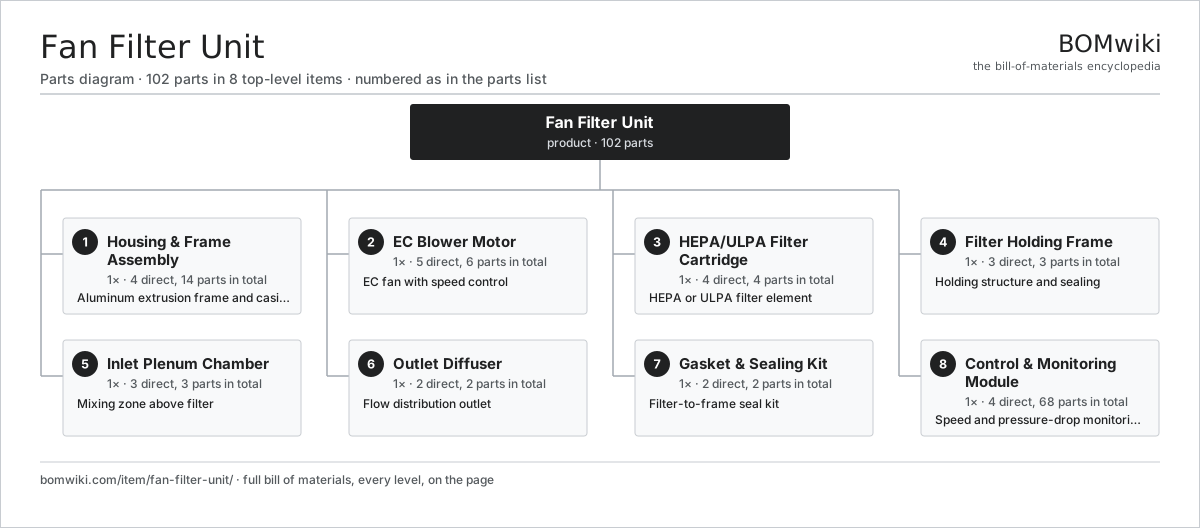
| # | Part | Qty | What it does |
|---|---|---|---|
| 1 | Housing & Frame Assembly 4 parts | 1× | Aluminum extrusion frame and casing |
| 2 | EC Blower Motor 5 parts | 1× | EC fan with speed control |
| 3 | HEPA/ULPA Filter Cartridge 4 parts | 1× | HEPA or ULPA filter element |
| 4 | Filter Holding Frame 3 parts | 1× | Holding structure and sealing |
| 5 | Inlet Plenum Chamber 3 parts | 1× | Mixing zone above filter |
| 6 | Outlet Diffuser 2 parts | 1× | Flow distribution outlet |
| 7 | Gasket & Sealing Kit 2 parts | 1× | Filter-to-frame seal kit |
| 8 | Control & Monitoring Module 4 parts | 1× | Speed and pressure-drop monitoring |
3D model
No 3D model yet. Have a CAD file of this? Add a 3D model. STL renders right on this page; STEP, FreeCAD, and OpenSCAD sources are welcome too (openly licensed, like all 3D models on BOMwiki).
Build & assembly graph
expand / collapse · shared sub-assemblies converge · links to related products · est. labourTap an assembly to expand/collapse · tap a part to open it · use “Open page” for any node · drag to pan, scroll to zoom.
Bill of materials for Fan Filter Unit
8 top-level lines · 39 rows shown · 102 parts total · indented to 3 levels| # | Item / sub-assembly | Part no. | Qty/assy | Ext. qty | Parts | Type |
|---|---|---|---|---|---|---|
| 1 | Housing & Frame Assembly 4 parts | fan-filter-unit-housing | 1× | 1 | 14 | assembly |
| 1.1 | Extrusion Frame | fan-filter-unit-frame-extrusion | 4× | 4 | · | part |
| 1.2 | Corner Bracket | fan-filter-unit-corner-bracket | 4× | 4 | · | part |
| 1.3 | Mounting Feet | fan-filter-unit-feet | 4× | 4 | · | part |
| 1.4 | Fastener Set | fastener-set | 2× | 2 | · | part |
| 2 | EC Blower Motor 5 parts | fan-filter-unit-blower-motor | 1× | 1 | 6 | assembly |
| 2.1 | EC Motor Windings | fan-filter-unit-ec-motor | 1× | 1 | · | part |
| 2.2 | Centrifugal Impeller | fan-filter-unit-impeller | 1× | 1 | · | part |
| 2.3 | Motor Ball Bearing | fan-filter-unit-motor-bearing | 2× | 2 | · | part |
| 2.4 | Motor Shroud | fan-filter-unit-motor-housing | 1× | 1 | · | part |
| 2.5 | EC Speed Controller | fan-filter-unit-ec-controller | 1× | 1 | · | part |
| 3 | HEPA/ULPA Filter Cartridge 4 parts | fan-filter-unit-filter-cartridge | 1× | 1 | 4 | assembly |
| 3.1 | Filter Media | fan-filter-unit-filter-media | 1× | 1 | · | part |
| 3.2 | Pleat Separator | fan-filter-unit-filter-separator | 1× | 1 | · | part |
| 3.3 | Filter Frame | fan-filter-unit-filter-frame-plastic | 1× | 1 | · | part |
| 3.4 | Filter Seal Gasket | fan-filter-unit-filter-seal-gasket | 1× | 1 | · | part |
| 4 | Filter Holding Frame 3 parts | fan-filter-unit-filter-frame | 1× | 1 | 3 | assembly |
| 4.1 | Frame Grid | fan-filter-unit-frame-grid | 1× | 1 | · | part |
| 4.2 | Seal Pocket | fan-filter-unit-frame-seal-pocket | 1× | 1 | · | part |
| 4.3 | Quick-Release Mechanism | fan-filter-unit-frame-quick-release | 1× | 1 | · | part |
| 5 | Inlet Plenum Chamber 3 parts | fan-filter-unit-plenum-chamber | 1× | 1 | 3 | assembly |
| 5.1 | Plenum Box | fan-filter-unit-plenum-box | 1× | 1 | · | part |
| 5.2 | Inlet Collar | fan-filter-unit-plenum-inlet-collar | 1× | 1 | · | part |
| 5.3 | Plenum Baffle | fan-filter-unit-plenum-baffle | 1× | 1 | · | part |
| 6 | Outlet Diffuser 2 parts | fan-filter-unit-diffuser | 1× | 1 | 2 | assembly |
| 6.1 | Diffuser Core | fan-filter-unit-diffuser-grid | 1× | 1 | · | part |
| 6.2 | Diffuser Frame | fan-filter-unit-diffuser-frame | 1× | 1 | · | part |
| 7 | Gasket & Sealing Kit 2 parts | fan-filter-unit-gasket-seal | 1× | 1 | 2 | assembly |
| 7.1 | EPDM Gasket Stock | fan-filter-unit-epdm-gasket | 1× | 1 | · | part |
| 7.2 | Silicone Sealant | fan-filter-unit-silicone-sealant | 1× | 1 | · | part |
| 8 | Control & Monitoring Module 4 parts | fan-filter-unit-control-module | 1× | 1 | 68 | assembly |
| 8.1 | Control Board 4 parts | fan-filter-unit-control-board | 1× | 1 | 65 | assembly |
| 8.1.1 | Bare PCB | pcb-bare | 1× | 1 | · | part |
| 8.1.2 | Microcontroller | mcu | 1× | 1 | · | part |
| 8.1.3 | SMD Passive (R/C/L) | smd-passives | 60× | 60 | · | part |
| 8.1.4 | Connector | connector | 3× | 3 | · | part |
| 8.2 | Filter Pressure Switch | fan-filter-unit-pressure-switch | 1× | 1 | · | part |
| 8.3 | Status Display | fan-filter-unit-display-panel | 1× | 1 | · | part |
| 8.4 | Network Interface Card | fan-filter-unit-network-module | 1× | 1 | · | part |
Something wrong in this list? Report a problem with this BOM.
Related products
same domain, ranked by shared parts Air Curtain
115 parts · shares 5 with this page
Air Curtain
115 parts · shares 5 with this page
 Air Handling Unit
631 parts · shares 5 with this page
Air Handling Unit
631 parts · shares 5 with this page
 Air Purifier
331 parts · shares 5 with this page
Air Purifier
331 parts · shares 5 with this page
 Ceiling Cassette AC
395 parts · shares 5 with this page
Ceiling Cassette AC
395 parts · shares 5 with this page
 Centrifugal Chiller
340 parts · shares 5 with this page
Commercial Kitchen Hood
170 parts · shares 5 with this page
Centrifugal Chiller
340 parts · shares 5 with this page
Commercial Kitchen Hood
170 parts · shares 5 with this page
Sourcing: possible vendors
Browse the supplier directory → Prices, MOQ, and lead times are algorithmic estimates, not quotes, and not claims about these companies. Company mappings are curated by keyword; est. price band $100–$20k. How estimates work| Vendor | HQ | Specialty | MOQ | Lead time |
|---|---|---|---|---|
|
🇺🇸Carrier
carrier.com ↗
|
Palm Beach Gardens, US | HVAC | 500 units | 8–14 wks |
| tranetechnologies.com ↗ | Davidson, US | HVAC | 500 units | 8–14 wks |
|
🇯🇵Daikin
daikin.com ↗
|
Osaka, JP | HVAC | 500 units | 8–14 wks |
|
🇺🇸Lennox
lennox.com ↗
|
Richardson, US | HVAC | 500 units | 8–14 wks |
| johnsoncontrols.com ↗ | Milwaukee, US | Building systems | 500 units | 8–14 wks |
1,063-word article