Feed Pusher Robot
ProductOverview
A feed pusher robot is an autonomous vehicle that continuously pushes silage or hay toward cattle in a barn, ensuring fresh feed remains within reach on the eating surface throughout the day. Cattle naturally push feed away as they eat, leaving older, less-palatable material at the rear of the bunk where it dries out and goes uneaten. A Feed Pusher Robot running 2-4 times per day counteracts this, it travels along the feed bunk, a Skirt Drive Mechanism rotating at the front and pushing all material back toward the eating line. The result is higher dry matter intake (more cattle eat more feed daily), better utilization of expensive silage, and measurable milk yield increases (2-5 % on average).
The technology is recent, commercial robots emerged around 2010, but has become standard in progressive European dairies and is rapidly spreading in North America. The economics improve with herd size (a 100-cow herd sees better ROI than a 30-cow operation), and labor savings are significant: a robot doing 4 push cycles per day eliminates a human job that previously required 1-2 hours daily.
Chassis and wheels
The Chassis Frame is a sturdy welded rectangular Main Frame (typically stainless or painted steel), 1.5-2.5 m wide, low-slung for stability. The robot sits on four or six wheels (depending on model), with independent Suspension System (spring or hydraulic) to cushion shock as it rolls over concrete and silage lumps. Tires are knobby agricultural pattern, sized to handle the damp, slippery floor of a silage barn without slipping.
Drive system
Two independent brushless Left Drive Motor and Right Drive Motor (0.5-1 kW each) drive the left and right wheels via a Wheel Gearbox reduction (typically 40-100:1, stepping down motor RPM from 200-400 to 10-30 RPM at the wheel). Each motor is controlled independently by a Motor Controller ESC, allowing differential speed for steering, turn right by spinning the left wheel faster than the right.
The Drive System delivers 2-5 km/h pushing speed, slow enough to allow cattle to move away and avoid being trapped, but fast enough to efficiently traverse a 50-100 m feed bunk in a few minutes.
Skirt and brush
The Skirt Drive Mechanism is the working end: a Brush Hub rotating at 30-60 RPM driven by a separate 0.5-1.5 kW motor. The brush is a drum or cylinder with radial Brush Bristles made of polymer or nylon, tuned in hardness to the feed type (stiffer for hay, softer for wet silage). As the robot moves forward, the rotating brush gently pushes feed laterally toward the eating surface. The bristles fold and recover, preventing aggressive damage to individual pieces while sweeping everything forward.
The brush is front-mounted so it does not push the robot itself; instead, the robot moves independently, and the brush is angled or offset to engage the feed pile.
Battery and autonomy
The Battery Pack is the critical constraint. A 4-8 kWh lithium-ion pack (typically 48 VDC, 100-200 Ah) stores energy from the drive motors (1-2 kW) and skirt motor (0.5-1.5 kW) running intermittently. A typical push cycle (3-4 minutes pushing, then return to dock) consumes 0.5-1 kWh, so a full charge allows 4-8 cycles, or 2-4 hours of continuous operation. Most dairies run the robot on a timer: morning push at 8 AM, midday at noon, afternoon at 4 PM, and evening at 8 PM, 4 cycles per day over roughly 12-16 minutes total daily pushing time.
The Battery Management System (battery management system) monitors individual cell voltages, temperature, and current draw, protecting against overcharge, deep discharge, and thermal runaway. Lithium batteries degrade slowly; after 5-6 years (1000+ charge cycles), usable capacity drops to 70-80 %. Most robots are designed for battery replacement at year 5-6, extending overall lifespan to 8-12 years.
Charging dock
The Charging Dock is a fixed docking station in the barn, typically mounted on a wall at the end of the feed bunk. The robot autonomously returns to the dock at the end of each cycle (using simple wall-following logic or GPS/fence-line navigation). The dock has spring-loaded Contact Pads (copper pads) that mate with corresponding pads on the robot's battery case. A Charger Electronics AC-DC converter steps 240 VAC down to 48 VDC at 20-30 A, charging the Battery Pack at 0.2-0.5C (slow charge, extending cell life).
Modern docks communicate with the robot via CAN bus, allowing the robot to report battery status and confirm charging state.
Navigation and autonomy
Early Control System systems were simple dead-reckoning: the robot ran forward for a fixed time, then returned. Modern systems use a Control PCB running a navigation loop that uses Proximity Sensor (LiDAR or ultrasonic) to detect the feed bunk edge and Inertial Measurement Unit inertial sensors (accelerometer and gyroscope) to track heading and distance. The robot can follow a fence line or wall, detecting obstacles and reversing if stuck. Some systems add GPS for long-range positioning, but GPS in a metal barn is unreliable; GPS is more useful for outdoor grazing or large open barns.
The Control PCB is programmed via a smartphone app or web interface, allowing the farmer to set push times, frequency, and pusher speed without mechanical adjustment.
Benefits and challenges
Benefits:
- 2-5 % increase in dry matter intake (cattle eat more fresh feed daily).
- Measurable milk yield increase (2-3 % on average across several studies).
- Reduced labor: eliminates 1-2 hours/day of manual pushing.
- Better feed utilization: less spoilage and sorting (cattle cannot pick desirable pieces and leave the rest).
- Improved herd health: constant fresh feed stimulates rumination and rumen pH stability.
Challenges:
- High capital cost: USD 60,000-120,000 new, though lease or used options reduce this.
- Requires good barn infrastructure (solid floor, adequate bunk space) for reliable operation.
- Battery degradation and replacement at 5-6 years ($15,000-25,000).
- Maintenance: brush bristle wear (yearly replacement, ~USD 500), controller software updates, dock contact maintenance.
- Learning curve for adoption: farmers must trust autonomous operation and troubleshoot navigation failures.
Placement in the dairy workflow
The Feed Pusher Robot is typically scheduled to run shortly after feeding (when fresh feed is dropped) or in the afternoon when cattle have picked through the feed and pushed it back. Dairies with robotic feeding (feed carts with auto-push systems) often pair them with a Feed Pusher Robot for complementary effect. The robot is not a replacement for human management; it is an amplifier that ensures the best feed stays available to cattle throughout the day.
On smaller dairies (< 50 cows), ROI is longer and adoption slower. On 100+ cow operations, robots are increasingly seen as essential infrastructure, similar to Herringbone Milking Parlor systems a generation ago.
Feed Pusher Robot parts and their functions
6 top-level parts · 93 parts in total · full bill of materials below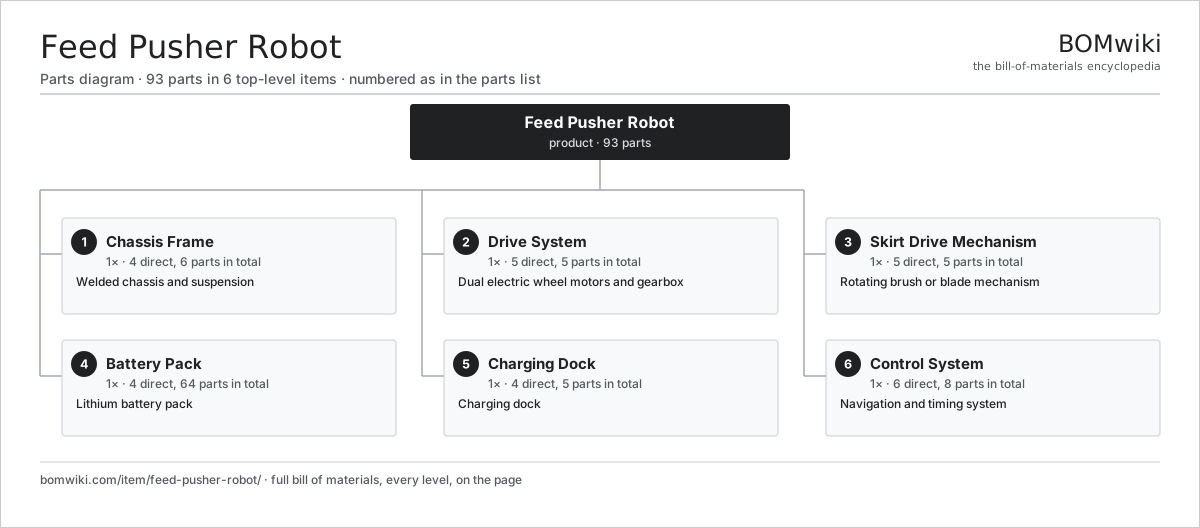
| # | Part | Qty | What it does |
|---|---|---|---|
| 1 | Chassis Frame 4 parts | 1× | Welded chassis and suspension |
| 2 | Drive System 5 parts | 1× | Dual electric wheel motors and gearbox |
| 3 | Skirt Drive Mechanism 5 parts | 1× | Rotating brush or blade mechanism |
| 4 | Battery Pack 4 parts | 1× | Lithium battery pack |
| 5 | Charging Dock 4 parts | 1× | Charging dock |
| 6 | Control System 6 parts | 1× | Navigation and timing system |
3D model
No 3D model yet. Have a CAD file of this? Add a 3D model. STL renders right on this page; STEP, FreeCAD, and OpenSCAD sources are welcome too (openly licensed, like all 3D models on BOMwiki).
Build & assembly graph
expand / collapse · shared sub-assemblies converge · links to related products · est. labourTap an assembly to expand/collapse · tap a part to open it · use “Open page” for any node · drag to pan, scroll to zoom.
Bill of materials for Feed Pusher Robot
6 top-level lines · 34 rows shown · 93 parts total · indented to 3 levels| # | Item / sub-assembly | Part no. | Qty/assy | Ext. qty | Parts | Type |
|---|---|---|---|---|---|---|
| 1 | Chassis Frame 4 parts | feed-pusher-frame | 1× | 1 | 6 | assembly |
| 1.1 | Main Frame | feed-pusher-main-frame | 1× | 1 | · | part |
| 1.2 | Feed Pusher Wheel Assembly | feed-pusher-robot-feed-pusher-wheel-assembly | 2× | 2 | · | part |
| 1.3 | Suspension System | feed-pusher-suspension | 1× | 1 | · | part |
| 1.4 | Fastener Set | fastener-set | 2× | 2 | · | part |
| 2 | Drive System 5 parts | feed-pusher-drive | 1× | 1 | 5 | assembly |
| 2.1 | Left Drive Motor | feed-pusher-left-motor | 1× | 1 | · | part |
| 2.2 | Right Drive Motor | feed-pusher-right-motor | 1× | 1 | · | part |
| 2.3 | Motor Controller | feed-pusher-motor-controller | 1× | 1 | · | part |
| 2.4 | Wheel Gearbox | feed-pusher-gearbox | 1× | 1 | · | part |
| 2.5 | Encoder | encoder | 1× | 1 | · | part |
| 3 | Skirt Drive Mechanism 5 parts | feed-pusher-skirt | 1× | 1 | 5 | assembly |
| 3.1 | Skirt Motor | feed-pusher-skirt-motor | 1× | 1 | · | part |
| 3.2 | Skirt Gearbox | feed-pusher-skirt-gearbox | 1× | 1 | · | part |
| 3.3 | Brush Hub | feed-pusher-brush-assembly | 1× | 1 | · | part |
| 3.4 | Brush Bristles | feed-pusher-brush-bristles | 1× | 1 | · | part |
| 3.5 | Coil Spring | coil-spring | 1× | 1 | · | part |
| 4 | Battery Pack 4 parts | feed-pusher-battery | 1× | 1 | 64 | assembly |
| 4.1 | Battery Enclosure | feed-pusher-battery-pack | 1× | 1 | · | part |
| 4.2 | Battery Management System | feed-pusher-bms | 1× | 1 | · | part |
| 4.3 | Li-ion Cell, 18650 | li-cell-18650 | 60× | 60 | · | part |
| 4.4 | Connector | connector | 2× | 2 | · | part |
| 5 | Charging Dock 4 parts | feed-pusher-charger | 1× | 1 | 5 | assembly |
| 5.1 | Dock Frame | feed-pusher-dock-frame | 1× | 1 | · | part |
| 5.2 | Contact Pads | feed-pusher-dock-contacts | 1× | 1 | · | part |
| 5.3 | Charger Electronics | feed-pusher-charger-module | 1× | 1 | · | part |
| 5.4 | Connector | connector | 2× | 2 | · | part |
| 6 | Control System 6 parts | feed-pusher-controls | 1× | 1 | 8 | assembly |
| 6.1 | Control PCB | feed-pusher-controller-pcb | 1× | 1 | · | part |
| 6.2 | Proximity Sensor | feed-pusher-distance-sensor | 2× | 2 | · | part |
| 6.3 | Inertial Measurement Unit | feed-pusher-imu | 1× | 1 | · | part |
| 6.4 | Microcontroller | mcu | 1× | 1 | · | part |
| 6.5 | Connector | connector | 2× | 2 | · | part |
| 6.6 | Relay | relay | 1× | 1 | · | part |
Something wrong in this list? Report a problem with this BOM.
Related products
same domain, ranked by shared parts Large Round Baler
783 parts · shares 4 with this page
Large Round Baler
783 parts · shares 4 with this page
 Agricultural Spray Drone
721 parts · shares 3 with this page
Agricultural Spray Drone
721 parts · shares 3 with this page
 Strip-Till Implement
124 parts · shares 3 with this page
Strip-Till Implement
124 parts · shares 3 with this page
 Robotic Milking System
153 parts · shares 3 with this page
Laser Land Leveler
66 parts · shares 2 with this page
Robotic Milking System
153 parts · shares 3 with this page
Laser Land Leveler
66 parts · shares 2 with this page
 Articulated Tractor
1,229 parts · shares 3 with this page
Articulated Tractor
1,229 parts · shares 3 with this page
Sourcing: possible vendors
Browse the supplier directory → Prices, MOQ, and lead times are algorithmic estimates, not quotes, and not claims about these companies. Company mappings are curated by keyword; est. price band $5k–$800k. How estimates work| Vendor | HQ | Specialty | MOQ | Lead time |
|---|---|---|---|---|
| deere.com ↗ | Moline, US | Agriculture & turf | made to order | 14–24 wks |
| cnh.com ↗ | Basildon, GB | Agriculture (Case IH, New Holland) | made to order | 14–24 wks |
|
🇺🇸AGCO
agcocorp.com ↗
|
Duluth, US | Agriculture (Fendt, Massey Ferguson) | made to order | 14–24 wks |
|
🇩🇪Claas
claas.com ↗
|
Harsewinkel, DE | Harvesters & tractors | made to order | 14–24 wks |
|
🇯🇵Kubota
kubota.com ↗
|
Osaka, JP | Compact tractors & equipment | made to order | 14–24 wks |
1,182-word article