Ferris Wheel
ProductOverview
A Ferris wheel is a large rotating vertical wheel with passenger cabins suspended from the rim. Unlike roller coasters and thrill rides, Ferris wheels prioritize scenic views, leisurely pace, and capacity. Riders experience a slow, continuous rotation (0.5–2 rpm), gradually ascending to the highest point and descending on the opposite side. A typical rotation takes 30–60 minutes, with cabins loading and unloading continuously at ground level while the wheel rotates.
Ferris wheels vary in size from small traveling wheels (20 meters diameter, 300–400 passengers per hour) to giant observation wheels (100+ meters, 1,000–2,000+ passengers per hour). They are iconic landmarks in amusement parks, waterfront areas, and theme parks worldwide.
How It Works
Cabin Suspension and Rotation
Each cabin is suspended from the rim via a pivot bearing that allows the cabin to swing slightly as the wheel rotates. As the wheel rotates, each cabin traces a vertical circle. Gravity ensures that the cabin floor remains roughly horizontal at all wheel positions (traditional Ferris wheels use gravity-based pendant suspension; modern observation wheels often have rotating cabins that actively stay upright throughout the rotation).
The drive system is a large electric motor (30–100 kW) connected via a multi-stage gearbox (reduction ratio 50:1 to 200:1) to a gear ring on the hub. The gearbox reduces motor speed from 1500–1800 rpm (standard AC induction motor) to 0.5–2 rpm wheel rotation. This low speed is essential for passenger safety and comfort, passengers should not experience significant g-forces or discomfort.
Rotation and Loading Cycle
The wheel rotates continuously at constant speed (e.g., 1 rotation per 45 minutes = 0.022 rpm). One cabin is always aligned with the loading platform at ground level. As passengers board and are seated, the wheel continues rotating very slowly. The loaded cabin gradually moves upward and to the side, making room for the next cabin to pull into the loading position.
This continuous-loading design maximizes throughput (one cabin is always being loaded while the previous cabin is climbing). A typical small wheel (36 cabins, 4 passengers per cabin) can load 144 passengers per rotation. At 1 rotation per 45 minutes, this equals 192 passengers per hour.
Cabin Load Management
As cabins move upward on the ascending side, they are slowed slightly by increased mechanical resistance (friction in the supporting cables and bearings, which increases with cabin elevation and gravitational moment). This resistance ensures that cabin speed remains constant (not accelerating downward on descent).
Some modern wheels use active load-balancing: if the ascending side becomes too heavily loaded (many cabins with full passenger counts), a secondary brake or load valve moderates to prevent uneven torque on the drive system.
Safety Mechanisms
Key safety features include:
- Soft-stop braking: The drive system includes a friction or spring-applied brake that engages if power is lost, preventing uncontrolled descent.
- Cabin door interlocks: A solenoid-locked door does not unlock until the cabin is aligned with the platform (position sensor confirms this). Passengers cannot open doors mid-rotation.
- Cable inspection: All suspension cables are visually inspected daily and replaced if any strand is broken.
- Emergency descent: If power is lost and the cabin stalls at a high elevation, a manual hand-crank or motorized backup descent system lowers the cabin at 0.1–0.3 m/s to ground level, allowing safe egress.
Mechanical Design and Components
Rim and Spoke Structure
The outer rim is a large welded steel circle, typically made from box-beam or I-beam sections joined at regular intervals (every 10–20 degrees). The rim's diameter ranges from 30 meters (small traveling wheels) to 135 meters (London Eye, world's tallest observation wheel).
Radial spokes (12–20 beams per wheel) connect the central hub to the rim. Each spoke is a large tubular or box-beam member, designed to carry:
- Compression: Cabins on the opposite side of the wheel push inward via the rim.
- Bending: Uneven cabin loading creates bending moments on the spokes.
- Tension: Cabins on the ascending side pull the rim inward via the spokes.
Spokes are analyzed for fatigue under millions of load cycles over 30–50 years of operation.
Cabin Suspension
Each cabin is suspended from the rim via a pendant system:
- Simple pendant: A cable or rod hangs vertically from the rim; the cabin is mounted at the lower end. As the wheel rotates, the cabin swings slightly due to centrifugal effects, but gravity keeps it roughly horizontal.
- Rotating cabin: Modern observation wheels use motorized cabins that rotate on their own (separate small motor) to keep the cabin floor horizontal relative to the ground frame, regardless of wheel position. This requires continuous power delivery via slip rings or wireless inductive coupling.
Suspension bearings are large angular-contact or spherical roller bearings, rated for 10–50 million cycles over the wheel's lifetime.
The Central Axle Bearing
The main axle bearing is one of the largest components, often 1–3 meters in diameter. This bearing supports:
- Radial load: Total weight of all cabins (200–500 tons depending on size) plus dynamic loading.
- Thrust load: Minimal (wheels are balanced so thrust is near zero).
- Moment load: Uneven passenger distribution creates bending moments.
Large ferris wheels use cylindrical roller bearings (one or two rows) or angular-contact ball bearings in a stacked configuration. Bearing preload (initial internal tension) is adjusted to prevent play while not over-constraining. Lubrication is critical: large bearings require continuous oil circulation (via externally mounted pumps) or grease-packed chambers.
Bearing life is typically 20–50 years with proper maintenance. Inspection every 3–5 years includes:
- Vibration analysis (detects wear or misalignment).
- Ultrasonic thickness testing (detects incipient cracks in races).
- Visual inspection for leakage or corrosion.
Drive System
The motor and gearbox are massive:
- Motor: AC induction motor, 50–100 kW (depending on wheel size), 3-phase 480 V or 600 V.
- Gearbox: Multi-stage helical or spur gearbox with ratios of 50:1 to 200:1, producing output torque of 50,000–500,000 N·m.
- Output gear: A large pinion (diameter 0.5–2 meters) meshes with an internal gear ring (diameter 20–50 meters) bolted to the wheel hub. Gear mesh is continuously lubricated via jets of circulating oil.
The variable-frequency drive (VFD) allows:
- Slow speed ramp-up at startup (2–5 seconds) to avoid shock loading.
- Constant-speed operation during normal rotation.
- Proportional braking on shutdown (smooth deceleration over 20–60 seconds).
Support Structure
The support structure is typically:
- A-frame: Two diagonal legs meeting at the top, supporting the wheel via the axle bearing. Used for smaller wheels (30–40 meters).
- Pedestal: A tall vertical column or box truss, supporting the wheel from below. Used for taller wheels (60+ meters) where A-frame sidelength becomes impractical.
Both designs are anchored to concrete foundations via large anchor bolts. Foundation depth depends on soil conditions and wheel size; typical designs include 2–4 meter deep pile caps or spread footings with 50–100 metric-ton capacity per anchor bolt group.
Cabin Design and Passenger Experience
Cabin Types
Traditional cabins are open-sided cages or partially enclosed boxes, offering unobstructed views. Passengers can feel the breeze and hear ambient sounds.
Modern observation wheels use fully enclosed climate-controlled cabins with windows on all sides, air conditioning, and often 360-degree rotating motion (cabin continuously rotates to keep passengers facing outward). These offer comfort for longer rotations (30–60 minutes) and protection from weather.
Boarding and Evacuation
Passengers board from a loading platform at ground level. The wheel rotates so slowly (often nearly imperceptible) that one cabin is always accessible at the platform. Boarding takes 1–2 minutes per cabin (loading 4–6 passengers, securing, closing doors).
In case of emergency:
- Power loss: A solenoid-released mechanical brake stops the wheel. Manual hand-crank systems (vintage) or motorized descent systems (modern) lower passengers at 0.1–0.3 m/s.
- Mechanical failure: Rescue personnel climb to the stuck cabin via a service ladder or external cage and assist passengers (very rare event).
Typical evacuation of a stuck cabin at mid-height (20–30 meters) takes 20–60 minutes, as descent is intentionally slow for safety.
Standards and Safety
Ferris wheels are designed to ASTM F24 (specifically F2291 for observation rides and F2374 for general fixed rides) and international ISO/IEC standards. Key requirements:
- Structural analysis: All welds and bolts are analyzed for fatigue under 10 million + loading cycles; typical design life is 50 years.
- Cable inspection: Every cable is visually and ultrasonically inspected annually.
- Bearing life: Main bearings are rated for 50 million+ cycles and inspected every 3–5 years.
- Emergency systems: Backup power and descent mechanisms can function for at least 8 hours continuously.
- Passenger comfort: Rotation speed is limited to 2 rpm to avoid g-forces > 0.1 g (essentially imperceptible).
Operational Economics and Market
A typical mid-sized Ferris wheel (45-meter diameter, 36 cabins, 4 passengers per cabin) costs $15–40 million including design, fabrication, installation, and infrastructure.
Annual operating costs are $400,000–$1.5 million (primarily labor, electricity, cable replacement, and bearing maintenance).
Revenue potential is $1.5–5 million per season, depending on:
- Location: High-traffic urban/tourist areas command premium tickets ($10–25 per ticket).
- Size and capacity: Larger wheels with more cabins generate higher throughput.
- Operating hours: Extended hours (12–16 hours/day) maximize revenue.
Ferris wheels are economically attractive because:
- High capacity: 1,000–2,000+ riders per hour (compared to 600–1,200 for coasters).
- Long ride duration: 30–60 minute rides mean passengers stay longer and feel they received good value.
- Minimal staff: Only 2–4 operators per shift (compared to 8–15 for dark rides).
- Low operational complexity: Simple motor control, no show systems or interactive elements.
- All-ages appeal: Safe, non-thrilling, suitable for children, elderly, and tourists.
Modern Ferris wheels are landmarks in:
- Amusement parks (Coney Island, Six Flags parks).
- Tourist destinations (London Eye, Singapore Flyer, High Roller Vegas).
- Waterfront redevelopment projects.
- Shopping malls and entertainment districts.
Recent innovations include:
- Observation wheel capsules: Luxury enclosed cabins with glass floors, interactive screens, and light shows.
- Gondola-style cabins: Smaller enclosed bubbles (2–4 passengers) suspended throughout the wheel structure (used in observation wheels like the Observation Wheel in Singapore).
- Tilting wheels: Some newer designs tilt the wheel 15–20° during rotation, adding a slight thrill element while maintaining safety.
- LED light shows: Nighttime operation with synchronized color-changing LED lighting on the rim and cabins.
Ferris wheels have experienced a resurgence in recent years due to their iconic status, Instagram-worthy aesthetics, and appeal to broad demographics, they remain one of the most financially successful amusement attractions per operating hour.
Ferris Wheel parts and their functions
8 top-level parts · 3,547 parts in total · full bill of materials below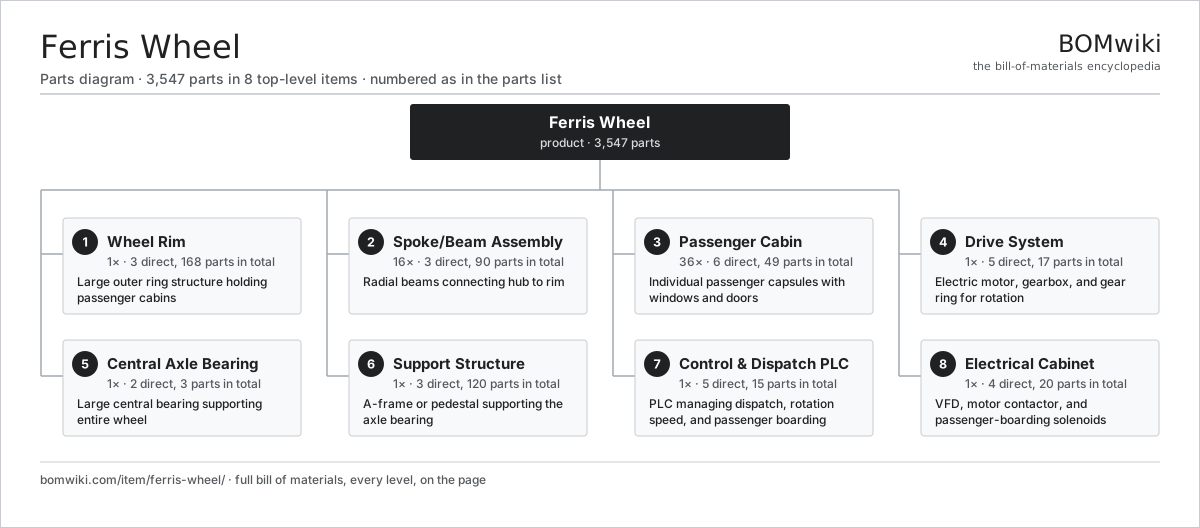
| # | Part | Qty | What it does |
|---|---|---|---|
| 1 | Wheel Rim 3 parts | 1× | Large outer ring structure holding passenger cabins |
| 2 | Spoke/Beam Assembly 3 parts | 16× | Radial beams connecting hub to rim |
| 3 | Passenger Cabin 6 parts | 36× | Individual passenger capsules with windows and doors |
| 4 | Drive System 5 parts | 1× | Electric motor, gearbox, and gear ring for rotation |
| 5 | Central Axle Bearing 2 parts | 1× | Large central bearing supporting entire wheel |
| 6 | Support Structure 3 parts | 1× | A-frame or pedestal supporting the axle bearing |
| 7 | Control & Dispatch PLC 5 parts | 1× | PLC managing dispatch, rotation speed, and passenger boarding |
| 8 | Electrical Cabinet 4 parts | 1× | VFD, motor contactor, and passenger-boarding solenoids |
Diagrams & photos

.jpg)
3D model
No 3D model yet. Have a CAD file of this? Add a 3D model. STL renders right on this page; STEP, FreeCAD, and OpenSCAD sources are welcome too (openly licensed, like all 3D models on BOMwiki).
Build & assembly graph
expand / collapse · shared sub-assemblies converge · links to related products · est. labourTap an assembly to expand/collapse · tap a part to open it · use “Open page” for any node · drag to pan, scroll to zoom.
Bill of materials for Ferris Wheel
8 top-level lines · 49 rows shown · 3,547 parts total · indented to 3 levels| # | Item / sub-assembly | Part no. | Qty/assy | Ext. qty | Parts | Type |
|---|---|---|---|---|---|---|
| 1 | Wheel Rim 3 parts | ferris-wheel-rim | 1× | 1 | 168 | assembly |
| 1.1 | Sheet Metal Panel | sheet-panel | 120× | 120 | · | part |
| 1.2 | Fastener Set | fastener-set | 12× | 12 | · | part |
| 1.3 | Ball Bearing | ball-bearing | 36× | 36 | · | part |
| 2 | Spoke/Beam Assembly 3 parts | ferris-wheel-spokes | 16× | 16 | 90 | assembly |
| 2.1 | Sheet Metal Panel | sheet-panel | 80× | 1,280 | · | part |
| 2.2 | Fastener Set | fastener-set | 8× | 128 | · | part |
| 2.3 | Ball Bearing | ball-bearing | 2× | 32 | · | part |
| 3 | Passenger Cabin 6 parts | ferris-wheel-cabin-assembly | 36× | 36 | 49 | assembly |
| 3.1 | Cabin Frame | ferris-wheel-cabin-frame | 1× | 36 | · | part |
| 3.2 | Cabin Exterior Shell | ferris-wheel-cabin-shell | 1× | 36 | · | part |
| 3.3 | Seat Assembly 5 parts | seat-assembly | 6× | 216 | 7 | assembly |
| 3.3.1 | Seat Frame | seat-frame | 1× | 216 | · | part |
| 3.3.2 | Seat Foam | seat-foam | 2× | 432 | · | part |
| 3.3.3 | Seat Cover | seat-cover | 1× | 216 | · | part |
| 3.3.4 | Seat Motor | seat-motor | 2× | 432 | · | part |
| 3.3.5 | Seat Heater Mat | seat-heater | 1× | 216 | · | part |
| 3.4 | Fastener Set | fastener-set | 2× | 72 | · | part |
| 3.5 | Connector | connector | 1× | 36 | · | part |
| 3.6 | Ball Bearing | ball-bearing | 2× | 72 | · | part |
| 4 | Drive System 5 parts | ferris-wheel-drive-system | 1× | 1 | 17 | assembly |
| 4.1 | Blower Motor | blower-motor | 1× | 1 | · | part |
| 4.2 | Gearbox Housing | gearbox-housing | 1× | 1 | · | part |
| 4.3 | Ball Bearing | ball-bearing | 4× | 4 | · | part |
| 4.4 | Wheel Assembly 5 parts | wheel-assembly | 1× | 1 | 9 | assembly |
| 4.4.1 | Alloy Wheel | alloy-wheel | 1× | 1 | · | part |
| 4.4.2 | Tire | tire | 1× | 1 | · | part |
| 4.4.3 | TPMS Sensor | tpms-sensor | 1× | 1 | · | part |
| 4.4.4 | Lug Nut | lug-nut | 5× | 5 | · | part |
| 4.4.5 | Valve Stem | valve-stem | 1× | 1 | · | part |
| 4.5 | Fastener Set | fastener-set | 2× | 2 | · | part |
| 5 | Central Axle Bearing 2 parts | ferris-wheel-axle-bearing | 1× | 1 | 3 | assembly |
| 5.1 | Ball Bearing | ball-bearing | 1× | 1 | · | part |
| 5.2 | Fastener Set | fastener-set | 2× | 2 | · | part |
| 6 | Support Structure 3 parts | ferris-wheel-support-structure | 1× | 1 | 120 | assembly |
| 6.1 | Sheet Metal Panel | sheet-panel | 100× | 100 | · | part |
| 6.2 | Fastener Set | fastener-set | 16× | 16 | · | part |
| 6.3 | Ball Bearing | ball-bearing | 4× | 4 | · | part |
| 7 | Control & Dispatch PLC 5 parts | ferris-wheel-control-system | 1× | 1 | 15 | assembly |
| 7.1 | Microcontroller | mcu | 1× | 1 | · | part |
| 7.2 | Relay | relay | 8× | 8 | · | part |
| 7.3 | Bare PCB | pcb-bare | 2× | 2 | · | part |
| 7.4 | LCD Panel | lcd-panel | 1× | 1 | · | part |
| 7.5 | Connector | connector | 3× | 3 | · | part |
| 8 | Electrical Cabinet 4 parts | ferris-wheel-electrical-cabinet | 1× | 1 | 20 | assembly |
| 8.1 | Relay | relay | 12× | 12 | · | part |
| 8.2 | Power Supply | power-supply | 2× | 2 | · | part |
| 8.3 | Connector | connector | 4× | 4 | · | part |
| 8.4 | Fastener Set | fastener-set | 2× | 2 | · | part |
Something wrong in this list? Report a problem with this BOM.
Related products
same domain, ranked by shared parts Roller Coaster
657 parts · shares 19 with this page
Roller Coaster
657 parts · shares 19 with this page
 Dark Ride System
1,005 parts · shares 17 with this page
Dark Ride System
1,005 parts · shares 17 with this page
 Alpine Coaster
1,850 parts · shares 10 with this page
Alpine Coaster
1,850 parts · shares 10 with this page
 Hobby RC Car
114 parts · shares 7 with this page
Hobby RC Car
114 parts · shares 7 with this page
 Kids Electric Balance Bike
129 parts · shares 6 with this page
Kids Electric Balance Bike
129 parts · shares 6 with this page
 Pirate Ship Ride
478 parts · shares 13 with this page
Pirate Ship Ride
478 parts · shares 13 with this page
Sourcing: possible vendors
Browse the supplier directory → Prices, MOQ, and lead times are algorithmic estimates, not quotes, and not claims about these companies. Company mappings are curated by keyword; est. price band $20–$3k. How estimates work| Vendor | HQ | Specialty | MOQ | Lead time |
|---|---|---|---|---|
|
🇩🇰LEGO
lego.com ↗
|
Billund, DK | Construction toys | 2,000 units | 6–10 wks |
|
🇺🇸Mattel
mattel.com ↗
|
El Segundo, US | Toys | 2,000 units | 6–10 wks |
|
🇺🇸Hasbro
hasbro.com ↗
|
Pawtucket, US | Toys & games | 2,000 units | 6–10 wks |
| bandainamco.co.jp ↗ | Tokyo, JP | Toys & amusement | 2,000 units | 6–10 wks |
| spinmaster.com ↗ | Toronto, CA | Toys | 2,000 units | 6–10 wks |
1,829-word article