Fertigation System
ProductOverview
Fertigation is precision irrigation combined with dissolved nutrient injection, delivering water and balanced fertilizer simultaneously through drip emitters. The system responds to soil moisture conditions: when matric potential (water availability) drops below a programmed setpoint, the irrigation pump activates and proportional dosing pumps inject concentrated nutrients into the main water stream. The Venturi Injector or Nutrient Dosing Pump mixes stock solutions into the flow stream, arriving at the drip line at target EC (electrical conductivity).
Fertigation is the dominant cultivation method for high-value field crops (vegetables, berries, orchard fruits) in arid and semi-arid regions. It reduces water consumption by 30–50% vs. flood irrigation while improving nutrient use efficiency by 15–25%, because fertilizer is delivered on-demand only when roots can absorb it. Combined with real-time EC and soil moisture feedback, fertigation minimizes nutrient waste and leaching into groundwater.
How It Works
The system operates on a demand-driven cycle initiated by soil moisture sensors buried 15–30 cm deep in the root zone. The Soil Moisture Sensor measures matric potential (the water tension holding water in soil pores), typically reporting 0–50 kPa range. When matric potential drops (meaning soil is drying toward wilting point), the sensor signal triggers the Controller Unit.
The controller energizes the Main Irrigation Pump, which draws water from a well, tank, or mains supply through a ebb-flow-system-pump-inlet-strainer. This water is pressurized to 2–3 bar and directed toward the Filtration Stage, which protects drip emitters from clogging by removing sediment and chemical precipitate.
Simultaneously, the controller activates the Nutrient Dosing Pump, which draws dilute stock solution from one or more Nutrient Stock Tanks. A proportional EC Dosing Solenoid or variable-speed motor control adjusts pump output based on EC feedback. The stock solution is injected into the main line via the Venturi Injector, a pressure-driven mixer exploiting the Bernoulli effect: as main water flows through a narrow orifice, pressure drops, creating suction that draws concentrate into the stream. Mixing occurs instantaneously; the combined nutrient-enriched water flows into the Drip Line Network.
Drip laterals run the length of crop rows, with Drip Emitter spaced at 0.3–1.5 m intervals. Each emitter is calibrated for 0.5–2 L/h, releasing a steady stream that wets soil in a cone pattern around the plant. Root uptake is precise: water is applied only where roots are, minimizing runoff and evaporation.
Real-time feedback from a EC Sensor Probe at the drip outlet ensures nutrient concentration remains at target (typically 1.0–1.2 mS/cm). If EC drifts high, the controller proportionally reduces dosing pump speed; if EC drifts low, it increases speed. This closed-loop adjustment maintains optimal nutrient availability throughout the irrigation event.
When soil moisture recovers (matric potential returns to setpoint), the controller shuts both pumps off, ending the cycle. A typical full cycle lasts 20–60 minutes, depending on soil type, root density, and transpiration rate.
Soil Moisture Control Strategy
Two common control modes:
Tensiometric (Water Tension) Control: The Soil Moisture Sensor measures matric potential directly (kPa). Setpoints typically range from -10 kPa (just after irrigation, soil at field capacity) to -30 kPa (optimal for most crops, balancing water availability and aeration). When matric potential drops below setpoint (e.g., -40 kPa during dry afternoon), irrigation triggers.
Capacitive (Volumetric Water Content) Control: Some sensors measure total water volume in a soil sample (0–50% by volume). Setpoint is set to maintain 30–40% volumetric water content, equivalent to -20 to -30 kPa matric potential for most soils.
Tensiometric is more precise for scheduling because it directly reflects plant available water; capacitive is cheaper but requires soil-specific calibration curves.
Nutrient Tank Configuration
Most systems use three separate Nutrient Stock Tanks:
Tank A: Macronutrients (nitrogen, phosphorus, potassium) as soluble salts.
Tank B: Secondary nutrients (calcium, magnesium, sulfur) and micronutrients (iron, manganese, zinc, boron, copper, molybdenum) as chelates.
Tank C: Optional acid (phosphoric acid or nitric acid) for pH correction if irrigation water is alkaline.
Separate tanks prevent precipitation: certain nutrients (Ca²⁺, Mg²⁺, PO₄³⁻) form insoluble salts if mixed at high concentration. Stock solutions are kept at ~2–5× concentration, then diluted by the Nutrient Dosing Pump during injection.
Calibration and Maintenance
Soil sensor calibration (quarterly): Tensiometric probes must be tested against a pressure chamber or calibration curve specific to soil texture. Capacitive sensors require periodic soil moisture verification using gravimetric sampling (oven-drying soil samples).
EC sensor cleaning (monthly): The EC Sensor Probe electrode can develop biofilm, causing reading drift. Soak in 5% bleach or 1% HCl solution for 15 minutes, then rinse thoroughly.
Filter cartridge replacement (every 30–50 operating hours): When Filtration Stage pressure gauge exceeds 2–3 bar, the Filter Cartridge is saturated; replace immediately.
Drip line inspection (monthly): Check for clogging (low flow rate per emitter) or blockage. Pressure-compensated emitters are more resilient than simple orifices; turbulent-flow designs self-clean by vibration. Run system daily at 2× normal pressure for 5 minutes to flush sediment.
Nutrient tank level monitoring (daily): The Tank Standpipe float switch triggers an alarm when stock falls below 10% capacity, prompting refill.
Field Application Examples
Vegetable Production (Tomatoes, Peppers, Cucumbers): Soil moisture setpoint -20 to -30 kPa. EC target 1.0–1.2 mS/cm. Irrigation cycles 2–4 times daily in summer, once daily in spring/fall. Nutrient uptake peaks during fruiting (weeks 8–16), requiring higher proportional dosing.
Berry Production (Strawberries, Blueberries): Acidic soil preference (pH 5.5–6.5). Fertigation delivers iron chelate to prevent chlorosis. EC 0.8–1.0 mS/cm. Frequency increases during flowering and fruit set.
Orchard Fruit (Apple, Citrus): Deep soils allow less frequent irrigation (once every 2–3 days). EC 0.6–0.8 mS/cm (lower concentration, avoiding salt burn). Fertigation reduces nitrogen leaching to groundwater vs. annual broadcast applications.
Water and Nutrient Savings
Fertigation reduces water consumption by 30–50% vs. flood irrigation (sprinkler) because water is applied only to the active root zone, not broadcast across entire field with evaporative losses (20–30% of applied water). Nutrient use efficiency increases by 15–25% because fertilizer is delivered on-demand, synchronized with peak root absorption (midday, during active transpiration), not applied as pre-season broadcast where leaching losses are high.
Example: A 1-hectare tomato field using flood irrigation (50,000 L/ha per season) releases ~40% as nutrient runoff (1,500 kg N/ha). Fertigation (25,000 L/ha, 1.0 EC) delivers ~300 kg N/ha, matching crop demand more precisely.
Integration with Climate and Variability
The Temperature Probe allows seasonal adjustment of target matric potential: as ambient temperature rises and transpiration increases, the controller automatically reduces setpoint (e.g., from -30 to -20 kPa) to increase irrigation frequency and maintain plant water status.
Rainfall integration (optional): A rain gauge input allows the controller to pause scheduled irrigation if significant rainfall occurs, further conserving water and reducing nitrogen runoff.
Comparison to Alternatives
Hand-mixed, time-based drip irrigation: Labor-intensive, variable nutrient concentration. High nutrient waste (over-application leads to leaching).
Broadcast fertilization + flood irrigation: Coarse control; 20–40% nutrient losses to runoff and leaching.
Precision soil testing (weekly samples, manual recipe adjustment): Higher labor cost but similar performance to automated fertigation. Automated systems are superior due to real-time feedback and consistency.
Fertigation is the standard in modern high-value horticulture and semi-arid agriculture, combining efficiency, consistency, and reduced environmental impact.
Fertigation System parts and their functions
8 top-level parts · 41 parts in total · full bill of materials below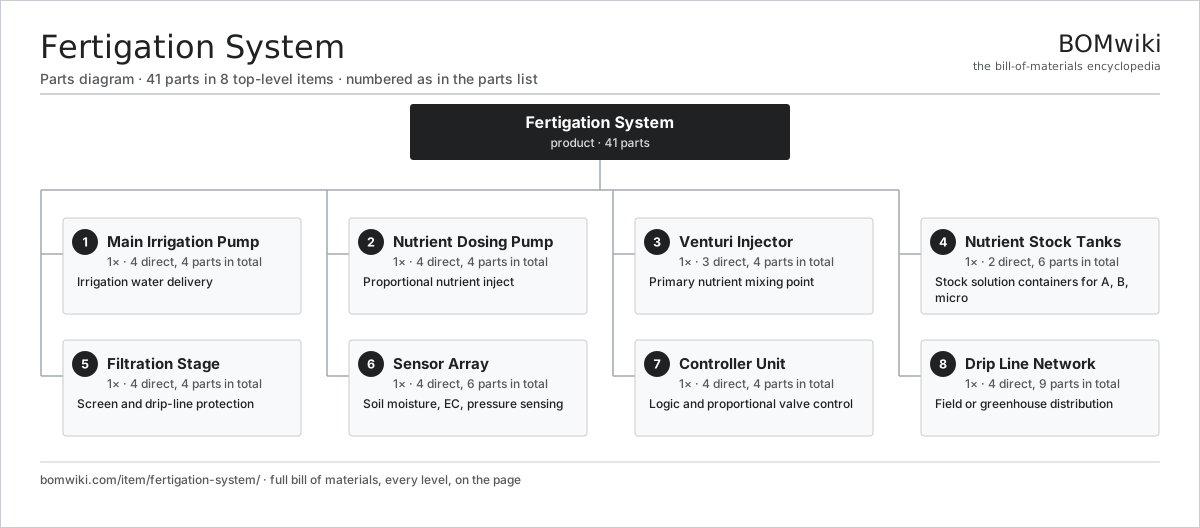
| # | Part | Qty | What it does |
|---|---|---|---|
| 1 | Main Irrigation Pump 4 parts | 1× | Irrigation water delivery |
| 2 | Nutrient Dosing Pump 4 parts | 1× | Proportional nutrient inject |
| 3 | Venturi Injector 3 parts | 1× | Primary nutrient mixing point |
| 4 | Nutrient Stock Tanks 2 parts | 1× | Stock solution containers for A, B, micro |
| 5 | Filtration Stage 4 parts | 1× | Screen and drip-line protection |
| 6 | Sensor Array 4 parts | 1× | Soil moisture, EC, pressure sensing |
| 7 | Controller Unit 4 parts | 1× | Logic and proportional valve control |
| 8 | Drip Line Network 4 parts | 1× | Field or greenhouse distribution |
3D model
No 3D model yet. Have a CAD file of this? Add a 3D model. STL renders right on this page; STEP, FreeCAD, and OpenSCAD sources are welcome too (openly licensed, like all 3D models on BOMwiki).
Build & assembly graph
expand / collapse · shared sub-assemblies converge · links to related products · est. labourTap an assembly to expand/collapse · tap a part to open it · use “Open page” for any node · drag to pan, scroll to zoom.
Bill of materials for Fertigation System
8 top-level lines · 37 rows shown · 41 parts total · indented to 3 levels| # | Item / sub-assembly | Part no. | Qty/assy | Ext. qty | Parts | Type |
|---|---|---|---|---|---|---|
| 1 | Main Irrigation Pump 4 parts | fertigation-system-main-pump | 1× | 1 | 4 | assembly |
| 1.1 | Blower Motor | blower-motor | 1× | 1 | · | part |
| 1.2 | Motor Housing | motor-housing | 1× | 1 | · | part |
| 1.3 | Ebb Flow System Pump Inlet Strainer | fertigation-system-ebb-flow-system-pump-inlet-strainer | 1× | 1 | · | part |
| 1.4 | Pressure Sensor | pressure-sensor | 1× | 1 | · | part |
| 2 | Nutrient Dosing Pump 4 parts | fertigation-system-dosing-pump | 1× | 1 | 4 | assembly |
| 2.1 | Dosing Pump Motor | fertigation-system-dosing-motor | 1× | 1 | · | part |
| 2.2 | Dosing Pump | nft-hydroponic-system-dosing-pump | 1× | 1 | · | part |
| 2.3 | Pump Tubing | fertigation-system-pump-tubing | 1× | 1 | · | part |
| 2.4 | Ebb Flow System Check Valve | fertigation-system-ebb-flow-system-check-valve | 1× | 1 | · | part |
| 3 | Venturi Injector 3 parts | fertigation-system-venturi-injector | 1× | 1 | 4 | assembly |
| 3.1 | Venturi Body | fertigation-system-venturi-body | 1× | 1 | · | part |
| 3.2 | Ebb Flow System Check Valve | fertigation-system-ebb-flow-system-check-valve | 2× | 2 | · | part |
| 3.3 | Pressure Sensor | pressure-sensor | 1× | 1 | · | part |
| 4 | Nutrient Stock Tanks 2 parts | fertigation-system-nutrient-tanks | 1× | 1 | 6 | assembly |
| 4.1 | Nutrient Stock Bottles | nft-hydroponic-system-nutrient-bottles | 3× | 3 | · | part |
| 4.2 | Tank Standpipe | fertigation-system-tank-standpipe | 3× | 3 | · | part |
| 5 | Filtration Stage 4 parts | fertigation-system-filtration-stage | 1× | 1 | 4 | assembly |
| 5.1 | Filter Housing | nft-hydroponic-system-filter-housing | 1× | 1 | · | part |
| 5.2 | Filter Cartridge | nft-hydroponic-system-filter-cartridge | 1× | 1 | · | part |
| 5.3 | Filter Bypass Valve | nft-hydroponic-system-bypass-valve | 1× | 1 | · | part |
| 5.4 | Pressure Sensor | pressure-sensor | 1× | 1 | · | part |
| 6 | Sensor Array 4 parts | fertigation-system-sensor-array | 1× | 1 | 6 | assembly |
| 6.1 | Soil Moisture Sensor | fertigation-system-soil-moisture-sensor | 2× | 2 | · | part |
| 6.2 | EC Sensor Probe | nft-hydroponic-system-ec-sensor | 1× | 1 | · | part |
| 6.3 | Pressure Sensor | pressure-sensor | 2× | 2 | · | part |
| 6.4 | Temperature Probe | fertigation-system-temperature-probe | 1× | 1 | · | part |
| 7 | Controller Unit 4 parts | fertigation-system-controller-unit | 1× | 1 | 4 | assembly |
| 7.1 | Controller Unit | nft-hydroponic-system-controller-unit | 1× | 1 | · | part |
| 7.2 | Nft Hydroponic System Relay Board | fertigation-system-nft-hydroponic-system-relay-board | 1× | 1 | · | part |
| 7.3 | Sensor Reader Display | ebb-flow-system-sensor-reader-display | 1× | 1 | · | part |
| 7.4 | Wire Bundle | wire-bundle | 1× | 1 | · | part |
| 8 | Drip Line Network 4 parts | fertigation-system-drip-line-network | 1× | 1 | 9 | assembly |
| 8.1 | Nft Hydroponic System Main Supply Line | fertigation-system-nft-hydroponic-system-main-supply-line | 1× | 1 | · | part |
| 8.2 | Ebb Flow System Distribution Tube | fertigation-system-ebb-flow-system-distribution-tube | 1× | 1 | · | part |
| 8.3 | Drip Emitter | fertigation-system-drip-emitter | 1× | 1 | · | part |
| 8.4 | Ebb Flow System Isolation Valve | fertigation-system-ebb-flow-system-isolation-valve | 6× | 6 | · | part |
Something wrong in this list? Report a problem with this BOM.
Related products
same domain, ranked by shared parts NFT Hydroponic System
91 parts · shares 10 with this page
Ebb and Flow System
61 parts · shares 2 with this page
Germination Chamber
55 parts · shares 2 with this page
NFT Hydroponic System
91 parts · shares 10 with this page
Ebb and Flow System
61 parts · shares 2 with this page
Germination Chamber
55 parts · shares 2 with this page
 Vertical Farm Rack
414 parts · shares 2 with this page
Vertical Farm Rack
414 parts · shares 2 with this page
 Egg Incubator
47 parts · shares 1 with this page
Egg Incubator
47 parts · shares 1 with this page
 Agricultural Spray Drone
721 parts · shares 3 with this page
Agricultural Spray Drone
721 parts · shares 3 with this page
Sourcing: possible vendors
Browse the supplier directory → Prices, MOQ, and lead times are algorithmic estimates, not quotes, and not claims about these companies. Company mappings are curated by keyword; est. price band $5k–$800k. How estimates work| Vendor | HQ | Specialty | MOQ | Lead time |
|---|---|---|---|---|
| deere.com ↗ | Moline, US | Agriculture & turf | made to order | 14–24 wks |
| cnh.com ↗ | Basildon, GB | Agriculture (Case IH, New Holland) | made to order | 14–24 wks |
|
🇺🇸AGCO
agcocorp.com ↗
|
Duluth, US | Agriculture (Fendt, Massey Ferguson) | made to order | 14–24 wks |
|
🇩🇪Claas
claas.com ↗
|
Harsewinkel, DE | Harvesters & tractors | made to order | 14–24 wks |
|
🇯🇵Kubota
kubota.com ↗
|
Osaka, JP | Compact tractors & equipment | made to order | 14–24 wks |
1,283-word article