Fiber Laser Cutter
ProductAlso known as: Fiber Laser Cutting Machine
Overview
A fiber laser cutter uses a high-power infrared laser beam to melt or vaporize metal, cutting complex shapes in sheet stock with minimal thermal distortion and edge quality suitable for direct assembly. Unlike CO₂ lasers (which excel at cutting acrylic and wood), fiber lasers are optimized for metals, they focus light at 1.064 μm wavelength, which is strongly absorbed by steel, aluminum, and stainless. A Fiber Laser Source generates the beam continuously at power levels from 500 W to 6000 W (high-end industrial machines). The beam is delivered via a single-mode optical fiber to a Cutting Head, where galvanometer-scanning mirrors rapidly redirect the focused spot across the cutting plane. The workpiece sits on a Cutting Table and is positioned by servo motors on the Motion System. Assist gas (compressed air or oxygen) blows out molten metal and dross, and the combination of high-energy focusing and gas pressure slices through sheet metal at speeds of 5–10 m/min for thin gauge and 0.5–2 m/min for heavy plate.
Fiber laser physics and wavelength advantages
The Fiber Laser Source consists of a Laser Module doped with rare-earth ytterbium atoms. A high-power diode laser (pump) optically excites ytterbium ions inside the fiber, causing stimulated emission of 1.064 μm photons. Unlike CO₂ lasers (which generate 10.6 μm infrared, absorbed well by dielectrics but poorly by metals), the 1.064 μm wavelength is highly absorbed by all metals. Reflectivity is low: mild steel absorbs ~65 % of fiber laser light, compared to ~2–5 % for CO₂. This high absorption translates to faster cutting speed and less wasted energy.
Beam quality (characterized by the M² parameter) is near diffraction-limited (M² < 1.3), meaning the laser can be focused to a very tight spot (0.1–0.2 mm), enabling fine detail and tight tolerances. The fiber delivery system is also an advantage: the Fiber Coupler is a flexible single-mode fiber, allowing the laser source to be remote from the cutting head. Many systems mount the laser in a sealed enclosure while the cutting head rides on the gantry, reducing mechanical mass and improving motion responsiveness.
Cutting mechanism and thermodynamics
As the Cutting Head is positioned over a workpiece edge or center point by the X-Y servo motors, the laser beam melts and vaporizes metal along a narrow line. The focused spot, typically 0.1–0.2 mm diameter, concentrates immense power density (MW/cm²), raising metal temperature above its melting point in microseconds. The Assist Gas System pressurized air or oxygen jet (1–2 bar) blows out the molten material and prevents resolidification along the kerf (cut edge). Oxygen-assist gas increases cutting speed (chemical energy from oxidation) but may leave a slightly oxidized edge; air-assist is gentler and preferred for stainless or finishes where oxidation discoloration is undesirable.
Cutting speeds depend on material, thickness, and laser power:
- Mild steel 1 mm: 5–10 m/min
- Stainless steel 1 mm: 2–4 m/min (lower thermal conductivity)
- Aluminum 1 mm: 1–3 m/min (higher reflectivity, more power required)
- Mild steel 5 mm: 1–2 m/min
- Mild steel 12 mm: 0.3–0.5 m/min
Edge quality is excellent: typical kerf width is 0.3–0.5 mm, and the HAZ (heat-affected zone) is minimal because the thermal cycle is so fast, the material is only exposed to extreme temperature for microseconds.
Galvanometer scanning and motion system
The Cutting Head contains Galvanometer Scanner, which are rapidly rotating mirrors with electromagnetic voice-coil actuators. The PLC commands the X and Y galvanometer angles, and the mirrors deflect the incoming beam to trace the part outline at speeds up to 10 m/s. Galvanometer scanning is orders of magnitude faster than mechanical XY table motion, making it ideal for engraving and detail work. However, for straight-line production cutting, the mechanical Motion System (X-Servo Motor and Y-Servo Motor) is typically used, moving the entire gantry (and cutting head) to reposition the workpiece.
Most industrial setups use a hybrid approach:
- Galvanometers handle small features (engravings, lettering, fine details) with high speed.
- Mechanical XY motion handles large-scale workpiece positioning and edge cutting.
The F-Theta Lens (an F-theta optics assembly) ensures the beam remains focused at the cutting plane throughout the scan field, maintaining consistent kerf width and edge quality.
Workpiece support and material handling
The Cutting Table is either:
Slat system: Parallel hardened aluminum slats resting on support rails, with gaps between slats that allow the laser to penetrate through small parts and cut-offs. Slats are replaced every 500–1000 hours as the laser scars them.
Honeycomb grid: Phenolic or aluminum honeycomb core providing continuous support with small holes (1–2 mm diameter) that the laser can penetrate. Honeycomb is denser and provides better support for delicate parts but is more expensive and is replaced periodically.
The Drainage Pan below the table collects dross, slag, and cooling water runoff. For production, an automated loading system (conveyor) or gantry-mount can index new sheets into position between cuts.
Thermal management and cooling
The Water Cooling System system is critical. The fiber laser module, optical head, and galvanometers all generate heat. Maintaining the optical head below 35 °C ensures the F-Theta Lens focal length remains stable and the galvanometers' servo response is consistent. The Water Chiller (thermostatic or active refrigeration) circulates chilled water at 15–25 °C. The Flow Sensor and Temperature Sensor provide feedback; if flow drops or temperature rises, the CNC stops lasing immediately to prevent component damage. Cooling load is typically 5–10 kW for a 1–2 kW laser because significant energy is wasted as heat in the power electronics and optical propagation.
Fume extraction and safety
Fume Extraction is essential. Laser cutting of metals produces zinc oxide vapor (from galvanized steel), stainless dust, and particulates. The Extraction Fan (1000–3000 CFM depending on table size) evacuates the Extraction Hood enclosure. Particles are removed by a Extraction Filter (HEPA or multi-stage), and the cleaned air is exhausted outside or recirculated if using an activated-carbon filter. Continuous Airflow Meter monitoring alerts the operator if extraction fails.
Safety interlocks prevent lasing if the hood is open or extraction airflow is inadequate. Fiber lasers are Class 4 (maximum hazard); direct or diffuse-reflected beams can cause instant blindness. All fiber and beam paths are enclosed in metal conduits or solid housings.
Assist gas and cut quality
The Assist Gas System delivers compressed air or pure oxygen at 0.5–2.0 bar through the nozzle coaxially with the laser beam. For oxygen, the chemical energy of oxidation adds 20–30 % cutting speed and produces a sharp edge, making oxygen ideal for production. Air is used for edge quality-sensitive parts (polished surfaces) and for cuts that will be welded (oxygen-cut edges have lower weldability). Nitrogen is sometimes used for stainless and aluminum to prevent oxidation, but it offers no speed benefit.
Control system and part programming
The CNC Control System reads CAD files (DXF, PDF, or proprietary formats) and converts them to motion commands and laser power modulation. The Motion Control Card outputs step/direction pulses to the X and Y X-Servo Motor and Y-Servo Motor, while the Laser Power Driver modulates laser power (0–100 %) via PWM or 0–10 V analog output. The Gas Solenoid Valve solenoid is synchronized with cutting: gas valve opens slightly before the laser fires and closes after, minimizing gas consumption.
Nesting software optimizes part layout on the sheet, calculating scrap minimization and cutting sequence. Many systems interface with CAM software (AutoCAD, CorelDRAW) or use vendor-specific CAM (Trotec JobControl, Epilog Dashboard).
Edge quality and post-processing
Fiber laser-cut edges are smooth and require minimal post-processing. Mild steel edges may have slight dross (solidified metal) on the bottom, which can be wiped away with a cloth or light wire brushing. Stainless and aluminum cut cleanly with negligible dross. Very thick material (> 10 mm) may benefit from a light deburring pass, but most laser-cut parts go directly to assembly.
Maintenance and uptime
The fiber laser source is sealed and maintenance-free; no mirrors to clean or lenses to realign. Water filtration (100 micron) prevents deposits on the cooling jacket. Cutting Surface (Slats or Honeycomb) replacement and Extraction Filter replacement are the main consumables. Ballscrew and servo encoders are standard industrial components with 10,000+ hour lifespans. Total mean time between failures is typically 5,000–10,000 hours, and repair turnaround is days because parts are standard and the laser module can be swapped quickly.
Economics and ROI
A 1–2 kW fiber laser cutter costs £40,000–£80,000. A 6 kW machine costs £150,000–£250,000. Compared to manual shearing, drilling, and hand-tool operations, a laser pays back in 18–36 months on moderate-volume metal-fabrication shops (20–50 parts/day cutting activity). High-speed cutting and zero retools make complex prototype-to-production transitions economical.
Fiber Laser Cutter parts and their functions
9 top-level parts · 88 parts in total · full bill of materials below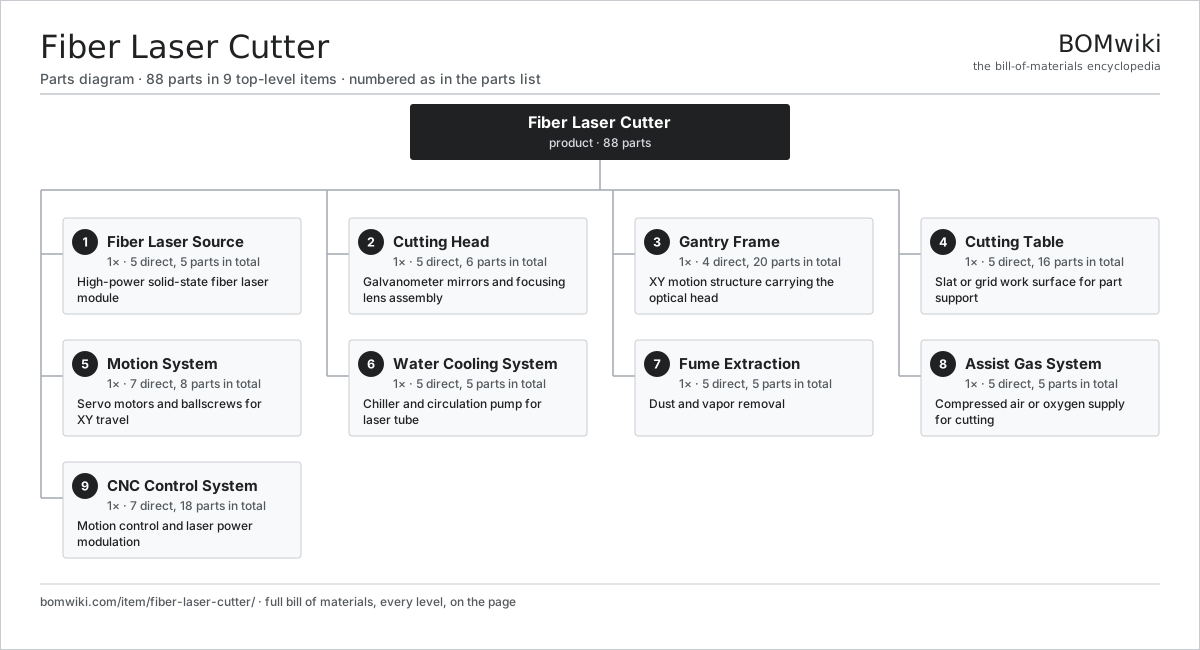
| # | Part | Qty | What it does |
|---|---|---|---|
| 1 | Fiber Laser Source 5 parts | 1× | High-power solid-state fiber laser module |
| 2 | Cutting Head 5 parts | 1× | Galvanometer mirrors and focusing lens assembly |
| 3 | Gantry Frame 4 parts | 1× | XY motion structure carrying the optical head |
| 4 | Cutting Table 5 parts | 1× | Slat or grid work surface for part support |
| 5 | Motion System 7 parts | 1× | Servo motors and ballscrews for XY travel |
| 6 | Water Cooling System 5 parts | 1× | Chiller and circulation pump for laser tube |
| 7 | Fume Extraction 5 parts | 1× | Dust and vapor removal |
| 8 | Assist Gas System 5 parts | 1× | Compressed air or oxygen supply for cutting |
| 9 | CNC Control System 7 parts | 1× | Motion control and laser power modulation |
3D model
No 3D model yet. Have a CAD file of this? Add a 3D model. STL renders right on this page; STEP, FreeCAD, and OpenSCAD sources are welcome too (openly licensed, like all 3D models on BOMwiki).
Build & assembly graph
expand / collapse · shared sub-assemblies converge · links to related products · est. labourTap an assembly to expand/collapse · tap a part to open it · use “Open page” for any node · drag to pan, scroll to zoom.
Bill of materials for Fiber Laser Cutter
9 top-level lines · 57 rows shown · 88 parts total · indented to 3 levels| # | Item / sub-assembly | Part no. | Qty/assy | Ext. qty | Parts | Type |
|---|---|---|---|---|---|---|
| 1 | Fiber Laser Source 5 parts | fiber-laser-cutter-fiber-laser-source | 1× | 1 | 5 | assembly |
| 1.1 | Laser Module | fiber-laser-cutter-laser-module | 1× | 1 | · | part |
| 1.2 | Laser Power Supply | fiber-laser-cutter-power-supply | 1× | 1 | · | part |
| 1.3 | Collimator Optics | fiber-laser-cutter-collimator | 1× | 1 | · | part |
| 1.4 | Optical Isolator | fiber-laser-cutter-isolator | 1× | 1 | · | part |
| 1.5 | Fiber Coupler | fiber-laser-cutter-fiber-coupler | 1× | 1 | · | part |
| 2 | Cutting Head 5 parts | fiber-laser-cutter-optical-head | 1× | 1 | 6 | assembly |
| 2.1 | Galvanometer Scanner | fiber-laser-cutter-galvo-scanners | 2× | 2 | · | part |
| 2.2 | F-Theta Lens | fiber-laser-cutter-focusing-lens | 1× | 1 | · | part |
| 2.3 | Nozzle Assembly | fiber-laser-cutter-nozzle-assembly | 1× | 1 | · | part |
| 2.4 | Cooling Jacket | fiber-laser-cutter-head-cooling-jacket | 1× | 1 | · | part |
| 2.5 | Beam Expander | fiber-laser-cutter-beam-expander | 1× | 1 | · | part |
| 3 | Gantry Frame 4 parts | fiber-laser-cutter-gantry-frame | 1× | 1 | 20 | assembly |
| 3.1 | Gantry Column | fiber-laser-cutter-gantry-columns | 2× | 2 | · | part |
| 3.2 | Gantry Crossbeam | fiber-laser-cutter-gantry-crossbeam | 1× | 1 | · | part |
| 3.3 | Gantry Base Frame | fiber-laser-cutter-gantry-base-frame | 1× | 1 | · | part |
| 3.4 | Fastener Set | fastener-set | 16× | 16 | · | part |
| 4 | Cutting Table 5 parts | fiber-laser-cutter-cutting-table | 1× | 1 | 16 | assembly |
| 4.1 | Table Frame | fiber-laser-cutter-table-frame | 1× | 1 | · | part |
| 4.2 | Slat Support Rail | fiber-laser-cutter-slat-rails | 1× | 1 | · | part |
| 4.3 | Cutting Surface (Slats or Honeycomb) | fiber-laser-cutter-slats-honeycomb | 1× | 1 | · | part |
| 4.4 | Drainage Pan | fiber-laser-cutter-drainage-pan | 1× | 1 | · | part |
| 4.5 | Fastener Set | fastener-set | 12× | 12 | · | part |
| 5 | Motion System 7 parts | fiber-laser-cutter-motion-system | 1× | 1 | 8 | assembly |
| 5.1 | X-Axis Rail | fiber-laser-cutter-x-axis-rail | 1× | 1 | · | part |
| 5.2 | Y-Axis Rail | fiber-laser-cutter-y-axis-rail | 1× | 1 | · | part |
| 5.3 | X-Axis Ballscrew | fiber-laser-cutter-x-ballscrew | 1× | 1 | · | part |
| 5.4 | Y-Axis Ballscrew | fiber-laser-cutter-y-ballscrew | 1× | 1 | · | part |
| 5.5 | X-Servo Motor | fiber-laser-cutter-x-servo-motor | 1× | 1 | · | part |
| 5.6 | Y-Servo Motor | fiber-laser-cutter-y-servo-motor | 1× | 1 | · | part |
| 5.7 | Motor Coupling | fiber-laser-cutter-motor-couplings | 2× | 2 | · | part |
| 6 | Water Cooling System 5 parts | fiber-laser-cutter-water-cooling | 1× | 1 | 5 | assembly |
| 6.1 | Water Chiller | fiber-laser-cutter-chiller-unit | 1× | 1 | · | part |
| 6.2 | Circulation Pump | fiber-laser-cutter-circulation-pump | 1× | 1 | · | part |
| 6.3 | Cooling Hoses | fiber-laser-cutter-hoses-fittings | 1× | 1 | · | part |
| 6.4 | Flow Sensor | fiber-laser-cutter-flow-sensor | 1× | 1 | · | part |
| 6.5 | Temperature Sensor | fiber-laser-cutter-temperature-sensor | 1× | 1 | · | part |
| 7 | Fume Extraction 5 parts | fiber-laser-cutter-extraction-system | 1× | 1 | 5 | assembly |
| 7.1 | Extraction Fan | fiber-laser-cutter-extraction-fan | 1× | 1 | · | part |
| 7.2 | Extraction Filter | fiber-laser-cutter-filter-cartridge | 1× | 1 | · | part |
| 7.3 | Ductwork | fiber-laser-cutter-ductwork | 1× | 1 | · | part |
| 7.4 | Extraction Hood | fiber-laser-cutter-hood-assembly | 1× | 1 | · | part |
| 7.5 | Airflow Meter | fiber-laser-cutter-airflow-meter | 1× | 1 | · | part |
| 8 | Assist Gas System 5 parts | fiber-laser-cutter-assist-gas-system | 1× | 1 | 5 | assembly |
| 8.1 | Air Compressor | fiber-laser-cutter-gas-compressor | 1× | 1 | · | part |
| 8.2 | Pressure Regulator | fiber-laser-cutter-gas-regulator | 1× | 1 | · | part |
| 8.3 | Gas Solenoid Valve | fiber-laser-cutter-gas-valve | 1× | 1 | · | part |
| 8.4 | Pressure Gauge | fiber-laser-cutter-gas-gauge | 1× | 1 | · | part |
| 8.5 | Gas Tubing | fiber-laser-cutter-gas-tubing | 1× | 1 | · | part |
| 9 | CNC Control System 7 parts | fiber-laser-cutter-cnc-control | 1× | 1 | 18 | assembly |
| 9.1 | Control PC | fiber-laser-cutter-control-pc | 1× | 1 | · | part |
| 9.2 | Motion Control Card | fiber-laser-cutter-motion-card | 1× | 1 | · | part |
| 9.3 | Laser Power Driver | fiber-laser-cutter-laser-power-module | 1× | 1 | · | part |
| 9.4 | I/O Interface | fiber-laser-cutter-io-interface | 1× | 1 | · | part |
| 9.5 | Operator Panel | fiber-laser-cutter-hmi-panel | 1× | 1 | · | part |
| 9.6 | Cooling Interlock | fiber-laser-cutter-cooling-thermostat | 1× | 1 | · | part |
| 9.7 | Connector | connector | 12× | 12 | · | part |
Something wrong in this list? Report a problem with this BOM.
Sourcing: possible vendors
Browse the supplier directory → Prices, MOQ, and lead times are algorithmic estimates, not quotes, and not claims about these companies. Company mappings are curated by keyword; est. price band $10k–$1M. How estimates work| Vendor | HQ | Specialty | MOQ | Lead time |
|---|---|---|---|---|
|
🇩🇪DMG MORI
dmgmori.com ↗
|
Bielefeld, DE | Machine tools | 5 units | 12–20 wks |
|
🇯🇵Mazak
mazak.com ↗
|
Oguchi, JP | Machine tools | 5 units | 12–20 wks |
| haascnc.com ↗ | Oxnard, US | CNC machine tools | 5 units | 12–20 wks |
|
🇯🇵Okuma
okuma.com ↗
|
Niwa, JP | Machine tools | 5 units | 12–20 wks |
|
🇩🇪Trumpf
trumpf.com ↗
|
Ditzingen, DE | Laser & sheet-metal machines | 5 units | 12–20 wks |
1,611-word article