Fiber ONT (Optical Network Terminal)
ProductOverview
An optical network terminal is the box where a passive optical network (PON) ends and the subscriber's home network begins. In a PON there is no powered equipment between the operator's central office and the home: one fiber from an optical line terminal (OLT) is split by passive glass splitters into 32 or 64 branches, each ending at an ONT. Every ONT on the splitter receives the same downstream light and shares the upstream by transmitting in assigned time slots, so the terminal is as much a precision timing device as a modem.
Light enters and leaves through the BOSA Optical Subassembly, a single sealed optical subassembly that transmits and receives on one fiber at different wavelengths. The PON Mainboard carries the PON SoC that terminates the protocol, decrypts traffic, and switches packets to the Ethernet LAN Ports LAN ports and the Voice Interface interface that lets an ordinary analog telephone work over fiber. The Power Section section keeps the whole terminal under about 5 W, and the Enclosure mounts on a wall with a covered bay that protects the fragile drop fiber.
How it works
Downstream is simple in principle: the OLT transmits a continuous 2.488 Gbit/s stream at 1490 nm that every ONT on the splitter receives. Frames are addressed by port ID, and each ONT's PON SoC filters out only its own traffic, which is AES-128 encrypted per subscriber precisely because the physical medium is shared, a neighbor's ONT sees your bits but cannot decrypt them. The Receive Photodiode must recover this stream at received powers down to −27 dBm, which after 20 km of fiber and a 1:64 split is only a few microwatts; the Transimpedance Amplifier sits millimeters away inside the BOSA package because the photocurrent is too small to route across a board.
Upstream is the hard direction. All ONTs transmit at 1310 nm toward the same OLT receiver, so they must take turns: the OLT grants each ONT specific time slots, and the Burst-Mode Laser Diode must go from completely dark to full optical power, send its burst, and go dark again, with rise and fall measured in nanoseconds. The Laser Driver manages this burst-mode operation, settling output power within the burst preamble. Because each ONT sits at a different distance from the OLT, anywhere from a few hundred meters to 20 km, the OLT runs a ranging process at activation that measures round-trip delay and assigns each ONT an equalization delay, aligning all bursts to a shared time base within about 8 ns. A laser that fails stuck-on takes down the whole splitter group, so ONTs include rogue-ONT detection that forces the transmitter off if it misbehaves.
The wavelength plan is what allows one fiber to carry both directions plus legacy video: 1310 nm up, 1490 nm down, with 1550 nm reserved for RF video overlay. Inside the BOSA Optical Subassembly, the WDM Filter, a thin-film dielectric mirror at 45°, separates these paths with better than 30 dB isolation. The SC/APC Receptacle uses an angled (APC) polish because a flat fiber endface would reflect enough light back into the laser to destabilize it.
Management and services
The ONT is operator-managed through OMCI (ITU-T G.988), a management channel the OLT runs over the PON itself. When a technician plugs in a new ONT, the OLT discovers it by serial number, ranges it, pushes service configuration, VLANs, bandwidth profiles, voice credentials, and can upgrade firmware into the standby bank of the Firmware Flash. The subscriber typically cannot configure anything on the PON side.
Voice service replicates a legacy phone line. The SLIC feeds the analog phone with −48 V loop current, detects off-hook, and plays dial tone, while the Ring Supply boosts the 12 V input to roughly 75 V RMS to ring a mechanical bell. Speech is digitized and carried as SIP or H.248 packets over the PON. Because a fiber line is dead during a power outage where copper was not, many deployments pair the DC Input Jack with an external battery backup unit to keep voice service alive.
XGS-PON terminals are mechanically and architecturally the same device with the optics and SoC rated for symmetric 9.953 Gbit/s, shifted to 1577/1270 nm so they can coexist on the same splitters as GPON during migration.
Fiber ONT (Optical Network Terminal) parts and their functions
6 top-level parts · 327 parts in total · full bill of materials below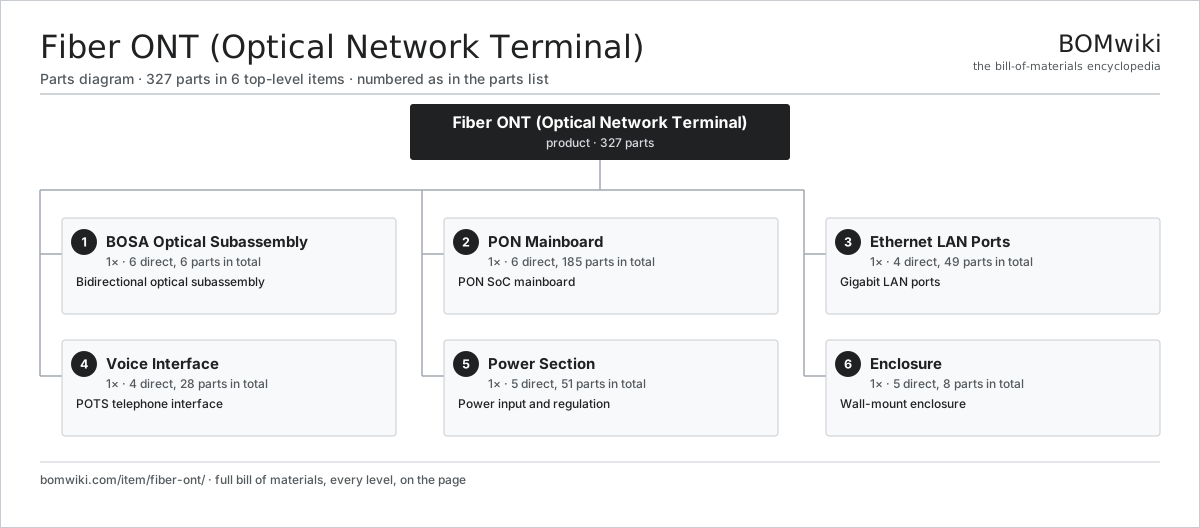
| # | Part | Qty | What it does |
|---|---|---|---|
| 1 | BOSA Optical Subassembly 6 parts | 1× | Bidirectional optical subassembly |
| 2 | PON Mainboard 6 parts | 1× | PON SoC mainboard |
| 3 | Ethernet LAN Ports 4 parts | 1× | Gigabit LAN ports |
| 4 | Voice Interface 4 parts | 1× | POTS telephone interface |
| 5 | Power Section 5 parts | 1× | Power input and regulation |
| 6 | Enclosure 5 parts | 1× | Wall-mount enclosure |
3D model
No 3D model yet. Have a CAD file of this? Add a 3D model. STL renders right on this page; STEP, FreeCAD, and OpenSCAD sources are welcome too (openly licensed, like all 3D models on BOMwiki).
Build & assembly graph
expand / collapse · shared sub-assemblies converge · links to related products · est. labourTap an assembly to expand/collapse · tap a part to open it · use “Open page” for any node · drag to pan, scroll to zoom.
Bill of materials for Fiber ONT (Optical Network Terminal)
6 top-level lines · 36 rows shown · 327 parts total · indented to 3 levels| # | Item / sub-assembly | Part no. | Qty/assy | Ext. qty | Parts | Type |
|---|---|---|---|---|---|---|
| 1 | BOSA Optical Subassembly 6 parts | fiber-ont-bosa | 1× | 1 | 6 | assembly |
| 1.1 | Burst-Mode Laser Diode | fiber-ont-laser-diode | 1× | 1 | · | part |
| 1.2 | Receive Photodiode | fiber-ont-photodiode | 1× | 1 | · | part |
| 1.3 | WDM Filter | fiber-ont-wdm-filter | 1× | 1 | · | part |
| 1.4 | Transimpedance Amplifier | fiber-ont-tia | 1× | 1 | · | part |
| 1.5 | Laser Driver | fiber-ont-laser-driver | 1× | 1 | · | part |
| 1.6 | SC/APC Receptacle | fiber-ont-receptacle | 1× | 1 | · | part |
| 2 | PON Mainboard 6 parts | fiber-ont-mainboard | 1× | 1 | 185 | assembly |
| 2.1 | Bare PCB | pcb-bare | 1× | 1 | · | part |
| 2.2 | PON SoC | fiber-ont-pon-soc | 1× | 1 | · | part |
| 2.3 | DDR Memory | fiber-ont-ddr | 1× | 1 | · | part |
| 2.4 | Firmware Flash | fiber-ont-flash | 1× | 1 | · | part |
| 2.5 | Reference Crystal | fiber-ont-xtal | 1× | 1 | · | part |
| 2.6 | SMD Passive (R/C/L) | smd-passives | 180× | 180 | · | part |
| 3 | Ethernet LAN Ports 4 parts | fiber-ont-ethernet | 1× | 1 | 49 | assembly |
| 3.1 | Gigabit PHY | fiber-ont-eth-phy | 1× | 1 | · | part |
| 3.2 | RJ45 Jack | fiber-ont-rj45 | 4× | 4 | · | part |
| 3.3 | Ethernet Magnetics | fiber-ont-magnetics | 4× | 4 | · | part |
| 3.4 | SMD Passive (R/C/L) | smd-passives | 40× | 40 | · | part |
| 4 | Voice Interface 4 parts | fiber-ont-voice | 1× | 1 | 28 | assembly |
| 4.1 | SLIC | fiber-ont-slic | 1× | 1 | · | part |
| 4.2 | RJ11 Jack | fiber-ont-rj11 | 1× | 1 | · | part |
| 4.3 | Ring Supply | fiber-ont-ring-supply | 1× | 1 | · | part |
| 4.4 | SMD Passive (R/C/L) | smd-passives | 25× | 25 | · | part |
| 5 | Power Section 5 parts | fiber-ont-power | 1× | 1 | 51 | assembly |
| 5.1 | Power Supply | power-supply | 1× | 1 | · | part |
| 5.2 | DC Input Jack | fiber-ont-dc-jack | 1× | 1 | · | part |
| 5.3 | Buck Regulators | fiber-ont-regulators | 3× | 3 | · | part |
| 5.4 | Thermal Fuse | thermal-fuse | 1× | 1 | · | part |
| 5.5 | SMD Passive (R/C/L) | smd-passives | 45× | 45 | · | part |
| 6 | Enclosure 5 parts | fiber-ont-enclosure | 1× | 1 | 8 | assembly |
| 6.1 | Top Cover | fiber-ont-top-cover | 1× | 1 | · | part |
| 6.2 | Base Shell | fiber-ont-base-shell | 1× | 1 | · | part |
| 6.3 | Fiber Bay | fiber-ont-fiber-bay | 1× | 1 | · | part |
| 6.4 | LED Light Pipe | fiber-ont-led-pipes | 4× | 4 | · | part |
| 6.5 | Fastener Set | fastener-set | 1× | 1 | · | part |
Something wrong in this list? Report a problem with this BOM.
Related products
same domain, ranked by shared parts


Sourcing: possible vendors
Browse the supplier directory → Prices, MOQ, and lead times are algorithmic estimates, not quotes, and not claims about these companies. Company mappings are curated by keyword; est. price band $30–$50k. How estimates work| Vendor | HQ | Specialty | MOQ | Lead time |
|---|---|---|---|---|
|
🇺🇸Cisco
cisco.com ↗
|
San Jose, US | Networking | 500 units | 8–14 wks |
|
🇺🇸Juniper
juniper.net ↗
|
Sunnyvale, US | Networking | 500 units | 8–14 wks |
| arista.com ↗ | Santa Clara, US | Networking | 500 units | 8–14 wks |
|
🇫🇮Nokia
nokia.com ↗
|
Espoo, FI | Telecom equipment | 500 units | 8–14 wks |
|
🇨🇳Huawei
huawei.com ↗
|
Shenzhen, CN | Networking & telecom | 500 units | 8–14 wks |
756-word article