Filament-Wound Pipe Machine
ProductOverview
A filament-wound pipe machine is a specialized variant of the filament winding process, optimized for high-volume, continuous production of composite pipes and tubes. Unlike general-purpose winding (which accommodates varied geometries), pipe machines are streamlined: the mandrel is cylindrical and typically fixed in orientation, fiber winding is helical (±45°) plus hoop layers, and production is a tight loop (wind → cure → extract → repeat).
Composite pipes manufactured via this process serve critical infrastructure roles: chemical plants (corrosive fluid resistance), oil and gas (pressure and subsea), water mains (weight and corrosion immunity), and industrial ducts (light weight). E-glass/polyester pipes are the commodity; carbon/epoxy pipes serve aerospace and high-pressure applications.
The economics are compelling: A filament-wound E-glass/polyester pipe costs 40–60% the price of equivalent steel pipe (half the weight, no coating or inspection needed), yet meets mechanical and chemical durability standards (AWWA C915 for water, DNV for subsea).
Mandrel & Spindle Design
The Mandrel Spindle is a tapered, rotating steel shaft (0.5–2° taper over length, 25–400 mm OD range). The taper allows radial removal of the hardened pipe by pulling the mandrel horizontally; without taper, friction locks the pipe to the mandrel.
- Small mandrel (25–50 mm OD): Spins at 100+ RPM, producing thin-walled tubing quickly.
- Large mandrel (500 mm+): Spins at 5–20 RPM, feeding fibers slowly to maintain uniform deposition.
The Bearing Blocks (front and rear) support the rotating shaft via Ball Bearings rated for radial loads (fiber tension, ~500 N per tow × 8–16 tows = 4–8 kN total). A Mandrel Seal prevents resin leakage at the shaft.
The Drive Coupling connects the mandrel to a hydraulic or electric motor (5–15 kW) via a speed reducer (gearbox or belt). For constant fiber deposition rate across varying mandrel diameters:
Mandrel RPM ∝ 1 / Pipe OD
A computer-automated calibration table in the PLC prevents operator error.
Fiber Path & Tension Control
The Fiber Creel & Tensioning holds 8–16 roving spools (200–2400 tex each), positioned radially around the machine. Each roving unwound at constant tension (0.5–3 kg via Tension Block servo brakes and load cells) ensures uniform fiber distribution and prevents bunching or waviness.
The Carriage & Traverse System single linear axis (Z-axis) moves the Fiber Guide Eyelet guide along the mandrel length, creating helical winding. The synchronization is critical:
Helix angle θ = arctan(carriage velocity / mandrel circumference × RPM)
At a 100 mm OD mandrel spinning 50 RPM (circumference 314 mm), moving the carriage at 104 mm/s produces a ±45° helix. The Traverse Motor drives a Ballscrew Z with Z-Encoder position feedback, maintaining constant pitch.
Resin Impregnation Bath
The Resin Bath System is simpler than general filament winding (no complex manifolding), typically a tank (100–500 L) heated to 40–50°C for polyester (lower viscosity aids wetting). Fibers pass through the bath once per mandrel revolution; multiple passes (if needed for thick walls) occur across successive mandrel rotations.
A Nip Roller pair squeezes excess resin, controlling fiber volume fraction (target 55–70% for pipe strength optimization). The Circulation System recirculates resin, maintaining even temperature and preventing catalyst settling.
Layup Sequence for Pipe
A typical high-pressure pipe combines:
- Hoop layer (0°): Circumferential fibers, maximum burst strength. Dominates burst pressure resistance (σ_burst ∝ (fiber)_hoop × wall thickness).
- ±45° helical layers: Load-carrying plus torsion resistance.
- Axial (90°): Longitudinal stiffness (if needed, minimal for pressure pipes).
Example: 100 mm ID, 5 mm wall, 20 MPa working pressure E-glass/polyester pipe:
- Hoop layer: 8 passes (fibers wrapped circumferentially), 2 mm thickness, load 314 mm × 5 mm × σ_fiber = 1570 MPa tension → distributes across fiber bundles.
- ±45°: 3 passes each direction, 1 mm thickness total.
- Axial finish (optional): 1 pass.
Typical wind time: 30–60 minutes total for a 1 m length.
Curing Strategy
Post-wind curing significantly affects pipe properties:
Room temperature (20°C):
- Gelation time: 4–24 hours (polyester).
- Full cure: 7 days (acceptable for non-critical application).
- Advantage: No oven cost, simpler facility.
- Disadvantage: Slow throughput, part properties may not stabilize for a week.
Accelerated oven cure (60–120°C):
- Gelation: 30–60 minutes.
- Full cure: 2–6 hours.
- The Curing Oven is a tunnel with integrated Oven Conveyor; pipes enter on a chain, traverse through heating zones, exit cooled.
- Advantage: High throughput (10–50 pipes per day), consistent properties.
- Disadvantage: Oven capital cost ($50k–200k), energy consumption ($5–20 per pipe).
The PLC coordinates oven temperature ramps (1–3°C/min to avoid thermal shock) with pipe transit time, ensuring proper gelation and cross-linking throughout the wall thickness.
Extraction & Demolding
Once cured, the pipe is held against the tapered mandrel by friction alone. The Mandrel Extraction hydraulic cylinder (50–100 kN) pulls the mandrel axially, overcoming friction. The tapered geometry reduces required force:
Extraction force ≈ friction coefficient × normal force (mandrel contact)
At 1° taper and 0.3 friction coefficient, the axial pull slides the mandrel cleanly.
Alternatively, for very tight fits, a Mandrel Clamp pneumatic collet releases the mandrel incrementally (backward spiral), or the mandrel is left in place (serving as a liner tube, acceptable for some applications like water pipe with internal mandrel stays).
Pipe Cutting
After cooling to <50°C, the Pipe Cutting Cutoff Saw (2–5 kW diamond-blade circular saw) trims pipes to customer length. A Length Stop programmable stop ensures ±2 mm accuracy. Sawing is fast (<1 min per cut) and clean (diamond blade reduces fraying vs. abrasive blade).
Quality & Testing
Typical test coupons per AWWA C915 or DNV-GL standards:
- Burst test: Pressurize pipe to failure, measure burst pressure (>25 MPa for standard E-glass).
- Hydrostatic pressure: Hold at 1.5× working pressure for 1 hour, inspect for leaks.
- Tensile coupon: Extract sample, test fiber tensile strength (verify fiber quality).
- Void content: Microscopy or ultrasonic inspection, target <2% voids.
- Dimensional: Wall thickness, roundness, length tolerance.
A single batch (10–20 pipes from the same mandrel setup) is tested once; remaining pipes assume acceptance.
Production Economics
Mid-size manufacturer: 500 mm OD, 5 mm wall, 2 m long composite pipes.
- Material cost: E-glass roving ($10/kg) + polyester resin ($6/kg) = ~$16/kg composite, ~$80–100 per pipe (5–6 kg per pipe).
- Labor: 1–2 operators managing 2–4 machines, ~$40–80 per pipe.
- Oven energy: $5–10 per pipe (accelerated cure).
- Total manufacturing cost: ~$125–190 per pipe.
- Selling price: $300–500 per pipe (2–3× markup, typical for industrial products).
Large producers (Future Pipe Industries, ZCL Composites) operate 20–50 filament-winding lines in dedicated factories, achieving economies of scale and producing 100,000+ pipes per year.
Standards & Certifications
- AWWA C915: Polyester pipe for water mains (USA).
- ASME RTP-1: Thermoplastic pipe, pressure-rated.
- DNV-GL: Offshore subsea pipes.
- ISO 9001: Quality management (standard for composites).
- NADCAP: Advanced Quality Management (aerospace/defense pipes).
Pipe manufacturers seeking aerospace or subsea contracts must achieve NADCAP certification, requiring documented material traceability, process controls, and destructive/non-destructive testing protocols.
Advantages & Limitations
Advantages:
- Corrosion immunity: Suitable for chemical, salt-water, and aggressive fluids where steel corrodes.
- Weight: 75–80% lighter than steel of equivalent strength, reducing handling and installation labor.
- Durability: 50+ year design life typical for E-glass/epoxy.
- Design flexibility: Wall thickness, fiber angle, and internal/external diameter easily customized.
Limitations:
- Long-term creep: Thermosetting polymers (polyester, epoxy) exhibit time-dependent deformation under sustained pressure, limiting very high-pressure applications (>30 MPa requires advanced resins/fibers).
- Damage sensitivity: Composite pipes are vulnerable to impact and cutting; steel pipe is more resilient.
- Joining complexity: Connections require threaded inserts or flanges (labor-intensive) vs. welded steel.
- Fire rating: Thermoset polymers are combustible; some installations (building interiors) face code restrictions.
Modern thermoplastic composite pipes (filament-wound polypropylene or PEEK) address some limitations but at higher material cost.
Filament-Wound Pipe Machine parts and their functions
8 top-level parts · 60 parts in total · full bill of materials below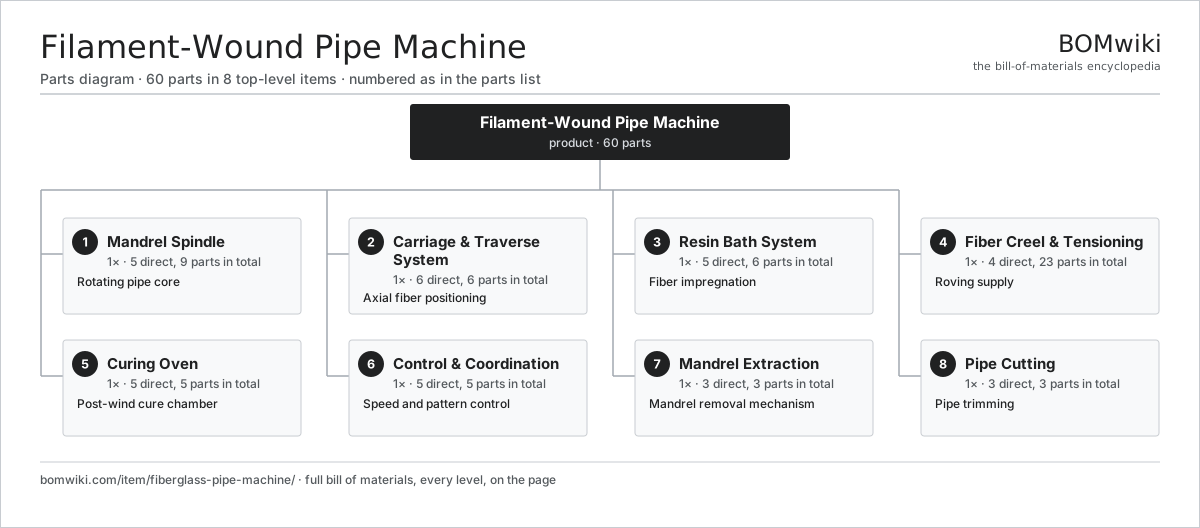
| # | Part | Qty | What it does |
|---|---|---|---|
| 1 | Mandrel Spindle 5 parts | 1× | Rotating pipe core |
| 2 | Carriage & Traverse System 6 parts | 1× | Axial fiber positioning |
| 3 | Resin Bath System 5 parts | 1× | Fiber impregnation |
| 4 | Fiber Creel & Tensioning 4 parts | 1× | Roving supply |
| 5 | Curing Oven 5 parts | 1× | Post-wind cure chamber |
| 6 | Control & Coordination 5 parts | 1× | Speed and pattern control |
| 7 | Mandrel Extraction 3 parts | 1× | Mandrel removal mechanism |
| 8 | Pipe Cutting 3 parts | 1× | Pipe trimming |
3D model
No 3D model yet. Have a CAD file of this? Add a 3D model. STL renders right on this page; STEP, FreeCAD, and OpenSCAD sources are welcome too (openly licensed, like all 3D models on BOMwiki).
Build & assembly graph
expand / collapse · shared sub-assemblies converge · links to related products · est. labourTap an assembly to expand/collapse · tap a part to open it · use “Open page” for any node · drag to pan, scroll to zoom.
Bill of materials for Filament-Wound Pipe Machine
8 top-level lines · 44 rows shown · 60 parts total · indented to 3 levels| # | Item / sub-assembly | Part no. | Qty/assy | Ext. qty | Parts | Type |
|---|---|---|---|---|---|---|
| 1 | Mandrel Spindle 5 parts | fiberglass-pipe-machine-mandrel-spindle | 1× | 1 | 9 | assembly |
| 1.1 | Mandrel Shaft | fiberglass-pipe-machine-mandrel-shaft | 1× | 1 | · | part |
| 1.2 | Bearing Block | fiberglass-pipe-machine-mandrel-bearing-block | 2× | 2 | · | part |
| 1.3 | Ball Bearing | ball-bearing | 4× | 4 | · | part |
| 1.4 | Mandrel Seal | fiberglass-pipe-machine-mandrel-seal | 1× | 1 | · | part |
| 1.5 | Drive Coupling | fiberglass-pipe-machine-mandrel-drive-coupling | 1× | 1 | · | part |
| 2 | Carriage & Traverse System 6 parts | fiberglass-pipe-machine-carriage-traverse | 1× | 1 | 6 | assembly |
| 2.1 | Carriage Frame | fiberglass-pipe-machine-carriage-frame | 1× | 1 | · | part |
| 2.2 | Linear Guide | fiberglass-pipe-machine-linear-guide-z | 1× | 1 | · | part |
| 2.3 | Traverse Motor | fiberglass-pipe-machine-servo-motor-z | 1× | 1 | · | part |
| 2.4 | Ballscrew Z | fiberglass-pipe-machine-ballscrew-z | 1× | 1 | · | part |
| 2.5 | Z-Encoder | fiberglass-pipe-machine-encoder-z | 1× | 1 | · | part |
| 2.6 | Fiber Guide Eyelet | fiberglass-pipe-machine-fiber-eyelet | 1× | 1 | · | part |
| 3 | Resin Bath System 5 parts | fiberglass-pipe-machine-resin-bath | 1× | 1 | 6 | assembly |
| 3.1 | Bath Tank | fiberglass-pipe-machine-bath-tank | 1× | 1 | · | part |
| 3.2 | Bath Heater | fiberglass-pipe-machine-bath-heater | 1× | 1 | · | part |
| 3.3 | Circulation System | fiberglass-pipe-machine-bath-circulation | 1× | 1 | · | part |
| 3.4 | Nip Roller | fiberglass-pipe-machine-nip-roller | 2× | 2 | · | part |
| 3.5 | Pressure Sensor | pressure-sensor | 1× | 1 | · | part |
| 4 | Fiber Creel & Tensioning 4 parts | fiberglass-pipe-machine-fiber-creel | 1× | 1 | 23 | assembly |
| 4.1 | Creel Frame | fiberglass-pipe-machine-creel-structure | 1× | 1 | · | part |
| 4.2 | Spool Bearing | fiberglass-pipe-machine-spool-bearing | 8× | 8 | · | part |
| 4.3 | Tension Block | fiberglass-pipe-machine-tension-block | 8× | 8 | · | part |
| 4.4 | Guide Eye | fiberglass-pipe-machine-guide-eye | 6× | 6 | · | part |
| 5 | Curing Oven 5 parts | fiberglass-pipe-machine-curing-oven | 1× | 1 | 5 | assembly |
| 5.1 | Oven Chamber | fiberglass-pipe-machine-oven-chamber | 1× | 1 | · | part |
| 5.2 | Oven Heater | fiberglass-pipe-machine-oven-heater | 1× | 1 | · | part |
| 5.3 | Oven Conveyor | fiberglass-pipe-machine-oven-conveyor | 1× | 1 | · | part |
| 5.4 | Oven Controller | fiberglass-pipe-machine-oven-controller | 1× | 1 | · | part |
| 5.5 | Circulation Fan | fiberglass-pipe-machine-circulation-fan | 1× | 1 | · | part |
| 6 | Control & Coordination 5 parts | fiberglass-pipe-machine-control-system | 1× | 1 | 5 | assembly |
| 6.1 | Pipe Machine PLC | fiberglass-pipe-machine-plc | 1× | 1 | · | part |
| 6.2 | Operator HMI | fiberglass-pipe-machine-hmi-touchscreen | 1× | 1 | · | part |
| 6.3 | Mandrel VFD | fiberglass-pipe-machine-vfd-mandrel | 1× | 1 | · | part |
| 6.4 | Traverse Drive | fiberglass-pipe-machine-servo-drive-z | 1× | 1 | · | part |
| 6.5 | Tension Controller | fiberglass-pipe-machine-tension-controller | 1× | 1 | · | part |
| 7 | Mandrel Extraction 3 parts | fiberglass-pipe-machine-extraction-system | 1× | 1 | 3 | assembly |
| 7.1 | Extraction Cylinder | fiberglass-pipe-machine-extraction-cylinder | 1× | 1 | · | part |
| 7.2 | Extraction Frame | fiberglass-pipe-machine-extraction-frame | 1× | 1 | · | part |
| 7.3 | Mandrel Clamp | fiberglass-pipe-machine-mandrel-clamp | 1× | 1 | · | part |
| 8 | Pipe Cutting 3 parts | fiberglass-pipe-machine-cutting-system | 1× | 1 | 3 | assembly |
| 8.1 | Cutoff Saw | fiberglass-pipe-machine-cutoff-saw | 1× | 1 | · | part |
| 8.2 | Saw Spindle | fiberglass-pipe-machine-saw-motor | 1× | 1 | · | part |
| 8.3 | Length Stop | fiberglass-pipe-machine-length-stop | 1× | 1 | · | part |
Something wrong in this list? Report a problem with this BOM.
Sourcing: possible vendors
Browse the supplier directory → Prices, MOQ, and lead times are algorithmic estimates, not quotes, and not claims about these companies. Company mappings are curated by keyword; est. price band $5k–$2M. How estimates work| Vendor | HQ | Specialty | MOQ | Lead time |
|---|---|---|---|---|
| atlascopco.com ↗ | Stockholm, SE | Compressors & industrial | 10 units | 12–20 wks |
|
🇦🇹Andritz
andritz.com ↗
|
Graz, AT | Process plants & machinery | 10 units | 12–20 wks |
| buhlergroup.com ↗ | Uzwil, CH | Food & materials processing | 10 units | 12–20 wks |
| gea.com ↗ | Düsseldorf, DE | Process technology | 10 units | 12–20 wks |
| mhi.com ↗ | Tokyo, JP | Heavy machinery | 10 units | 12–20 wks |
1,367-word article