Finger Jointing Machine
ProductOverview
A finger jointing machine cuts and glues interlocking finger joints on the ends of wooden boards, extending grain length (end-joining multiple shorter boards into longer stock). Finger-jointed lumber is standard in furniture, cabinetry, engineered beams, and laminated wood structural elements, enabling full utilization of mill waste and shorter logs.
Traditional butt joints (squared ends glued face-to-face) have low shear strength along the glue line. Finger joints interlock like clasped hands, multiplying glue surface area (12–20 fingers per joint) and distributing stress across the entire joint perimeter, resulting in joints as strong or stronger than the solid wood surrounding them.
Finger Cutter Head
The rotating finger cutter is a specialized multi-tooth block with 12 carbide-tipped teeth arranged in alternating male-female profile:
Male fingers: Protrude 15–30 mm; mate into cavities on mating stock.
Female fingers: Recessed cavities of identical geometry; receive male fingers from partner board.
Pitch: 20 mm finger spacing (standard industrial size). Larger spacing (25–30 mm) used for thick stock (>40 mm) or rough utility lumber.
Tooth material: Carbide (tungsten carbide tipped) for durability. One cutter head produces ~5000–10000 meters of jointed lumber before resharpening.
Glue Application System
The integrated glue applicator is critical, finger joints must be completely saturated to achieve full strength:
Glue pump: Peristaltic pump (0–2 liters/min) draws adhesive from tank and pressurizes it to 3–5 bar for nozzle spray.
Nozzle array: 6–8 spray jets directed at finger cavities (male surfaces) as stock approaches cutter. Precise timing (sync to board motion) ensures even saturation.
Application rate: 0.1–0.2 liters per linear meter of joint. Excess glue creates squeeze-out; insufficient glue leaves voids. PLC-controlled pump modulates flow based on stock speed.
Adhesive Chemistry
Polyurethane (PU)
One-component moisture-cure: Resin activates when exposed to atmospheric moisture. No mixing required; simplified operation.
Open time: 10–15 minutes. Long open time allows stock repositioning; board doesn't set immediately on feeding.
Cure time: 24–48 hours to full strength. Press temperature (50–80 °C) accelerates to 4–8 hours.
Shear strength (cured): 7–12 MPa (comparable to wood failure strength). Joint is as strong as surrounding wood.
Cost: ~$8–12 per liter.
Melamine-Urea-Formaldehyde (MUF)
Two-component reactive: Resin + hardener; mixed immediately before use. Longer shelf life than UF; better water resistance.
Open time: 20–30 minutes (slower than PU).
Cure time: 60–120 minutes to handling strength; full cure 24 hours. Heat accelerates significantly; 100 °C platen reduces handling time to 30 minutes.
Shear strength: 8–14 MPa (slightly higher than PU).
Cost: ~$5–8 per liter (cheaper than PU).
Pressing and Heat
The heated press section applies controlled heat and pressure:
Heated platens (upper and lower, 600 × 200 mm each): Electric heaters maintain 50–100 °C, accelerating adhesive cure without degrading wood properties.
Pneumatic press cylinder (80 mm bore, 6 bar): Applies 300–500 N clamp force, compressing joint while glue sets.
Press dwell time: 5–30 seconds (PU + heat) or 30–60 seconds (MUF). Longer dwell improves joint integrity; production rate trade-off.
Conveyor and Speed Control
The motorized conveyor propels stock through cutter and press at synchronized speed (5–30 m/min variable):
Fast speed (20–30 m/min): Softwood production, high throughput. Shorter press dwell; curing completes in post-press cooling.
Medium speed (10–15 m/min): Hardwood production (oak, maple). Balanced speed; press dwell 10–20 seconds.
Slow speed (5–10 m/min): Specialty woods (walnut, cherry) or thicker stock. Longer press dwell (30+ seconds); superior joint consolidation.
Operating Workflow
Setup
- Adhesive preparation: Mix PU or MUF to specified ratio; fill 50-liter supply tank.
- Stock calibration: Measure board thickness and width; set cutter height (0.1 mm tolerance).
- Speed selection: Dial in conveyor speed (medium 12 m/min standard).
- Glue flow test: Run empty; verify nozzle spray pattern before loading stock.
Production Run
- Feed board: Operator positions board end-grain into cutter head (squarely aligned).
- Automatic cutter: Spinning cutter head cuts finger profile into board end (~2 seconds contact).
- Glue spray: Nozzles apply adhesive to freshly cut fingers.
- Partner board: Second board fed immediately after; fingers interlock as both boards advance.
- Press and heat: Clamped pair passes through heated press (5–30 second dwell).
- Offload: Jointed pair exits onto cooling conveyor; stacked for curing (24 hours ambient or 4–8 hours with post-press heating).
Cycle time: ~30 seconds per joint (including handling and spacing).
Production rate: ~120 joints/hour = 240 linear meters/hour (typical 2-meter boards).
Joint Design Variations
Standard Finger Joint
Male and female fingers equal size (15–20 mm pitch). Symmetric; suitable for most applications.
Slope-Sided Finger
Fingers angled (7–10° slope). Reduces cross-grain tension; improves strength in weak species (poplar, pine) by 10–15%.
Micro-Finger
Smaller pitch (10–12 mm), 18–24 fingers per joint. Higher glue surface area; stronger joints. Slower production (narrower feed, tighter tolerances).
Quality Control
Visual inspection:
- Glue squeeze-out: Light amount (~1 mm line) indicates good saturation. Excess ooze suggests overspeed (glue migration).
- Finger alignment: Fingers should interlock perfectly with no gaps. Misalignment indicates spindle runout or cutter dulling.
Destructive testing:
- Break test: Apply tensile load to jointed pair until failure. Good joints fail in wood (grain separation), not glue line.
- Shear test: Measure shear strength of cured joint (lab testing). Target >7 MPa.
Maintenance
Daily:
- Inspect cutter head for dull or chipped teeth (replace if >10% area worn).
- Clear glue-saturated sawdust from press platens (dry, hard-to-remove buildup).
- Test adhesive viscosity; verify pump flow rate (should deliver 0.1–0.2 L per meter of joint).
Weekly:
- Clean nozzles by flushing with warm water or solvent (acetone for PU, water for MUF).
- Recalibrate conveyor speed (verify against reference length).
- Inspect press seals for adhesive leakage.
Monthly:
- Sharpen or replace dull cutter head (professional service, ~$150–250 per head).
- Replace platen seals if leaking oil.
- Recalibrate PLC glue flow sensor.
Annually:
- Overhaul spindle bearings and spindle taper.
- Replace worn conveyor belt.
- Recalibrate platen thermostat.
- Inspect and replace peristaltic pump tubing (deteriorates from adhesive exposure).
Limitations
Finger jointing machines are optimized for uniform stock width and thickness. Cupped or warped boards don't engage cutter uniformly; skip-tooth cutting results. Pre-surfacing on planer or thickness sander is essential.
Very thick stock (>50 mm) exceeds standard cutter reach; custom deep-cutting heads required. Small stock (<40 mm width) is hazardous to feed; jigs or automatic feed systems mandatory.
Curved or angled profiles exceed cutter geometry. Custom cutter heads can accommodate (custom-profile edge joints), but tooling cost ($500–1500 per head) is prohibitive for one-off work.
Exotic hardwoods (ebony, lignum vitae, rosewood) dull cutters rapidly (2–3× faster than oak). Slower speeds and frequent sharpening necessary.
Finger Jointing Machine parts and their functions
8 top-level parts · 45 parts in total · full bill of materials below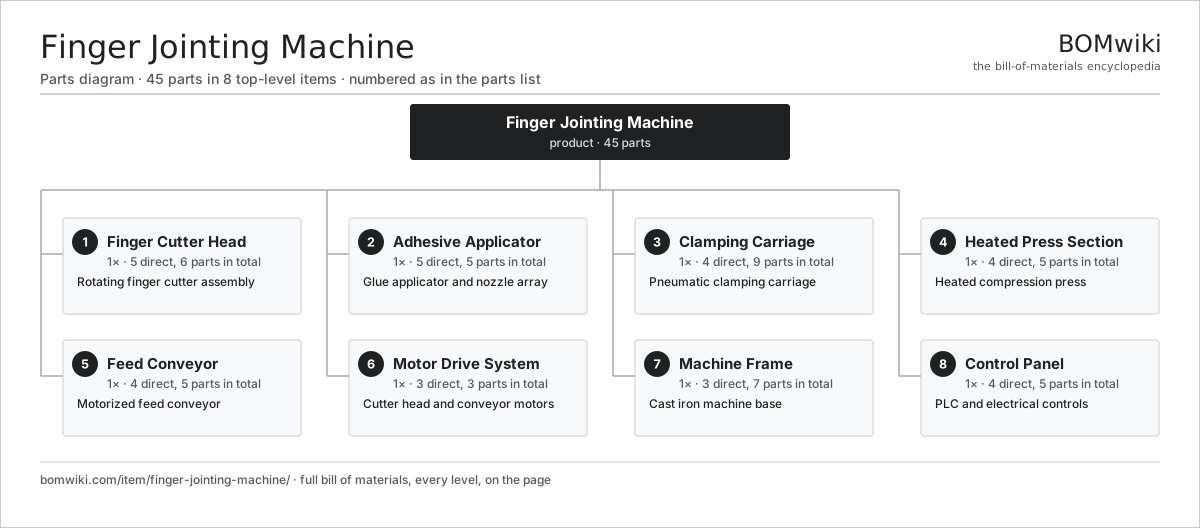
| # | Part | Qty | What it does |
|---|---|---|---|
| 1 | Finger Cutter Head 5 parts | 1× | Rotating finger cutter assembly |
| 2 | Adhesive Applicator 5 parts | 1× | Glue applicator and nozzle array |
| 3 | Clamping Carriage 4 parts | 1× | Pneumatic clamping carriage |
| 4 | Heated Press Section 4 parts | 1× | Heated compression press |
| 5 | Feed Conveyor 4 parts | 1× | Motorized feed conveyor |
| 6 | Motor Drive System 3 parts | 1× | Cutter head and conveyor motors |
| 7 | Machine Frame 3 parts | 1× | Cast iron machine base |
| 8 | Control Panel 4 parts | 1× | PLC and electrical controls |
3D model
No 3D model yet. Have a CAD file of this? Add a 3D model. STL renders right on this page; STEP, FreeCAD, and OpenSCAD sources are welcome too (openly licensed, like all 3D models on BOMwiki).
Build & assembly graph
expand / collapse · shared sub-assemblies converge · links to related products · est. labourTap an assembly to expand/collapse · tap a part to open it · use “Open page” for any node · drag to pan, scroll to zoom.
Bill of materials for Finger Jointing Machine
8 top-level lines · 40 rows shown · 45 parts total · indented to 3 levels| # | Item / sub-assembly | Part no. | Qty/assy | Ext. qty | Parts | Type |
|---|---|---|---|---|---|---|
| 1 | Finger Cutter Head 5 parts | finger-jointing-machine-cutter-head | 1× | 1 | 6 | assembly |
| 1.1 | Spindle Shaft | finger-jointing-machine-spindle-shaft | 1× | 1 | · | part |
| 1.2 | Spindle Motor | finger-jointing-machine-spindle-motor | 1× | 1 | · | part |
| 1.3 | Finger Cutter | finger-jointing-machine-finger-cutter | 1× | 1 | · | part |
| 1.4 | Spindle Bearing | finger-jointing-machine-spindle-bearing | 2× | 2 | · | part |
| 1.5 | Cutter Holder | finger-jointing-machine-cutter-holder | 1× | 1 | · | part |
| 2 | Adhesive Applicator 5 parts | finger-jointing-machine-glue-system | 1× | 1 | 5 | assembly |
| 2.1 | Glue Pump | finger-jointing-machine-glue-pump | 1× | 1 | · | part |
| 2.2 | Glue Tank | finger-jointing-machine-glue-tank | 1× | 1 | · | part |
| 2.3 | Nozzle Array | finger-jointing-machine-nozzle-array | 1× | 1 | · | part |
| 2.4 | Regulator | finger-jointing-machine-pressure-regulator | 1× | 1 | · | part |
| 2.5 | Flow Meter | finger-jointing-machine-flow-meter | 1× | 1 | · | part |
| 3 | Clamping Carriage 4 parts | finger-jointing-machine-clamp-carriage | 1× | 1 | 9 | assembly |
| 3.1 | Clamp Jaw | finger-jointing-machine-clamp-jaw | 2× | 2 | · | part |
| 3.2 | Clamp Cylinder | finger-jointing-machine-clamp-cylinder | 2× | 2 | · | part |
| 3.3 | Clamp Pad | finger-jointing-machine-clamp-pad | 4× | 4 | · | part |
| 3.4 | Carriage Rail | finger-jointing-machine-carriage-rail | 1× | 1 | · | part |
| 4 | Heated Press Section 4 parts | finger-jointing-machine-press-section | 1× | 1 | 5 | assembly |
| 4.1 | Press Platen | finger-jointing-machine-press-platens | 2× | 2 | · | part |
| 4.2 | Press Heater | finger-jointing-machine-press-heater | 1× | 1 | · | part |
| 4.3 | Press Cylinder | finger-jointing-machine-press-cylinder | 1× | 1 | · | part |
| 4.4 | Temp Controller | finger-jointing-machine-press-temperature-control | 1× | 1 | · | part |
| 5 | Feed Conveyor 4 parts | finger-jointing-machine-conveyor | 1× | 1 | 5 | assembly |
| 5.1 | Conveyor Belt | finger-jointing-machine-conveyor-belt | 1× | 1 | · | part |
| 5.2 | Conveyor Motor | finger-jointing-machine-conveyor-motor | 1× | 1 | · | part |
| 5.3 | Conveyor Roller | finger-jointing-machine-conveyor-roller | 2× | 2 | · | part |
| 5.4 | Speed Controller | finger-jointing-machine-speed-controller | 1× | 1 | · | part |
| 6 | Motor Drive System 3 parts | finger-jointing-machine-drive-system | 1× | 1 | 3 | assembly |
| 6.1 | Spindle VFD | finger-jointing-machine-spindle-drive | 1× | 1 | · | part |
| 6.2 | Conveyor VFD | finger-jointing-machine-conveyor-drive | 1× | 1 | · | part |
| 6.3 | Gearbox | finger-jointing-machine-gearbox | 1× | 1 | · | part |
| 7 | Machine Frame 3 parts | finger-jointing-machine-frame | 1× | 1 | 7 | assembly |
| 7.1 | Frame Beam | finger-jointing-machine-frame-beam | 4× | 4 | · | part |
| 7.2 | Base Plate | finger-jointing-machine-base-plate | 1× | 1 | · | part |
| 7.3 | Sheet Metal Panel | sheet-panel | 2× | 2 | · | part |
| 8 | Control Panel 4 parts | finger-jointing-machine-control-panel | 1× | 1 | 5 | assembly |
| 8.1 | PLC | finger-jointing-machine-plc | 1× | 1 | · | part |
| 8.2 | HMI Display | finger-jointing-machine-hmi-screen | 1× | 1 | · | part |
| 8.3 | Pressure Switch | finger-jointing-machine-pressure-switch | 2× | 2 | · | part |
| 8.4 | Safety Relay | finger-jointing-machine-safety-module | 1× | 1 | · | part |
Something wrong in this list? Report a problem with this BOM.
Related products
same domain, ranked by shared parts All-Electric Injection Molding Machine
851 parts · shares 1 with this page
Automated Paint Spray Line
2,003 parts · shares 1 with this page
Blown Film Extrusion Line
436 parts · shares 1 with this page
All-Electric Injection Molding Machine
851 parts · shares 1 with this page
Automated Paint Spray Line
2,003 parts · shares 1 with this page
Blown Film Extrusion Line
436 parts · shares 1 with this page
 Briquetting Press
92 parts · shares 1 with this page
Can Densifier
44 parts · shares 1 with this page
Briquetting Press
92 parts · shares 1 with this page
Can Densifier
44 parts · shares 1 with this page
Sourcing: possible vendors
Browse the supplier directory → Prices, MOQ, and lead times are algorithmic estimates, not quotes, and not claims about these companies. Company mappings are curated by keyword; est. price band $5k–$2M. How estimates work| Vendor | HQ | Specialty | MOQ | Lead time |
|---|---|---|---|---|
| atlascopco.com ↗ | Stockholm, SE | Compressors & industrial | 10 units | 12–20 wks |
|
🇦🇹Andritz
andritz.com ↗
|
Graz, AT | Process plants & machinery | 10 units | 12–20 wks |
| buhlergroup.com ↗ | Uzwil, CH | Food & materials processing | 10 units | 12–20 wks |
| gea.com ↗ | Düsseldorf, DE | Process technology | 10 units | 12–20 wks |
| mhi.com ↗ | Tokyo, JP | Heavy machinery | 10 units | 12–20 wks |
1,158-word article