Fire Extinguisher Product
Overview
A portable fire extinguisher is a self-contained pressure vessel that stores a chemical agent and expels it onto a fire under stored gas pressure. This unit is a stored-pressure ABC dry-chemical type: a steel cylinder is charged with mono-ammonium phosphate powder and pressurized with dry nitrogen, so squeezing the valve lever immediately drives agent out through the discharge horn. The ABC rating means it is effective on Class A (ordinary combustibles), Class B (flammable liquids) and Class C (energized electrical) fires, the most common hazards in homes, vehicles and commercial occupancies.
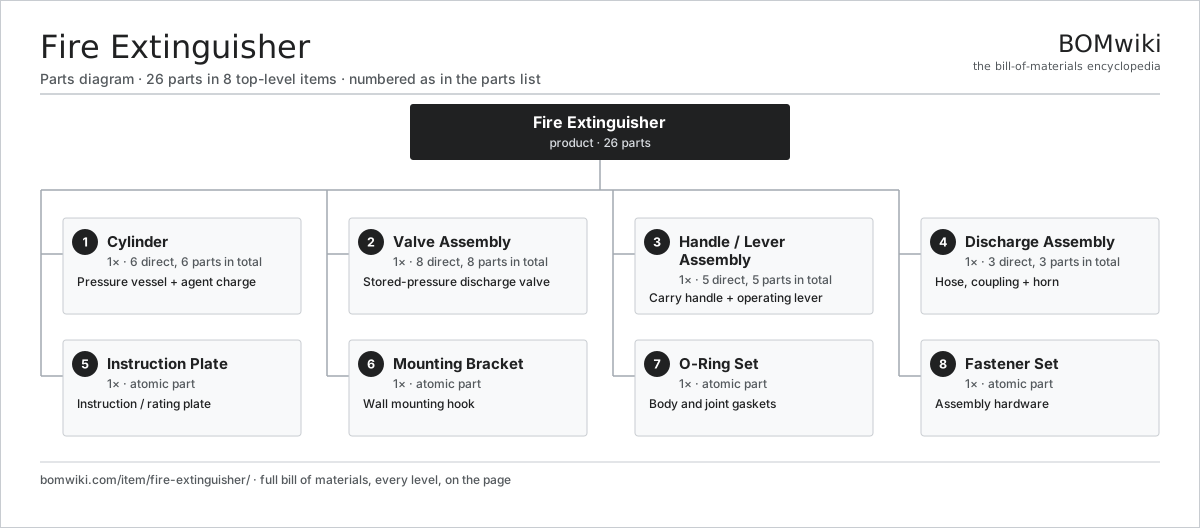
The pressure boundary is the welded Cylinder, which holds both the powder charge and the nitrogen expellant. Pressure is held back by the Valve Assembly, a brass body whose spring-loaded stem seals against a seat until lifted. The operator interacts with the Handle / Lever Assembly, a fixed carry handle and pivoting lever locked by a pull pin and tamper seal. When discharged, agent leaves through the Discharge Assembly hose and horn, which shape the powder into a directed cone. The Mounting Bracket holds the unit at ready height and the Instruction Plate carries the UL rating and service record.
How it works
In storage the cylinder sits pressurized to roughly 195 psi, with the gauge needle in the green band confirming the charge. To operate, the user pulls the safety pin, breaking the tamper seal, then aims the horn at the base of the fire and squeezes the lever. Squeezing rotates the lever about its pivot and depresses the valve stem off its seat. Nitrogen pressure forces powder up the internal siphon tube, through the valve and hose, and out the horn. The mono-ammonium phosphate interrupts the chemical chain reaction of combustion and melts to form a barrier that smothers Class A embers. Sweeping the discharge side to side coats the burning surface until the agent is exhausted, typically within about twenty seconds.', },
'fire-truck': { specs: [ ['Configuration', 'Custom-chassis midship pumper'], ['Pump type', 'Two-stage centrifugal'], ['Pump rating', '1500 GPM (5680 LPM) at 150 psi'], ['Water tank', '750 US gal (2840 L)'], ['Foam concentrate tank', '30 US gal (114 L)'], ['Engine', 'Turbocharged inline-6 diesel'], ['Engine power', '500 hp (373 kW)'], ['Transmission', '6-speed automatic'], ['Drive', '4x2, split-shaft pump PTO'], ['GVWR', '44,000 lb (19,960 kg)'], ['Brakes', 'Full air, dual circuit'], ['Crew capacity', '4–6 (enclosed cab)'], ['Ground ladders', 'Extension + roof + attic'], ['Deck gun flow', '1000 GPM master stream'], ], body: '## Overview
A fire engine, or pumper, is a self-propelled apparatus that carries water, hose, ladders and crew to a fire and supplies pressurized water to attack lines. This unit is a midship pumper built on a custom cab-forward chassis: a centrifugal fire pump mounted amidships draws from an onboard tank or a hydrant and boosts it to the pressures handlines and master streams require. Unlike a ladder truck, the pumper's primary role is delivering water and foam, though it carries ground ladders and rescue tools as well.
Everything rides on the Truck Chassis, a heavy frame with a diesel powertrain, air brakes and dual rear wheels. The Crew Cab seats the crew with SCBA-mount seats. At the heart of the apparatus is the Centrifugal Fire Pump, a two-stage centrifugal pump driven through a split-shaft PTO. It draws from the Water & Foam System system, a 750-gallon booster tank with a foam cell and proportioner. The operator works the Pump Operator Panel, reading pressure gauges and setting discharge valves. The Apparatus Body holds hose beds, ground ladders and tool compartments, and the Warning & Deluge System system carries warning lights, the siren and a roof-mounted deck gun.
How it works
On arrival the driver sets the parking brake and engages the split-shaft PTO, which disconnects the driveline and routes engine torque to the pump shaft. The centrifugal impellers accelerate water outward, converting velocity to pressure in the volute; the two stages can run in series for high pressure or parallel for high volume. A priming pump first evacuates air so the pump can draft from a static source through the suction intake. The pressure governor holds a steady discharge pressure as lines are opened and closed by modulating engine throttle. Foam concentrate is metered into the discharge stream by the proportioner to produce a film that suppresses flammable-liquid fires. The pump panel gives the operator continuous control of every discharge while the booster tank or a hydrant supply keeps the pump fed.', },
'smoke-detector': { specs: [ ['Type', 'Combination photoelectric smoke + CO alarm'], ['Smoke sensor', 'Photoelectric light-scattering chamber'], ['CO sensor', 'Electrochemical cell'], ['Smoke sensitivity', '1.5–3.5 %/ft obscuration'], ['CO alarm thresholds', '70 ppm / 60 min, 400 ppm / 15 min'], ['Coverage area', 'Up to 900 ft² (84 m²)'], ['Alarm output', '85 dB at 10 ft (3 m)'], ['Alarm pattern', 'T-3 (fire) / T-4 (CO) temporal'], ['Power', '120 VAC with sealed lithium backup'], ['Backup life', '10 years (sealed cell)'], ['Interconnect', 'Sub-GHz RF wireless, up to 18 units'], ['Operating temperature', '40–100 °F (4–38 °C)'], ['Annunciation', 'Voice + temporal tone'], ], body: '## Overview
A smoke detector is a fixed sensing device that continuously monitors the air for the products of combustion and sounds a local alarm when they exceed a threshold. This unit is a combination alarm: it carries both a photoelectric smoke chamber and an electrochemical carbon-monoxide cell, so it responds to visible smoke from smoldering fires and to the colorless CO produced by incomplete combustion. Mounted on a ceiling, it protects up to about 900 square feet and links wirelessly to other units so any one detector triggers them all.
Air enters the Housing through vents into the Smoke Chamber, a light-trapping labyrinth holding an infrared LED and an offset photodiode. The CO Sensor is a three-electrode electrochemical cell behind a charcoal filter. Both feed the Main Board, where an MCU and a precision ADC evaluate the signals against alarm thresholds. When an alarm is declared the Sounder produces an 85 dB temporal tone with a spoken annunciation, while the Wireless Interconnect broadcasts the event over a sub-GHz RF link. The Power Module module runs the unit from mains with a sealed ten-year lithium cell for backup.
How it works
The photoelectric chamber works on light scattering. Its IR LED pulses into the labyrinth, where baffles block ambient light from reaching the photodiode. In clean air almost no light reaches the photodiode; when smoke particles enter, they scatter the beam and a fraction reaches the sensor, raising its output. The MCU watches this rise against a sensitivity window of roughly 1.5 to 3.5 percent per foot obscuration to reject dust while catching real smoke. The CO cell separately generates a current proportional to carbon-monoxide concentration, and the firmware integrates exposure over time, alarming faster at high concentrations. Either condition drives the piezo horn in its distinct temporal pattern, T-3 for fire and T-4 for CO, and asserts the RF interconnect so the whole network sounds together.', },
'fire-sprinkler-system': {
specs: [
['System type', 'Wet-pipe automatic sprinkler'],
['Design standard', 'NFPA 13'],
['Sprinkler heads', '60 pendent, quick-response'],
['Head orifice / K-factor', '1/2 in, K=5.6'],
['Bulb activation temperature', '155 °F (68 °C), red bulb'],
['Standing system pressure', '175 psi (12 bar)'],
['Fire pump rating', '750 GPM at 100 psi'],
['Jockey pump', 'Pressure-maintenance, multistage'],
['Riser size', '6 in (150 mm)'],
['Pipe', 'Schedule-40 black steel'],
['Coverage per head', '130 ft² (12 m²)'],
['Alarm', 'Waterflow switch + water motor gong'],
['Supervision', 'Valve tamper + flow to panel'],
['FDC', 'Two-way siamese, 2.5 in inlets'],
],
body: '## Overview
An automatic fire sprinkler system is a building-wide network of piping and heat-activated sprinklers that detects and controls a fire at its origin, discharging water only over the area that is actually burning. This is a wet-pipe system, meaning the piping is filled with pressurized water at all times so discharge begins the instant a sprinkler opens. Designed to NFPA 13, it combines a supervised water supply, an alarm-sensing riser, a fire pump set and distribution piping feeding sixty pendent heads.
Water enters through the Water Supply Assembly, which carries the backflow preventer and supervised OS&Y isolation valve. It passes the Alarm Check Valve Assembly, a clapper-type alarm check valve whose retard chamber, pressure switch and water motor gong signal flow. Demand flow and pressure are provided by the Fire Pump Set, a centrifugal fire pump with a jockey pump and listed controller. The Piping Network of cross mains and branch lines distributes water to each Sprinkler Head, a frame holding a heat-sensitive glass bulb over a sealed orifice. The Fire Department Connection lets the fire department augment supply, while the Fire Alarm Control Panel supervises the flow and tamper switches.
How it works
Each sprinkler holds a frangible glass bulb filled with a colored liquid that seals a cap against the orifice. Fire heat raises the air temperature at the ceiling; when the bulb reaches its rated temperature, typically 155 °F, the trapped liquid expands and shatters the glass, releasing the cap so water sprays off the deflector in a defined pattern. Only sprinklers over the fire open, limiting water damage. The pressure drop as water flows trips the alarm check valve, which ports water to the pressure switch and the hydraulically driven gong. The fire pump controller starts the main pump on the falling pressure to sustain the rated flow, while the jockey pump handles minor leakage so the main pump is not cycled needlessly. Tamper switches on the control valves report to the panel so a closed valve cannot silently disable the system.', },
'scba-breathing-apparatus': {
specs: [
['Type', 'Open-circuit, positive-pressure SCBA'],
['Standard', 'NFPA 1981 compliant'],
['Cylinder', 'Carbon-fiber-wrapped composite'],
['Cylinder pressure', '4500 psi (310 bar)'],
['Air capacity', '45 ft³ (1275 L) free air'],
['Rated duration', '30 min'],
['Mask facepiece', 'Full-face, positive pressure'],
['First-stage output', '100 psi medium pressure'],
['Low-air alarm', '33% remaining (1500 psi)'],
['PASS alarm', 'Motion-loss after 30 s, 95 dB'],
['HUD', 'In-mask pressure / status display'],
['Rescue connection', 'RIC/UAC buddy-breathing fitting'],
['Cylinder weight', '9.5 lb (4.3 kg)'],
['System weight', '25 lb (11.3 kg)'],
],
body: '## Overview
A self-contained breathing apparatus supplies a firefighter with clean breathing air independent of the surrounding atmosphere, protecting against smoke, toxic gases and oxygen-deficient environments. This is an open-circuit, positive-pressure SCBA: a high-pressure cylinder of compressed air is reduced in stages and delivered on demand to a sealed full-face mask, held always slightly above ambient pressure so any leak pushes outward rather than letting contaminated air in. Built to NFPA 1981, it integrates a distress alarm and an in-mask display so the wearer and rescuers can monitor air supply and motion.
Air is stored in the Air Cylinder, a carbon-fiber-wrapped composite bottle charged to 4500 psi with a burst disc for overpressure relief. The whole unit rides on the Backframe & Harness. The First-Stage Pressure Reducer drops cylinder pressure to a stable medium-pressure supply, and the Second-Stage Demand Valve releases air only on inhalation into the Facepiece Mask, which seals to the face and carries the voice amplifier and HUD. The PASS Distress Alarm is a motion-and-pressure alarm that sounds if the wearer stops moving, and the RIC/UAC Rescue Connection lets a rescue crew refill the cylinder from another unit.
How it works
Opening the cylinder valve admits air at 4500 psi to the first-stage reducer, where a balanced piston referenced against a spring holds the downstream supply at roughly 100 psi regardless of falling bottle pressure. That medium-pressure air travels through a hose to the second-stage demand valve mounted on the mask. When the firefighter inhales, the pressure drop deflects a sensing diaphragm that opens the valve and admits air; a spring biases the diaphragm so the mask stays slightly positive even between breaths. Exhaled air leaves through a one-way exhalation valve. The PASS device watches a MEMS motion sensor and triggers a 95 dB distress alarm after about thirty seconds of inactivity, and a mechanical whistle plus the HUD warn the wearer when the cylinder falls to roughly one-third remaining.', },
'fire-hydrant': { specs: [ ['Type', 'Dry-barrel fire hydrant'], ['Standard', 'AWWA C502'], ['Hose outlets', 'Two 2.5 in NST'], ['Pumper / steamer outlet', 'One 4.5 in NST'], ['Main valve size', '5.25 in (133 mm)'], ['Inlet connection', '6 in mechanical joint'], ['Main valve type', 'Compression, opens against pressure'], ['Operating nut', 'Pentagon, 1.5 in point-to-flat'], ['Rated working pressure', '250 psi (17 bar)'], ['Test pressure', '500 psi (34 bar)'], ['Bury depth', '4 ft 6 in (1.4 m) typical'], ['Drain', 'Automatic barrel drain'], ['Breakaway', 'Traffic flange + safety stem coupling'], ['Body material', 'Ductile / cast iron'], ], body: '## Overview
A fire hydrant is a fixed connection to a water distribution main that lets firefighters draw large volumes of water for fire suppression. This is a dry-barrel hydrant, the standard type in regions where freezing occurs: the shutoff valve sits buried below the frost line, so the above-ground barrel stays empty between uses and cannot freeze and crack. The operating nut at the top drives a long stem down to a main valve at the base; only when the hydrant is opened does water rise into the barrel and pressurize the nozzles.
The operating mechanism lives in the Upper Barrel & Operating Head, where the bonnet carries the pentagon operating nut, thrust bearing and oil reservoir. The above-ground column is the Barrel Body & Breakaway, split at a traffic flange engineered to shear on vehicle impact. Hose connections are made at the Nozzle Cluster, two 2.5-inch outlets plus a large pumper outlet, each with a chained cap. The Main Valve Assembly is the buried compression valve that actually starts and stops flow, and the Shoe / Base Elbow turns water from the horizontal main up into the barrel. The Drain Valve Assembly automatically empties the barrel when the hydrant is shut.
How it works
To open the hydrant, a firefighter turns the operating nut with a hydrant wrench. The nut rotates the operating stem, which threads the lower plunger downward and lifts the rubber-faced main valve disc off its bronze seat ring. This is a compression valve that opens against system pressure, so water from the main flows up through the shoe and barrel and out the nozzles. As the valve nears full open, the drain ring closes the automatic drain ports so water is not wasted to ground. When the hydrant is shut, the disc reseats on the seat ring, flow stops, and the drain ports reopen to let the column of water in the barrel drain away into the surrounding gravel pocket. The traffic flange and safety stem coupling let the barrel break cleanly away in a collision without rupturing the buried valve or the main.', },
'jaws-of-life': { specs: [ ['Type', 'Battery-powered hydraulic rescue spreader'], ['Max spreading force', '147 kN (33,000 lbf)'], ['Min spreading force', '42 kN at tips'], ['Pulling force', '54 kN (12,100 lbf)'], ['Spreading distance', '32 in (812 mm)'], ['System pressure', '720 bar (10,400 psi)'], ['Pump type', 'Two-stage, gear + radial piston'], ['Motor', 'Brushless DC'], ['Battery', '28 V Li-ion, removable'], ['Hydraulic fluid', 'Biodegradable, low-temperature'], ['Control', 'Proportional deadman flow valve'], ['Scene lighting', 'Integrated LED array'], ['Weight', '~20 kg (44 lb) with battery'], ['Operating temperature', '-20 to 55 °C'], ], body: '## Overview
A hydraulic rescue spreader, commonly called the "jaws of life," is a powered extrication tool that forces apart, pulls or crushes wrecked vehicle structure to free trapped occupants. This unit is fully self-contained and battery-powered, carrying its own motor, pump and reservoir so it needs no external power unit or umbilical hoses. Two forged arms pivot on a center bolt; driven by a hydraulic cylinder, they generate tens of kilonewtons of force to pry open doors, push back dashboards and spread crushed sheet metal.
The working head is the Spreader Arm Assembly assembly, a pair of forged aluminium-bronze arms with replaceable serrated tips on a high-tensile pivot bolt. Force is delivered by the Hydraulic System, a high-pressure cylinder, directional control valve and relief valve fed from a bladder reservoir. Pressure is generated by the Pump Unit, a brushless motor turning a two-stage pump with an accumulator. The Motor Controller commutates that motor with overload protection, drawing from the removable Battery Pack. The operator works the Control Handle, a pistol grip with a deadman trigger and proportional flow valve, while the Work Light Module illuminate the scene.
How it works
Pressing the deadman trigger spins the brushless motor, which drives the two-stage pump. The first gear stage delivers high flow at low pressure to close the gap quickly with little resistance; once the tips meet structure and resistance rises, the tool automatically shifts to the radial piston stage, trading speed for the full system pressure of around 720 bar. The control handle's proportional valve routes fluid to either side of the cylinder piston, and a toggle linkage converts the piston's short stroke into a wide 32-inch arm spread. The cylinder force multiplied through the arm geometry yields up to 147 kN at the spreading tips. A relief valve caps peak pressure to protect the tool, and releasing the deadman trigger stops the motor and pump instantly, freezing the arms in position under load.', },
'fire-alarm-panel': { specs: [ ['Type', 'Addressable fire alarm control panel'], ['Standard', 'NFPA 72, UL 864 listed'], ['Architecture', 'Addressable SLC loops'], ['SLC loops', '2 (up to ~250 devices each)'], ['NAC circuits', '4 supervised, class B/A'], ['NAC output', '24 VDC regulated'], ['Operator interface', 'Touchscreen LCD annunciator'], ['Primary power', '120 VAC'], ['Standby power', 'Dual 12 V sealed lead-acid'], ['Standby duration', '24 h supervisory + 5 min alarm'], ['Off-premises reporting', 'Dialer / IP / cellular'], ['Event log', 'Non-volatile, time-stamped'], ['Supervision', 'Ground-fault + open/short loop'], ['Enclosure', 'Locked steel cabinet, dead front'], ], body: '## Overview
A fire alarm control panel is the supervising brain of a building's fire alarm system. It continuously monitors initiating devices, declares alarms, drives the notification appliances that warn occupants, and reports events off-site to a monitoring station. This is an addressable panel built to NFPA 72: rather than wiring detectors in simple zones, it polls each device individually over a signaling line circuit, so the panel knows exactly which detector or pull station has activated and can pinpoint the location.
Everything mounts in the Cabinet Enclosure, a locked steel cabinet with a dead-front barrier isolating the operator from line voltage. The Main CPU Board runs the system, holding the device database and event log in non-volatile memory. Field devices connect through the SLC Loop Driver Board, which polls the addressable loop and isolates short-circuited segments, while the NAC Notification Board drives the supervised horn/strobe circuits. The operator works the Display Annunciator, a touchscreen with acknowledge, silence and reset controls. The Power Supply & Charger float-charges the standby batteries, and the Communicator Module reports alarms and troubles to the central station over dialer, IP or cellular paths.
How it works
The panel continuously polls every device on each signaling line circuit, reading back its address and analog value. A smoke detector reports its obscuration level, a heat detector its temperature, and a pull station its alarm state. The CPU compares each reading against its programmed thresholds; when one crosses into alarm, the panel records the event, lights the alarm indicators and energizes the notification appliance circuits, sounding horns and flashing strobes in a synchronized temporal pattern. Loop isolators automatically section out a shorted segment so the rest of the loop keeps reporting. The panel supervises all of its field wiring, signaling a trouble on any open, short or ground fault, and it watches its own power: on loss of AC it transfers seamlessly to the sealed lead-acid standby batteries, which carry the system through the required standby and alarm periods.
Build & assembly graph
expand / collapse · shared sub-assemblies converge · links to related products · est. labourTap an assembly to expand/collapse · tap a part to open it · use “Open page” for any node · drag to pan, scroll to zoom.
Bill of materials
8 top-level lines · 30 rows shown · 26 parts total · indented to 3 levels| # | Item / sub-assembly | Part no. | Qty/assy | Ext. qty | Parts | Type |
|---|---|---|---|---|---|---|
| 1 | Cylinder 6 parts | fire-extinguisher-cylinder | 1× | 1 | 6 | assembly |
| 1.1 | Cylinder Shell | fire-extinguisher-shell | 1× | 1 | — | part |
| 1.2 | Neck Ring | fire-extinguisher-neck-ring | 1× | 1 | — | part |
| 1.3 | Base Ring | fire-extinguisher-base-ring | 1× | 1 | — | part |
| 1.4 | Internal Coating | fire-extinguisher-coating | 1× | 1 | — | part |
| 1.5 | Dry-Chemical Agent | fire-extinguisher-agent | 1× | 1 | — | part |
| 1.6 | Nitrogen Expellant | fire-extinguisher-nitrogen | 1× | 1 | — | part |
| 2 | Valve Assembly 8 parts | fire-extinguisher-valve | 1× | 1 | 8 | assembly |
| 2.1 | Valve Body | fire-extinguisher-valve-body | 1× | 1 | — | part |
| 2.2 | Valve Stem | fire-extinguisher-valve-stem | 1× | 1 | — | part |
| 2.3 | Coil Spring | coil-spring | 1× | 1 | — | part |
| 2.4 | Valve Seat | fire-extinguisher-valve-seat | 1× | 1 | — | part |
| 2.5 | Siphon / Dip Tube | fire-extinguisher-siphon-tube | 1× | 1 | — | part |
| 2.6 | Pressure Gauge | fire-extinguisher-gauge | 1× | 1 | — | part |
| 2.7 | Charging Valve | fire-extinguisher-schrader | 1× | 1 | — | part |
| 2.8 | O-Ring Set | oring-set | 1× | 1 | — | part |
| 3 | Handle / Lever Assembly 5 parts | fire-extinguisher-handle | 1× | 1 | 5 | assembly |
| 3.1 | Carry Handle | fire-extinguisher-carry-handle | 1× | 1 | — | part |
| 3.2 | Operating Lever | fire-extinguisher-lever | 1× | 1 | — | part |
| 3.3 | Pivot Pin | fire-extinguisher-pivot-pin | 1× | 1 | — | part |
| 3.4 | Safety Pin & Ring | fire-extinguisher-safety-pin | 1× | 1 | — | part |
| 3.5 | Tamper Seal | fire-extinguisher-tamper-seal | 1× | 1 | — | part |
| 4 | Discharge Assembly 3 parts | fire-extinguisher-discharge | 1× | 1 | 3 | assembly |
| 4.1 | Discharge Hose | fire-extinguisher-hose | 1× | 1 | — | part |
| 4.2 | Hose Coupling | fire-extinguisher-coupling | 1× | 1 | — | part |
| 4.3 | Horn / Nozzle | fire-extinguisher-horn | 1× | 1 | — | part |
| 5 | Instruction Plate | fire-extinguisher-label | 1× | 1 | — | part |
| 6 | Mounting Bracket | fire-extinguisher-bracket | 1× | 1 | — | part |
| 7 | O-Ring Set | oring-set | 1× | 1 | — | part |
| 8 | Fastener Set | fastener-set | 1× | 1 | — | part |
Sourcing — likely vendors
Companies that make this · indicative price $30–$1M · MOQ & lead are typical| Vendor | HQ | Specialty | MOQ | Lead time |
|---|---|---|---|---|
| rosenbauer.com ↗ | Leonding, AT | Fire apparatus | 200 units | 8–14 wks |
| 🇺🇸Oshkosh oshkoshcorp.com ↗ | Oshkosh, US | Specialty trucks (Pierce) | 200 units | 8–14 wks |
| msasafety.com ↗ | Cranberry Township, US | Safety equipment | 200 units | 8–14 wks |
| 🇩🇪Dräger draeger.com ↗ | Lübeck, DE | Safety & medical tech | 200 units | 8–14 wks |
| honeywell.com ↗ | Charlotte, US | Building & safety tech | 200 units | 8–14 wks |
3,431-word article