Firefighting Thermal Camera
ProductOverview
A firefighting thermal camera images the long-wave infrared radiation that every object emits as a function of its temperature. Smoke particles that scatter visible light are nearly transparent at 8–14 µm wavelengths, so the camera shows walls, doors, furniture, and people in a smoke-filled room where the eye sees nothing. Crews use it for primary search, locating hidden fire in walls and ceilings, reading hot gas layers before flashover, and finding their way back out.
Everything is packaged for the fireground. The Ruggedized Housing is an IP67 two-shell enclosure with a Rubber Overmold that survives a 2 m drop onto concrete, and the whole instrument is tested to NFPA 1801 heat soak requirements: 260 °C for five minutes without loss of function. A Lanyard Boss tethers the camera to the firefighter's harness so a dropped unit stays with its user.
How it works
Incoming radiation passes through the LWIR Lens Assembly. Glass is opaque in the LWIR band, so the optics use two Germanium Lens Element elements in an aluminum Lens Barrel at f/1.0, a fast aperture is necessary because uncooled detectors need every available photon. A sacrificial Protective Window with a diamond-like-carbon coating sits in front and absorbs abrasion and radiant heat; it is replaced in the field rather than the lens itself.
The image forms on the Microbolometer FPA inside the Microbolometer Sensor Core. Each of the 76,800 pixels is a suspended vanadium-oxide membrane, thermally isolated from the substrate by thin legs, whose electrical resistance shifts as absorbed radiation warms it by milli-kelvins. The array sits in a vacuum package so air conduction cannot short-circuit that thermal isolation. The Sensor Bias Board biases each pixel and digitizes the readout; the Core Frame holds detector and lens mount in permanent alignment.
Because every pixel has a slightly different gain and offset, the camera periodically performs a non-uniformity correction: the NUC Shutter swings its blackened Shutter Blade across the aperture via the Shutter Solenoid, presenting a uniform-temperature scene from which fresh per-pixel offsets are computed. The user experiences this as a brief freeze every minute or two.
The Image Processing Board runs the rest of the pipeline on a Compute SoC Module: offset and gain correction from tables in Flash Memory, radiometric temperature calculation, automatic gain switching between a high-sensitivity mode for search and a high-range mode (up to 650 °C) for fire attack, and colorization. NFPA 1801 mandates a common color scheme: grayscale for the bulk of the scene with yellow, orange, and red overlays as surfaces pass fixed temperature thresholds, so any firefighter can interpret any compliant camera.
The result appears on the Display Module, a 4-inch LCD Panel driven at roughly 1000 cd/m² so it remains readable through a fogged SCBA facepiece, protected by a polycarbonate Display Window sealed with a Display Gasket.
Operation and controls
The camera is built for one gloved hand. The User Interface Controls reduce to a Trigger Switch for power and freeze-frame capture plus a Button Pad of oversized silicone buttons, about 20 mm across, that can be located by feel in zero visibility. Dome switches on the Button PCB register presses, a Status LED shows battery and mode state, and a Speaker sounds when the scene exceeds a temperature alarm threshold. There are deliberately no menus in the primary operating mode: NFPA 1801 requires a single-button path from off to a usable image.
Power comes from the Battery Pack, two Li-ion Cell, 18650 cells supervised by a BMS Board inside a latching Battery Case with sealed Battery Contacts. A pack delivers roughly four hours of continuous imaging, several working cycles, and swaps in seconds at the truck charger.
Limitations
A thermal camera images surface temperature, not depth: it cannot see through glass (which is opaque in LWIR and reflects like a mirror), through water, or through walls, fire inside a wall reveals itself only by conducted heat on the surface. Wet surfaces and shiny metal read misleadingly because of emissivity differences, and accuracy of spot temperature readouts is typically ±10 % at best. Training therefore emphasizes interpreting patterns and movement of heat rather than trusting absolute numbers.
Firefighting Thermal Camera parts and their functions
7 top-level parts · 42 parts in total · full bill of materials below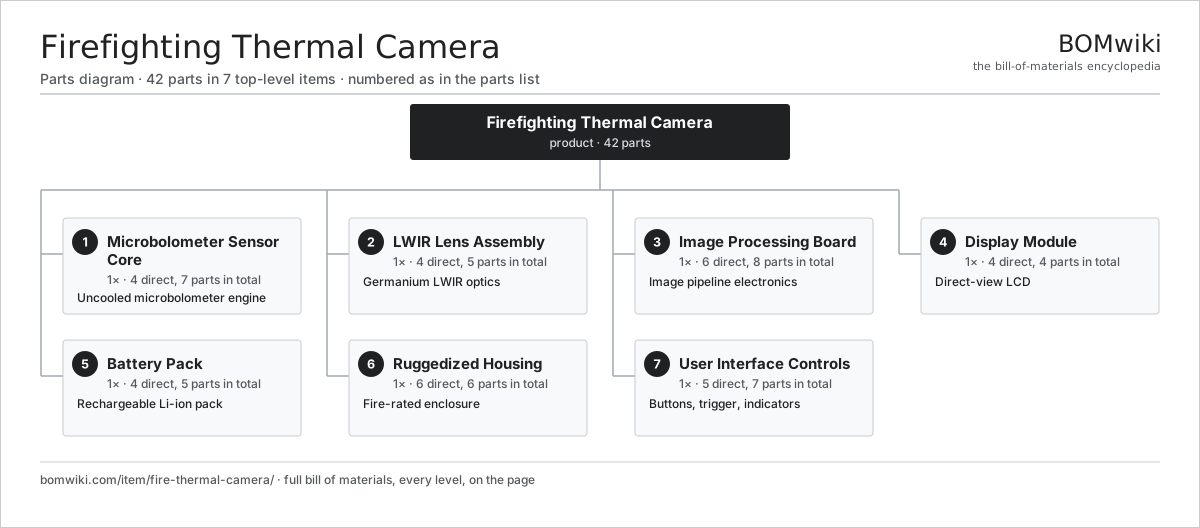
| # | Part | Qty | What it does |
|---|---|---|---|
| 1 | Microbolometer Sensor Core 4 parts | 1× | Uncooled microbolometer engine |
| 2 | LWIR Lens Assembly 4 parts | 1× | Germanium LWIR optics |
| 3 | Image Processing Board 6 parts | 1× | Image pipeline electronics |
| 4 | Display Module 4 parts | 1× | Direct-view LCD |
| 5 | Battery Pack 4 parts | 1× | Rechargeable Li-ion pack |
| 6 | Ruggedized Housing 6 parts | 1× | Fire-rated enclosure |
| 7 | User Interface Controls 5 parts | 1× | Buttons, trigger, indicators |
3D model
No 3D model yet. Have a CAD file of this? Add a 3D model. STL renders right on this page; STEP, FreeCAD, and OpenSCAD sources are welcome too (openly licensed, like all 3D models on BOMwiki).
Build & assembly graph
expand / collapse · shared sub-assemblies converge · links to related products · est. labourTap an assembly to expand/collapse · tap a part to open it · use “Open page” for any node · drag to pan, scroll to zoom.
Bill of materials for Firefighting Thermal Camera
7 top-level lines · 48 rows shown · 42 parts total · indented to 3 levels| # | Item / sub-assembly | Part no. | Qty/assy | Ext. qty | Parts | Type |
|---|---|---|---|---|---|---|
| 1 | Microbolometer Sensor Core 4 parts | fire-thermal-camera-sensor-core | 1× | 1 | 7 | assembly |
| 1.1 | Microbolometer FPA | fire-thermal-camera-fpa | 1× | 1 | · | part |
| 1.2 | NUC Shutter 2 parts | fire-thermal-camera-nuc-shutter | 1× | 1 | 2 | assembly |
| 1.2.1 | Shutter Blade | fire-thermal-camera-shutter-blade | 1× | 1 | · | part |
| 1.2.2 | Shutter Solenoid | fire-thermal-camera-shutter-solenoid | 1× | 1 | · | part |
| 1.3 | Sensor Bias Board 3 parts | fire-thermal-camera-sensor-pcb | 1× | 1 | 3 | assembly |
| 1.3.1 | Bare PCB | pcb-bare | 1× | 1 | · | part |
| 1.3.2 | SMD Passive (R/C/L) | smd-passives | 1× | 1 | · | part |
| 1.3.3 | Connector | connector | 1× | 1 | · | part |
| 1.4 | Core Frame | fire-thermal-camera-core-frame | 1× | 1 | · | part |
| 2 | LWIR Lens Assembly 4 parts | fire-thermal-camera-lens-assembly | 1× | 1 | 5 | assembly |
| 2.1 | Germanium Lens Element | fire-thermal-camera-germanium-lens | 2× | 2 | · | part |
| 2.2 | Lens Barrel | fire-thermal-camera-lens-barrel | 1× | 1 | · | part |
| 2.3 | Protective Window | fire-thermal-camera-lens-window | 1× | 1 | · | part |
| 2.4 | O-Ring Set | oring-set | 1× | 1 | · | part |
| 3 | Image Processing Board 6 parts | fire-thermal-camera-processing-board | 1× | 1 | 8 | assembly |
| 3.1 | Bare PCB | pcb-bare | 1× | 1 | · | part |
| 3.2 | Compute SoC Module | soc-module | 1× | 1 | · | part |
| 3.3 | Microcontroller | mcu | 1× | 1 | · | part |
| 3.4 | Flash Memory | fire-thermal-camera-memory | 1× | 1 | · | part |
| 3.5 | SMD Passive (R/C/L) | smd-passives | 1× | 1 | · | part |
| 3.6 | Connector | connector | 3× | 3 | · | part |
| 4 | Display Module 4 parts | fire-thermal-camera-display-module | 1× | 1 | 4 | assembly |
| 4.1 | LCD Panel | lcd-panel | 1× | 1 | · | part |
| 4.2 | Display Window | fire-thermal-camera-display-window | 1× | 1 | · | part |
| 4.3 | Display Gasket | fire-thermal-camera-display-gasket | 1× | 1 | · | part |
| 4.4 | Connector | connector | 1× | 1 | · | part |
| 5 | Battery Pack 4 parts | fire-thermal-camera-battery-pack | 1× | 1 | 5 | assembly |
| 5.1 | Li-ion Cell, 18650 | li-cell-18650 | 2× | 2 | · | part |
| 5.2 | BMS Board | bms-board | 1× | 1 | · | part |
| 5.3 | Battery Case | fire-thermal-camera-battery-case | 1× | 1 | · | part |
| 5.4 | Battery Contacts | fire-thermal-camera-battery-contacts | 1× | 1 | · | part |
| 6 | Ruggedized Housing 6 parts | fire-thermal-camera-housing | 1× | 1 | 6 | assembly |
| 6.1 | Front Shell | fire-thermal-camera-front-shell | 1× | 1 | · | part |
| 6.2 | Rear Shell | fire-thermal-camera-rear-shell | 1× | 1 | · | part |
| 6.3 | Rubber Overmold | fire-thermal-camera-rubber-overmold | 1× | 1 | · | part |
| 6.4 | Lanyard Boss | fire-thermal-camera-lanyard-boss | 1× | 1 | · | part |
| 6.5 | O-Ring Set | oring-set | 1× | 1 | · | part |
| 6.6 | Fastener Set | fastener-set | 1× | 1 | · | part |
| 7 | User Interface Controls 5 parts | fire-thermal-camera-ui-controls | 1× | 1 | 7 | assembly |
| 7.1 | Trigger Switch | fire-thermal-camera-trigger-switch | 1× | 1 | · | part |
| 7.2 | Button Pad | fire-thermal-camera-button-pad | 1× | 1 | · | part |
| 7.3 | Button PCB 3 parts | fire-thermal-camera-button-pcb | 1× | 1 | 3 | assembly |
| 7.3.1 | Bare PCB | pcb-bare | 1× | 1 | · | part |
| 7.3.2 | SMD Passive (R/C/L) | smd-passives | 1× | 1 | · | part |
| 7.3.3 | Connector | connector | 1× | 1 | · | part |
| 7.4 | Status LED | fire-thermal-camera-status-led | 1× | 1 | · | part |
| 7.5 | Speaker | speaker | 1× | 1 | · | part |
Something wrong in this list? Report a problem with this BOM.
Related products
same domain, ranked by shared parts Fire Alarm Control Panel
88 parts · shares 4 with this page
Fire Alarm Control Panel
88 parts · shares 4 with this page
 Police Cruiser
686 parts · shares 4 with this page
Police Cruiser
686 parts · shares 4 with this page
 Hydraulic Rescue Spreader
95 parts · shares 4 with this page
Hydraulic Rescue Spreader
95 parts · shares 4 with this page
 SCBA Breathing Apparatus
191 parts · shares 4 with this page
SCBA Breathing Apparatus
191 parts · shares 4 with this page
 Powered Ambulance Stretcher
85 parts · shares 3 with this page
Powered Ambulance Stretcher
85 parts · shares 3 with this page
 Water Rescue Drone (Powered Buoy)
87 parts · shares 3 with this page
Water Rescue Drone (Powered Buoy)
87 parts · shares 3 with this page
Sourcing: possible vendors
Browse the supplier directory → Prices, MOQ, and lead times are algorithmic estimates, not quotes, and not claims about these companies. Company mappings are curated by keyword; est. price band $30–$1M. How estimates work| Vendor | HQ | Specialty | MOQ | Lead time |
|---|---|---|---|---|
| rosenbauer.com ↗ | Leonding, AT | Fire apparatus | 200 units | 8–14 wks |
|
🇺🇸Oshkosh
oshkoshcorp.com ↗
|
Oshkosh, US | Specialty trucks (Pierce) | 200 units | 8–14 wks |
| msasafety.com ↗ | Cranberry Township, US | Safety equipment | 200 units | 8–14 wks |
|
🇩🇪Dräger
draeger.com ↗
|
Lübeck, DE | Safety & medical tech | 200 units | 8–14 wks |
| honeywell.com ↗ | Charlotte, US | Building & safety tech | 200 units | 8–14 wks |
779-word article