Fish Counter
ProductOverview
Fish counting systems measure throughput (fish/minute) at critical junctures: bin discharges to grading machines, transport truck loading, or post-harvest processing lines. Unlike manual counting (labor-intensive, prone to error beyond 50 fish/min), automated counters provide real-time feedback and permanent audit trails.
Optical and resistivity-based counters each excel in different conditions: optical works well in clear well water but fails in turbid seawater or after sediment disturbance. Resistivity detects individual fish by electrical conductivity change (fish body ~5000 µS/cm vs. seawater ~50,000 µS/cm, freshwater ~300 µS/cm), working equally well in murky water. Modern installations often deploy both, selecting the best signal post-installation.
How it works
Fish enter the Manifold Pipe Array, typically positioned downstream of a grading machine or pump discharge. The Input Manifold splits inlet flow equally into 4–8 Branch Pipes. Balanced flow distribution ensures even fish spacing; if one branch receives 2× flow, fish pack tighter, risking jamming.
Optical path: Each Branch Pipes houses a IR LED Transmitter (infrared transmitter) on one side and a Photodiode Receiver (receiver) on the opposite side. As a fish passes, it shadows the IR beam; the received signal drops sharply for 10–100 ms (depending on fish speed and size). The Amplifier & Filter (variable-gain, 100 Hz low-pass) boosts the signal 10–100×, smoothing noise. The Threshold Comparator detects when the signal crosses the user-set threshold; the Peak Detector & Monostable generates one clean pulse per crossing event, feeding the Counter MCU.
Resistivity alternative: The Electrode Pair (two titanium or platinum electrodes spaced 2–5 mm apart) applies a constant-current 1 kHz AC signal across the pipe. A fish's ionic body conductivity (~5000 µS/cm) creates a detectable change in voltage across the electrodes. The AC Signal Generator drives current; the Lock-In Detector (lock-in amplifier) demodulates at 1 kHz, extracting the fish-conductivity signal (±100 µS/cm resolution). This method works in opaque water and handles both saltwater and freshwater seamlessly.
The Counter MCU tallies pulses from all 4–8 channels, computing per-channel rate (fish/min) and cumulative count. The Display Panel shows real-time throughput; every 60 seconds, data is logged to the SD Card Interface with timestamp from the RTC Module.
Operators download data via USB Data Link, view trends in the Analysis Software (graphs of throughput spikes, daily totals, per-channel comparison), and export CSV for farm management records or regulatory audits.
Design considerations
Pipe diameter selection. Smaller pipes (DN25, 28 mm) suit juvenile fish (10–50 g); fish pack closer, increasing detection density. Large fish (500+ g) need DN50 or larger to prevent jamming. Multi-channel systems using different diameters per channel (DN25 for small, DN40 for medium, DN50 for large) allow size-based sorting feedback.
Flow velocity and transit time. Optimal flow is 0.5–1.5 m/s (transit time 1–4 seconds per fish). Too fast (<0.3 m/s), fish cluster and interfere with detection. Too slow (>2 m/s), signal width narrows, risking aliasing if sampling slow. 10 kHz sampling (0.1 ms intervals) handles a 2 m/s fish (1 cm body) traversing in 5 ms, oversampling by 50×.
Optical vs. resistivity trade-offs:
- Optical: cheaper, faster response (1 ms), needs clear water, sensitive to LED aging (yearly replacement)
- Resistivity: works in murky water and saltwater, requires temperature compensation (conductivity varies 2%/°C), more complex electronics
Sites with variable water clarity often install both in parallel; cross-checking accuracy catches sensor drift.
False positives and debounce. Debris, large bubbles, or even fish scales can trigger brief shadows. The Debounce Hysteresis uses hysteresis: a signal must be below threshold for at least 200 ms before the next fish is counted (prevents double-counting from signal noise). At 1000 fish/min, the 200 ms debounce is safe (minimum fish spacing ~60 ms).
Cumulative count reliability. For regulatory compliance (stocking records, sale audits), count accuracy must be ±1% over 10,000+ fish. This requires:
- Periodic optical window cleaning (algae/biofilm degrades transmission)
- LED brightness compensation (aging LEDs weaken at ~5% per year)
- Temperature-corrected thresholds if resistivity used
Integration with farm systems
The counter is typically installed downstream of:
- Grading machine: confirming output match expected sized distribution
- Transport loading: final count before truck departure (audit trail for sale receipt)
- Processing line: monitoring production rate, alerting if jam detected (count drops suddenly)
Real-time feedback allows operators to adjust upstream pump speed or grading bar gap if throughput drops unexpectedly, catching mechanical faults early (blocked filter, loose coupling vibration) before major damage.
Cloud-connected systems (via Ethernet Module (Optional)) push daily counts to a central data lake, enabling predictive analytics: daily totals, weekly trends, seasonal patterns. A machine-learning model trained on 2–3 years of data can predict stocking errors or processing delays 1–2 days in advance.
Fish Counter parts and their functions
6 top-level parts · 22 parts in total · full bill of materials below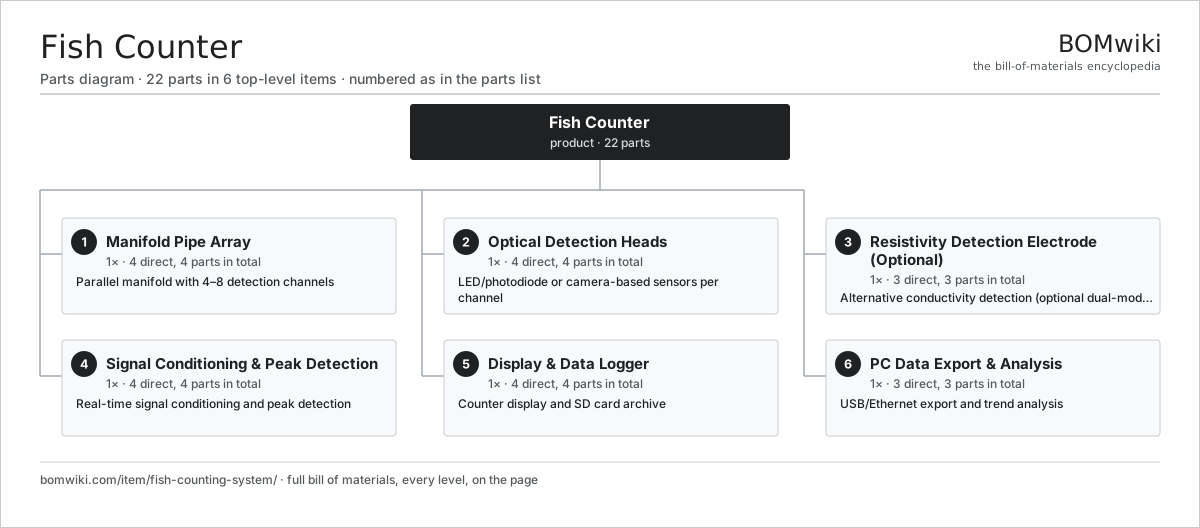
| # | Part | Qty | What it does |
|---|---|---|---|
| 1 | Manifold Pipe Array 4 parts | 1× | Parallel manifold with 4–8 detection channels |
| 2 | Optical Detection Heads 4 parts | 1× | LED/photodiode or camera-based sensors per channel |
| 3 | Resistivity Detection Electrode (Optional) 3 parts | 1× | Alternative conductivity detection (optional dual-mode) |
| 4 | Signal Conditioning & Peak Detection 4 parts | 1× | Real-time signal conditioning and peak detection |
| 5 | Display & Data Logger 4 parts | 1× | Counter display and SD card archive |
| 6 | PC Data Export & Analysis 3 parts | 1× | USB/Ethernet export and trend analysis |
3D model
No 3D model yet. Have a CAD file of this? Add a 3D model. STL renders right on this page; STEP, FreeCAD, and OpenSCAD sources are welcome too (openly licensed, like all 3D models on BOMwiki).
Build & assembly graph
expand / collapse · shared sub-assemblies converge · links to related products · est. labourTap an assembly to expand/collapse · tap a part to open it · use “Open page” for any node · drag to pan, scroll to zoom.
Bill of materials for Fish Counter
6 top-level lines · 28 rows shown · 22 parts total · indented to 3 levels| # | Item / sub-assembly | Part no. | Qty/assy | Ext. qty | Parts | Type |
|---|---|---|---|---|---|---|
| 1 | Manifold Pipe Array 4 parts | fish-counting-system-pipe-array | 1× | 1 | 4 | assembly |
| 1.1 | Input Manifold | fish-counting-system-main-manifold | 1× | 1 | · | part |
| 1.2 | Branch Pipes | fish-counting-system-branch-pipes | 1× | 1 | · | part |
| 1.3 | Sensor Port Fittings | fish-counting-system-sensor-ports | 1× | 1 | · | part |
| 1.4 | Outlet Manifold | fish-counting-system-recombine-manifold | 1× | 1 | · | part |
| 2 | Optical Detection Heads 4 parts | fish-counting-system-optical-heads | 1× | 1 | 4 | assembly |
| 2.1 | IR LED Transmitter | fish-counting-system-ir-led | 1× | 1 | · | part |
| 2.2 | Photodiode Receiver | fish-counting-system-photodiode | 1× | 1 | · | part |
| 2.3 | Optical Window | fish-counting-system-optical-window | 1× | 1 | · | part |
| 2.4 | Optical Alignment Block | fish-counting-system-optical-alignment-jig | 1× | 1 | · | part |
| 3 | Resistivity Detection Electrode (Optional) 3 parts | fish-counting-system-resistivity-electrode | 1× | 1 | 3 | assembly |
| 3.1 | Electrode Pair | fish-counting-system-electrode-pair | 1× | 1 | · | part |
| 3.2 | AC Signal Generator | fish-counting-system-electrode-ac-source | 1× | 1 | · | part |
| 3.3 | Lock-In Detector | fish-counting-system-electrode-detector | 1× | 1 | · | part |
| 4 | Signal Conditioning & Peak Detection 4 parts | fish-counting-system-signal-processor | 1× | 1 | 4 | assembly |
| 4.1 | Amplifier & Filter | fish-counting-system-amplifier-filter | 1× | 1 | · | part |
| 4.2 | Threshold Comparator | fish-counting-system-comparator | 1× | 1 | · | part |
| 4.3 | Peak Detector & Monostable | fish-counting-system-peak-counter | 1× | 1 | · | part |
| 4.4 | Debounce Hysteresis | fish-counting-system-debounce-logic | 1× | 1 | · | part |
| 5 | Display & Data Logger 4 parts | fish-counting-system-data-logger | 1× | 1 | 4 | assembly |
| 5.1 | Counter MCU | fish-counting-system-counter-microcontroller | 1× | 1 | · | part |
| 5.2 | Display Panel | fish-counting-system-display-lcd | 1× | 1 | · | part |
| 5.3 | SD Card Interface | fish-counting-system-sd-card-socket | 1× | 1 | · | part |
| 5.4 | RTC Module | fish-counting-system-real-time-clock | 1× | 1 | · | part |
| 6 | PC Data Export & Analysis 3 parts | fish-counting-system-software-interface | 1× | 1 | 3 | assembly |
| 6.1 | USB Data Link | fish-counting-system-usb-interface | 1× | 1 | · | part |
| 6.2 | Analysis Software | fish-counting-system-analysis-software | 1× | 1 | · | part |
| 6.3 | Ethernet Module (Optional) | fish-counting-system-ethernet-optional | 1× | 1 | · | part |
Something wrong in this list? Report a problem with this BOM.
Sourcing: possible vendors
Browse the supplier directory → Prices, MOQ, and lead times are algorithmic estimates, not quotes, and not claims about these companies. Company mappings are curated by keyword; est. price band $2k–$500M. How estimates work| Vendor | HQ | Specialty | MOQ | Lead time |
|---|---|---|---|---|
| hd.com ↗ | Ulsan, KR | Shipbuilder | made to order | 52–104 wks |
| fincantieri.com ↗ | Trieste, IT | Shipbuilder | made to order | 52–104 wks |
| damen.com ↗ | Gorinchem, NL | Shipbuilder | made to order | 52–104 wks |
| brunswick.com ↗ | Mettawa, US | Marine & boats | made to order | 52–104 wks |
|
🇨🇳CSSC
cssc.net.cn ↗
|
Shanghai, CN | Shipbuilding conglomerate | made to order | 52–104 wks |
869-word article