Fish Deheading Machine
ProductOverview
The fish deheading machine is a production workhorse in industrial seafood processing plants, designed to remove heads from whole fish with minimal waste and maximum throughput. The reciprocating blade mechanism executes a precise cut perpendicular to the spine, severing the head while leaving the collar meat on the body for filleting. A gravity-fed hopper with vibratory feeder orients fish heads-first onto the main conveyor, where the cutting head engages. Hydraulic actuation drives the blade at 60–80 strokes per minute, synchronized to conveyor speed for consistent cut placement. The discharge assembly splits product and waste streams, with deheaded bodies continuing downstream and severed heads dropping into a separate collection bin for further processing or disposal.
Deheading is typically the first step in premium fish processing lines, as head removal simplifies downstream filleting, reduces microbial contamination vectors, and enables automated bone removal. By cutting close to the operculum (gill cover), the operator preserves the maximum length of the loin and allows gill-attached collar meat to remain on the body. This improves meat recovery and reduces cost per kilogram of processed product.
The machine is engineered for stainless steel construction or food-grade epoxy coating to withstand daily washdown and high-humidity environments. All wetted surfaces are sloped or perforated to ensure rapid drainage, and the hydraulic system is sealed against direct spray. Operator controls sit at ergonomic height with a 7-inch HMI display for configuring species-specific cut depths and conveyor speeds; an emergency stop button triggers dual-channel hydraulic shutdown and motor kill relay.
How it works
Fish enter the feed hopper in bulk. A vibratory motor at 60 Hz spacing prevents clumping and allows gravity to feed individual fish down an angled guide tube. The guide tube has soft ribs to orient fish heads-forward without damaging scales or flesh. Fish bodies rest head-to-tail on the main conveyor belt, which moves at 50–200 mm/s (species dependent). As each fish reaches the cutting station, the reciprocating blade, driven by a hydraulic cylinder through a connecting rod, executes a rapid horizontal stroke perpendicular to the spine. The blade contacts the fish at a programmed depth set via the HMI, typically 10–15 mm behind the operculum, severing the head cleanly in a single or two-stroke motion.
The blade assembly consists of paired cutting blades mounted on a carriage that slides on precision linear ball-bearing rails. Blade speed and hydraulic pressure are feedback-controlled; a pressure sensor monitors the cut force, and the PLC adjusts pump displacement or stroke rate to maintain consistent cut quality. Once the head is severed, the body continues downstream on the body conveyor, while the head and associated waste (scales, blood, bone dust) fall through a stainless steel chute into a collection bin. Low-pressure spray jets mounted above the cutting zone wash blood and debris from the cutting head and the conveyor, directing the slurry into the same waste stream for disposal or rendering.
Key assemblies
Cutting head: The blade carriage houses two hardened steel knives (62 HRC) with a 3 mm edge radius to resist chipping during bone contact. Linear ball-bearing guides support 4 bearing blocks on each rail, allowing smooth travel at 60–80 strokes/minute with minimal friction and wear. The connecting rod links a crankshaft (or cam) to the carriage, converting rotational or reciprocating hydraulic motion into precise blade travel.
Conveyor drive: A 2–5 kW motor powers a helical gearbox (50–200 rpm output) through a flexible coupling. The gearbox drives a main conveyor roller via a synthetic rubber drive belt with cleats for positive fish grip. Speed is infinitely variable via motor VFD (variable frequency drive) or pump displacement control, allowing operators to tune throughput without changing gearbox ratios.
Hydraulic system: A variable displacement axial piston pump supplies 40 L/min at 2000 psi. The pump is pilot-operated, reducing energy waste when the machine idles. A double-acting cylinder (150 mm bore, 500 mm stroke) drives the blade carriage. Pressure relief, check valves, and solenoid directional control valves ensure fail-safe operation and prevent cavitation. A 20–30 liter reservoir with a suction strainer and 150-micron return filter keeps the hydraulic oil clean, extending component life and reducing wear.
Control system: A compact PLC executes cut timing at 10 ms cycle resolution, integrating feedback from depth sensors, pressure transducers, and an encoder on the main conveyor. The 7-inch HMI display allows operators to program species profiles (salmon, cod, herring, etc.) with preset blade depths and conveyor speeds. An emergency stop button wired to a dual-channel safety relay cuts 24 VDC control power to both the pump motor and conveyor brake, bringing the machine to a halt in less than 1 second.
Maintenance and design life
Blade wear is the primary consumable. High-carbon steel blades maintain an edge for 8–16 hours of operation (depending on fish bone density and hardness) before sharpening or replacement becomes necessary. Most operators keep spare blade sets on hand and swap them during lunch break, minimizing downtime. Blade life can be extended by 20–30% through regular honing with a ceramic stone (every 4 hours) and by controlling hydraulic pressure to avoid overload.
Hydraulic fluid should be sampled quarterly for viscosity and particle count; a 15-micron ISO cleanliness target prevents pump and cylinder seal wear. Filter elements are replaced annually or every 500 operating hours. Linear bearing blocks are sealed against direct spray but should be flushed with light machine oil monthly; rail corrosion is rare in stainless steel but can occur if salt water or acidic cleaning agents pool against the rail.
The gearbox requires an annual fluid check and gear tooth inspection for pitting or scuffing. Most industrial helical gearboxes are rated for 10,000–20,000 operating hours before major overhaul. The motor coupling should be inspected for wear and realigned yearly; a worn coupling introduces vibration that accelerates bearing failure in the motor and gearbox.
Variants and scalability
Small batch operations (100–400 kg/hour) use single-blade machines with manual depth adjustment and fixed 100 mm/s conveyor speed. Mid-range plants employ dual-blade machines (one primary, one secondary for backup or rework) with programmable blade depth and variable-speed hydraulics. High-volume processors (1–2 tonnes/hour) install primary deheaders followed by secondary automated collaring machines that remove unwanted tissue near the collar. Some facilities integrate thermal imaging or laser line sensors to auto-detect optimal cut location based on individual fish size, improving meat recovery by 2–4% across large batches.
Water usage for washdown is typically 50–100 liters/hour for a 5-tonne/hour machine; facilities with strict discharge limits often recirculate chilled washwater through a settlement tank and hydrocyclone for solids removal before reuse.
Fish Deheading Machine parts and their functions
7 top-level parts · 55 parts in total · full bill of materials below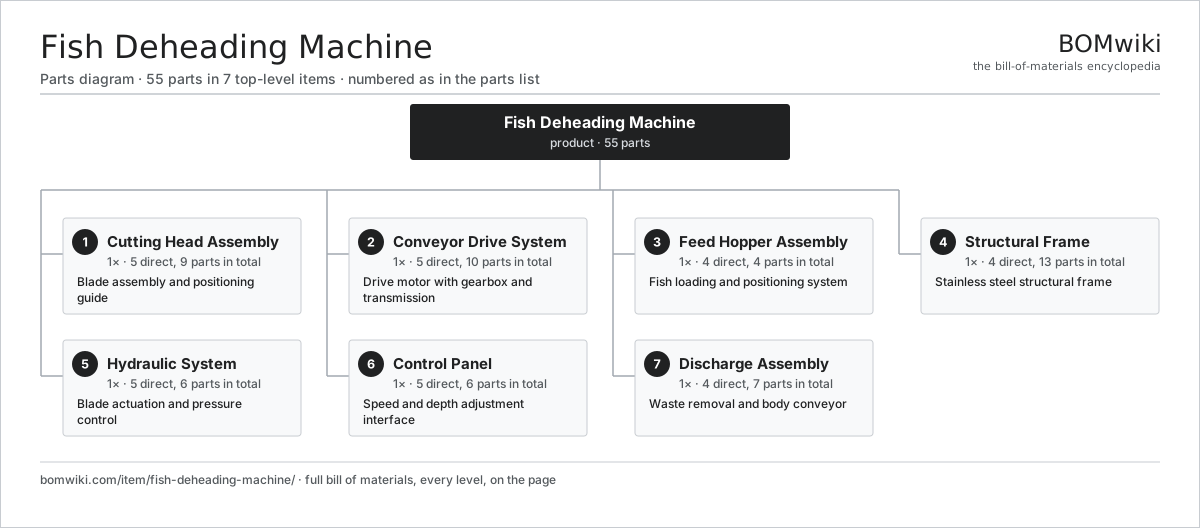
| # | Part | Qty | What it does |
|---|---|---|---|
| 1 | Cutting Head Assembly 5 parts | 1× | Blade assembly and positioning guide |
| 2 | Conveyor Drive System 5 parts | 1× | Drive motor with gearbox and transmission |
| 3 | Feed Hopper Assembly 4 parts | 1× | Fish loading and positioning system |
| 4 | Structural Frame 4 parts | 1× | Stainless steel structural frame |
| 5 | Hydraulic System 5 parts | 1× | Blade actuation and pressure control |
| 6 | Control Panel 5 parts | 1× | Speed and depth adjustment interface |
| 7 | Discharge Assembly 4 parts | 1× | Waste removal and body conveyor |
3D model
No 3D model yet. Have a CAD file of this? Add a 3D model. STL renders right on this page; STEP, FreeCAD, and OpenSCAD sources are welcome too (openly licensed, like all 3D models on BOMwiki).
Build & assembly graph
expand / collapse · shared sub-assemblies converge · links to related products · est. labourTap an assembly to expand/collapse · tap a part to open it · use “Open page” for any node · drag to pan, scroll to zoom.
Bill of materials for Fish Deheading Machine
7 top-level lines · 39 rows shown · 55 parts total · indented to 3 levels| # | Item / sub-assembly | Part no. | Qty/assy | Ext. qty | Parts | Type |
|---|---|---|---|---|---|---|
| 1 | Cutting Head Assembly 5 parts | fish-deheading-machine-cutting-head | 1× | 1 | 9 | assembly |
| 1.1 | Cutting Blade Set | fish-deheading-machine-blade-set | 1× | 1 | · | part |
| 1.2 | Linear Guide Rail | fish-deheading-machine-blade-guide | 2× | 2 | · | part |
| 1.3 | Connecting Rod Assembly | fish-deheading-machine-connecting-rod | 1× | 1 | · | part |
| 1.4 | Ball Bearing | ball-bearing | 4× | 4 | · | part |
| 1.5 | Fastener Set | fastener-set | 1× | 1 | · | part |
| 2 | Conveyor Drive System 5 parts | fish-deheading-machine-conveyor-drive | 1× | 1 | 10 | assembly |
| 2.1 | Blower Motor | blower-motor | 1× | 1 | · | part |
| 2.2 | Gearbox Reducer | fish-deheading-machine-gearbox | 1× | 1 | · | part |
| 2.3 | Drive Belt Assembly | fish-deheading-machine-drive-belt | 1× | 1 | · | part |
| 2.4 | Ball Bearing | ball-bearing | 6× | 6 | · | part |
| 2.5 | Shaft Coupling | shaft-coupling | 1× | 1 | · | part |
| 3 | Feed Hopper Assembly 4 parts | fish-deheading-machine-feed-hopper | 1× | 1 | 4 | assembly |
| 3.1 | Hopper Pan | fish-deheading-machine-hopper-pan | 1× | 1 | · | part |
| 3.2 | Vibratory Feeder Motor | fish-deheading-machine-vibratory-feeder | 1× | 1 | · | part |
| 3.3 | Orientation Guide Tube | fish-deheading-machine-guide-tube | 1× | 1 | · | part |
| 3.4 | Fastener Set | fastener-set | 1× | 1 | · | part |
| 4 | Structural Frame 4 parts | fish-deheading-machine-frame | 1× | 1 | 13 | assembly |
| 4.1 | Base Plate | fish-deheading-machine-base-plate | 1× | 1 | · | part |
| 4.2 | Vertical Support Column | fish-deheading-machine-uprights | 4× | 4 | · | part |
| 4.3 | Cross-Brace Beam | fish-deheading-machine-crossmembers | 6× | 6 | · | part |
| 4.4 | Fastener Set | fastener-set | 2× | 2 | · | part |
| 5 | Hydraulic System 5 parts | fish-deheading-machine-hydraulics | 1× | 1 | 6 | assembly |
| 5.1 | Hydraulic Pump | fish-deheading-machine-pump | 1× | 1 | · | part |
| 5.2 | Hydraulic Cylinder | fish-deheading-machine-cylinder | 1× | 1 | · | part |
| 5.3 | Pressure Relief Valve | fish-deheading-machine-pressure-valve | 1× | 1 | · | part |
| 5.4 | Pressure Sensor | pressure-sensor | 2× | 2 | · | part |
| 5.5 | Hydraulic Hose Assembly | fish-deheading-machine-hose-bundle | 1× | 1 | · | part |
| 6 | Control Panel 5 parts | fish-deheading-machine-controls | 1× | 1 | 6 | assembly |
| 6.1 | PLC Module | fish-deheading-machine-plc | 1× | 1 | · | part |
| 6.2 | HMI Touchscreen | fish-deheading-machine-hmi-panel | 1× | 1 | · | part |
| 6.3 | Emergency Stop Assembly | fish-deheading-machine-e-stop | 1× | 1 | · | part |
| 6.4 | Relay | relay | 2× | 2 | · | part |
| 6.5 | Bare PCB | pcb-bare | 1× | 1 | · | part |
| 7 | Discharge Assembly 4 parts | fish-deheading-machine-discharge | 1× | 1 | 7 | assembly |
| 7.1 | Body Conveyor Belt | fish-deheading-machine-body-conveyor | 1× | 1 | · | part |
| 7.2 | Waste Chute Assembly | fish-deheading-machine-head-chute | 1× | 1 | · | part |
| 7.3 | Spray Washdown System | fish-deheading-machine-spray-system | 1× | 1 | · | part |
| 7.4 | Ball Bearing | ball-bearing | 4× | 4 | · | part |
Something wrong in this list? Report a problem with this BOM.
Related products
same domain, ranked by shared parts Chocolate Enrober
470 parts · shares 3 with this page
Gummy Depositor
87 parts · shares 3 with this page
Spiral Freezer
179 parts · shares 3 with this page
Chocolate Moulding Line
223 parts · shares 2 with this page
Chocolate Enrober
470 parts · shares 3 with this page
Gummy Depositor
87 parts · shares 3 with this page
Spiral Freezer
179 parts · shares 3 with this page
Chocolate Moulding Line
223 parts · shares 2 with this page
Sourcing: possible vendors
Browse the supplier directory → Prices, MOQ, and lead times are algorithmic estimates, not quotes, and not claims about these companies. Company mappings are curated by keyword; est. price band $1k–$500k. How estimates work| Vendor | HQ | Specialty | MOQ | Lead time |
|---|---|---|---|---|
| gea.com ↗ | Düsseldorf, DE | Process technology | 20 units | 12–20 wks |
| buhlergroup.com ↗ | Uzwil, CH | Food & materials processing | 20 units | 12–20 wks |
| tetrapak.com ↗ | Pully, CH | Food packaging & processing | 20 units | 12–20 wks |
| jbtc.com ↗ | Chicago, US | Food processing equipment | 20 units | 12–20 wks |
| alfalaval.com ↗ | Lund, SE | Heat transfer & separation | 20 units | 12–20 wks |
1,138-word article