Fish Hold Refrigeration
ProductOverview
A fish-hold refrigeration system is a closed-loop vapor-compression cooling plant designed to maintain pelagic catch in a pristine frozen state throughout multi-week fishing operations. The system uses RSW (refrigerated seawater) technology: chilled seawater circulates through an evaporator coil immersed in the fish hold, absorbing latent heat from the catch. A Compressor (20–40 hp, typically R-404A or R-507A refrigerant) pressurizes this vapor, condensing it in a seawater-cooled Condenser. Liquid refrigerant is stored in a Receiver Tank, metered through a Expansion Valve, and evaporates anew, completing the cycle.
The RSW Evaporator is an immersion cooler, a titanium or 316 stainless coil submerged in the fish hold sump. Chilled water (or glycol in arctic operations) from this coil is circulated via Circulation Pump (50–100 L/min) to spray bars or flooded evaporators that blanket the fish stack. The Insulated Hold itself is a highly insulated compartment (100–150 mm polyurethane foam, R-value 5–7 per inch) lined with stainless steel or food-grade plastic, preventing external heat gain. A Control Panel maintains setpoint temperature (0 to -3°C) via PLC-based compressor cycling, armed with high-pressure alarms, liquid-level monitors, and temperature display.
Most fishing vessels deploy this system for pelagic fish (tuna, mackerel, sardine) where rapid chilling and maintenance at deep-freezing temperature preserves texture, flavor, and market value. Smaller vessels may use simpler ice-based systems, but RSW systems are standard on all commercial longliner and trawler operations operating >5 days from port.
How It Works
Steady-state cooling: The Compressor runs continuously during fishing operations. Discharge pressure is typically 10–15 bar absolute (gauge 9–14 bar). The high-pressure liquid from the Condenser flows into the Receiver Tank, where vapors separate and liquid collects. The Expansion Valve meters flow based on a Expansion Bulb temperature sensor at the evaporator outlet, maintaining 5–10°C superheat (prevents flooded evaporator but keeps full cooling capacity).
Refrigerant vapor enters the RSW Evaporator coil at low pressure (1–3 bar absolute) and boils in the titanium tubes, absorbing 30–100 kW latent heat. The resulting low-pressure vapor exits the coil and returns to the Compressor intake, completing the cycle. Total cycle time is typically 4–8 minutes for a small RSW system.
Circulation and heat removal: The Circulation Pump (driven by a 3–5 hp motor) draws chilled seawater from the RSW Evaporator sump and circulates it at 50–100 L/min through spray headers or flooded coolers mounted above the fish stack. Cold water cascades downward, enveloping the catch and draining back to the sump. The hold sump is sloped 10–15° toward a Drain Plug to allow meltwater and blood-ice slurry to be periodically drained overboard.
Seawater cooling loop: Raw seawater is drawn through a through-hull strainer and fed to the Condenser inlet at 100–200 L/min. Heat is rejected; discharge seawater (now 2–3°C warmer) exits overboard. This "open-loop" cooling approach is highly efficient but requires regular strainer maintenance (cleaned weekly in productive fishing grounds where plankton fouls the intake).
Control and safety: The Control Panel contains a Temperature Sensor (Pt100 RTD or 4–20 mA transmitter) in the fish-hold sump. When temperature rises above setpoint (e.g., 0°C), the PLC energizes the Compressor Contactor, engaging the compressor via 3-phase starter. As hold temperature falls to setpoint, the compressor is cycled off (or modulated via suction unloaders on larger units). A High Pressure Switch monitors discharge pressure; if it exceeds 20 bar (seawater inlet blockage or ambient heat), an alarm sounds and the compressor is de-energized to prevent catastrophic pressure rupture.
Defrost cycle (periodic): In long fishing seasons, ice may accumulate on evaporator coils, reducing heat-transfer efficiency. Some systems include periodic hot-gas bypass defrosting (diverting warm discharge gas through the coil) once per 12–24 hours. The meltwater drains to the sump and is manually pumped overboard.
Refrigerant Selection
R-404A and R-507A: High-pressure HFC blends, typical operating pressures 10–15 bar suction, 12–18 bar discharge. Both are ozone-safe (ODP = 0) and have been phased in post-Montreal Protocol. R-507A has slightly lower capacity and higher discharge temperature; R-404A is more common in marine retrofit applications.
R-507H (drop-in for R-404A): Lower GWP replacement, emerging in new builds and retrofits per EU F-Gas regulations.
Charge quantity: Typically 30–50 kg per system depending on component volumes and displacement. Undercharging reduces capacity; overcharging increases discharge pressure and risks liquid slugging at the compressor inlet.
Operational Considerations
Fishing sequence: Upon catch landing, fish are rapidly bled and gutted, then placed in the hold on a bed of ice or directly into the spray-cooled zone. The Circulation Pump is engaged at full flow (100 L/min), and the Compressor maintains continuous operation. Within 2–4 hours, the stack interior cools to -1°C; by 8–10 hours, the entire catch is at -2 to -3°C throughout. Blood and juices drain toward the sump, where a Drain Plug is opened periodically to purge accumulated liquid. This practice, called "blood ice" or "slurry ice" removal, prevents microbial colonization and maintains fish quality.
Continuous fishing: On extended (3–4 week) voyages, successive catches are stacked atop prior frozen fish. The RSW Evaporator is typically undersized relative to total hold volume, so equilibrium is reached at -2 to -1°C (rather than deep-freeze -20°C). However, at -2°C, microbial growth is negligible, and enzymatic spoilage is arrested. Fish remain market-quality for 2–3 weeks.
Power consumption: A 40 hp compressor drawing 30 kW continuous, plus 5 kW circulation pump and PLC, totals ~35 kW auxiliary load. On a vessel with 100+ kW main propulsion, this is <40% auxiliary burden.
Maintenance
- Weekly: Check seawater strainer basket for fouling; backflush condenser if inlet temperature rises >5°C above ambient; verify receiver-tank liquid level via sight glass.
- Monthly: Oil-change interval for reciprocating compressor (drain crankcase sump, refill with synthetic PAO refrigerant oil); inspect Temperature Sensor calibration via ice-bath check.
- Quarterly: Condenser hydro-test (if stainless tubes) to detect pinhole corrosion; measure refrigerant charge via scales if system shows reduced capacity.
- Annually: Full system evacuation and recharge (25–50 kg refrigerant); compressor head removal and piston-ring inspection; expansion-valve bulb response test.
Alternative Technologies
Glycol-loop chilling: Some vessels use a closed propylene-glycol loop rather than direct seawater evaporation, allowing better control in arctic waters where raw seawater freezes at -2°C. A plate-frame heat exchanger transfers cold from glycol to hold water. Adds complexity but prevents ice blockage.
Slurry ice: Purpose-made slurry-ice generators create ice crystals suspended in brine, providing superior surface contact with fish and faster chilling than block ice. Some modern vessels integrate these with RSW systems.
Tuna wells: Live fish carriers pump chilled seawater through specialized "tuna wells" on deck, keeping live catch alive for premium price. RSW systems feed these wells independently from the main hold.
Environmental and Market Impact
RSW technology transformed deep-sea fishing by extending voyage duration from 1–2 weeks (ice-limited) to 4–6 weeks. This reduced port-side infrastructure needs and enabled access to remote fishing grounds. Today, nearly all commercial pelagic fleets (tuna, mackerel, sardine) operate RSW systems. Fish quality is exceptional, color, texture, and nutritional value are superior to air-frozen alternatives.
Fish Hold Refrigeration parts and their functions
8 top-level parts · 39 parts in total · full bill of materials below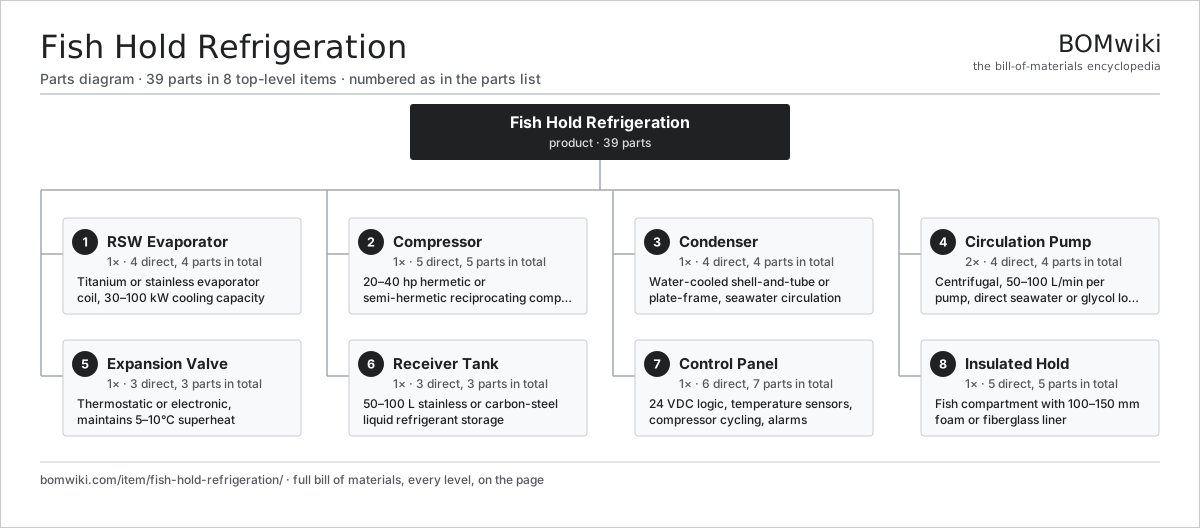
| # | Part | Qty | What it does |
|---|---|---|---|
| 1 | RSW Evaporator 4 parts | 1× | Titanium or stainless evaporator coil, 30–100 kW cooling capacity |
| 2 | Compressor 5 parts | 1× | 20–40 hp hermetic or semi-hermetic reciprocating compressor |
| 3 | Condenser 4 parts | 1× | Water-cooled shell-and-tube or plate-frame, seawater circulation |
| 4 | Circulation Pump 4 parts | 2× | Centrifugal, 50–100 L/min per pump, direct seawater or glycol loop |
| 5 | Expansion Valve 3 parts | 1× | Thermostatic or electronic, maintains 5–10°C superheat |
| 6 | Receiver Tank 3 parts | 1× | 50–100 L stainless or carbon-steel liquid refrigerant storage |
| 7 | Control Panel 6 parts | 1× | 24 VDC logic, temperature sensors, compressor cycling, alarms |
| 8 | Insulated Hold 5 parts | 1× | Fish compartment with 100–150 mm foam or fiberglass liner |
3D model
No 3D model yet. Have a CAD file of this? Add a 3D model. STL renders right on this page; STEP, FreeCAD, and OpenSCAD sources are welcome too (openly licensed, like all 3D models on BOMwiki).
Build & assembly graph
expand / collapse · shared sub-assemblies converge · links to related products · est. labourTap an assembly to expand/collapse · tap a part to open it · use “Open page” for any node · drag to pan, scroll to zoom.
Bill of materials for Fish Hold Refrigeration
8 top-level lines · 42 rows shown · 39 parts total · indented to 3 levels| # | Item / sub-assembly | Part no. | Qty/assy | Ext. qty | Parts | Type |
|---|---|---|---|---|---|---|
| 1 | RSW Evaporator 4 parts | fish-hold-refrigeration-rsw-unit | 1× | 1 | 4 | assembly |
| 1.1 | Evaporator Coil | fish-hold-refrigeration-evaporator-coil | 1× | 1 | · | part |
| 1.2 | Coil Baffle | fish-hold-refrigeration-coil-baffle | 1× | 1 | · | part |
| 1.3 | Hold Sump | fish-hold-refrigeration-hold-sump | 1× | 1 | · | part |
| 1.4 | Fastener Set | fastener-set | 1× | 1 | · | part |
| 2 | Compressor 5 parts | fish-hold-refrigeration-compressor | 1× | 1 | 5 | assembly |
| 2.1 | Compressor Motor | fish-hold-refrigeration-compressor-motor | 1× | 1 | · | part |
| 2.2 | Compressor Head | fish-hold-refrigeration-compressor-head | 1× | 1 | · | part |
| 2.3 | Reed Valve | fish-hold-refrigeration-reed-valve | 1× | 1 | · | part |
| 2.4 | Crankshaft | fish-hold-refrigeration-crankshaft | 1× | 1 | · | part |
| 2.5 | Bearing Set | fish-hold-refrigeration-bearing-set | 1× | 1 | · | part |
| 3 | Condenser 4 parts | fish-hold-refrigeration-condenser | 1× | 1 | 4 | assembly |
| 3.1 | Condenser Core | fish-hold-refrigeration-condenser-core | 1× | 1 | · | part |
| 3.2 | Seawater Inlet | fish-hold-refrigeration-seawater-inlet | 1× | 1 | · | part |
| 3.3 | Seawater Outlet | fish-hold-refrigeration-seawater-outlet | 1× | 1 | · | part |
| 3.4 | Condenser Header | fish-hold-refrigeration-condenser-header | 1× | 1 | · | part |
| 4 | Circulation Pump 4 parts | fish-hold-refrigeration-circulation-pump | 2× | 2 | 4 | assembly |
| 4.1 | Pump Motor | fish-hold-refrigeration-pump-motor | 1× | 2 | · | part |
| 4.2 | Pump Impeller | fish-hold-refrigeration-pump-impeller | 1× | 2 | · | part |
| 4.3 | Pump Casing | fish-hold-refrigeration-pump-casing | 1× | 2 | · | part |
| 4.4 | Pump Shaft Seal | fish-hold-refrigeration-pump-shaft-seal | 1× | 2 | · | part |
| 5 | Expansion Valve 3 parts | fish-hold-refrigeration-expansion-valve | 1× | 1 | 3 | assembly |
| 5.1 | Expansion Bulb | fish-hold-refrigeration-expansion-bulb | 1× | 1 | · | part |
| 5.2 | Expansion Needle | fish-hold-refrigeration-expansion-needle | 1× | 1 | · | part |
| 5.3 | Expansion Housing | fish-hold-refrigeration-expansion-housing | 1× | 1 | · | part |
| 6 | Receiver Tank 3 parts | fish-hold-refrigeration-receiver-tank | 1× | 1 | 3 | assembly |
| 6.1 | Receiver Shell | fish-hold-refrigeration-receiver-shell | 1× | 1 | · | part |
| 6.2 | Receiver Internals | fish-hold-refrigeration-receiver-internals | 1× | 1 | · | part |
| 6.3 | Receiver Valve Set | fish-hold-refrigeration-receiver-valve-set | 1× | 1 | · | part |
| 7 | Control Panel 6 parts | fish-hold-refrigeration-control-panel | 1× | 1 | 7 | assembly |
| 7.1 | Panel Enclosure | fish-hold-refrigeration-panel-enclosure | 1× | 1 | · | part |
| 7.2 | Temperature Sensor | fish-hold-refrigeration-temperature-sensor | 2× | 2 | · | part |
| 7.3 | Compressor Contactor | fish-hold-refrigeration-compressor-contactor | 1× | 1 | · | part |
| 7.4 | Liquid Level Alarm | fish-hold-refrigeration-liquid-level-alarm | 1× | 1 | · | part |
| 7.5 | Digital Display | fish-hold-refrigeration-digital-display | 1× | 1 | · | part |
| 7.6 | High Pressure Switch | fish-hold-refrigeration-high-pressure-switch | 1× | 1 | · | part |
| 8 | Insulated Hold 5 parts | fish-hold-refrigeration-insulated-hold | 1× | 1 | 5 | assembly |
| 8.1 | Hold Frame | fish-hold-refrigeration-hold-frame | 1× | 1 | · | part |
| 8.2 | Foam Insulation | fish-hold-refrigeration-foam-insulation | 1× | 1 | · | part |
| 8.3 | Hold Liner | fish-hold-refrigeration-liner | 1× | 1 | · | part |
| 8.4 | Drain Plug | fish-hold-refrigeration-drain-plug | 1× | 1 | · | part |
| 8.5 | Access Hatch | fish-hold-refrigeration-access-hatch | 1× | 1 | · | part |
Something wrong in this list? Report a problem with this BOM.
Sourcing: possible vendors
Browse the supplier directory → Prices, MOQ, and lead times are algorithmic estimates, not quotes, and not claims about these companies. Company mappings are curated by keyword; est. price band $2k–$500M. How estimates work| Vendor | HQ | Specialty | MOQ | Lead time |
|---|---|---|---|---|
| hd.com ↗ | Ulsan, KR | Shipbuilder | made to order | 52–104 wks |
| fincantieri.com ↗ | Trieste, IT | Shipbuilder | made to order | 52–104 wks |
| damen.com ↗ | Gorinchem, NL | Shipbuilder | made to order | 52–104 wks |
| brunswick.com ↗ | Mettawa, US | Marine & boats | made to order | 52–104 wks |
|
🇨🇳CSSC
cssc.net.cn ↗
|
Shanghai, CN | Shipbuilding conglomerate | made to order | 52–104 wks |
1,324-word article