Fish Transfer Pump
ProductOverview
Fish transfer pumps move live fish between tanks, barges, grading systems, and slaughter lines with minimal injury and stress. Unlike conventional centrifugal pumps designed for inanimate solids, fish pumps must handle the biological fragility of aquatic animals: they cannot tolerate cavitation shocks, high shear forces, or rapid pressure changes. Modern fish pumps combine gentle handling (low-shear progressive-cavity or wide-blade centrifugal geometry) with intelligent control (VFD soft-start ramps, pressure monitoring) to achieve <2% injury and mortality rates.
A typical transfer operation moves 50–200 kg batches from a grading machine to processing, or from a holding tank to a transport truck. The pump reduces cycle time from 30+ minutes (gravity or dip-net transfer) to 5–10 minutes, dramatically improving productivity and welfare.
How it works
The Vacuum Suction Chamber submerged in the source tank creates a low-pressure suction zone. Fish are gently drawn into a 400–600 mm diameter Suction Cone with smooth internal radius (>0.5 m). The Intake Screen (10–25 mm mesh) prevents waste and plant matter from clogging the Gentle-Shear Impeller.
The Drive Motor & Variable Speed (5–25 kW) drives the pump via a Variable-Frequency Drive, initially rammed up slowly: 0–100% speed over 5–10 seconds. This gradual acceleration prevents cavitation (sudden vapor formation) that would shock fish and damage gills. At cruise speed (typically 30–80% of max RPM for low shear), the Gentle-Shear Impeller moves fish at 2–5 m/s steady-state velocity through the pump housing.
The Control Valve Manifold controls suction source (intake tank), discharge direction (via solenoid diverter), and safeguards. A Pressure Relief Valve set at 2–5 bar protects the pump if discharge becomes blocked (e.g., kinked hose, clogged dewatering screen). The Flow Meter on discharge continuously measures flow (L/min), allowing the operator to estimate transfer volume and detect cavitation (sudden flow drop indicates air ingress).
Discharged fish exit into the Dewatering Separator: a vibrating screen or inclined screw press separating water. The vibrating deck at 50–100 Hz removes 15–25% of the water weight before fish land in transport bins, reducing ice cost and improving truck payload. Separated water drains back to the source tank, completing the loop.
The Control & Safety Unit (PLC with wireless Control Pendant) monitors discharge pressure via a Pressure Transducer. If suction pressure drops below 0.5 bar (indicating imminent cavitation), the PLC automatically reduces motor speed by 10% or triggers a visual/audible alarm, allowing the operator to investigate (empty tank, blocked intake screen, etc.).
Design considerations
Progressive-cavity vs. centrifugal. Progressive-cavity (Moineau) pumps are gentler: the fish ride in expanding cavities as a screw rotor turns inside a stator, exiting smoothly with minimal turbulence. They tolerate higher solids (e.g., 10–20 mm feces or uneaten pellets) without clogging. Centrifugal pumps are simpler and lower cost but generate higher turbulence; they require cleaner intake conditions and tighter fish sizes to avoid cavitation.
Suction vs. discharge design. Suction-side (vacuum) intake is preferred over submerged pressure intake: it allows a single pump to serve multiple source tanks (grading output, holding tank, transport truck prep) via a valve selector. Pressure intake would require separate pump discharge lines, complexity and cost.
Cavitation and soft-start rationale. Aquaculture researchers found that fish exposed to sudden pressure drops (>0.5 bar change in <1 second) suffer burst airbladders and hemorrhaging, even if not physically injured. The soft-start ramp extends acceleration over 5–10 seconds, keeping pressure drop <0.1 bar/second. Some high-end systems use two-stage start: soft-ramp to 30% speed (slow fill), hold 5 sec, then ramp to cruise speed.
Dewatering economics. Ice costs 50–200 EUR/ton; reducing water weight 15–25% saves 2–5 EUR per fish transferred. For a farm processing 1000 fish/day, dewatering pays for itself in 6–12 months and becomes a net cost saver.
Integration with farm workflow
Fish pumps are typically installed at three nodes:
- Post-harvest grading output: moving sorted fish to live bins or transport trucks
- Tank-to-tank transfers: moving stock between grow-out tanks or from rearing to processing
- Truck loading: transferring fish from live bins into transport tanks
A single portable pump unit (mounted on a mobile cart or barge) can be rolled between these sites, reducing capital cost vs. dedicated stationary installations at each location. Hose connections use ISO quick-couplers for fast (<2 min) setup/teardown.
Operators require minimal training: the control pendant has three buttons (start, stop, speed). The PLC handles all safety logic and pressure monitoring. Visual pressure gauges (optional glycerin-filled 0–10 bar analog) on the manifold allow quick operator diagnosis ("pressure too low = blocked screen, pressure too high = kinked hose").
Fish Transfer Pump parts and their functions
7 top-level parts · 26 parts in total · full bill of materials below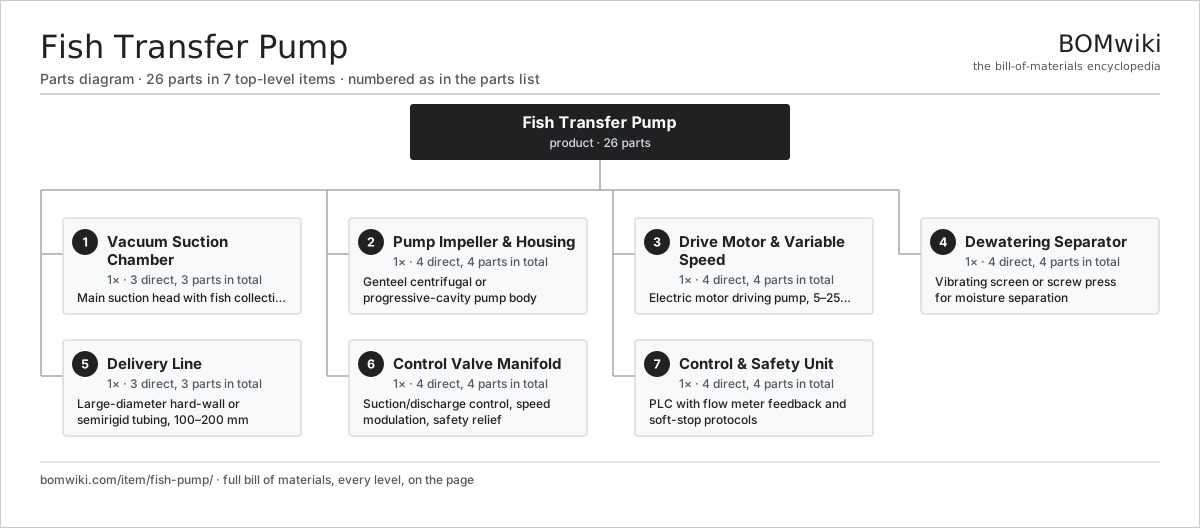
| # | Part | Qty | What it does |
|---|---|---|---|
| 1 | Vacuum Suction Chamber 3 parts | 1× | Main suction head with fish collection cone |
| 2 | Pump Impeller & Housing 4 parts | 1× | Genteel centrifugal or progressive-cavity pump body |
| 3 | Drive Motor & Variable Speed 4 parts | 1× | Electric motor driving pump, 5–25 kW variable speed |
| 4 | Dewatering Separator 4 parts | 1× | Vibrating screen or screw press for moisture separation |
| 5 | Delivery Line 3 parts | 1× | Large-diameter hard-wall or semirigid tubing, 100–200 mm |
| 6 | Control Valve Manifold 4 parts | 1× | Suction/discharge control, speed modulation, safety relief |
| 7 | Control & Safety Unit 4 parts | 1× | PLC with flow meter feedback and soft-stop protocols |
3D model
No 3D model yet. Have a CAD file of this? Add a 3D model. STL renders right on this page; STEP, FreeCAD, and OpenSCAD sources are welcome too (openly licensed, like all 3D models on BOMwiki).
Build & assembly graph
expand / collapse · shared sub-assemblies converge · links to related products · est. labourTap an assembly to expand/collapse · tap a part to open it · use “Open page” for any node · drag to pan, scroll to zoom.
Bill of materials for Fish Transfer Pump
7 top-level lines · 33 rows shown · 26 parts total · indented to 3 levels| # | Item / sub-assembly | Part no. | Qty/assy | Ext. qty | Parts | Type |
|---|---|---|---|---|---|---|
| 1 | Vacuum Suction Chamber 3 parts | fish-pump-vacuum-chamber | 1× | 1 | 3 | assembly |
| 1.1 | Suction Cone | fish-pump-intake-cone | 1× | 1 | · | part |
| 1.2 | Intake Screen | fish-pump-debris-screen | 1× | 1 | · | part |
| 1.3 | Suction Transition | fish-pump-suction-pipe | 1× | 1 | · | part |
| 2 | Pump Impeller & Housing 4 parts | fish-pump-impeller-housing | 1× | 1 | 4 | assembly |
| 2.1 | Gentle-Shear Impeller | fish-pump-impeller | 1× | 1 | · | part |
| 2.2 | Pump Housing | fish-pump-housing-body | 1× | 1 | · | part |
| 2.3 | Bearing & Mechanical Seals | fish-pump-bearing-seals | 1× | 1 | · | part |
| 2.4 | Discharge Flange | fish-pump-discharge-flange | 1× | 1 | · | part |
| 3 | Drive Motor & Variable Speed 4 parts | fish-pump-motor | 1× | 1 | 4 | assembly |
| 3.1 | Electric Motor | fish-pump-electric-motor | 1× | 1 | · | part |
| 3.2 | Variable-Frequency Drive | fish-pump-vfd | 1× | 1 | · | part |
| 3.3 | Motor Soft-Start | fish-pump-motor-starter | 1× | 1 | · | part |
| 3.4 | Drive Coupling | fish-pump-coupling | 1× | 1 | · | part |
| 4 | Dewatering Separator 4 parts | fish-pump-dewatering-system | 1× | 1 | 4 | assembly |
| 4.1 | Vibrating Screen Deck | fish-pump-dewater-screen | 1× | 1 | · | part |
| 4.2 | Vibration Motor | fish-pump-dewater-motor | 1× | 1 | · | part |
| 4.3 | Dewater Trough | fish-pump-dewater-housing | 1× | 1 | · | part |
| 4.4 | Drainage Channel | fish-pump-dewater-drain | 1× | 1 | · | part |
| 5 | Delivery Line 3 parts | fish-pump-delivery-hose | 1× | 1 | 3 | assembly |
| 5.1 | Discharge Hose | fish-pump-discharge-pipe | 1× | 1 | · | part |
| 5.2 | Pipe Support Clamps | fish-pump-pipe-clamps | 1× | 1 | · | part |
| 5.3 | Long-Radius Elbows | fish-pump-pipe-elbows | 1× | 1 | · | part |
| 6 | Control Valve Manifold 4 parts | fish-pump-valve-manifold | 1× | 1 | 4 | assembly |
| 6.1 | Suction Valve | fish-pump-suction-valve | 1× | 1 | · | part |
| 6.2 | Pressure Relief Valve | fish-pump-pressure-relief | 1× | 1 | · | part |
| 6.3 | Discharge Diverter Valve | fish-pump-discharge-diverter | 1× | 1 | · | part |
| 6.4 | Flow Meter | fish-pump-flowmeter | 1× | 1 | · | part |
| 7 | Control & Safety Unit 4 parts | fish-pump-control-unit | 1× | 1 | 4 | assembly |
| 7.1 | PLC | fish-pump-plc-controller | 1× | 1 | · | part |
| 7.2 | Control Pendant | fish-pump-operator-pendant | 1× | 1 | · | part |
| 7.3 | Pressure Transducer | fish-pump-pressure-transducer | 1× | 1 | · | part |
| 7.4 | Control Enclosure | fish-pump-enclosure | 1× | 1 | · | part |
Something wrong in this list? Report a problem with this BOM.
Sourcing: possible vendors
Browse the supplier directory → Prices, MOQ, and lead times are algorithmic estimates, not quotes, and not claims about these companies. Company mappings are curated by keyword; est. price band $2k–$500M. How estimates work| Vendor | HQ | Specialty | MOQ | Lead time |
|---|---|---|---|---|
| hd.com ↗ | Ulsan, KR | Shipbuilder | made to order | 52–104 wks |
| fincantieri.com ↗ | Trieste, IT | Shipbuilder | made to order | 52–104 wks |
| damen.com ↗ | Gorinchem, NL | Shipbuilder | made to order | 52–104 wks |
| brunswick.com ↗ | Mettawa, US | Marine & boats | made to order | 52–104 wks |
|
🇨🇳CSSC
cssc.net.cn ↗
|
Shanghai, CN | Shipbuilding conglomerate | made to order | 52–104 wks |
809-word article