Flail Mulcher
ProductOverview
A flail mulcher is a tractor-mounted accessory that reduces crop residue, woody branches, and brush into small chips suitable for composting, animal bedding, or soil incorporation. Unlike a rotary cutter (which has fixed blades), the Flail Arms are suspended on Arm Pivot Bearings, allowing them to swing backward on impact. This impact-based mechanism is gentler on the drive system and is less likely to wrap hair or string, making it popular for mixed material and off-farm brush clearing.
The Rotor Assembly runs at 600–1200 rpm, driven from the tractor's PTO Shaft Assembly (typically 540 or 1000 rpm) through a Gearbox & Drive reduction. Material drops from the hopper onto the spinning rotor, is struck multiple times by the flails, and is ejected out the Discharge Hood. The Feed Roller sits above the rotor to compress and meter material entry, preventing overload and choking.
Rotor and flailing mechanism
The horizontal Rotor Disk carries 12–16 Flail Arms distributed radially. Each arm is a spring steel bar, typically 300–400 mm long, hinged on a Arm Pivot Bearing (usually a spherical roller bearing or needle roller). When rotating at full speed, centrifugal force pulls the flails outward and slightly backward. When a flail strikes resistant material, the arm swings backward (absorbed by its pivot bearing) and then springs forward for the next impact.
This design has two advantages over fixed blades. First, the swinging action dissipates impact energy and reduces shock loads on the drive train. Second, because the flails don't cut material cleanly (they impact and fracture it), they don't catch or wrap hair, string, or vine as easily as a rotary blade would. The chip size is determined by the rotor speed and material toughness: stiffer material is hit more times and finer, while woody branches may pass through with larger chip size.
The Rotor Shaft is a solid 40 mm diameter steel shaft supported by Ball Bearings at both ends. Oil and grease seals keep paddy or dusty field conditions out of the bearings. The rotor disk is typically case-hardened steel to resist impact fatigue.
Gearbox and transmission
The Gearbox & Drive is a compact helical gear reducer mounted on the Frame & Hopper. It receives input from the tractor's PTO Shaft Assembly at 540 or 1000 rpm (selectable via modular gearbox) and steps it down by a ratio of 1:3 to 1:4, resulting in rotor speeds of 600–1200 rpm. The Input Pinion meshes with the Output Gear, which is splined to the Rotor Shaft.
The gearbox Gearbox Housing is cast iron with an oil sump and drain plug. Typical oil-bath capacity is 4–6 liters. The box must be refilled after 50–100 operating hours depending on load. For protection against jamming (if the rotor hits a hidden rock or metal), many mulchers have a Slip Clutch in the PTO Shaft Assembly: a shear-pin type that breaks if torque exceeds a threshold, or a friction-disk type that slips. This prevents the drive shaft from breaking or the gearbox teeth from fracturing.
Feed system
The Feed Roller sits directly above the Rotor Assembly and is driven by a Feed Drive Chain from a sprocket on the rotor shaft. The roller typically rotates at 200–300 rpm (much slower than the rotor) and has a rubber-coated surface for traction. As material falls into the hopper, the roller presses it down onto the rotor. The slower roller speed prevents overfeeding and buildup of material in the rotor chamber, which would cause choking and loss of power.
Material falls from the Hopper Walls and Hopper Bottom down onto the rotor. Typical hopper volume is 30–50 liters, enough for about 10–20 minutes of operation before reloading.
Discharge and output
The Discharge Hood is a curved or flat steel panel that directs the ejected mulch. On most machines, the hood is hinged and can be swung left or right to control discharge direction. A Hood Latch pin locks the hood in place during operation. On wider machines (1.5 m+), a Chute Extension spout can be fitted to throw mulch further to the side, reducing the width of the spreading pattern for better pile formation.
Discharge is centrifugal (thrown by the rotor), not guided through a conveyor, so the machine is light. Chip size depends on rotor speed and material: a 1000 rpm rotor produces 5–10 mm chips from dry grass or straw, while the same rotor at 600 rpm may produce 15–25 mm chips from coarser woody material.
Hitch and height control
The machine attaches to the tractor via a Category 2 three-point Hitch & Coupling with 25 mm Hitch Pins. The Hitch Frame is welded to the main Frame & Hopper and has ISO 730 lift points. Many machines include an optional Height Control Cylinder connected to the tractor's remote hydraulic circuit; this allows the operator to adjust cutting height from the cabin without stopping. On simpler models, height is set by adjusting the position of the hitch pins or by mechanical stops welded to the frame.
Working height is typically 30–150 mm, set so the Feed Roller just clears the ground. Too low and the machine will dig into soil; too high and material doesn't feed to the rotor.
Field operation and maintenance
Most mulcher work is on stubble (post-harvest straw), orchard prunings, or pasture renovation (mulching invasive brush). Operators drive at 3–6 km/h depending on material density and the tractor's ground clearance. PTO engagement should be gradual to avoid shock loading; the Slip Clutch will slip if the rotor jams on a hidden rock.
The main wear item is the Flail Arms, which dull or break after 50–100 operating hours depending on material. Replacement is a field-level job: the operator loosens the bolt on each Arm Pivot Bearing, removes the worn arm, and installs a new one. Because flails are cheap consumables (USD 2–5 each) and kept as spares, farmers can extend machine life indefinitely.
The Gearbox Cover provides access for inspection. The Rotor Guard mesh screen above the rotor prevents operators from reaching into the spinning rotor and protects against flying debris. The Chain Guard covers the Feed Drive Chain.
Flail Mulcher parts and their functions
8 top-level parts · 72 parts in total · full bill of materials below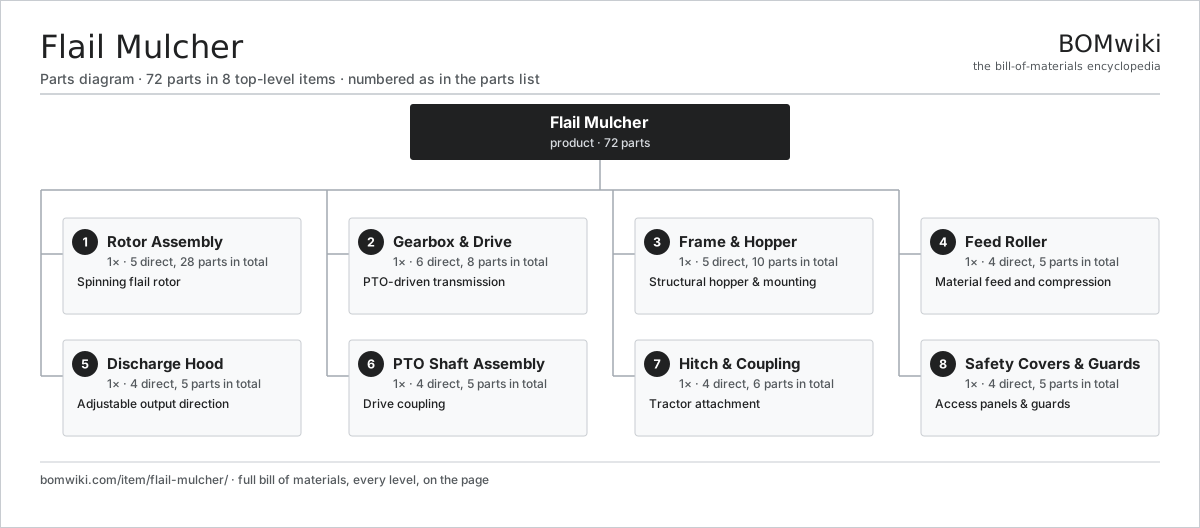
| # | Part | Qty | What it does |
|---|---|---|---|
| 1 | Rotor Assembly 5 parts | 1× | Spinning flail rotor |
| 2 | Gearbox & Drive 6 parts | 1× | PTO-driven transmission |
| 3 | Frame & Hopper 5 parts | 1× | Structural hopper & mounting |
| 4 | Feed Roller 4 parts | 1× | Material feed and compression |
| 5 | Discharge Hood 4 parts | 1× | Adjustable output direction |
| 6 | PTO Shaft Assembly 4 parts | 1× | Drive coupling |
| 7 | Hitch & Coupling 4 parts | 1× | Tractor attachment |
| 8 | Safety Covers & Guards 4 parts | 1× | Access panels & guards |
3D model
No 3D model yet. Have a CAD file of this? Add a 3D model. STL renders right on this page; STEP, FreeCAD, and OpenSCAD sources are welcome too (openly licensed, like all 3D models on BOMwiki).
Build & assembly graph
expand / collapse · shared sub-assemblies converge · links to related products · est. labourTap an assembly to expand/collapse · tap a part to open it · use “Open page” for any node · drag to pan, scroll to zoom.
Bill of materials for Flail Mulcher
8 top-level lines · 44 rows shown · 72 parts total · indented to 3 levels| # | Item / sub-assembly | Part no. | Qty/assy | Ext. qty | Parts | Type |
|---|---|---|---|---|---|---|
| 1 | Rotor Assembly 5 parts | flail-mulcher-rotor-assembly | 1× | 1 | 28 | assembly |
| 1.1 | Rotor Shaft | flail-mulcher-rotor-shaft | 1× | 1 | · | part |
| 1.2 | Flail Arm | flail-mulcher-flail-arm | 12× | 12 | · | part |
| 1.3 | Arm Pivot Bearing | flail-mulcher-arm-pivot-bearing | 12× | 12 | · | part |
| 1.4 | Rotor Disk | flail-mulcher-rotor-disk | 1× | 1 | · | part |
| 1.5 | Ball Bearing | ball-bearing | 2× | 2 | · | part |
| 2 | Gearbox & Drive 6 parts | flail-mulcher-gearbox | 1× | 1 | 8 | assembly |
| 2.1 | Gearbox Housing | flail-mulcher-gearbox-housing | 1× | 1 | · | part |
| 2.2 | Input Pinion | flail-mulcher-input-pinion | 1× | 1 | · | part |
| 2.3 | Output Gear | flail-mulcher-output-gear | 1× | 1 | · | part |
| 2.4 | Bearing Boss | flail-mulcher-bearing-boss | 2× | 2 | · | part |
| 2.5 | Oil Seal | oil-seal | 2× | 2 | · | part |
| 2.6 | O-Ring Set | oring-set | 1× | 1 | · | part |
| 3 | Frame & Hopper 5 parts | flail-mulcher-frame | 1× | 1 | 10 | assembly |
| 3.1 | Frame Tube | flail-mulcher-frame-tube | 4× | 4 | · | part |
| 3.2 | Hopper Wall | flail-mulcher-hopper-wall | 2× | 2 | · | part |
| 3.3 | Hopper Bottom | flail-mulcher-hopper-bottom | 1× | 1 | · | part |
| 3.4 | Rotor Support Bracket | flail-mulcher-rotor-support-bracket | 2× | 2 | · | part |
| 3.5 | Fastener Set | fastener-set | 1× | 1 | · | part |
| 4 | Feed Roller 4 parts | flail-mulcher-feed-roller | 1× | 1 | 5 | assembly |
| 4.1 | Roller Tube | flail-mulcher-roller-tube | 1× | 1 | · | part |
| 4.2 | Roller Sprocket | flail-mulcher-roller-sprocket | 1× | 1 | · | part |
| 4.3 | Roller Bearing | flail-mulcher-roller-bearing | 2× | 2 | · | part |
| 4.4 | Feed Drive Chain | flail-mulcher-feed-chain | 1× | 1 | · | part |
| 5 | Discharge Hood 4 parts | flail-mulcher-discharge-hood | 1× | 1 | 5 | assembly |
| 5.1 | Hood Panel | flail-mulcher-hood-panel | 1× | 1 | · | part |
| 5.2 | Hood Hinge | flail-mulcher-hood-hinge | 2× | 2 | · | part |
| 5.3 | Hood Latch | flail-mulcher-hood-latch | 1× | 1 | · | part |
| 5.4 | Chute Extension | flail-mulcher-chute-extension | 1× | 1 | · | part |
| 6 | PTO Shaft Assembly 4 parts | flail-mulcher-pto-shaft | 1× | 1 | 5 | assembly |
| 6.1 | PTO Input Coupling | flail-mulcher-pto-input-coupling | 1× | 1 | · | part |
| 6.2 | Universal Joint | flail-mulcher-universal-joint | 2× | 2 | · | part |
| 6.3 | PTO Tube | flail-mulcher-pto-tube | 1× | 1 | · | part |
| 6.4 | Slip Clutch | flail-mulcher-slip-clutch | 1× | 1 | · | part |
| 7 | Hitch & Coupling 4 parts | flail-mulcher-hitch | 1× | 1 | 6 | assembly |
| 7.1 | Hitch Frame | flail-mulcher-hitch-frame | 1× | 1 | · | part |
| 7.2 | Hitch Pin | flail-mulcher-hitch-pin | 3× | 3 | · | part |
| 7.3 | Height Control Cylinder | flail-mulcher-hydraulic-cyinder | 1× | 1 | · | part |
| 7.4 | Drawbar | flail-mulcher-drawbar | 1× | 1 | · | part |
| 8 | Safety Covers & Guards 4 parts | flail-mulcher-safety-covers | 1× | 1 | 5 | assembly |
| 8.1 | Gearbox Cover | flail-mulcher-gearbox-cover | 1× | 1 | · | part |
| 8.2 | Rotor Guard | flail-mulcher-rotor-guard | 1× | 1 | · | part |
| 8.3 | Chain Guard | flail-mulcher-chain-guard | 1× | 1 | · | part |
| 8.4 | Warning Decal | flail-mulcher-warning-decal | 2× | 2 | · | part |
Something wrong in this list? Report a problem with this BOM.
Related products
same domain, ranked by shared parts Agricultural Tractor
306 parts · shares 2 with this page
Agricultural Tractor
306 parts · shares 2 with this page
 Articulated Tractor
1,229 parts · shares 2 with this page
Articulated Tractor
1,229 parts · shares 2 with this page
 Bale Shredder Feeder
142 parts · shares 2 with this page
Bale Shredder Feeder
142 parts · shares 2 with this page
 Beet Cleaner Loader
228 parts · shares 2 with this page
Beet Cleaner Loader
228 parts · shares 2 with this page
 Center-Pivot Irrigator
945 parts · shares 2 with this page
Center-Pivot Irrigator
945 parts · shares 2 with this page
 Cotton Module Builder
99 parts · shares 2 with this page
Cotton Module Builder
99 parts · shares 2 with this page
Sourcing: possible vendors
Browse the supplier directory → Prices, MOQ, and lead times are algorithmic estimates, not quotes, and not claims about these companies. Company mappings are curated by keyword; est. price band $5k–$800k. How estimates work| Vendor | HQ | Specialty | MOQ | Lead time |
|---|---|---|---|---|
| deere.com ↗ | Moline, US | Agriculture & turf | made to order | 14–24 wks |
| cnh.com ↗ | Basildon, GB | Agriculture (Case IH, New Holland) | made to order | 14–24 wks |
|
🇺🇸AGCO
agcocorp.com ↗
|
Duluth, US | Agriculture (Fendt, Massey Ferguson) | made to order | 14–24 wks |
|
🇩🇪Claas
claas.com ↗
|
Harsewinkel, DE | Harvesters & tractors | made to order | 14–24 wks |
|
🇯🇵Kubota
kubota.com ↗
|
Osaka, JP | Compact tractors & equipment | made to order | 14–24 wks |
1,126-word article