Flare Stack
ProductOverview
A flare stack is a continuous combustion system designed to safely burn waste gases that cannot be recovered or must be disposed of for safety/environmental reasons. Flares are universal in petroleum refineries, chemical plants, landfills (methane from Anaerobic Digester), and natural gas facilities as the final safety valve against atmospheric venting of hydrocarbons or hydrogen.
The Riser Pipe conducts gas to an elevated Flare Tip where waste gas is mixed with air and optionally steam, then combusted in a continuous flame maintained by a Pilot Ignition system. The Knockout Drum removes condensed liquids upstream, and the Seal System prevents air backflow.
Effective flare design balances three goals: (1) complete combustion (>99%) of hazardous/odorous components, (2) acceptable thermal radiation at ground level, and (3) low operational noise.
How it works
Gas Supply and Sealing
Waste gas from a process unit (e.g., a pressure relief valve on a Anaerobic Digester, or vapor recovery from a Hydrogen Tube Trailer unloading operation) enters a Seal System. The Seal Pot maintains a water or oil seal creating a pressure barrier (~50–200 mbar) preventing air from diffusing backward into the collection system (which would create an explosive mixture).
The Backpressure Regulator automatically adjusts the seal differential to balance upstream gas supply pressure and the rising pressure inside the riser (which increases with flare load). This prevents seal breakage or siphoning.
Liquid Removal
Gas then passes through the Knockout Drum, a horizontal settling vessel where entrained liquid (condensed hydrocarbons, water) gravitationally separates and pools at the bottom. The Drain Valve periodically bleds off accumulated liquid (manually or via solenoid timer). Entrained liquid in the flare tip would cause popping and incomplete combustion; the knockout drum ensures dry gas enters the riser.
Vertical Rise and Combustion
Dry waste gas enters the Riser Pipe, a vertical steel or stainless tube typically 4–50 m tall. Height is chosen to:
- Reduce ground-level radiation: Thermal radiation intensity falls as the inverse square of distance from the flame. A 20 m tall stack reduces radiation at 50 m ground distance by a factor of ~2 compared to a 10 m stack.
- Accelerate gas rise: Buoyancy and natural draft from the combustion-heated riser accelerates gas upward, improving air entrainment and turbulence.
The Insulation Wrap protects the external scaffold from radiant heat; the Expansion Joint accommodates thermal growth during combustion. Guy Cables stabilize the slender tower against wind and seismic motion.
Flame and Pilot System
At the top, waste gas enters the Flare Tip, a multi-port burner head where:
- Rapid mixing: Gas exits multiple Tip Ports (small orifices), promoting radial spreading and air entrainment.
- Pilot flame ignition: A continuous Pilot Nozzle supplies a small stream of natural gas, ignited and maintained by the Pilot Ignition system (spark + photodetector). Pilot flame temperature ~800–900 °C.
- Waste gas combustion: Incoming waste gas (H₂, CH₄, CO, etc.) mixes with pilot flame and air entrained from surroundings:
$$\text{Waste gas} (\text{H}_2/\text{CH}_4/\text{CO}) + \text{O}_2 \to \text{CO}_2 + \text{H}_2\text{O}$$
Complete combustion is achieved via:
- High temperature (pilot + chemical reaction): >1100 °C
- Residence time: ~1–2 seconds in the flame zone
- Turbulent mixing: Port design and geometry induce high-shear eddies
Combustion efficiency >99% is routinely achieved.
Thermal Radiation Control
For large waste gas flows, thermal radiation at ground level can exceed safe limits (typically <5 kW/m² per API 521 standard). Radiation is reduced by:
- Elevated tip height: A 30 m stack naturally reduces radiation at 50 m distance.
- Steam injection: The Steam Injection optional lance supplies steam, which absorbs radiation energy and dilutes the flame, lowering peak temperature while maintaining combustion. Steam also reduces visible flame length and noise.
- Smokeless combustion: Adding air (or low-smokiness tip design) reduces soot formation, lowering infrared radiation.
Typical practice: Flares burning >10 MW often employ steam injection (1–2 kg steam per kg fuel) to maintain ground-level radiation compliance.
Pilot Control and Flame Monitoring
The Pilot Ignition continuously supplies a small pilot flame (0.5–2 kg/hour natural gas). The Pilot Flame Detector (UV or IR sensor) continuously confirms pilot flame presence. If pilot extinguishes (e.g., due to wind, pilot fuel supply loss, or ignition system failure), the Ignition Controller immediately re-energizes the Spark Plug (10–20 kV spark) to reignite.
Should waste gas arrive when the pilot is out, the Control Panel PLC triggers an alarm, preventing unburned gas release. Redundant flame detection and pilot ignition systems (including manual igniter as backup) ensure high reliability.
Instrumentation and Monitoring
The Instrumentation provides operational status:
- Flame Detector: Primary indication of flame presence/absence.
- Temperature Sensor: Monitors flame zone temperature; falling temperature indicates incomplete combustion or flame extinction.
- Pressure Sensor (upstream): Indicates gas flow rate and approach to design capacity.
- Level Indicator: Alerts when knockout drum liquid level becomes excessive.
Integration with Process Systems
Flares serve as the final disposal stage in systems like:
- Pressure relief from Anaerobic Digester: If dome overpressure exceeds setpoint, relief valve vents biogas to flare, burning it safely rather than venting to atmosphere.
- Hydrogen recovery from Hydrogen Dispenser: Purge gas during fill ramp-up can be captured and flared rather than vented.
- Startup/shutdown of Solid Oxide Fuel Cell Module: Off-spec syngas during warm-up phase is flared.
Noise and Environmental Considerations
Unsilenced flares at high capacity produce 85–95 dB sound pressure level at 50 m. Steam injection and specially designed tip geometries (low-noise burners) reduce noise to 80–85 dB. For residential areas or strict noise ordinances, enclosed flare systems (with acoustic shrouds and heat recovery) are used, trading cost and complexity for silent operation.
Environmental impact is minimal if combustion is complete (>99% destruction efficiency): all hydrocarbons and H₂ are oxidized to benign CO₂ and H₂O. H₂S (if present in waste stream) oxidizes to SO₂, which is visible as a slight haze but requires atmospheric permit compliance in some jurisdictions.
Economic Role
A flare is insurance: it costs nothing to operate per unit gas (just pilot fuel, ~$10–50/day for a typical plant) but prevents catastrophic safety events (overpressure rupture, uncontrolled atmospheric venting of toxic/flammable gas). Modern flares (with instrumentation and fail-safe logic) are highly reliable; uptime >99.5% is typical.
Flare Stack parts and their functions
7 top-level parts · 27 parts in total · full bill of materials below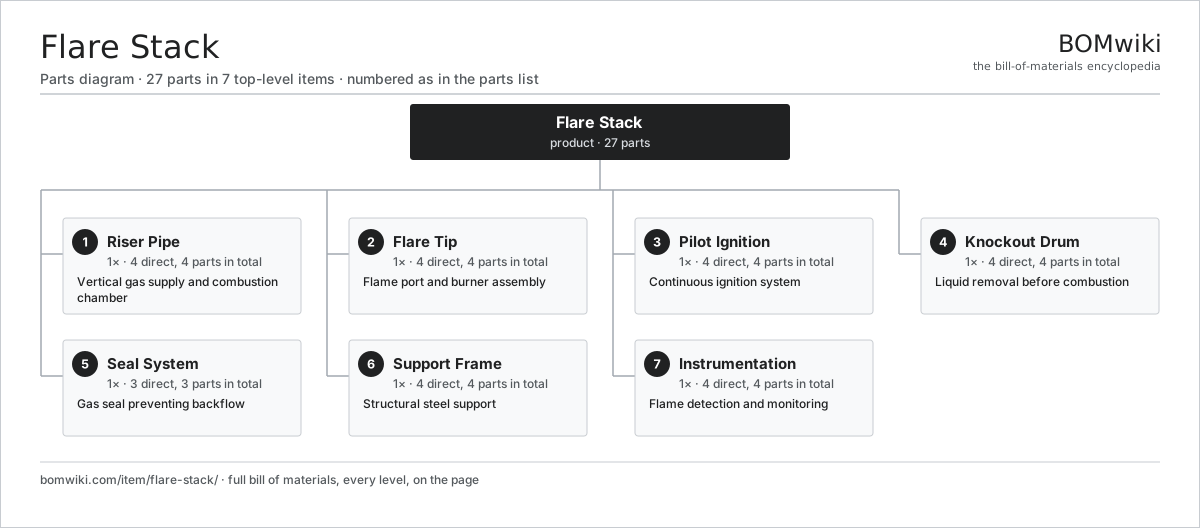
| # | Part | Qty | What it does |
|---|---|---|---|
| 1 | Riser Pipe 4 parts | 1× | Vertical gas supply and combustion chamber |
| 2 | Flare Tip 4 parts | 1× | Flame port and burner assembly |
| 3 | Pilot Ignition 4 parts | 1× | Continuous ignition system |
| 4 | Knockout Drum 4 parts | 1× | Liquid removal before combustion |
| 5 | Seal System 3 parts | 1× | Gas seal preventing backflow |
| 6 | Support Frame 4 parts | 1× | Structural steel support |
| 7 | Instrumentation 4 parts | 1× | Flame detection and monitoring |
3D model
No 3D model yet. Have a CAD file of this? Add a 3D model. STL renders right on this page; STEP, FreeCAD, and OpenSCAD sources are welcome too (openly licensed, like all 3D models on BOMwiki).
Build & assembly graph
expand / collapse · shared sub-assemblies converge · links to related products · est. labourTap an assembly to expand/collapse · tap a part to open it · use “Open page” for any node · drag to pan, scroll to zoom.
Bill of materials for Flare Stack
7 top-level lines · 34 rows shown · 27 parts total · indented to 3 levels| # | Item / sub-assembly | Part no. | Qty/assy | Ext. qty | Parts | Type |
|---|---|---|---|---|---|---|
| 1 | Riser Pipe 4 parts | flare-stack-riser-pipe | 1× | 1 | 4 | assembly |
| 1.1 | Vertical Pipe | flare-stack-vertical-pipe | 1× | 1 | · | part |
| 1.2 | Insulation Wrap | flare-stack-insulation-wrap | 1× | 1 | · | part |
| 1.3 | Expansion Joint | flare-stack-expansion-joint | 1× | 1 | · | part |
| 1.4 | Guy Cables | flare-stack-guy-cables | 1× | 1 | · | part |
| 2 | Flare Tip 4 parts | flare-stack-flare-tip | 1× | 1 | 4 | assembly |
| 2.1 | Tip Body | flare-stack-tip-body | 1× | 1 | · | part |
| 2.2 | Tip Ports | flare-stack-tip-ports | 1× | 1 | · | part |
| 2.3 | Steam Injection | flare-stack-steam-injection | 1× | 1 | · | part |
| 2.4 | Pilot Nozzle | flare-stack-pilot-nozzle | 1× | 1 | · | part |
| 3 | Pilot Ignition 4 parts | flare-stack-pilot-ignition | 1× | 1 | 4 | assembly |
| 3.1 | Pilot Gas Regulator | flare-stack-pilot-gas-regulator | 1× | 1 | · | part |
| 3.2 | Spark Plug | flare-stack-spark-plug | 1× | 1 | · | part |
| 3.3 | Ignition Controller | flare-stack-ignition-controller | 1× | 1 | · | part |
| 3.4 | Pilot Flame Detector | flare-stack-pilot-flame-detector | 1× | 1 | · | part |
| 4 | Knockout Drum 4 parts | flare-stack-knockout-drum | 1× | 1 | 4 | assembly |
| 4.1 | Drum Vessel | flare-stack-drum-vessel | 1× | 1 | · | part |
| 4.2 | Drain Valve | flare-stack-drain-valve | 1× | 1 | · | part |
| 4.3 | Pressure Relief Valve | flare-stack-pressure-relief-valve | 1× | 1 | · | part |
| 4.4 | Level Indicator | flare-stack-level-indicator | 1× | 1 | · | part |
| 5 | Seal System 3 parts | flare-stack-seal-system | 1× | 1 | 3 | assembly |
| 5.1 | Seal Pot | flare-stack-seal-pot | 1× | 1 | · | part |
| 5.2 | Seal Liquid | flare-stack-seal-liquid | 1× | 1 | · | part |
| 5.3 | Backpressure Regulator | flare-stack-backpressure-regulator | 1× | 1 | · | part |
| 6 | Support Frame 4 parts | flare-stack-support-frame | 1× | 1 | 4 | assembly |
| 6.1 | Frame Legs | flare-stack-frame-legs | 1× | 1 | · | part |
| 6.2 | Cross Bracing | flare-stack-cross-bracing | 1× | 1 | · | part |
| 6.3 | Platform | flare-stack-platform | 1× | 1 | · | part |
| 6.4 | Cable Routing | flare-stack-cable-routing | 1× | 1 | · | part |
| 7 | Instrumentation 4 parts | flare-stack-instrumentation | 1× | 1 | 4 | assembly |
| 7.1 | Flame Detector | flare-stack-flame-detector | 1× | 1 | · | part |
| 7.2 | Temperature Sensor | flare-stack-temperature-sensor | 1× | 1 | · | part |
| 7.3 | Pressure Sensor | pressure-sensor | 1× | 1 | · | part |
| 7.4 | Control Panel | flare-stack-control-panel | 1× | 1 | · | part |
Something wrong in this list? Report a problem with this BOM.
Related products
same domain, ranked by shared parts Autotransformer
7,784 parts · shares 1 with this page
Biogas Generator (CHP)
338 parts · shares 1 with this page
Autotransformer
7,784 parts · shares 1 with this page
Biogas Generator (CHP)
338 parts · shares 1 with this page
 Biogas Upgrader
29 parts · shares 1 with this page
Bottom Ash Handling System
1,782 parts · shares 1 with this page
Carbon Capture Skid
40 parts · shares 1 with this page
Biogas Upgrader
29 parts · shares 1 with this page
Bottom Ash Handling System
1,782 parts · shares 1 with this page
Carbon Capture Skid
40 parts · shares 1 with this page
 CNG Dispenser
44 parts · shares 1 with this page
CNG Dispenser
44 parts · shares 1 with this page
Sourcing: possible vendors
Browse the supplier directory → Prices, MOQ, and lead times are algorithmic estimates, not quotes, and not claims about these companies. Company mappings are curated by keyword; est. price band $5k–$50M. How estimates work| Vendor | HQ | Specialty | MOQ | Lead time |
|---|---|---|---|---|
| gevernova.com ↗ | Cambridge, US | Power generation | made to order | 20–40 wks |
| siemens-energy.com ↗ | Munich, DE | Power & grid | made to order | 20–40 wks |
| hitachienergy.com ↗ | Zurich, CH | Grid & transformers | made to order | 20–40 wks |
|
🇨🇭ABB
abb.com ↗
|
Zurich, CH | Electrification & automation | made to order | 20–40 wks |
| se.com ↗ | Rueil-Malmaison, FR | Electrical & automation | made to order | 20–40 wks |
1,114-word article