Screen Print Flash Dryer
ProductOverview
A flash dryer is a tabletop infrared heater used in screen printing to rapidly cure ink between successive print strokes. In multi-colour screen printing, each colour is printed wet; before the next colour is applied, ink must set (not fully cure, but dry enough not to smudge). Flash dryers provide this intermediate heat in 2–10 seconds, enabling one press operator to print 6–12 colour jobs per hour without waiting for air-dry.
The machine consists of an infrared (IR) heating panel mounted on an adjustable arm, suspended over the printing table. The operator manually positions the printed garment under the panel, presses a button, and heat from IR elements softens the ink film. Once ink surface is set and tacky (not wet), it's ready for the next screen. Final cure happens either through air-dry overnight or in a conveyor dryer at the end of the line.
Flash dryers are indispensable infrastructure in any multi-colour t-shirt printing operation, representing a €1500–4000 per-machine investment with 1–2 year ROI.
How It Works
The Infrared Heating Panel contains 4–8 infrared heating elements (quartz or ceramic, 500–1500W each) mounted on a Reflector Backing of polished aluminium. When energised, these elements rapidly heat to 200–350°C surface temperature and radiate infrared energy (primarily 0.7–10 microns wavelength, non-ionising thermal radiation).
The operator positions a wet-printed garment on the press table directly under the panel and holds it in place. Height is typically 10–30 cm above the garment surface (adjustable via the Adjustable Arm). Closer proximity = faster heating; farther = more gentle, even heating.
The Control Board timer is set (typically 3–10 seconds for plastisol ink on cotton). The operator presses the start button or foot pedal. The Relay closes, energising the IR Heater Element through an AC TRIAC Module that regulates power output.
Infrared radiation penetrates the wet ink film and heats the substrate (cotton, polyester, blend) underneath. The ink-substrate boundary temperature rises to 80–100°C, softening the ink plastisol binder (a suspension of PVC particles in plasticiser oil). The surface becomes tacky enough to support the next screen without smudging. The garment is not fully cured, ink still has some tack and flexibility.
When the timer expires, the Auto-Shutoff relay de-energises the heater. The panel cools in 10–30 seconds (residual IR radiation and convection). The operator removes the garment and positions the next one, or proceeds to print the next colour on the same garment.
The Hand Guard prevents accidental hand contact with the hot panel during operation.
Temperature and Timing Guidelines
Plastisol ink (standard) on 100% cotton:
- Surface set temperature: 80–100°C.
- Flash time: 3–8 seconds at medium power.
- Height: 20 cm typical.
Plastisol on polyester/blend:
- Surface set: 85–110°C.
- Flash time: 5–10 seconds (polyester insulates slightly, slower heating).
Water-based or discharge ink:
- More aggressive heating needed (ink wets substrate more deeply).
- Flash time: 8–15 seconds.
- Risk: Over-heating can set ink too hard, preventing next-colour adhesion. Operator must experiment per ink and substrate.
Light-coloured ink on dark fabric:
- More IR absorption by fabric (dark surface) = faster heating.
- Flash time: 2–5 seconds (shorter than light fabric).
Machine Design Variants
Pedestal stand (fixed position, €1500–2500):
- Heavy base with arm extending 30–60 cm above table.
- Ideal for single-press shops; arm height and angle are adjustable but not mobile.
- Reliable, takes up permanent floor space.
Tabletop clamp (portable, €800–1500):
- Mounts to existing table via C-clamp.
- Space-saving; can be moved between presses.
- Best for shops with limited real estate or shared equipment.
Carousel or multi-station (large format, €5000–10000):
- Multiple heated zones feeding a rotating carousel of printed garments.
- One operator loads and unloads while dryer cycles others.
- High throughput (20–30 garments per hour); ROI in large contract shops.
Enclosed hood dryer (premium safety, €4000–8000):
- Panel fully enclosed above substrate.
- Fume extraction option (venting solvent fumes from air-dry ink).
- Zero burn risk, but less visual feedback of garment condition.
Inking and Curing Strategy
Flash dryers enable a specific workflow: wet-on-wet printing (multiple colours without intermediate air-dry).
Example: 4-colour design on 100% cotton t-shirt:
- Load blank on press.
- Print colour 1 (cyan).
- Flash-dry 5 seconds.
- Print colour 2 (magenta).
- Flash-dry 5 seconds.
- Print colour 3 (yellow).
- Flash-dry 5 seconds.
- Print colour 4 (black).
- No flash (final layer left wet).
- Garment removed and hung on dryer or air-dried (final cure).
Total press time: ~5 minutes per garment. Throughput: 12–15 garments per hour on one press.
Without flash dryer: Each colour requires 10–30 minutes air-dry, reducing throughput to 2–3 garments per hour (unviable for commercial shops).
Maintenance and Safety
Heating element lifespan: 2–3 years for quartz tubes at frequent use (8+ hours/day). Gradual brightness loss signals aging. Replacement: €50–150 per element.
Reflector maintenance: Polished backing oxidises over time; annual polishing with metal cleaner and soft cloth maintains heat focus.
Temperature calibration: Infrared radiometer (optional €200–500 meter) measures actual panel surface temp; useful for verifying power output drifts or age-related loss.
Thermal fuse: Redundant safety cutout that melts above 250°C, disabling the heater if thermostat fails. Rarely triggers; replacement cost €5–10 if it does.
Burn prevention: Operator training is critical. Common burns occur when operator's hand enters the heated zone. Supervision of new staff and clear signage are essential. The Hand Guard provides partial protection but doesn't eliminate risk entirely.
Ink splatter: Plastisol can splatter onto the reflector and heating elements over months, reducing brightness. Periodic wipe-down with dry cloth (never wet, risk electrical hazard) keeps surface clean. Professional cleaning every 6 months extends element life.
Power cord safety: GFCI (ground-fault circuit interrupter) outlet recommended. Machine should be hard-wired or on a dedicated circuit, not shared with printing presses (high amp draw).
Screen Print Flash Dryer parts and their functions
6 top-level parts · 40 parts in total · full bill of materials below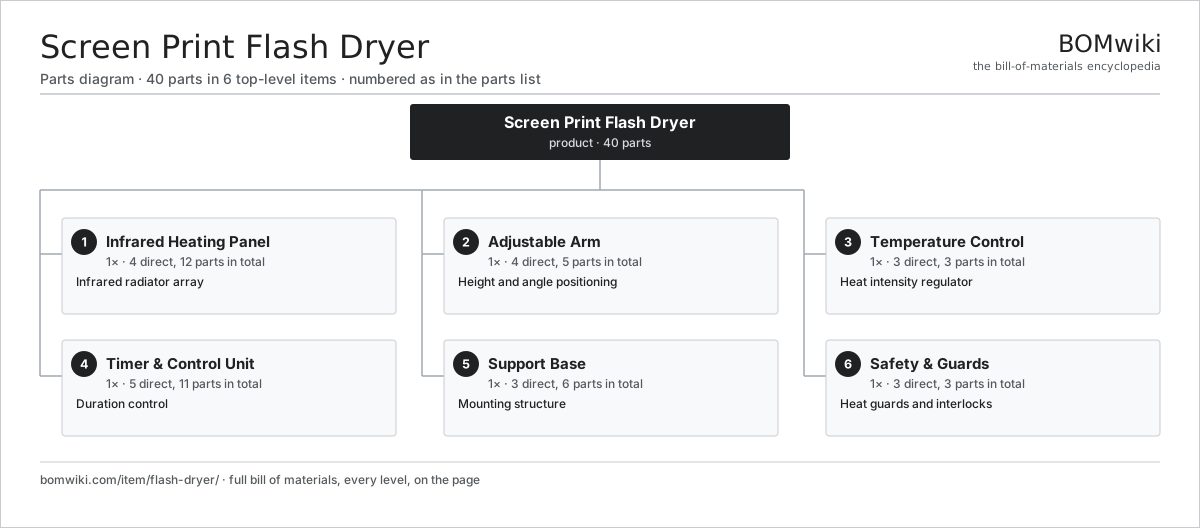
| # | Part | Qty | What it does |
|---|---|---|---|
| 1 | Infrared Heating Panel 4 parts | 1× | Infrared radiator array |
| 2 | Adjustable Arm 4 parts | 1× | Height and angle positioning |
| 3 | Temperature Control 3 parts | 1× | Heat intensity regulator |
| 4 | Timer & Control Unit 5 parts | 1× | Duration control |
| 5 | Support Base 3 parts | 1× | Mounting structure |
| 6 | Safety & Guards 3 parts | 1× | Heat guards and interlocks |
3D model
No 3D model yet. Have a CAD file of this? Add a 3D model. STL renders right on this page; STEP, FreeCAD, and OpenSCAD sources are welcome too (openly licensed, like all 3D models on BOMwiki).
Build & assembly graph
expand / collapse · shared sub-assemblies converge · links to related products · est. labourTap an assembly to expand/collapse · tap a part to open it · use “Open page” for any node · drag to pan, scroll to zoom.
Bill of materials for Screen Print Flash Dryer
6 top-level lines · 34 rows shown · 40 parts total · indented to 3 levels| # | Item / sub-assembly | Part no. | Qty/assy | Ext. qty | Parts | Type |
|---|---|---|---|---|---|---|
| 1 | Infrared Heating Panel 4 parts | flash-dryer-ir-heating-panel | 1× | 1 | 12 | assembly |
| 1.1 | IR Heater Element | flash-dryer-ir-element | 8× | 8 | · | part |
| 1.2 | Reflector Backing | flash-dryer-reflector-backing | 1× | 1 | · | part |
| 1.3 | Element Frame | flash-dryer-element-frame | 1× | 1 | · | part |
| 1.4 | Thermal Fuse | thermal-fuse | 2× | 2 | · | part |
| 2 | Adjustable Arm 4 parts | flash-dryer-adjustable-arm | 1× | 1 | 5 | assembly |
| 2.1 | Support Arm | flash-dryer-arm-support | 1× | 1 | · | part |
| 2.2 | Height Adjuster | flash-dryer-height-adjustment | 1× | 1 | · | part |
| 2.3 | Angle Adjuster | flash-dryer-angle-adjust | 1× | 1 | · | part |
| 2.4 | Ball Bearing | ball-bearing | 2× | 2 | · | part |
| 3 | Temperature Control 3 parts | flash-dryer-temperature-control | 1× | 1 | 3 | assembly |
| 3.1 | Power Controller | flash-dryer-power-supply | 1× | 1 | · | part |
| 3.2 | TRIAC Module | flash-dryer-triac-module | 1× | 1 | · | part |
| 3.3 | Temperature Sensor | flash-dryer-temp-sensor | 1× | 1 | · | part |
| 4 | Timer & Control Unit 5 parts | flash-dryer-timer-control | 1× | 1 | 11 | assembly |
| 4.1 | Control Board 4 parts | flash-dryer-control-board | 1× | 1 | 6 | assembly |
| 4.1.1 | Bare PCB | pcb-bare | 1× | 1 | · | part |
| 4.1.2 | Microcontroller | mcu | 1× | 1 | · | part |
| 4.1.3 | SMD Passive (R/C/L) | smd-passives | 1× | 1 | · | part |
| 4.1.4 | Connector | connector | 3× | 3 | · | part |
| 4.2 | Timer Display 2 parts | flash-dryer-display-panel | 1× | 1 | 2 | assembly |
| 4.2.1 | LCD Panel | lcd-panel | 1× | 1 | · | part |
| 4.2.2 | Bare PCB | pcb-bare | 1× | 1 | · | part |
| 4.3 | Relay | relay | 1× | 1 | · | part |
| 4.4 | Microcontroller | mcu | 1× | 1 | · | part |
| 4.5 | SMD Passive (R/C/L) | smd-passives | 1× | 1 | · | part |
| 5 | Support Base 3 parts | flash-dryer-support-base | 1× | 1 | 6 | assembly |
| 5.1 | Base Frame | flash-dryer-base-frame | 1× | 1 | · | part |
| 5.2 | Rolling Caster | flash-dryer-rolling-casters | 4× | 4 | · | part |
| 5.3 | Tabletop Clamp | flash-dryer-clamp-post | 1× | 1 | · | part |
| 6 | Safety & Guards 3 parts | flash-dryer-safety-system | 1× | 1 | 3 | assembly |
| 6.1 | Hand Guard | flash-dryer-hand-guard | 1× | 1 | · | part |
| 6.2 | Auto-Shutoff | flash-dryer-timer-auto-shutoff | 1× | 1 | · | part |
| 6.3 | Thermal Fuse | thermal-fuse | 1× | 1 | · | part |
Something wrong in this list? Report a problem with this BOM.
Related products
same domain, ranked by shared parts Dye-Sublimation Printer
414 parts · shares 1 with this page
Dye-Sublimation Printer
414 parts · shares 1 with this page
 Hot Foil Stamping Machine
69 parts · shares 1 with this page
Ream Wrapping Machine
540 parts · shares 1 with this page
Hot Foil Stamping Machine
69 parts · shares 1 with this page
Ream Wrapping Machine
540 parts · shares 1 with this page
 Screen Exposure Unit
83 parts · shares 1 with this page
Screen Exposure Unit
83 parts · shares 1 with this page
 Screen Print Conveyor Dryer
123 parts · shares 1 with this page
Screen Print Conveyor Dryer
123 parts · shares 1 with this page
 Stretch Wrapper
66 parts · shares 1 with this page
Stretch Wrapper
66 parts · shares 1 with this page
Sourcing: possible vendors
Browse the supplier directory → Prices, MOQ, and lead times are algorithmic estimates, not quotes, and not claims about these companies. Company mappings are curated by keyword; est. price band $10k–$3M. How estimates work| Vendor | HQ | Specialty | MOQ | Lead time |
|---|---|---|---|---|
| heidelberg.com ↗ | Heidelberg, DE | Printing presses | 10 units | 12–22 wks |
|
🇨🇭Bobst
bobst.com ↗
|
Lausanne, CH | Packaging machinery | 10 units | 12–22 wks |
| koenig-bauer.com ↗ | Würzburg, DE | Printing presses | 10 units | 12–22 wks |
| wuh-group.com ↗ | Lengerich, DE | Flexible packaging machines | 10 units | 12–22 wks |
| markandy.com ↗ | Chesterfield, US | Label presses | 10 units | 12–22 wks |
1,026-word article