Thread Rolling Machine
ProductOverview
Thread rolling machines form threads on fastener blanks by plastically deforming the blank surface between hardened dies, without removing material. Unlike thread cutting, which uses a cutting tool to remove chips, rolling displaces the blank material outward, compressing it into thread grooves. The result is a fastener with superior tensile strength and fatigue resistance compared to cut threads, because the grain structure remains continuous and work-hardened at the root.
A thread roller uses flat dies (paired die plates) or cylindrical dies that rotate against a rotating blank. As the blank turns, it advances axially into progressively deeper die cavities, forming one complete thread per revolution. Flat-die machines are the most common design for fasteners M4 to M12. They are economical, require minimal setup, and produce excellent surface finish with thread runs of ±0.05 mm pitch tolerance.
Thread rolling is the predominant fastener threading method globally, accounting for over 80% of threaded fasteners produced. It is more cost-effective than cutting for high-volume production and delivers stronger fasteners for the same nominal diameter.
How it works
The blank feed system orients a preformed blank, typically produced by cold heading, and seats it on the work spindle. The operator or automatic feeder positions the blank so that the thread runout will be at the correct location on the fastener.
The main drive rotates the blank at 200–600 rpm. As the spindle turns, the blank is presented to the fixed lower die. The pressure system then closes the upper die against the blank, applying 50–200 tonnes of clamping force.
The rotating blank rides on the stationary die pair. As it rotates, a mechanical slide mechanism advances the blank axially at a rate of one thread pitch per revolution. This synchronized advance causes the blank to progressively engage deeper thread cavity grooves, displacing material from the blank's shoulder into the die grooves, forming the thread flank.
The rolling process typically requires two to three revolutions to fully form the thread profile. During rolling, material is displaced radially outward and axially forward, creating the thread roots and flanks. The displaced material at the thread run-out end forms a slight flash or fins, which are either sheared off or remain as an integral feature depending on specification.
Once the blank has advanced through the entire active die length, the cycle is complete. The pressure system opens, releasing the dies, and the finished fastener drops or is ejected. The spindle retracts or indexes to receive the next blank.
Pressure and force control
The rolling force depends on blank diameter, thread pitch, material hardness, and die condition. Typical clamping pressures range from 250 to 350 bar (3600–5100 psi), generating 50–200 tonnes of closing force. Pressure is regulated by a pressure control valve that is adjusted per job setup.
Overload protection is critical. Excessive pressure can fracture dies or damage the spindle bearings. Many modern thread rollers use load-sensing hydraulics or pilot-operated proportional valves that limit force to a preset maximum, protecting tooling and providing consistent part quality across production runs.
Thread advance and pitch accuracy
The slide mechanism advances the blank one pitch per spindle revolution. This is achieved using a precision lead screw or ball screw driven by the spindle shaft or a geared drive. The lead screw is precision-cut to match the exact thread pitch (typically 0.7 to 1.75 mm for common fasteners).
Pitch tolerance is typically ±0.05 mm over the effective thread length, and runout (axial wobble) is held to ±0.02 mm. These tolerances are maintained by the rigidity of the frame, spindle bearing preload, and die and screw precision.
Die life and material interaction
The die inserts, hardened to 58–62 HRC, can form 100,000 to 200,000 parts before their cavity edges dull and produce pitch creep. Die life depends on blank material and hardness. Rolling soft-steel blanks extends die life; rolling hardened or stainless-steel blanks reduces it. When die edges begin to round, the thread flanks become rounded, and parts start to fall out of tolerance. Worn dies are reshaped by hand honing or sent for professional resharpening at 300–600 EUR per pair.
Material choice affects rolling load. Low-carbon steel blanks roll easily; stainless steel (austenitic) requires higher pressure; precipitation-hardened stainless demands the most force and reduces die life. Brass and aluminum roll with minimal force and leave excellent surface finish.
Setup and changeover
Changing thread pitch requires swapping the dies and adjusting or replacing the lead screw to match the new pitch. A complete changeover takes 20–40 minutes. The spindle speed and clamping pressure are adjusted via the speed controller and pressure regulator.
Some machines are equipped with multi-pitch cams or stepped lead screws that allow rapid switching between two or three common pitches without full disassembly. These allow changeover in under 10 minutes.
Blank design and pre-rolling conditions
Thread rollers accept blanks with a shoulder (under-head diameter), which must be sized to account for material displacement during rolling. For a fastener with nominal diameter d and thread pitch p, the blank shoulder is typically 0.15–0.25 mm larger than the minor thread diameter. This is called the "rollability margin."
Blanks must be straight and free of cracks. Surface defects, seams, or inclusions in the blank will result in thread defects. Blanks are typically produced by cold heading, which ensures straightness and surface quality.
Pre-rolling conditions, blank surface hardness, lubrication, temperature, affect rolling quality. Hard, work-hardened blanks (typical of cold heading) roll smoothly. Annealed blanks tend to work-harden during rolling, increasing pressure and reducing die life. Lubrication with a light mineral oil reduces friction and improves surface finish.
Applications
Thread rolling is used for all fastener types that require rolled threads:
- Metric and inch bolts, cap screws, machine screws
- Wood screws, sheet metal screws, drywall screws
- Stud bolts and foundation fasteners
- Lock nuts and prevailing-torque nuts
- Fasteners for automotive, construction, aerospace, and electrical equipment
Rolled threads are stronger than cut threads of the same size and cost less to produce at high volumes. A fastener with rolled M10 threads has approximately 15% higher tensile strength and 25% higher fatigue strength than the same fastener with cut threads.
Economics
A thread rolling machine costs 40,000 to 120,000 EUR. A set of dies (upper and lower pair) costs 600 to 1500 EUR depending on pitch and diameter. Production cost per fastener is 0.01–0.05 EUR, making thread rolling economical for volumes exceeding 10,000 parts per job. For commodity fasteners like bolts and screws, annual production per machine reaches 5–20 million parts.
Thread Rolling Machine parts and their functions
7 top-level parts · 35 parts in total · full bill of materials below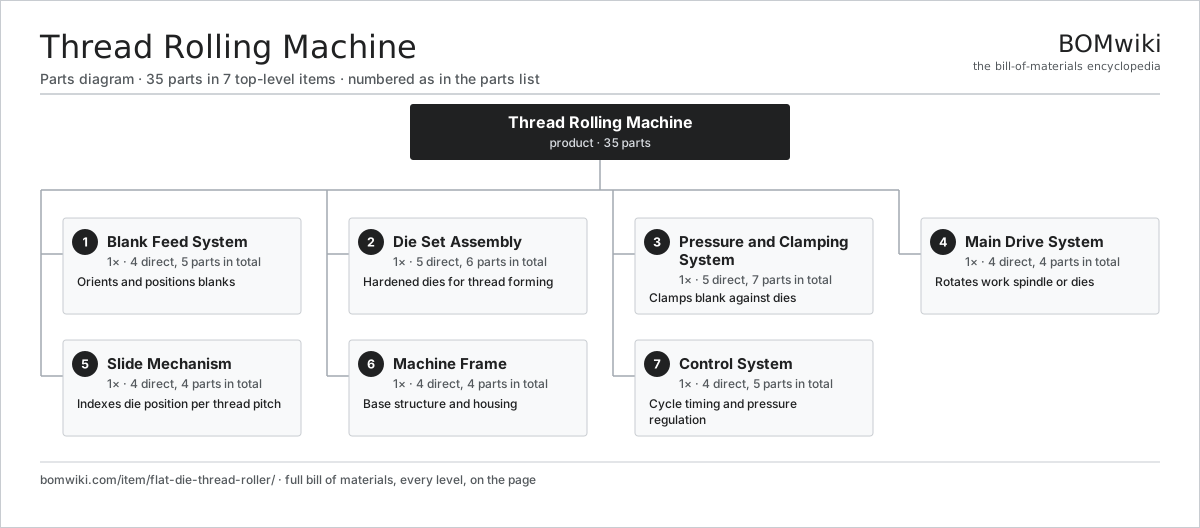
| # | Part | Qty | What it does |
|---|---|---|---|
| 1 | Blank Feed System 4 parts | 1× | Orients and positions blanks |
| 2 | Die Set Assembly 5 parts | 1× | Hardened dies for thread forming |
| 3 | Pressure and Clamping System 5 parts | 1× | Clamps blank against dies |
| 4 | Main Drive System 4 parts | 1× | Rotates work spindle or dies |
| 5 | Slide Mechanism 4 parts | 1× | Indexes die position per thread pitch |
| 6 | Machine Frame 4 parts | 1× | Base structure and housing |
| 7 | Control System 4 parts | 1× | Cycle timing and pressure regulation |
3D model
No 3D model yet. Have a CAD file of this? Add a 3D model. STL renders right on this page; STEP, FreeCAD, and OpenSCAD sources are welcome too (openly licensed, like all 3D models on BOMwiki).
Build & assembly graph
expand / collapse · shared sub-assemblies converge · links to related products · est. labourTap an assembly to expand/collapse · tap a part to open it · use “Open page” for any node · drag to pan, scroll to zoom.
Bill of materials for Thread Rolling Machine
7 top-level lines · 37 rows shown · 35 parts total · indented to 3 levels| # | Item / sub-assembly | Part no. | Qty/assy | Ext. qty | Parts | Type |
|---|---|---|---|---|---|---|
| 1 | Blank Feed System 4 parts | flat-die-thread-roller-blank-feed | 1× | 1 | 5 | assembly |
| 1.1 | Hopper | flat-die-thread-roller-hopper | 1× | 1 | · | part |
| 1.2 | Vibratory Feeder | flat-die-thread-roller-vibratory-feeder | 1× | 1 | · | part |
| 1.3 | Feed Nest | flat-die-thread-roller-feed-nest | 1× | 1 | · | part |
| 1.4 | Ball Bearing | ball-bearing | 2× | 2 | · | part |
| 2 | Die Set Assembly 5 parts | flat-die-thread-roller-die-set | 1× | 1 | 6 | assembly |
| 2.1 | Upper Die Insert | flat-die-thread-roller-upper-die | 1× | 1 | · | part |
| 2.2 | Lower Die Insert | flat-die-thread-roller-lower-die | 1× | 1 | · | part |
| 2.3 | Upper Die Holder | flat-die-thread-roller-die-holder-upper | 1× | 1 | · | part |
| 2.4 | Lower Die Holder | flat-die-thread-roller-die-holder-lower | 1× | 1 | · | part |
| 2.5 | Fastener Set | fastener-set | 2× | 2 | · | part |
| 3 | Pressure and Clamping System 5 parts | flat-die-thread-roller-pressure-system | 1× | 1 | 7 | assembly |
| 3.1 | Hydraulic Pump | flat-die-thread-roller-hydraulic-pump | 1× | 1 | · | part |
| 3.2 | Pressure Accumulator | flat-die-thread-roller-pressure-accumulator | 1× | 1 | · | part |
| 3.3 | Clamp Cylinder | flat-die-thread-roller-clamp-cylinder | 1× | 1 | · | part |
| 3.4 | Pressure Control Valve | flat-die-thread-roller-pressure-valve | 1× | 1 | · | part |
| 3.5 | O-Ring Set | oring-set | 3× | 3 | · | part |
| 4 | Main Drive System 4 parts | flat-die-thread-roller-main-drive | 1× | 1 | 4 | assembly |
| 4.1 | Electric Motor | flat-die-thread-roller-motor | 1× | 1 | · | part |
| 4.2 | Work Spindle | flat-die-thread-roller-spindle | 1× | 1 | · | part |
| 4.3 | Spindle Bearings | flat-die-thread-roller-spindle-bearings | 1× | 1 | · | part |
| 4.4 | Drive Belt | drive-belt | 1× | 1 | · | part |
| 5 | Slide Mechanism 4 parts | flat-die-thread-roller-slide-mechanism | 1× | 1 | 4 | assembly |
| 5.1 | Slide Base Block | flat-die-thread-roller-slide-base | 1× | 1 | · | part |
| 5.2 | Slide Carriage | flat-die-thread-roller-slide-block | 1× | 1 | · | part |
| 5.3 | Lead Screw | flat-die-thread-roller-lead-screw | 1× | 1 | · | part |
| 5.4 | Ball Screw | ball-screw | 1× | 1 | · | part |
| 6 | Machine Frame 4 parts | flat-die-thread-roller-machine-frame | 1× | 1 | 4 | assembly |
| 6.1 | Base Casting | flat-die-thread-roller-base-casting | 1× | 1 | · | part |
| 6.2 | Column Support | flat-die-thread-roller-column | 1× | 1 | · | part |
| 6.3 | Die Bridge | flat-die-thread-roller-die-bridge | 1× | 1 | · | part |
| 6.4 | Sheet Metal Panel | sheet-panel | 1× | 1 | · | part |
| 7 | Control System 4 parts | flat-die-thread-roller-control-system | 1× | 1 | 5 | assembly |
| 7.1 | Speed Controller | flat-die-thread-roller-speed-control | 1× | 1 | · | part |
| 7.2 | Pressure Regulator | flat-die-thread-roller-pressure-regulator | 1× | 1 | · | part |
| 7.3 | Relay | relay | 2× | 2 | · | part |
| 7.4 | Pressure Sensor | pressure-sensor | 1× | 1 | · | part |
Something wrong in this list? Report a problem with this BOM.
Related products
same domain, ranked by shared parts Crankshaft Grinder
511 parts · shares 4 with this page
Crankshaft Grinder
511 parts · shares 4 with this page
 Creep-Feed Grinder
571 parts · shares 4 with this page
Drag Finishing Machine
735 parts · shares 4 with this page
Laser Tube Cutting Machine
299 parts · shares 4 with this page
Creep-Feed Grinder
571 parts · shares 4 with this page
Drag Finishing Machine
735 parts · shares 4 with this page
Laser Tube Cutting Machine
299 parts · shares 4 with this page
Sourcing: possible vendors
Browse the supplier directory → Prices, MOQ, and lead times are algorithmic estimates, not quotes, and not claims about these companies. Company mappings are curated by keyword; est. price band $10k–$1M. How estimates work| Vendor | HQ | Specialty | MOQ | Lead time |
|---|---|---|---|---|
|
🇩🇪DMG MORI
dmgmori.com ↗
|
Bielefeld, DE | Machine tools | 5 units | 12–20 wks |
|
🇯🇵Mazak
mazak.com ↗
|
Oguchi, JP | Machine tools | 5 units | 12–20 wks |
| haascnc.com ↗ | Oxnard, US | CNC machine tools | 5 units | 12–20 wks |
|
🇯🇵Okuma
okuma.com ↗
|
Niwa, JP | Machine tools | 5 units | 12–20 wks |
|
🇩🇪Trumpf
trumpf.com ↗
|
Ditzingen, DE | Laser & sheet-metal machines | 5 units | 12–20 wks |
1,213-word article