Computerized Flat Knitting Machine
ProductOverview
A computerized flat knitting machine produces weft-knitted fabric on two flat needle beds arranged in an inverted V, with the needle hooks of the front and rear beds rising toward each other across a narrow gap. Unlike a circular knitting machine, which can only produce a continuous tube, a flat machine can widen, narrow, transfer and bind off under program control, so it knits fully shaped panels, sweater fronts, sleeves, collars, and, on machines with sufficient carriers and sinker control, complete garments in one piece with no cutting or sewing. Machines of this type are built by Shima Seiki, Stoll and a number of Chinese makers in gauges from 3 to 18 needles per inch and widths from 36 to 52 inches.
The defining feature against older mechanical flat machines is electronic needle selection: every needle on both beds can be individually told to knit, tuck or miss on every carriage pass, which makes jacquard, intarsia, cables and shaping all software problems rather than cam-fitting problems.
How it works
The Needle Beds hold a Latch Needle in every trick, each sitting on a Selection Jack and flanked by Movable Sinker plates that pin the fabric down while needles rise. Knitting happens only where the Cam Carriage is: as it traverses, its Cam Plate tracks engage the butts of the jacks and needles, lifting selected needles to clearing height, feeding them yarn, then drawing them down so the new loop is pulled through the old one while the latch casts the old loop off.
Selection is done at full speed by the Piezo Selector units on the carriage. Each holds a stack of piezoelectric fingers that flick the butt of each passing jack into or out of the cam track within about a millisecond, steered by firing data the controller streams against the carriage position encoder. A Stitch Cam Motor on each cam system shifts the stitch cam vertically during the stroke, so loop length, and therefore fabric density, can change from one needle group to the next.
Yarn reaches the needles through the Yarn Feeding system. Cones on the Yarn Stand feed through Top Tension Assembly discs and Side Tension Unit take-up arms to a Yarn Carrier running on a Carrier Rail above the needle gap. The carriage picks up whichever carriers the current course needs and parks the rest, which is how intarsia areas in different colours are each fed by their own carrier. A Yarn Break Detector on every end stops the machine within one stroke on a break or empty cone.
Below the gap, the Fabric Take-Down keeps the fabric under controlled downward tension. At the start of a piece the Set-Up Comb rises between the beds, hooks the cast-on course and pulls it down to the Take-Down Roller nip; from then on a servo motor drives the rollers at a programmed tension profile that can change course by course, which matters because shaping and transfer rows need much lighter take-down than plain knitting.
Loop transfer, the basis of shaping, cables and rib changes, relies on the Racking Mechanism mechanism. A servo and Ball Screw shift the whole rear bed sideways in exact needle-pitch steps (typically up to two inches of travel) so a loop held on a front needle can be handed to a chosen rear needle and vice versa. Combined with individual selection, this lets the machine narrow a panel by moving edge loops inward, or cross loop groups over each other to form cables.
Carriage drive and control
The carriage is hauled by a toothed belt and servo in the Carriage Drive, reversing at each end of the programmed stroke rather than the full bed width, which saves time on narrow pieces. The Machine Controller runs the knitting program produced on offline design software: its SoC interprets the pattern and HMI while dedicated MCUs on the Control Board fire the piezo selectors against encoder position and close the loops of the racking, take-down and traverse servos. Stroke-by-stroke data rates are significant, at 14 gauge and 1.6 m/s the selectors make roughly 900 knit/tuck/miss decisions per second per system.
Applications
Flat knitting machines dominate sweater and knitwear panel production, technical spacer fabrics, and increasingly knitted shoe uppers, where one machine knits the complete upper with integral structure zones. Whole-garment machines eliminate linking and sewing entirely, trading slower piece rates for zero make-up labour and near-zero yarn waste; conventional shaped-panel knitting still accounts for most installed capacity because it is faster per machine and simpler to program.
Computerized Flat Knitting Machine parts and their functions
10 top-level parts · 6,577 parts in total · full bill of materials below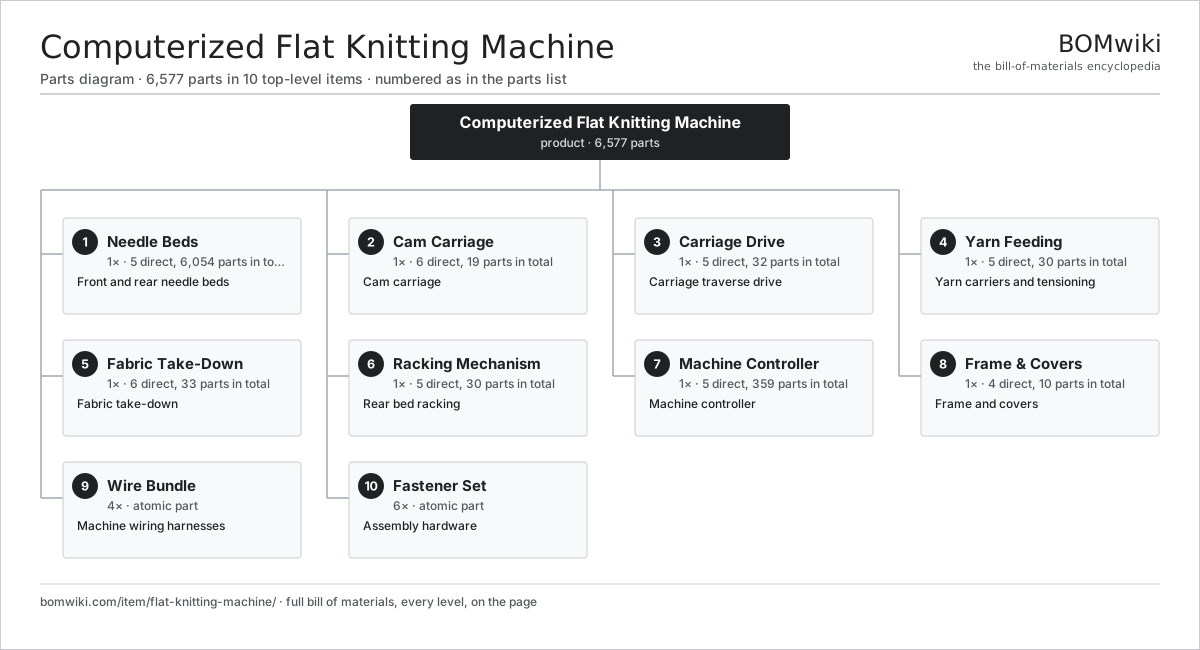
| # | Part | Qty | What it does |
|---|---|---|---|
| 1 | Needle Beds 5 parts | 1× | Front and rear needle beds |
| 2 | Cam Carriage 6 parts | 1× | Cam carriage |
| 3 | Carriage Drive 5 parts | 1× | Carriage traverse drive |
| 4 | Yarn Feeding 5 parts | 1× | Yarn carriers and tensioning |
| 5 | Fabric Take-Down 6 parts | 1× | Fabric take-down |
| 6 | Racking Mechanism 5 parts | 1× | Rear bed racking |
| 7 | Machine Controller 5 parts | 1× | Machine controller |
| 8 | Frame & Covers 4 parts | 1× | Frame and covers |
| 9 | Wire Bundle | 4× | Machine wiring harnesses |
| 10 | Fastener Set | 6× | Assembly hardware |
Diagrams & photos
_07.jpg)
_19.jpg)
_06.jpg)
_17.jpg)
3D model
No 3D model yet. Have a CAD file of this? Add a 3D model. STL renders right on this page; STEP, FreeCAD, and OpenSCAD sources are welcome too (openly licensed, like all 3D models on BOMwiki).
Build & assembly graph
expand / collapse · shared sub-assemblies converge · links to related products · est. labourTap an assembly to expand/collapse · tap a part to open it · use “Open page” for any node · drag to pan, scroll to zoom.
Bill of materials for Computerized Flat Knitting Machine
10 top-level lines · 69 rows shown · 6,577 parts total · indented to 3 levels| # | Item / sub-assembly | Part no. | Qty/assy | Ext. qty | Parts | Type |
|---|---|---|---|---|---|---|
| 1 | Needle Beds 5 parts | flat-knitting-machine-needle-beds | 1× | 1 | 6,054 | assembly |
| 1.1 | Needle Bed Plate | flat-knitting-machine-needle-bed | 2× | 2 | · | part |
| 1.2 | Latch Needle | flat-knitting-machine-latch-needle | 2016× | 2,016 | · | part |
| 1.3 | Selection Jack | flat-knitting-machine-selection-jack | 2016× | 2,016 | · | part |
| 1.4 | Movable Sinker | flat-knitting-machine-sinker | 2016× | 2,016 | · | part |
| 1.5 | Carriage Rail | flat-knitting-machine-bed-rail | 4× | 4 | · | part |
| 2 | Cam Carriage 6 parts | flat-knitting-machine-carriage | 1× | 1 | 19 | assembly |
| 2.1 | Carriage Bridge | flat-knitting-machine-carriage-body | 1× | 1 | · | part |
| 2.2 | Cam Plate | flat-knitting-machine-cam-plate | 4× | 4 | · | part |
| 2.3 | Piezo Selector | flat-knitting-machine-piezo-selector | 4× | 4 | · | part |
| 2.4 | Stitch Cam Motor | flat-knitting-machine-stitch-motor | 4× | 4 | · | part |
| 2.5 | Latch Brush | flat-knitting-machine-carriage-brush | 4× | 4 | · | part |
| 2.6 | Hall Sensor | hall-sensor | 2× | 2 | · | part |
| 3 | Carriage Drive 5 parts | flat-knitting-machine-carriage-drive | 1× | 1 | 32 | assembly |
| 3.1 | Servo Motor 4 parts | servo-motor | 1× | 1 | 24 | assembly |
| 3.1.1 | Stator Assembly 3 parts + deeper › | stator-assembly | 1× | 1 | 3 | assembly |
| 3.1.2 | Rotor Assembly 4 parts + deeper › | rotor-assembly | 1× | 1 | 19 | assembly |
| 3.1.3 | Encoder | encoder | 1× | 1 | · | part |
| 3.1.4 | Motor Housing | motor-housing | 1× | 1 | · | part |
| 3.2 | Drive Belt | drive-belt | 1× | 1 | · | part |
| 3.3 | Drive Pulley | flat-knitting-machine-drive-pulley | 2× | 2 | · | part |
| 3.4 | Encoder | encoder | 1× | 1 | · | part |
| 3.5 | Ball Bearing | ball-bearing | 4× | 4 | · | part |
| 4 | Yarn Feeding 5 parts | flat-knitting-machine-yarn-feeding | 1× | 1 | 30 | assembly |
| 4.1 | Yarn Carrier | flat-knitting-machine-yarn-carrier | 8× | 8 | · | part |
| 4.2 | Carrier Rail | flat-knitting-machine-carrier-rail | 4× | 4 | · | part |
| 4.3 | Side Tension Unit | flat-knitting-machine-side-tension | 2× | 2 | · | part |
| 4.4 | Top Tension Assembly | flat-knitting-machine-top-tension | 8× | 8 | · | part |
| 4.5 | Yarn Break Detector | flat-knitting-machine-yarn-sensor | 8× | 8 | · | part |
| 5 | Fabric Take-Down 6 parts | flat-knitting-machine-take-down | 1× | 1 | 33 | assembly |
| 5.1 | Take-Down Roller | flat-knitting-machine-takedown-roller | 2× | 2 | · | part |
| 5.2 | Sub Roller | flat-knitting-machine-sub-roller | 1× | 1 | · | part |
| 5.3 | Set-Up Comb | flat-knitting-machine-setup-comb | 1× | 1 | · | part |
| 5.4 | Servo Motor 4 parts | servo-motor | 1× | 1 | 24 | assembly |
| 5.4.1 | Stator Assembly 3 parts + deeper › | stator-assembly | 1× | 1 | 3 | assembly |
| 5.4.2 | Rotor Assembly 4 parts + deeper › | rotor-assembly | 1× | 1 | 19 | assembly |
| 5.4.3 | Encoder | encoder | 1× | 1 | · | part |
| 5.4.4 | Motor Housing | motor-housing | 1× | 1 | · | part |
| 5.5 | Helical Gear Pair | gear-pair | 1× | 1 | · | part |
| 5.6 | Coil Spring | coil-spring | 4× | 4 | · | part |
| 6 | Racking Mechanism 5 parts | flat-knitting-machine-racking | 1× | 1 | 30 | assembly |
| 6.1 | Servo Motor 4 parts | servo-motor | 1× | 1 | 24 | assembly |
| 6.1.1 | Stator Assembly 3 parts + deeper › | stator-assembly | 1× | 1 | 3 | assembly |
| 6.1.2 | Rotor Assembly 4 parts + deeper › | rotor-assembly | 1× | 1 | 19 | assembly |
| 6.1.3 | Encoder | encoder | 1× | 1 | · | part |
| 6.1.4 | Motor Housing | motor-housing | 1× | 1 | · | part |
| 6.2 | Ball Screw | ball-screw | 1× | 1 | · | part |
| 6.3 | Encoder | encoder | 1× | 1 | · | part |
| 6.4 | Racking Slide | flat-knitting-machine-racking-slide | 2× | 2 | · | part |
| 6.5 | Ball Bearing | ball-bearing | 2× | 2 | · | part |
| 7 | Machine Controller 5 parts | flat-knitting-machine-control | 1× | 1 | 359 | assembly |
| 7.1 | Control Board 6 parts | flat-knitting-machine-control-board | 1× | 1 | 352 | assembly |
| 7.1.1 | Bare PCB | pcb-bare | 1× | 1 | · | part |
| 7.1.2 | Compute SoC Module | soc-module | 1× | 1 | · | part |
| 7.1.3 | Microcontroller | mcu | 2× | 2 | · | part |
| 7.1.4 | SMD Passive (R/C/L) | smd-passives | 320× | 320 | · | part |
| 7.1.5 | Power MOSFET | mosfet | 16× | 16 | · | part |
| 7.1.6 | Connector | connector | 12× | 12 | · | part |
| 7.2 | LCD Panel | lcd-panel | 1× | 1 | · | part |
| 7.3 | Touch Digitizer | touch-digitizer | 1× | 1 | · | part |
| 7.4 | Power Supply | power-supply | 1× | 1 | · | part |
| 7.5 | Relay | relay | 4× | 4 | · | part |
| 8 | Frame & Covers 4 parts | flat-knitting-machine-frame | 1× | 1 | 10 | assembly |
| 8.1 | Base Frame | flat-knitting-machine-base-frame | 1× | 1 | · | part |
| 8.2 | Yarn Stand | flat-knitting-machine-yarn-stand | 1× | 1 | · | part |
| 8.3 | Sheet Metal Panel | sheet-panel | 6× | 6 | · | part |
| 8.4 | Fastener Set | fastener-set | 2× | 2 | · | part |
| 9 | Wire Bundle | wire-bundle | 4× | 4 | · | part |
| 10 | Fastener Set | fastener-set | 6× | 6 | · | part |
Something wrong in this list? Report a problem with this BOM.
Related products
same domain, ranked by shared parts Automatic Fabric Cutting Machine
1,695 parts · shares 9 with this page
Button Attaching Machine
280 parts · shares 5 with this page
Laser Fabric Cutting Machine
297 parts · shares 8 with this page
Mercerizing Range
585 parts · shares 8 with this page
Multi-Needle Quilting Machine
1,111 parts · shares 7 with this page
Automatic Fabric Cutting Machine
1,695 parts · shares 9 with this page
Button Attaching Machine
280 parts · shares 5 with this page
Laser Fabric Cutting Machine
297 parts · shares 8 with this page
Mercerizing Range
585 parts · shares 8 with this page
Multi-Needle Quilting Machine
1,111 parts · shares 7 with this page
Sourcing: possible vendors
Browse the supplier directory → Prices, MOQ, and lead times are algorithmic estimates, not quotes, and not claims about these companies. Company mappings are curated by keyword; est. price band $10k–$1M. How estimates work| Vendor | HQ | Specialty | MOQ | Lead time |
|---|---|---|---|---|
|
🇨🇭Rieter
rieter.com ↗
|
Winterthur, CH | Spinning machinery | 10 units | 14–24 wks |
| truetzschler.com ↗ | Mönchengladbach, DE | Textile machinery | 10 units | 14–24 wks |
|
🇧🇪Picanol
picanol.be ↗
|
Ypres, BE | Weaving machines | 10 units | 14–24 wks |
| karlmayer.com ↗ | Obertshausen, DE | Warp knitting machines | 10 units | 14–24 wks |
|
🇨🇭Saurer
saurer.com ↗
|
Arbon, CH | Spinning & embroidery | 10 units | 14–24 wks |
827-word article