Full-Flight Simulator
ProductOverview
A full-flight simulator is the only machine in which an airline pilot can legally complete an entire type rating, first landing in the real aircraft happens with passengers aboard. To earn that authority, a Level D device must reproduce one specific aircraft type so faithfully that regulators accept simulator hours as flight hours: a Replica Cockpit built from the same part numbers as the aircraft, a six-axis Motion Platform, a collimated Visual System, and a flight model validated point-by-point against flight-test data. The complete machine weighs about 12 tonnes on the moving side, costs US$10–15 million, and runs up to 20 hours a day.
Motion: the washout trick
The cabin sits on a Stewart platform, six Electric Motion Actuator legs between a Base Frame on the foundation and an Upper Frame under the cabin, each leg swinging on two Gimbal Joint universals. Coordinating six leg lengths produces any combination of pitch, roll, yaw, surge, sway and heave within roughly ±34 degrees and ±1.4 m. Modern platforms are electric: each leg pairs a 30 kW Servo Motor with a Ball Screw, replacing the hydraulic rams (and their pump rooms, accumulators and oil) that dominated the type until the 2010s.
A platform with 1.5 m of stroke obviously cannot reproduce a 3,000 m takeoff roll. The Motion Controller therefore runs washout algorithms: it renders the onset of each acceleration faithfully, then bleeds the platform back to neutral below the vestibular threshold of about 0.05 g, where the inner ear cannot detect the cheat. Sustained longitudinal acceleration is faked by tilting the cabin backward so gravity supplies the push, with the visual scene held level, the brain reads the tilt as thrust. Motion cueing is psychophysics as much as mechanics, and the Vibration Shaker units under the floor fill in everything too high-frequency for the legs: runway rumble, buffet, the thump of gear into wells.
Vision at infinity
The visual problem is that two pilots sit a metre apart but must both see the runway in the correct direction. A direct screen a few metres away would give each pilot a different parallax. The solution is collimation: three Projector units throw an edge-blended 200 × 40 degree scene onto a Back-Projection Screen above the cockpit, and the crew views its reflection in a Collimating Mirror, a vacuum-tensioned aluminised mylar membrane curved to about a 3 m radius. The mirror places the image at optical infinity, so both seats see the scene in the same direction with relaxed focus, exactly as out a real windscreen. The Image Generator renders airport databases at 60 Hz; regulators cap total transport delay, control input to correlated visual and motion response, at 100 ms, since latency between cue systems is what makes simulators induce nausea and negative training.
The cockpit and its forces
Inside, fidelity is literal: the Glareshield, Centre Pedestal and Overhead Panel are aircraft parts or exact replicas, the displays are real LCD Panel units driven through the Avionics Interface Unit on ARINC 429 buses, and crews strap into aircraft Seat Assembly hardware. What the pilot's hands feel comes from Control Loading Unit units on the column, wheel and pedals: a Servo Motor and Force Transducer close a force loop at 2 kHz, reproducing the measured force-versus-displacement curves of the real aircraft, including breakout friction, trim shifts and the heavying of controls with airspeed. Control feel is among the most heavily checked items in certification because pilots transfer motor memory directly from this hardware to the aircraft.
The Host Computer System runs the aerodynamic, engine and systems models, supplied as a validated data package by the airframe manufacturer, on redundant Host Computer servers, synchronised with motion, visual and sound over deterministic Network Switch Ethernet. The Sound and Vibration System reproduces engine spool, airflow and precipitation noise through eight Speaker channels to certification tolerances measured in decibels.
Training and certification
Behind the pilots, the instructor works from the Instructor Operating Station: two Touch Digitizer consoles from which they reposition the aircraft to short final at Innsbruck, set 200 m RVR fog, fail an engine at V1, or freeze the simulation for debrief. This is the point of the machine, the failures rehearsed here (windshear escapes, dual hydraulic loss, rejected takeoffs) are exactly those that cannot be practised in an aircraft.
Certification is continuous, not one-time. A Qualification Test Guide defines hundreds of automated test points, control sweeps, takeoff rotations, engine-out climbs, each compared against flight-test data within tolerances of a few percent, re-run quarterly and witnessed annually by the regulator. Crews board across the Boarding Ramp, whose interlock Relay chain must prove the drawbridge retracted before the platform will move: a 12-tonne cabin sweeping through its envelope shares the hall with nothing.
Full-Flight Simulator parts and their functions
7 top-level parts · 379 parts in total · full bill of materials below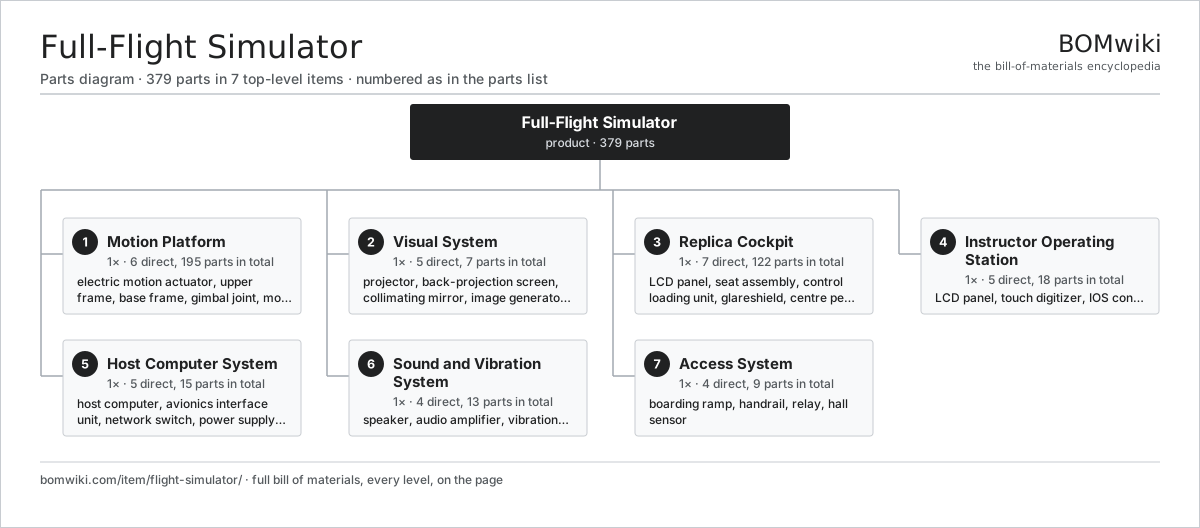
| # | Part | Qty | What it does |
|---|---|---|---|
| 1 | Motion Platform 6 parts | 1× | Stewart hexapod of six electric actuators moving the 12-tonne cabin in all six degrees of freedom. |
| 2 | Visual System 5 parts | 1× | Collimated cross-cockpit display giving both pilots a correct 200 x 40 degree out-the-window scene focused at infinity. |
| 3 | Replica Cockpit 7 parts | 1× | Flight deck duplicating the simulated aircraft down to part-numbered panels, switches and seat rails. |
| 4 | Instructor Operating Station 5 parts | 1× | Console behind the pilots from which the instructor positions the aircraft, sets weather and injects failures. |
| 5 | Host Computer System 5 parts | 1× | Real-time computers running the aircraft flight model, engines and systems simulation at 60 Hz or faster. |
| 6 | Sound and Vibration System 4 parts | 1× | Speaker array and seat shakers reproducing engine, airflow, gear and runway noise to certification tolerances. |
| 7 | Access System 4 parts | 1× | Retracting drawbridge and interlocks letting crews board the cabin only when the platform is parked. |
3D model
No 3D model yet. Have a CAD file of this? Add a 3D model. STL renders right on this page; STEP, FreeCAD, and OpenSCAD sources are welcome too (openly licensed, like all 3D models on BOMwiki).
Build & assembly graph
expand / collapse · shared sub-assemblies converge · links to related products · est. labourTap an assembly to expand/collapse · tap a part to open it · use “Open page” for any node · drag to pan, scroll to zoom.
Bill of materials for Full-Flight Simulator
7 top-level lines · 63 rows shown · 379 parts total · indented to 3 levels| # | Item / sub-assembly | Part no. | Qty/assy | Ext. qty | Parts | Type |
|---|---|---|---|---|---|---|
| 1 | Motion Platform 6 parts | flight-simulator-motion-platform | 1× | 1 | 195 | assembly |
| 1.1 | Electric Motion Actuator 5 parts | flight-simulator-actuator | 6× | 6 | 29 | assembly |
| 1.1.1 | Ball Screw | ball-screw | 1× | 6 | · | part |
| 1.1.2 | Servo Motor 4 parts + deeper › | servo-motor | 1× | 6 | 24 | assembly |
| 1.1.3 | Encoder | encoder | 1× | 6 | · | part |
| 1.1.4 | Ball Bearing | ball-bearing | 2× | 12 | · | part |
| 1.1.5 | Actuator Tube | flight-simulator-actuator-tube | 1× | 6 | · | part |
| 1.2 | Upper Frame | flight-simulator-upper-frame | 1× | 1 | · | part |
| 1.3 | Base Frame | flight-simulator-base-frame | 1× | 1 | · | part |
| 1.4 | Gimbal Joint | flight-simulator-gimbal-joint | 12× | 12 | · | part |
| 1.5 | Motion Controller | flight-simulator-motion-controller | 1× | 1 | · | part |
| 1.6 | Servo Drive | flight-simulator-servo-drive | 6× | 6 | · | part |
| 2 | Visual System 5 parts | flight-simulator-visual-system | 1× | 1 | 7 | assembly |
| 2.1 | Projector | flight-simulator-projector | 3× | 3 | · | part |
| 2.2 | Back-Projection Screen | flight-simulator-bp-screen | 1× | 1 | · | part |
| 2.3 | Collimating Mirror | flight-simulator-collimating-mirror | 1× | 1 | · | part |
| 2.4 | Image Generator | flight-simulator-image-generator | 1× | 1 | · | part |
| 2.5 | Alignment Camera | flight-simulator-alignment-camera | 1× | 1 | · | part |
| 3 | Replica Cockpit 7 parts | flight-simulator-cockpit | 1× | 1 | 122 | assembly |
| 3.1 | LCD Panel | lcd-panel | 6× | 6 | · | part |
| 3.2 | Seat Assembly 5 parts | seat-assembly | 3× | 3 | 7 | assembly |
| 3.2.1 | Seat Frame | seat-frame | 1× | 3 | · | part |
| 3.2.2 | Seat Foam | seat-foam | 2× | 6 | · | part |
| 3.2.3 | Seat Cover | seat-cover | 1× | 3 | · | part |
| 3.2.4 | Seat Motor | seat-motor | 2× | 6 | · | part |
| 3.2.5 | Seat Heater Mat | seat-heater | 1× | 3 | · | part |
| 3.3 | Control Loading Unit 5 parts | flight-simulator-control-loading | 3× | 3 | 28 | assembly |
| 3.3.1 | Servo Motor 4 parts + deeper › | servo-motor | 1× | 3 | 24 | assembly |
| 3.3.2 | Ball Screw | ball-screw | 1× | 3 | · | part |
| 3.3.3 | Encoder | encoder | 1× | 3 | · | part |
| 3.3.4 | Force Transducer | flight-simulator-force-transducer | 1× | 3 | · | part |
| 3.3.5 | Bare PCB | pcb-bare | 1× | 3 | · | part |
| 3.4 | Glareshield | flight-simulator-glareshield | 1× | 1 | · | part |
| 3.5 | Centre Pedestal | flight-simulator-pedestal | 1× | 1 | · | part |
| 3.6 | Overhead Panel | flight-simulator-overhead-panel | 1× | 1 | · | part |
| 3.7 | Wire Bundle | wire-bundle | 8× | 8 | · | part |
| 4 | Instructor Operating Station 5 parts | flight-simulator-instructor-station | 1× | 1 | 18 | assembly |
| 4.1 | LCD Panel | lcd-panel | 2× | 2 | · | part |
| 4.2 | Touch Digitizer | touch-digitizer | 2× | 2 | · | part |
| 4.3 | IOS Console | flight-simulator-ios-console | 1× | 1 | · | part |
| 4.4 | Seat Assembly 5 parts | seat-assembly | 1× | 1 | 7 | assembly |
| 4.4.1 | Seat Frame | seat-frame | 1× | 1 | · | part |
| 4.4.2 | Seat Foam | seat-foam | 2× | 2 | · | part |
| 4.4.3 | Seat Cover | seat-cover | 1× | 1 | · | part |
| 4.4.4 | Seat Motor | seat-motor | 2× | 2 | · | part |
| 4.4.5 | Seat Heater Mat | seat-heater | 1× | 1 | · | part |
| 4.5 | Connector | connector | 6× | 6 | · | part |
| 5 | Host Computer System 5 parts | flight-simulator-host-system | 1× | 1 | 15 | assembly |
| 5.1 | Host Computer | flight-simulator-host-computer | 2× | 2 | · | part |
| 5.2 | Avionics Interface Unit | flight-simulator-avionics-interface | 1× | 1 | · | part |
| 5.3 | Network Switch | flight-simulator-network-switch | 2× | 2 | · | part |
| 5.4 | Power Supply | power-supply | 4× | 4 | · | part |
| 5.5 | Wire Bundle | wire-bundle | 6× | 6 | · | part |
| 6 | Sound and Vibration System 4 parts | flight-simulator-sound-system | 1× | 1 | 13 | assembly |
| 6.1 | Speaker | speaker | 8× | 8 | · | part |
| 6.2 | Audio Amplifier | flight-simulator-audio-amplifier | 1× | 1 | · | part |
| 6.3 | Vibration Shaker | flight-simulator-vibration-shaker | 2× | 2 | · | part |
| 6.4 | Wire Bundle | wire-bundle | 2× | 2 | · | part |
| 7 | Access System 4 parts | flight-simulator-access-system | 1× | 1 | 9 | assembly |
| 7.1 | Boarding Ramp | flight-simulator-boarding-ramp | 1× | 1 | · | part |
| 7.2 | Handrail | flight-simulator-handrail | 2× | 2 | · | part |
| 7.3 | Relay | relay | 4× | 4 | · | part |
| 7.4 | Hall Sensor | hall-sensor | 2× | 2 | · | part |
Something wrong in this list? Report a problem with this BOM.
Related products
same domain, ranked by shared parts Business Jet
1,654 parts · shares 23 with this page
Business Jet
1,654 parts · shares 23 with this page
 Gyroplane
168 parts · shares 19 with this page
Gyroplane
168 parts · shares 19 with this page
 Floatplane
813 parts · shares 15 with this page
Floatplane
813 parts · shares 15 with this page
 Flying Boat
4,224 parts · shares 15 with this page
Flying Boat
4,224 parts · shares 15 with this page
 Freighter Aircraft
6,717 parts · shares 15 with this page
Freighter Aircraft
6,717 parts · shares 15 with this page
 Turboprop Airliner
3,298 parts · shares 15 with this page
Turboprop Airliner
3,298 parts · shares 15 with this page
Sourcing: possible vendors
Browse the supplier directory → Prices, MOQ, and lead times are algorithmic estimates, not quotes, and not claims about these companies. Company mappings are curated by keyword; est. price band $50k–$300M. How estimates work| Vendor | HQ | Specialty | MOQ | Lead time |
|---|---|---|---|---|
|
🇺🇸Boeing
boeing.com ↗
|
Arlington, US | Aerospace OEM | made to order | 40–80 wks |
|
🇫🇷Airbus
airbus.com ↗
|
Toulouse, FR | Aerospace OEM | made to order | 40–80 wks |
| lockheedmartin.com ↗ | Bethesda, US | Aerospace & defense | made to order | 40–80 wks |
|
🇧🇷Embraer
embraer.com ↗
|
São José dos Campos, BR | Aircraft OEM | made to order | 40–80 wks |
| txtav.com ↗ | Wichita, US | Aircraft OEM | made to order | 40–80 wks |
847-word article