Petrol Flint Lighter
ProductOverview
A flint lighter is a mechanical fire-starting device that creates a spark via friction and ignites fuel vapor. The user pushes a Flint Wheel Assembly that rotates against a hardened steel striker, creating sparks; the spark ignites flammable vapor from a Wick and Cotton Assembly soaked in naphtha or butane stored in the Fuel Chamber Assembly.
The design has remained largely unchanged since the 1920s, when Ronson perfected the mechanism. Unlike a lighter with a piezo ignition (which requires no fuel), a flint lighter requires both the mechanical spark and the fuel vapor to be present simultaneously. The advantage is reliability: flint lighters work in wind and at high altitude; they require no batteries or electronic components.
A quality flint lighter (often a premium brand like Zippo or S.T. Dupont) can last a lifetime with occasional maintenance. The Flint Rod is replaceable, the Tank Body can be refilled from a fluid bottle, and the Wick String can be replaced. Budget lighters are disposable and designed to be thrown away when they fail.
How it works
The Flint Wheel Assembly is the critical spark-generating mechanism. The Flint Rod is a stick of ferrocerium (cerium + iron + rare earths) or magnesium alloy, about 2–3 mm in diameter. The Wheel Hub is a roughened steel or aluminum wheel that rotates. When you push the lighter, the Striker Blade (a hardened steel bar) is pushed against the rotating wheel by the Striker Spring.
As the wheel spins and the striker scrapes it, millions of tiny metal particles are sheared off and heated by friction. These particles ignite in air at roughly 1,000 K (730 °C), producing bright orange sparks. The sparks fall downward into the Wick and Cotton Assembly chamber.
The Fuel Chamber Assembly is a sealed tank containing naphtha (petroleum ether) or butane. As you strike the flint, some of the liquid fuel evaporates, creating a flammable vapor above the Cotton Pad. The hot sparks from the Flint Wheel Assembly ignite this vapor, producing a flame that ignites the Wick String.
The Wick String is a braided cotton or synthetic cord that soaks up fuel from the Cotton Pad below. Once lit, the wick burns, producing a visible flame that lasts as long as you keep the lighter pressed. The Wick Guide Nozzle nozzle surrounds the wick and focuses the flame.
The Hinged Lid Assembly flips open to expose the wick and flint wheel. Inside the lid is a Fuel Valve Cam, a small lobe that contacts a flint-lighter-fuel-valve (not listed as a separate node but implied in the fuel chamber). When you open the lid, the cam opens the fuel valve slightly, allowing air to enter and prevent a vacuum as fuel evaporates. When closed, the valve seals, stopping evaporation and preserving fuel.
Refueling is done by unscrewing the flint-lighter-cap-seal at the bottom of the Fuel Chamber Assembly and pouring naphtha through the Filler Tube. The Tank Seal rubber O-ring keeps the fuel sealed.
Replacing the Flint Rod requires pushing out the Wheel Axle pin and removing the Wheel Hub. A fresh Flint Rod is inserted, and the wheel is reassembled. This operation is simple enough that many users do it themselves; replacement Flint Rods are inexpensive.
Ignition sequence
For a flint lighter to ignite, three conditions must be met: the Flint Wheel Assembly must produce hot sparks, the Cotton Pad must be saturated with fuel, and there must be enough fuel vapor above the Cotton Pad to be ignited. If any one condition fails, the lighter won't work.
A dry lighter (no fuel) produces sparks but no flame. A lighter with wet fuel (water contamination) produces sparks but too much liquid and no vapor. A lighter with a worn Flint Rod produces weak or no sparks. A lighter exposed to wind can have the flame blown out before igniting the wick.
The Wick String must be properly trimmed. If too long, the wick will produce a tall, diffuse flame; if too short, it won't light at all. A well-trimmed wick produces a steady 40–50 mm flame.
Fuel types and performance
Naphtha-based lighter fluid (like Zippo brand) is the standard. It is a mixture of petroleum ether compounds with boiling points around 40–90 °C. It evaporates slowly, allowing the lighter to sit unused for weeks without significant fuel loss. Naphtha is odorless and burns cleanly.
Butane lighters use pressurized liquid butane. They are lighter and more portable but require a better seal to prevent evaporation. Butane lighters fail at high altitudes (where air pressure is low) and in extreme cold.
Premium lighters (like S.T. Dupont) use special fuel formulations with additives that prevent wick gumming and extend the Wick String life.
Durability and maintenance
The Flint Rod is consumable and wears out after 200–500 strikes depending on pressure and the rod's quality. A new Flint Rod cost 50 cents to a few dollars.
The Wick String lasts 1–2 years with regular use. Over time, the wick carbonizes and becomes crusty. The flame becomes sputtery and difficult to light. Replacing the wick requires opening the Case Body and carefully extracting the Wick and Cotton Assembly assembly; this is more complex than changing the flint rod.
The Hinged Lid Assembly hinge can crack if dropped repeatedly. Premium lighters use brass or steel hinges; budget lighters use pot metal (zinc alloy) that is brittle.
The Tank Seal rubber O-ring dries and cracks after 10+ years, causing slow fuel evaporation. Replacement seals are available but require disassembly of the Fuel Chamber Assembly.
The Case Finish (chrome, nickel, or paint) corrodes over time. Brass cases develop a patina; polished cases can be buffed to restore shine.
Safety
A flint lighter produces an open flame and should never be used carelessly. The Fuel Chamber Assembly is pressurized and can rupture if heated above 60 °C or pierced. Never leave a lighter in a hot car or near a heat source.
Overfilling the Fuel Chamber Assembly causes fuel to overflow and soak the exterior, creating a fire hazard.
A lit flint lighter should not be left unattended, as the Wick String can ignite nearby materials.
Petrol Flint Lighter parts and their functions
5 top-level parts · 19 parts in total · full bill of materials below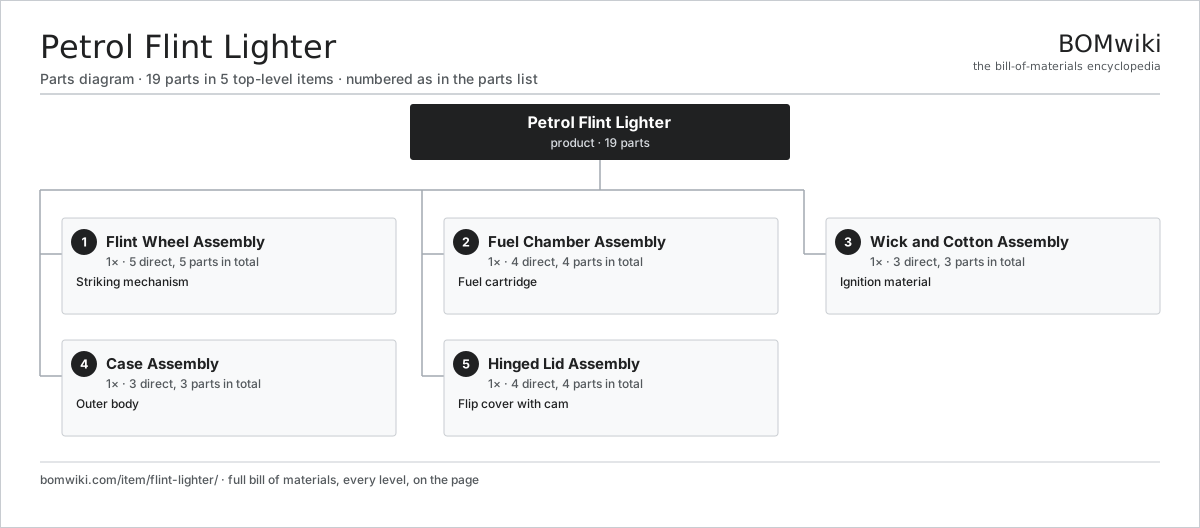
| # | Part | Qty | What it does |
|---|---|---|---|
| 1 | Flint Wheel Assembly 5 parts | 1× | Striking mechanism |
| 2 | Fuel Chamber Assembly 4 parts | 1× | Fuel cartridge |
| 3 | Wick and Cotton Assembly 3 parts | 1× | Ignition material |
| 4 | Case Assembly 3 parts | 1× | Outer body |
| 5 | Hinged Lid Assembly 4 parts | 1× | Flip cover with cam |
3D model
No 3D model yet. Have a CAD file of this? Add a 3D model. STL renders right on this page; STEP, FreeCAD, and OpenSCAD sources are welcome too (openly licensed, like all 3D models on BOMwiki).
Build & assembly graph
expand / collapse · shared sub-assemblies converge · links to related products · est. labourTap an assembly to expand/collapse · tap a part to open it · use “Open page” for any node · drag to pan, scroll to zoom.
Bill of materials for Petrol Flint Lighter
5 top-level lines · 24 rows shown · 19 parts total · indented to 3 levels| # | Item / sub-assembly | Part no. | Qty/assy | Ext. qty | Parts | Type |
|---|---|---|---|---|---|---|
| 1 | Flint Wheel Assembly 5 parts | flint-lighter-flint-wheel-asm | 1× | 1 | 5 | assembly |
| 1.1 | Flint Rod | flint-lighter-flint-rod | 1× | 1 | · | part |
| 1.2 | Wheel Hub | flint-lighter-wheel-hub | 1× | 1 | · | part |
| 1.3 | Wheel Axle | flint-lighter-wheel-axle | 1× | 1 | · | part |
| 1.4 | Striker Blade | flint-lighter-striker-blade | 1× | 1 | · | part |
| 1.5 | Striker Spring | flint-lighter-striker-spring | 1× | 1 | · | part |
| 2 | Fuel Chamber Assembly 4 parts | flint-lighter-fuel-chamber | 1× | 1 | 4 | assembly |
| 2.1 | Tank Body | flint-lighter-tank-body | 1× | 1 | · | part |
| 2.2 | Tank Seal | flint-lighter-tank-seal | 1× | 1 | · | part |
| 2.3 | Filler Tube | flint-lighter-filler-tube | 1× | 1 | · | part |
| 2.4 | Fuel Vent | flint-lighter-fuel-vent | 1× | 1 | · | part |
| 3 | Wick and Cotton Assembly 3 parts | flint-lighter-wick-cotton | 1× | 1 | 3 | assembly |
| 3.1 | Cotton Pad | flint-lighter-cotton-pad | 1× | 1 | · | part |
| 3.2 | Wick String | flint-lighter-wick-string | 1× | 1 | · | part |
| 3.3 | Wick Guide Nozzle | flint-lighter-wick-guide | 1× | 1 | · | part |
| 4 | Case Assembly 3 parts | flint-lighter-case | 1× | 1 | 3 | assembly |
| 4.1 | Case Body | flint-lighter-case-body | 1× | 1 | · | part |
| 4.2 | Case Base | flint-lighter-case-base | 1× | 1 | · | part |
| 4.3 | Case Finish | flint-lighter-case-finish | 1× | 1 | · | part |
| 5 | Hinged Lid Assembly 4 parts | flint-lighter-hinged-lid | 1× | 1 | 4 | assembly |
| 5.1 | Lid Plate | flint-lighter-lid-plate | 1× | 1 | · | part |
| 5.2 | Lid Hinge | flint-lighter-lid-hinge | 1× | 1 | · | part |
| 5.3 | Fuel Valve Cam | flint-lighter-cam-mechanism | 1× | 1 | · | part |
| 5.4 | Spring Latch | flint-lighter-spring-latch | 1× | 1 | · | part |
Something wrong in this list? Report a problem with this BOM.
Sourcing: possible vendors
Browse the supplier directory → Prices, MOQ, and lead times are algorithmic estimates, not quotes, and not claims about these companies. Company mappings are curated by keyword; est. price band $30–$800. How estimates work| Vendor | HQ | Specialty | MOQ | Lead time |
|---|---|---|---|---|
| stanleyblackanddecker.com ↗ | New Britain, US | Tools (DeWalt, Craftsman) | 500 units | 6–12 wks |
| bosch-professional.com ↗ | Leinfelden, DE | Power tools | 500 units | 6–12 wks |
| ttigroup.com ↗ | Hong Kong, CN | Tools (Milwaukee, Ryobi) | 500 units | 6–12 wks |
|
🇯🇵Makita
makita.com ↗
|
Anjo, JP | Power tools | 500 units | 6–12 wks |
|
🇨🇭Hilti
hilti.com ↗
|
Schaan, CH | Construction tools | 500 units | 6–12 wks |
1,118-word article