Flotation Cell
ProductOverview
Froth flotation is the dominant method of concentrating sulphide and many other ores, and the mechanical flotation cell is the machine that does it. Ground ore is mixed with water and chemical reagents into a slurry (pulp), and conditioned so that the valuable mineral surfaces become water-repellent while gangue stays wetted. In the cell, air is dispersed into millimetre-scale bubbles; hydrophobic mineral particles collide with bubbles, attach, and ride them to the surface, where they overflow as a mineral-loaded froth. The barren pulp passes on to the next cell. A concentrator runs cells in banks of 4–10, in rougher, scavenger and cleaner duties, and a large copper plant may operate over a hundred of them. Individual cells have grown from a few cubic metres in the mid-20th century to 300–600 m³ today, since one large cell is cheaper to build and power than several small ones of equal total volume.
How it works
Everything happens in three zones. In the turbulent zone at the bottom, the Rotor-Stator Mechanism does three jobs simultaneously: it keeps solids suspended, it pumps pulp through itself for repeated bubble-particle contact, and it shears the incoming air into bubbles. The Rotor, spinning at a tip speed of 5–8 m/s, creates low-pressure cavities behind its vanes; air drawn down the hollow Mechanism Shaft from the Standpipe is ripped into 0.5–2 mm bubbles in these cavities, and the surrounding Stator kills the rotational swirl and disperses the bubble-pulp jet evenly into the tank.
Above this is the quiescent zone, where Internal Baffle calm the flow and loaded bubbles rise while hydraulically entrained gangue drains back. At the top, bubbles accumulate into a froth bed 100–800 mm deep. Froth depth is the main grade control: a deeper froth gives entrained gangue more time to drain back, raising grade at some cost in recovery. The froth overflows the lip into the Outer Launder; on large-diameter cells, Radial Launders and a Froth Crowder keep the transport distance short enough that fragile froth reports before it collapses, and Launder Sprayss flush the concentrate to the Concentrate Outlet.
Level and air control
The pulp-froth interface is held at setpoint by the Level Control System loop. A Level Float rides the interface and a Level Transmitter reads its position to within ±5 mm; the controller strokes Dart Valve Actuators on the Dart Valves in the Discharge Box, throttling pulp flow to the next cell. Because cells in a bank are hydraulically coupled, level control is a genuine multivariable problem, opening one cell's darts disturbs every cell downstream, and modern plants use decoupling or model-predictive control across the bank.
Air is the second manipulated variable. The Flotation Blower supplies air at 20–50 kPa, metered per cell by an Air Control Valve and measured by an Air Flowmeter. More air generally lifts recovery until the froth overloads or the mechanism floods. Many plants run air-rate profiling down the bank (high at the head, tapering toward the tail) and close the loop on froth velocity measured by a Froth Camera, which images bubble size, speed and colour at the surface.
Tank and wear
The Tank Shell is plain welded steel; the slurry never touches it, because a 6–10 mm bonded Tank Lining of natural rubber takes the abrasion. Feed enters through the Feed Box below the surface so it cannot disturb the froth. The severe wear parts are in the mechanism: rotor and stator mouldings typically last one to three years depending on ore abrasivity, and Shaft Wear Sleeves protect the shaft where it passes through pulp. Mechanism changeout is designed as a crane lift of the whole Drive Bridge assembly, motor, Bearing Housing, shaft, rotor, so a cell returns to service in hours.
Drive and energy
The Drive Motor powers the rotor through a V-belt Pulley Set giving roughly 3–6:1 reduction to 80–200 rpm. Specific power is about 1–2 kW per m³ of cell volume, which makes flotation one of the larger power consumers in a concentrator after grinding; a 300 m³ cell carries a 400–600 kW motor. Variable-frequency drives are increasingly fitted so tip speed can be tuned to the duty, roughers run harder for suspension and contacting, cleaners gentler to protect froth stability.
Variants
Forced-air cells (with an external blower, as described) and self-aspirated cells (where rotor suction draws its own air) are the two mechanical families; forced air dominates at large sizes because the air rate is independently controllable. Flotation columns, which have no mechanism at all and contact slurry against sparged bubbles in counter-current flow with froth washing, are common in final cleaning duty alongside mechanical cells.
Flotation Cell parts and their functions
7 top-level parts · 63 parts in total · full bill of materials below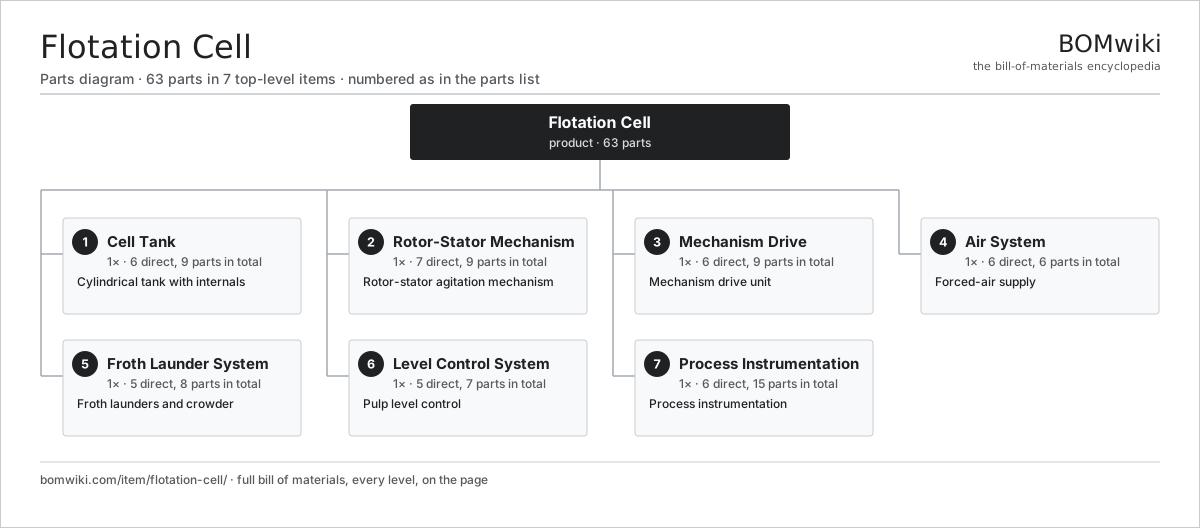
| # | Part | Qty | What it does |
|---|---|---|---|
| 1 | Cell Tank 6 parts | 1× | Cylindrical tank with internals |
| 2 | Rotor-Stator Mechanism 7 parts | 1× | Rotor-stator agitation mechanism |
| 3 | Mechanism Drive 6 parts | 1× | Mechanism drive unit |
| 4 | Air System 6 parts | 1× | Forced-air supply |
| 5 | Froth Launder System 5 parts | 1× | Froth launders and crowder |
| 6 | Level Control System 5 parts | 1× | Pulp level control |
| 7 | Process Instrumentation 6 parts | 1× | Process instrumentation |
3D model
No 3D model yet. Have a CAD file of this? Add a 3D model. STL renders right on this page; STEP, FreeCAD, and OpenSCAD sources are welcome too (openly licensed, like all 3D models on BOMwiki).
Build & assembly graph
expand / collapse · shared sub-assemblies converge · links to related products · est. labourTap an assembly to expand/collapse · tap a part to open it · use “Open page” for any node · drag to pan, scroll to zoom.
Bill of materials for Flotation Cell
7 top-level lines · 52 rows shown · 63 parts total · indented to 3 levels| # | Item / sub-assembly | Part no. | Qty/assy | Ext. qty | Parts | Type |
|---|---|---|---|---|---|---|
| 1 | Cell Tank 6 parts | flotation-cell-tank | 1× | 1 | 9 | assembly |
| 1.1 | Tank Shell | flotation-cell-tank-shell | 1× | 1 | · | part |
| 1.2 | Tank Lining | flotation-cell-tank-lining | 1× | 1 | · | part |
| 1.3 | Feed Box | flotation-cell-feed-box | 1× | 1 | · | part |
| 1.4 | Discharge Box | flotation-cell-discharge-box | 1× | 1 | · | part |
| 1.5 | Internal Baffle | flotation-cell-internal-baffles | 4× | 4 | · | part |
| 1.6 | Drain Valve | flotation-cell-drain-valve | 1× | 1 | · | part |
| 2 | Rotor-Stator Mechanism 7 parts | flotation-cell-mechanism | 1× | 1 | 9 | assembly |
| 2.1 | Rotor | flotation-cell-rotor | 1× | 1 | · | part |
| 2.2 | Stator | flotation-cell-stator | 1× | 1 | · | part |
| 2.3 | Mechanism Shaft | flotation-cell-main-shaft | 1× | 1 | · | part |
| 2.4 | Standpipe | flotation-cell-standpipe | 1× | 1 | · | part |
| 2.5 | Ball Bearing | ball-bearing | 2× | 2 | · | part |
| 2.6 | Oil Seal | oil-seal | 2× | 2 | · | part |
| 2.7 | Shaft Wear Sleeves | flotation-cell-wear-sleeves | 1× | 1 | · | part |
| 3 | Mechanism Drive 6 parts | flotation-cell-drive | 1× | 1 | 9 | assembly |
| 3.1 | Drive Motor | flotation-cell-drive-motor | 1× | 1 | · | part |
| 3.2 | Drive Belt | drive-belt | 4× | 4 | · | part |
| 3.3 | Pulley Set | flotation-cell-pulley-set | 1× | 1 | · | part |
| 3.4 | Drive Bridge | flotation-cell-drive-bridge | 1× | 1 | · | part |
| 3.5 | Bearing Housing | flotation-cell-bearing-housing | 1× | 1 | · | part |
| 3.6 | Fastener Set | fastener-set | 1× | 1 | · | part |
| 4 | Air System 6 parts | flotation-cell-air-system | 1× | 1 | 6 | assembly |
| 4.1 | Flotation Blower | flotation-cell-blower | 1× | 1 | · | part |
| 4.2 | Blower Motor | blower-motor | 1× | 1 | · | part |
| 4.3 | Air Control Valve | flotation-cell-air-control-valve | 1× | 1 | · | part |
| 4.4 | Air Flowmeter | flotation-cell-air-flowmeter | 1× | 1 | · | part |
| 4.5 | Air Manifold | flotation-cell-air-manifold | 1× | 1 | · | part |
| 4.6 | Pressure Sensor | pressure-sensor | 1× | 1 | · | part |
| 5 | Froth Launder System 5 parts | flotation-cell-launder-system | 1× | 1 | 8 | assembly |
| 5.1 | Outer Launder | flotation-cell-outer-launder | 1× | 1 | · | part |
| 5.2 | Radial Launder | flotation-cell-radial-launder | 4× | 4 | · | part |
| 5.3 | Froth Crowder | flotation-cell-froth-crowder | 1× | 1 | · | part |
| 5.4 | Launder Sprays | flotation-cell-launder-spray | 1× | 1 | · | part |
| 5.5 | Concentrate Outlet | flotation-cell-concentrate-outlet | 1× | 1 | · | part |
| 6 | Level Control System 5 parts | flotation-cell-level-control | 1× | 1 | 7 | assembly |
| 6.1 | Dart Valve | flotation-cell-dart-valve | 2× | 2 | · | part |
| 6.2 | Dart Valve Actuator | flotation-cell-valve-actuator | 2× | 2 | · | part |
| 6.3 | Level Float | flotation-cell-level-float | 1× | 1 | · | part |
| 6.4 | Level Transmitter | flotation-cell-level-transmitter | 1× | 1 | · | part |
| 6.5 | Microcontroller | mcu | 1× | 1 | · | part |
| 7 | Process Instrumentation 6 parts | flotation-cell-instrumentation | 1× | 1 | 15 | assembly |
| 7.1 | Froth Camera 4 parts | flotation-cell-froth-camera | 1× | 1 | 4 | assembly |
| 7.1.1 | CMOS Image Sensor | image-sensor | 1× | 1 | · | part |
| 7.1.2 | Lens Assembly | camera-lens | 1× | 1 | · | part |
| 7.1.3 | Bare PCB | pcb-bare | 1× | 1 | · | part |
| 7.1.4 | Compute SoC Module | soc-module | 1× | 1 | · | part |
| 7.2 | Pulp Density Gauge | flotation-cell-density-gauge | 1× | 1 | · | part |
| 7.3 | Junction Box | flotation-cell-junction-box | 1× | 1 | · | part |
| 7.4 | Wire Bundle | wire-bundle | 2× | 2 | · | part |
| 7.5 | Connector | connector | 6× | 6 | · | part |
| 7.6 | Pressure Sensor | pressure-sensor | 1× | 1 | · | part |
Something wrong in this list? Report a problem with this BOM.
Related products
same domain, ranked by shared parts Sensor-Based Ore Sorter
414 parts · shares 3 with this page
Sensor-Based Ore Sorter
414 parts · shares 3 with this page
 Rotary Blasthole Drill
92 parts · shares 1 with this page
Rotary Blasthole Drill
92 parts · shares 1 with this page
 Drilling Jumbo
175 parts · shares 1 with this page
Longwall Shearer
302 parts · shares 1 with this page
Drilling Jumbo
175 parts · shares 1 with this page
Longwall Shearer
302 parts · shares 1 with this page
 Aggregate Wash Plant
115 parts · shares 1 with this page
Double Roll Crusher
214 parts · shares 1 with this page
Aggregate Wash Plant
115 parts · shares 1 with this page
Double Roll Crusher
214 parts · shares 1 with this page
Sourcing: possible vendors
Browse the supplier directory → Prices, MOQ, and lead times are algorithmic estimates, not quotes, and not claims about these companies. Company mappings are curated by keyword; est. price band $200k–$5M. How estimates work| Vendor | HQ | Specialty | MOQ | Lead time |
|---|---|---|---|---|
| caterpillar.com ↗ | Irving, US | Construction & mining equipment | made to order | 20–36 wks |
|
🇯🇵Komatsu
komatsu.com ↗
|
Tokyo, JP | Construction & mining equipment | made to order | 20–36 wks |
|
🇸🇪Sandvik
rocktechnology.sandvik ↗
|
Stockholm, SE | Mining & rock technology | made to order | 20–36 wks |
|
🇸🇪Epiroc
epiroc.com ↗
|
Stockholm, SE | Mining & drilling equipment | made to order | 20–36 wks |
|
🇫🇮Metso
metso.com ↗
|
Helsinki, FI | Crushing & minerals processing | made to order | 20–36 wks |
854-word article