Roller Flour Mill
ProductAlso known as: Flour Roller Mill
Overview
A roller flour mill separates a wheat kernel into its three parts, starchy endosperm (about 83 % of the kernel), bran skins, and germ, and grinds the endosperm into white flour. It does this not in one pass but by gradual reduction: a dozen or more grinding passages, each followed by sifting, each taking only a small step. Wheat enters the Grain Cleaning Section section as a dusty field crop and leaves the Flour Packing Station line 24 hours of process time later as 25 kg bags of flour, with bran and wheatfeed sold as separate streams. The system was worked out in Hungary and Switzerland in the 1870s–80s and its architecture, Roller Mill Stands on the ground floor, Plansifters at the top, stock flying between them through the Pneumatic Conveying System system, is still how essentially all of the world's white flour is made.
Cleaning and tempering
Wheat arrives with stones, straw, other seeds, dust, and the occasional bolt. The Sieve Separator screens out oversize and undersize material, the Gravity Destoner floats wheat off a vibrating deck while stones walk uphill against the airflow, Magnet Separators pull tramp iron, and the Grain Scourer and Aspiration Channel rub and lift dirt off the kernels.
Clean wheat is then conditioned in the Tempering System system. The Water Dosing Unit adds water against the live reading of the Online Moisture Meter, the Intensive Dampener smears it over every kernel, and the grain rests 12–36 hours in a Tempering Bin at 15.5–17 % moisture. Tempering is what makes roller milling work: moist bran becomes tough and peels off in large flakes instead of shattering into specks, while the endosperm stays friable.
Breaking and reduction
The first break Roller Mill Stand does not crush the kernel, it shears it open. Each Grinding Roll Pair runs with a 2.5:1 speed differential, the fast roll's spiral flutes slicing against the slow roll's so the kernel unrolls, releasing chunks of endosperm (semolina and middlings) while leaving the bran in broad flakes. Four or five break passages with progressively finer flutes and tighter gaps scrape the bran cleaner each time. The Feed Gate & Roll spreads stock in an even curtain across the kilometre-per-minute roll surface, and the Roll Gap Adjuster disengages the rolls the instant feed stops so they never touch metal-to-metal.
Reduction passages use smooth rolls at a gentle 1.25:1 differential to flatten and grind purified middlings into flour over 8–12 stages, with Roll Scraper Knifes keeping the surfaces clean. Grinding gaps run from about 0.5 mm at first break down to 0.03 mm on the last reductions.
Sifting and purification
After every grinding passage the stock goes up the mill and into the Plansifter. This is a large box hung on flexible Suspension Canes, gyrating in a 60–80 mm circle at about 220 rpm under its Eccentric Gyratory Drive. Inside, each Sieve Section holds up to 28 sieves: coarse covers on top take overs back to the next break, mid covers split out middlings, and 132–150 µm nylon flour covers at the bottom pass finished flour. Bouncing Sieve Cleaner pads keep the mesh open, and Stock Outlet Sleeves carry the dozen sorted fractions from the swinging box to fixed spouts. A single sifter section sorts one machine's output into five or six streams continuously.
The Middlings Purifier handles the middle fractions, where pure endosperm and bran-attached particles are the same size and sieving alone cannot separate them. Its Purifier Sieve Deck decks oscillate while the Purifier Aspiration Fan draws air upward: dense, pure semolina sinks through the mesh while lighter bran flakes float off the top, with Air Regulation Valves letting the miller tune the lift zone by zone. Purified semolina goes to the head reductions and becomes the whitest patent flour.
Conveying, control, and packing
The Pneumatic Conveying System system replaced bucket elevators in the 1950s. A Main Conveying Blower holds the whole network under vacuum; every grinding stream is picked up at the roll stand, accelerated to 18–22 m/s up a Pneumatic Lift Duct, spun out of the air in a Cyclone Separator, and dropped through a Rotary Airlock into its sifter, simultaneously cooling the stock and the rolls. The Baghouse Filter recovers airborne flour before the blower. Flour dust above 50 g/m³ is explosive, so ducting, filters, and airlocks are all part of the mill's ATEX zoning.
The Mill Control System PLC starts the plant in reverse stock order, packing first, first break last, so nothing grinds into a dead end, and Choke Detectors in every spout stop the upstream section before a blockage buries a machine. At the end of the line the Rebolt Check Sifter, Net Weigh Hopper, and Packing Metal Detector provide the final quality gate before bags are stitched shut, while a well-run mill converts 100 kg of wheat into roughly 76 kg of flour for 5–8 kWh of electricity.
Roller Flour Mill parts and their functions
8 top-level parts · 391 parts in total · full bill of materials below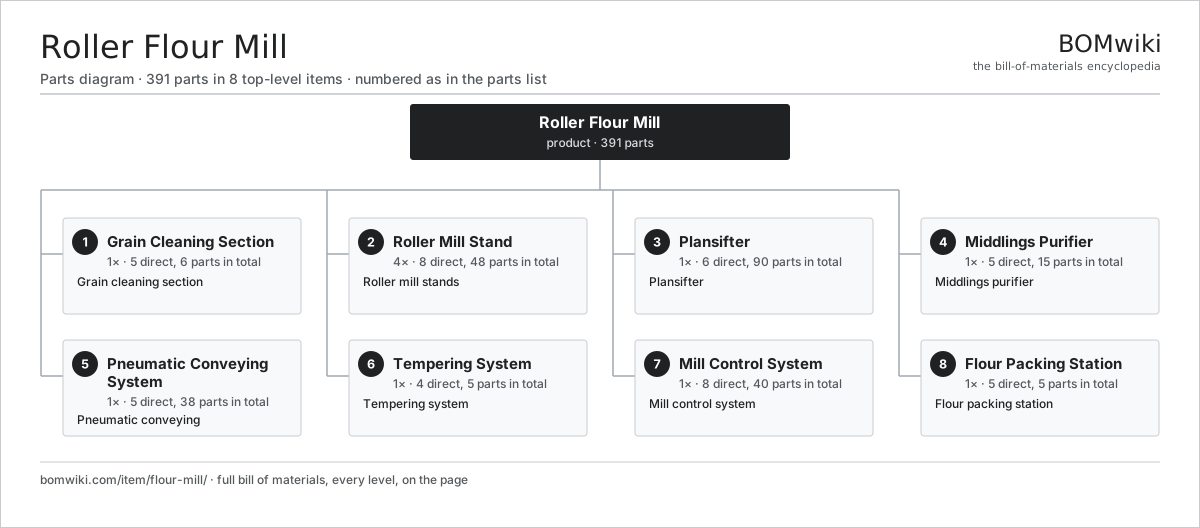
| # | Part | Qty | What it does |
|---|---|---|---|
| 1 | Grain Cleaning Section 5 parts | 1× | Grain cleaning section |
| 2 | Roller Mill Stand 8 parts | 4× | Roller mill stands |
| 3 | Plansifter 6 parts | 1× | Plansifter |
| 4 | Middlings Purifier 5 parts | 1× | Middlings purifier |
| 5 | Pneumatic Conveying System 5 parts | 1× | Pneumatic conveying |
| 6 | Tempering System 4 parts | 1× | Tempering system |
| 7 | Mill Control System 8 parts | 1× | Mill control system |
| 8 | Flour Packing Station 5 parts | 1× | Flour packing station |
3D model
No 3D model yet. Have a CAD file of this? Add a 3D model. STL renders right on this page; STEP, FreeCAD, and OpenSCAD sources are welcome too (openly licensed, like all 3D models on BOMwiki).
Build & assembly graph
expand / collapse · shared sub-assemblies converge · links to related products · est. labourTap an assembly to expand/collapse · tap a part to open it · use “Open page” for any node · drag to pan, scroll to zoom.
Bill of materials for Roller Flour Mill
8 top-level lines · 59 rows shown · 391 parts total · indented to 3 levels| # | Item / sub-assembly | Part no. | Qty/assy | Ext. qty | Parts | Type |
|---|---|---|---|---|---|---|
| 1 | Grain Cleaning Section 5 parts | flour-mill-cleaning | 1× | 1 | 6 | assembly |
| 1.1 | Sieve Separator | flour-mill-separator | 1× | 1 | · | part |
| 1.2 | Gravity Destoner | flour-mill-destoner | 1× | 1 | · | part |
| 1.3 | Magnet Separator | flour-mill-magnet | 2× | 2 | · | part |
| 1.4 | Grain Scourer | flour-mill-scourer | 1× | 1 | · | part |
| 1.5 | Aspiration Channel | flour-mill-aspirator | 1× | 1 | · | part |
| 2 | Roller Mill Stand 8 parts | flour-mill-roller-stand | 4× | 4 | 48 | assembly |
| 2.1 | Grinding Roll Pair | flour-mill-roll-pair | 2× | 8 | · | part |
| 2.2 | Feed Gate & Roll | flour-mill-feed-gate | 2× | 8 | · | part |
| 2.3 | Roll Gap Adjuster | flour-mill-roll-adjuster | 2× | 8 | · | part |
| 2.4 | Stand Drive Motor 5 parts | flour-mill-stand-motor | 1× | 4 | 26 | assembly |
| 2.4.1 | Stator Assembly 3 parts + deeper › | stator-assembly | 1× | 4 | 3 | assembly |
| 2.4.2 | Rotor Assembly 4 parts + deeper › | rotor-assembly | 1× | 4 | 19 | assembly |
| 2.4.3 | Copper Winding | copper-winding | 1× | 4 | · | part |
| 2.4.4 | Motor Housing | motor-housing | 1× | 4 | · | part |
| 2.4.5 | Ball Bearing | ball-bearing | 2× | 8 | · | part |
| 2.5 | Drive Belt | drive-belt | 2× | 8 | · | part |
| 2.6 | Ball Bearing | ball-bearing | 8× | 32 | · | part |
| 2.7 | Roll Scraper Knife | flour-mill-roll-scraper | 4× | 16 | · | part |
| 2.8 | Pressure Sensor | pressure-sensor | 2× | 8 | · | part |
| 3 | Plansifter 6 parts | flour-mill-plansifter | 1× | 1 | 90 | assembly |
| 3.1 | Sieve Section | flour-mill-sieve-stack | 8× | 8 | · | part |
| 3.2 | Sifter Swing Frame | flour-mill-sifter-frame | 1× | 1 | · | part |
| 3.3 | Eccentric Gyratory Drive | flour-mill-eccentric-drive | 1× | 1 | · | part |
| 3.4 | Suspension Cane | flour-mill-cane-rod | 4× | 4 | · | part |
| 3.5 | Sieve Cleaner | flour-mill-sieve-cleaner | 64× | 64 | · | part |
| 3.6 | Stock Outlet Sleeve | flour-mill-outlet-sleeve | 12× | 12 | · | part |
| 4 | Middlings Purifier 5 parts | flour-mill-purifier | 1× | 1 | 15 | assembly |
| 4.1 | Purifier Sieve Deck | flour-mill-purifier-sieve | 3× | 3 | · | part |
| 4.2 | Purifier Aspiration Fan | flour-mill-purifier-fan | 1× | 1 | · | part |
| 4.3 | Purifier Oscillation Drive | flour-mill-purifier-drive | 1× | 1 | · | part |
| 4.4 | Air Regulation Valve | flour-mill-air-valve | 6× | 6 | · | part |
| 4.5 | Fraction Hopper | flour-mill-collecting-hopper | 4× | 4 | · | part |
| 5 | Pneumatic Conveying System 5 parts | flour-mill-pneumatic | 1× | 1 | 38 | assembly |
| 5.1 | Pneumatic Lift Duct | flour-mill-lift-duct | 12× | 12 | · | part |
| 5.2 | Cyclone Separator | flour-mill-cyclone | 12× | 12 | · | part |
| 5.3 | Rotary Airlock | flour-mill-airlock | 12× | 12 | · | part |
| 5.4 | Main Conveying Blower | flour-mill-main-blower | 1× | 1 | · | part |
| 5.5 | Baghouse Filter | flour-mill-filter | 1× | 1 | · | part |
| 6 | Tempering System 4 parts | flour-mill-tempering | 1× | 1 | 5 | assembly |
| 6.1 | Water Dosing Unit | flour-mill-water-doser | 1× | 1 | · | part |
| 6.2 | Intensive Dampener | flour-mill-intensive-damper | 1× | 1 | · | part |
| 6.3 | Tempering Bin | flour-mill-temper-bin | 2× | 2 | · | part |
| 6.4 | Online Moisture Meter | flour-mill-moisture-meter | 1× | 1 | · | part |
| 7 | Mill Control System 8 parts | flour-mill-controls | 1× | 1 | 40 | assembly |
| 7.1 | Microcontroller | mcu | 2× | 2 | · | part |
| 7.2 | LCD Panel | lcd-panel | 1× | 1 | · | part |
| 7.3 | Choke Detector | flour-mill-choke-sensor | 8× | 8 | · | part |
| 7.4 | Bare PCB | pcb-bare | 2× | 2 | · | part |
| 7.5 | Relay | relay | 12× | 12 | · | part |
| 7.6 | Connector | connector | 12× | 12 | · | part |
| 7.7 | Power Supply | power-supply | 2× | 2 | · | part |
| 7.8 | Wire Bundle | wire-bundle | 1× | 1 | · | part |
| 8 | Flour Packing Station 5 parts | flour-mill-packing | 1× | 1 | 5 | assembly |
| 8.1 | Rebolt Check Sifter | flour-mill-rebolt-sifter | 1× | 1 | · | part |
| 8.2 | Net Weigh Hopper | flour-mill-weigh-hopper | 1× | 1 | · | part |
| 8.3 | Bag Filling Spout | flour-mill-bag-spout | 1× | 1 | · | part |
| 8.4 | Bag Stitcher | flour-mill-bag-stitcher | 1× | 1 | · | part |
| 8.5 | Packing Metal Detector | flour-mill-metal-detector | 1× | 1 | · | part |
Something wrong in this list? Report a problem with this BOM.
Related products
same domain, ranked by shared parts Bottle Washing Machine
2,388 parts · shares 17 with this page
Brine Chilling System
239 parts · shares 17 with this page
Egg Breaking and Separating Line
1,126 parts · shares 17 with this page
Egg Grading and Packing Line
705 parts · shares 17 with this page
Bottle Washing Machine
2,388 parts · shares 17 with this page
Brine Chilling System
239 parts · shares 17 with this page
Egg Breaking and Separating Line
1,126 parts · shares 17 with this page
Egg Grading and Packing Line
705 parts · shares 17 with this page
 Flour Milling Plant
2,774 parts · shares 17 with this page
Fruit Grading Line
3,765 parts · shares 17 with this page
Flour Milling Plant
2,774 parts · shares 17 with this page
Fruit Grading Line
3,765 parts · shares 17 with this page
Sourcing: possible vendors
Browse the supplier directory → Prices, MOQ, and lead times are algorithmic estimates, not quotes, and not claims about these companies. Company mappings are curated by keyword; est. price band $1k–$500k. How estimates work| Vendor | HQ | Specialty | MOQ | Lead time |
|---|---|---|---|---|
| gea.com ↗ | Düsseldorf, DE | Process technology | 20 units | 12–20 wks |
| buhlergroup.com ↗ | Uzwil, CH | Food & materials processing | 20 units | 12–20 wks |
| tetrapak.com ↗ | Pully, CH | Food packaging & processing | 20 units | 12–20 wks |
| jbtc.com ↗ | Chicago, US | Food processing equipment | 20 units | 12–20 wks |
| alfalaval.com ↗ | Lund, SE | Heat transfer & separation | 20 units | 12–20 wks |
890-word article