Fluid Bed Granulator
ProductOverview
A fluid bed granulator creates agglomerated particles by spraying a binder solution into a fluidized powder cloud. Unlike wet granulation (which uses a mixer with added liquid), fluid bed granulation achieves finer, more uniform granule size and faster drying. The process is critical in pharmaceutical manufacturing: granules flow better into capsules or tablet dies than fine powders, and granules provide improved tablet hardness through mechanical interlocking.
The fundamental principle is straightforward: heated air rises through a perforated plate at controlled velocity (5–20 cm/s linear), suspending powder particles in a turbulent cloud. Binder solution is sprayed downward into this cloud via a pneumatic nozzle. Droplets coat particles, which collide and agglomerate, forming granules. As granules grow heavier, they settle toward the bottom of the bowl, creating a stratified bed: finer particles and droplets near the nozzle, larger granules below. Hot air continuously evaporates solvent, driving the growth of granule size and binding strength.
Batch size typically ranges 5–100 kg; the process is inherently batch-wise because the bowl must be emptied and refilled. Cycle time from powder to finished granules is 60–180 minutes, depending on formulation viscosity, spray rate, and drying capacity.
How it works
A typical granulation cycle progresses through five overlapping phases:
Fluidization Startup (5–10 minutes): Dry powder is charged to the product bowl. The inlet blower starts, heating the air to 40–80°C. As air velocity increases, powder begins to tumble; at the minimum fluidization velocity (typically 0.5–1 m/s superficial), the powder expands and behaves like a boiling liquid. The plenum pressure rises to 5–10 cmH₂O, indicating stable fluidization.
Spray Phase (40–90 minutes): The spray nozzle opens, dispensing 1–10 L/minute of binder solution. Droplets are atomized to 50–200 micron size and fall into the fluidized bed, coating particles. Initial droplets dry quickly (within 0.1 seconds) and stick to powder surfaces via van der Waals forces and polymer cohesion. As coating builds, particles collide and agglomerate. The bed temperature rises slightly (to 60–70°C) due to friction and exothermic solvent evaporation.
Growth & Stratification (continuous during spray): Granules increase in size as layers of solvent-binder accumulate. Larger granules settle toward the bowl bottom; finer particles and fresh droplets remain suspended near the spray zone. This stratification is natural and desired; it prevents the finest particles from being carried into the exhaust. The granule size distribution broadens over time, typically settling at 200–500 microns.
Drying Phase (10–30 minutes): After spray ceases, the blower continues, drawing hot air through the granule bed. Solvent evaporates from granule surfaces and pore networks. Inlet air temperature may be increased to 70–80°C to speed drying. The plenum pressure drops slightly as granule density increases, indicating settling.
Cooling & Discharge (5–10 minutes): The blower continues at reduced temperature (50–60°C) to cool granules to handling temperature (30–40°C). A vibration motor briefly agitates the bowl, settling any cohesive granules and assisting filter cleaning. The discharge valve opens, granules fall into a collection vessel, and the cycle repeats.
Key Subsystems
Fluidization Air Supply
The air compressor or blower is the heart of the system. A positive-displacement or centrifugal blower supplies constant volumetric flow (500–2000 m³/h) at modest pressure (5–20 cmH₂O). The air is heated by an immersion or steam-jacketed heater to 40–80°C, increasing its evaporative capacity. Humidity control is subtle but critical: inlet air dew point should be 5–15°C below the product temperature to ensure net moisture removal; conversely, if inlet air is too dry (<10% RH), granule surfaces crack due to rapid solvent loss.
A proportional flow control valve allows the operator to adjust air volume during the cycle. Initial fluidization requires maximum air flow; as granules grow, flow can be reduced slightly to prevent over-mixing and granule shattering.
Spray System
The binder pump and nozzle are sized to the spray rate requirement. Peristaltic pumps are preferred for suspensions containing abrasive pigments or insoluble fillers; gear pumps suit clear polymer solutions. Pump rate ranges 1–10 L/minute, precisely controlled by the PLC via proportional solenoid flow regulator.
The spray nozzle is a two-fluid (liquid + atomizing air) design. Liquid flow and atomizing air pressure are independently metered; typical atomizing pressure is 2–4 bar. Droplet size (50–200 microns) depends on nozzle design, orifice diameter, and air pressure; finer atomization improves granule uniformity but increases air consumption and nozzle plugging risk.
Product Bowl Geometry
The bowl is typically conical or cylindrical with a perforated stainless steel bottom. Perforation size is 0.5–2 mm, fine enough to prevent granules from sinking into the plenum but coarse enough to maintain air flow. A sintered stainless steel or fabric distributor plate (beneath the perforations) ensures uniform air entry and prevents fine particles from settling into the plenum.
An overflow dam inside the bowl defines maximum product level, preventing granules from spilling into the exhaust duct. The discharge valve at the bowl bottom is a pneumatic butterfly or ball valve, sized 50–100 mm diameter.
Filter System
Granule dust and fine particles are carried into the exhaust air stream and must be captured. A multi-cartridge bag filter (typically 4–8 cartridges) removes particles to <1 micron, achieving 99.9% collection efficiency. Filter pressure drop increases as dust accumulates; when differential pressure exceeds 4–5 kPa, the filter is saturated.
A vibration motor is mounted on the filter housing. During the drying phase, the vibrator runs intermittently (1 second on, 2 seconds off) to shake the cartridges and dislodge dust cake, extending filter life to 200–500 operating hours per cartridge.
Temperature & Pressure Control
Real-time monitoring of inlet air temperature and plenum pressure is essential for process consistency. If inlet temperature drifts below target (e.g., 60°C desired, actual 50°C), drying slows and granules may not reach target moisture content. If plenum pressure rises unexpectedly (above 20 cmH₂O), it indicates filter clogging or restricted air flow; an alarm prompts operator intervention.
The PLC continuously logs temperature, pressure, spray rate, and cycle duration. Over many batches, operators develop recipes: "Set inlet to 70°C, spray rate 5 L/min, run until plenum pressure drops to 8 cmH₂O." These recipes are stored and recalled, ensuring batch-to-batch consistency.
Operating Considerations
Formulation Requirements
Not all powders are suitable for fluid bed granulation. Powders must be:
- Free-flowing: Cohesive powders bridge in the bowl and jam the fluidization. If the API is cohesive, blend it with flow-promoting excipients (silica gel, talc) before granulation.
- Heat-stable: Inlet air at 40–80°C is safe for most pharmaceuticals, but heat-sensitive actives (vitamins, antibiotics) may degrade. Reduce inlet temperature or use alternative granulation methods.
- Moisture-tolerant: Spray binders introduce moisture; the product must tolerate 10–20% transient moisture without caking or decomposing.
Binder Selection
Binders are typically polymers dissolved in aqueous or organic solvents:
- Aqueous (water-based): Fast-drying, environmentally friendly, but slow cooling and higher moisture levels. PVP, HPMC, gum arabic are common.
- Organic (ethanol, isopropanol): Fast-drying, allows lower inlet temperatures, but solvent recovery is needed for environmental compliance.
Binder concentration typically ranges 10–20% w/w in solution; lower concentrations require higher spray rates, while higher concentrations improve binding strength but slow drying.
Granule Size Control
Granule size is influenced by:
- Spray rate: Higher rates accelerate agglomeration, yielding larger granules. Doubling spray rate increases median granule size by ~20–30%.
- Binder viscosity: Higher viscosity improves binding; lower viscosity allows finer atomization and smaller granules.
- Inlet air temperature: Higher temperature accelerates drying, allowing more spray droplets to coalesce before drying, yielding larger granules.
- Fluidization velocity: Higher air velocity shears granules apart; lower velocity allows growth but risks channeling (uneven fluidization).
Operators adjust these parameters iteratively to target a specific granule size distribution, typically 200–500 microns (>80% in range) for optimal tablet machine performance.
Drying Kinetics
The final moisture content of granules is critical. Tablets compressed from under-dried granules (>8% moisture) show poor hardness and slow dissolution; over-dried granules (<1% moisture) crumble during handling. Target moisture is 2–5%, typically verified by Karl Fischer titration at the end of each batch.
Drying time depends on granule size and inlet air temperature. A 500-micron granule at 70°C inlet reaches 5% moisture in ~20 minutes; a 200-micron granule at 50°C inlet may take 40 minutes. The PLC can estimate moisture loss using inlet-outlet air humidity differential; when measured moisture approaches target, the operator stops the drying phase and allows cooling.
Troubleshooting
Poor granule strength: Binder insufficiently mixed or concentration too low. Solutions: increase spray rate, increase binder concentration, or reduce air flow to extend contact time.
Over-granulation (lumping): Granules exceed 1000 microns. Cause: spray rate too high, binder too viscous, or air velocity too low. Solutions: reduce spray rate by 20–30%, thin binder solution, or increase air flow.
High moisture content (>8%): Drying insufficient. Cause: inlet air too cool or cycle too short. Solutions: increase inlet temperature to 75–80°C, extend drying phase, or reduce product batch size.
Filter plugging: Pressure drop exceeds 5 kPa rapidly. Cause: excessive fines from over-atomization or abrasive pigment concentration too high. Solutions: reduce atomizing air pressure, use coarser nozzle orifice, or increase filter shake frequency.
Maintenance
Spray nozzle blockage is the most common issue. During idle periods, residual binder dries inside the nozzle orifice, restricting flow. Prevention: run circulation line during standby (returning unused binder to tank) or purge nozzle with water/solvent immediately after batch completion.
Filter cartridge replacement is typically required every 200–500 hours. Manifold inspection every 1000 hours identifies wear in the distributor plate or plenum seal.
The vibration motor on the filter housing should be inspected annually; bearing grease lasts 500–1000 hours before requiring replacement.
See Also
- Product Bowl Assembly – Fluidization chamber design
- Binder Spray System – Binder atomization system
- Fluidizing Air System – Air supply and temperature control
- Filter Bag System – Dust capture and filter maintenance
- Control & Instrumentation – Process monitoring and automation
Fluid Bed Granulator parts and their functions
8 top-level parts · 52 parts in total · full bill of materials below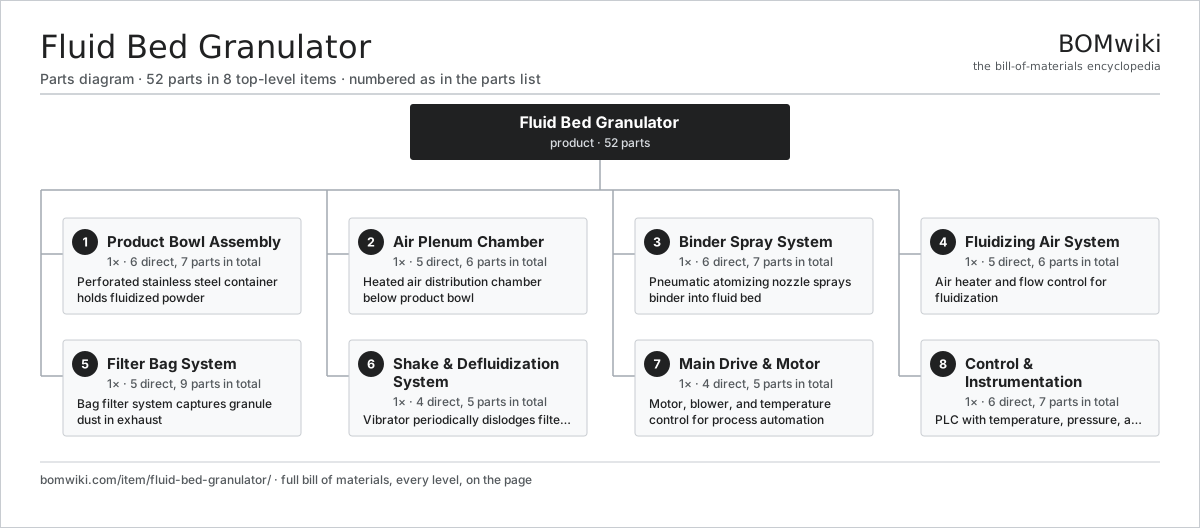
| # | Part | Qty | What it does |
|---|---|---|---|
| 1 | Product Bowl Assembly 6 parts | 1× | Perforated stainless steel container holds fluidized powder |
| 2 | Air Plenum Chamber 5 parts | 1× | Heated air distribution chamber below product bowl |
| 3 | Binder Spray System 6 parts | 1× | Pneumatic atomizing nozzle sprays binder into fluid bed |
| 4 | Fluidizing Air System 5 parts | 1× | Air heater and flow control for fluidization |
| 5 | Filter Bag System 5 parts | 1× | Bag filter system captures granule dust in exhaust |
| 6 | Shake & Defluidization System 4 parts | 1× | Vibrator periodically dislodges filter cakes and settles granules |
| 7 | Main Drive & Motor 4 parts | 1× | Motor, blower, and temperature control for process automation |
| 8 | Control & Instrumentation 6 parts | 1× | PLC with temperature, pressure, and spray rate feedback |
3D model
No 3D model yet. Have a CAD file of this? Add a 3D model. STL renders right on this page; STEP, FreeCAD, and OpenSCAD sources are welcome too (openly licensed, like all 3D models on BOMwiki).
Build & assembly graph
expand / collapse · shared sub-assemblies converge · links to related products · est. labourTap an assembly to expand/collapse · tap a part to open it · use “Open page” for any node · drag to pan, scroll to zoom.
Bill of materials for Fluid Bed Granulator
8 top-level lines · 49 rows shown · 52 parts total · indented to 3 levels| # | Item / sub-assembly | Part no. | Qty/assy | Ext. qty | Parts | Type |
|---|---|---|---|---|---|---|
| 1 | Product Bowl Assembly 6 parts | fluid-bed-product-bowl | 1× | 1 | 7 | assembly |
| 1.1 | Bowl Shell | fluid-bed-bowl-shell | 1× | 1 | · | part |
| 1.2 | Air Distributor Plate | fluid-bed-bowl-perforated-plate | 1× | 1 | · | part |
| 1.3 | Thermal Jacket | fluid-bed-bowl-jacket | 1× | 1 | · | part |
| 1.4 | Overflow Dam | fluid-bed-overflow-dam | 1× | 1 | · | part |
| 1.5 | Discharge Valve | fluid-bed-discharge-valve | 1× | 1 | · | part |
| 1.6 | Fastener Set | fastener-set | 2× | 2 | · | part |
| 2 | Air Plenum Chamber 5 parts | fluid-bed-air-plenum | 1× | 1 | 6 | assembly |
| 2.1 | Plenum Vessel | fluid-bed-plenum-shell | 1× | 1 | · | part |
| 2.2 | Plenum Heater | fluid-bed-plenum-heater | 1× | 1 | · | part |
| 2.3 | Thermal Insulation | fluid-bed-plenum-insulation | 1× | 1 | · | part |
| 2.4 | Plenum Pressure Gauge | fluid-bed-pressure-gauge | 1× | 1 | · | part |
| 2.5 | Fastener Set | fastener-set | 2× | 2 | · | part |
| 3 | Binder Spray System 6 parts | fluid-bed-spray-nozzle | 1× | 1 | 7 | assembly |
| 3.1 | Spray Nozzle | fluid-bed-spray-gun | 1× | 1 | · | part |
| 3.2 | Binder Supply Pump | fluid-bed-binder-pump | 1× | 1 | · | part |
| 3.3 | Binder Immersion Heater | fluid-bed-binder-heater | 1× | 1 | · | part |
| 3.4 | Spray Air Regulator | fluid-bed-spray-air-regulator | 1× | 1 | · | part |
| 3.5 | Circulation Return Line | fluid-bed-spray-circulation | 1× | 1 | · | part |
| 3.6 | Fastener Set | fastener-set | 2× | 2 | · | part |
| 4 | Fluidizing Air System 5 parts | fluid-bed-inlet-heating | 1× | 1 | 6 | assembly |
| 4.1 | Air Compressor Unit | fluid-bed-air-compressor | 1× | 1 | · | part |
| 4.2 | Inlet Air Heater | fluid-bed-inlet-heater-element | 1× | 1 | · | part |
| 4.3 | Flow Control Valve | fluid-bed-flow-control-valve | 1× | 1 | · | part |
| 4.4 | Inlet Humidity Sensor | fluid-bed-humidity-sensor | 1× | 1 | · | part |
| 4.5 | Fastener Set | fastener-set | 2× | 2 | · | part |
| 5 | Filter Bag System 5 parts | fluid-bed-filter-bags | 1× | 1 | 9 | assembly |
| 5.1 | Filter Vessel | fluid-bed-filter-housing | 1× | 1 | · | part |
| 5.2 | Filter Cartridges | fluid-bed-filter-cartridges | 4× | 4 | · | part |
| 5.3 | Filter Vibrator Motor | fluid-bed-filter-shake-motor | 1× | 1 | · | part |
| 5.4 | Filter Differential Pressure Gauge | fluid-bed-filter-pressure-gauge | 1× | 1 | · | part |
| 5.5 | Fastener Set | fastener-set | 2× | 2 | · | part |
| 6 | Shake & Defluidization System 4 parts | fluid-bed-shake-mechanism | 1× | 1 | 5 | assembly |
| 6.1 | Shake Motor | fluid-bed-shake-motor-unit | 1× | 1 | · | part |
| 6.2 | Vibration Damper | fluid-bed-shake-damper | 1× | 1 | · | part |
| 6.3 | Optional Cooling Jacket | fluid-bed-cooling-jacket | 1× | 1 | · | part |
| 6.4 | Fastener Set | fastener-set | 2× | 2 | · | part |
| 7 | Main Drive & Motor 4 parts | fluid-bed-drive-system | 1× | 1 | 5 | assembly |
| 7.1 | Blower Motor | blower-motor | 1× | 1 | · | part |
| 7.2 | Motor Soft-Starter or VFD | fluid-bed-main-motor-contactor | 1× | 1 | · | part |
| 7.3 | Motor Brake (Optional) | fluid-bed-main-motor-brake | 1× | 1 | · | part |
| 7.4 | Fastener Set | fastener-set | 2× | 2 | · | part |
| 8 | Control & Instrumentation 6 parts | fluid-bed-electrical-control | 1× | 1 | 7 | assembly |
| 8.1 | Process Control PLC | fluid-bed-process-plc | 1× | 1 | · | part |
| 8.2 | Temperature Sensors | fluid-bed-temperature-probe | 1× | 1 | · | part |
| 8.3 | Pressure Transducers | fluid-bed-pressure-transducer | 1× | 1 | · | part |
| 8.4 | Spray Rate Flow Meter | fluid-bed-spray-rate-meter | 1× | 1 | · | part |
| 8.5 | Optional Batch Weight Scale | fluid-bed-weight-scale | 1× | 1 | · | part |
| 8.6 | Fastener Set | fastener-set | 2× | 2 | · | part |
Something wrong in this list? Report a problem with this BOM.
Related products
same domain, ranked by shared parts Belt Filter Press
57 parts · shares 1 with this page
Binder Jetting Printer
112 parts · shares 1 with this page
Belt Filter Press
57 parts · shares 1 with this page
Binder Jetting Printer
112 parts · shares 1 with this page
 Brush Making Machine
50 parts · shares 1 with this page
Cable Armoring Machine
37 parts · shares 1 with this page
Brush Making Machine
50 parts · shares 1 with this page
Cable Armoring Machine
37 parts · shares 1 with this page
 Cable Coiling Machine
36 parts · shares 1 with this page
Cable Coiling Machine
36 parts · shares 1 with this page
Sourcing: possible vendors
Browse the supplier directory → Prices, MOQ, and lead times are algorithmic estimates, not quotes, and not claims about these companies. Company mappings are curated by keyword; est. price band $5k–$2M. How estimates work| Vendor | HQ | Specialty | MOQ | Lead time |
|---|---|---|---|---|
| atlascopco.com ↗ | Stockholm, SE | Compressors & industrial | 10 units | 12–20 wks |
|
🇦🇹Andritz
andritz.com ↗
|
Graz, AT | Process plants & machinery | 10 units | 12–20 wks |
| buhlergroup.com ↗ | Uzwil, CH | Food & materials processing | 10 units | 12–20 wks |
| gea.com ↗ | Düsseldorf, DE | Process technology | 10 units | 12–20 wks |
| mhi.com ↗ | Tokyo, JP | Heavy machinery | 10 units | 12–20 wks |
1,693-word article