Fluid Coupling
ProductOverview
Fluid couplings are hydrodynamic power transmitters that smoothly connect a motor to a driven load using an oil circuit rather than rigid mechanical links. Unlike rigid couplings, they allow controlled slip, absorbing shock loads and protecting machinery during startup. The principle dates to the 1920s and remains fundamental in heavy process industries, cement mills, mine hoists, large pumps, and marine propulsion all rely on fluid couplings for reliable, fault-tolerant power transmission.
Inside the coupling, a motor-driven impeller wheel accelerates oil radially outward. This oil stream impacts a load-driven runner wheel, which decelerates and redirects the flow back to the impeller eye (center), completing the circuit. The continuous cycle transfers torque through fluid momentum, not mechanical contact, enabling smooth engagement regardless of speed difference.
How it works
The impeller rotates at input (motor) speed, typically 500–3600 RPM. Centrifugal force accelerates oil from the impeller center outward along the blade channels to the periphery of the shell. This high-velocity oil stream enters the runner blade channels, impacting the blades and transferring momentum.
As the runner decelerates the oil, it also accelerates rotationally, driving the output shaft. The circulating oil returns to the impeller eye through the central core, where the cycle repeats. At synchronous speed (impeller = runner RPM), slip is zero and torque is pure hydrodynamic reaction. Under transient startup (motor > runner speed), slip increases, allowing controlled load acceleration.
The slip (RPM differential) is proportional to load torque. Full slip condition (runner stalled, impeller free-wheeling) produces maximum slip losses, 10–20% of input power dissipates as heat. This is characteristic of fluid couplings and distinct from mechanical clutches; the coupling never fully locks, instead modulating slip to match load torque demand.
Damping and shock protection
A critical advantage is torsional damping. The incompressible oil column absorbs shock loads (belt whip, electrical fault transients) that would cause rigid couplings to transmit damaging spikes. Torsional oscillation amplitude is typically <2° at rated speed, protecting motor windings and driven-equipment gearboxes. Mining applications exploit this: large jaw crushers coupled via fluid coupling reduce motor and frame failure rates by 40–60% versus rigid shafting.
Thermal management
The slip loss energy converts to heat, raising oil temperature. Light-duty couplings (low slip) running in <50 °C ambient can rely on natural convection cooling through the steel shell surface. Continuous-duty or high-power couplings (>30 kW) require active cooling: water-cooled oil radiator or fan-driven air-cooled radiator connected to thermal control ports.
Typical operating window is 40–80 °C; above 80 °C, oil viscosity drops, reducing torque capacity. At 100 °C, coupling output torque may fall 15–20% and thermal runaway is risk. Modern designs include thermostatic bypass valves and automatic cooler engagement above 75 °C setpoint.
The oil circuit is self-circulating; no external pump is required. Initial fill volume is critical: 60–80% of shell capacity is standard. Overfilling reduces damping and increases slip loss; underfilling starves the runner, reducing torque transmission.
Load startup and ramp
Cold couplings (oil viscosity ~500 cSt at 0 °C) exhibit higher slip resistance, protecting equipment from shock torque spikes during motor start-up. As oil temperature rises to 40 °C (working viscosity ~100 cSt), slip resistance decreases and coupling accelerates smoothly. This self-modulating behavior is ideal for large conveyor belts, pump drives, and cement mill motors, allowing soft-start without expensive VFDs or reduced-voltage starters.
Oil condition and life
Standard fluid coupling oils are mineral ISO 46–68 (depending on design and climate). Synthetic PAO or PAG oils are used in food and pharmaceutical applications for cleanability and lower toxicity. Oil degradation from oxidation and particle contamination is the primary wear mechanism. Annual oil analysis (ASTM D4378) monitoring acid number (TAN) and particle count (ISO 4406) predicts coupling degradation 500–1000 operating hours in advance.
The seal system is critical to longevity. Dual lip seals at rotating shafts, static gaskets at shell flanges, and a breather element collectively prevent oil loss and water ingress. Water contamination causes viscosity sludge and corrosion; breather replacement every 6–12 months is standard maintenance in humid climates.
Failure modes and diagnosis
Coupling failure is rare if seals and breather are maintained. Common failure modes:
- Seal leakage: Oil weeping at shaft seals indicates wear or misalignment; lip seal replacement required.
- Thermal runaway: Uncontrolled temperature rise above 100 °C signals over-slip or cooler blockage; load or speed adjustment needed.
- Cavitation: In very high-speed designs (>5000 RPM), vapor pockets can form in the low-pressure region; aeration symptoms include noise and vibration.
- Bearing failure: Excessive runout or misalignment accelerates bearing wear; realignment or bearing cartridge replacement needed.
Modern couplings are remarkably robust, with bearing life >10 years and oil life >3000 operating hours under nominal duty.
Fluid Coupling parts and their functions
7 top-level parts · 46 parts in total · full bill of materials below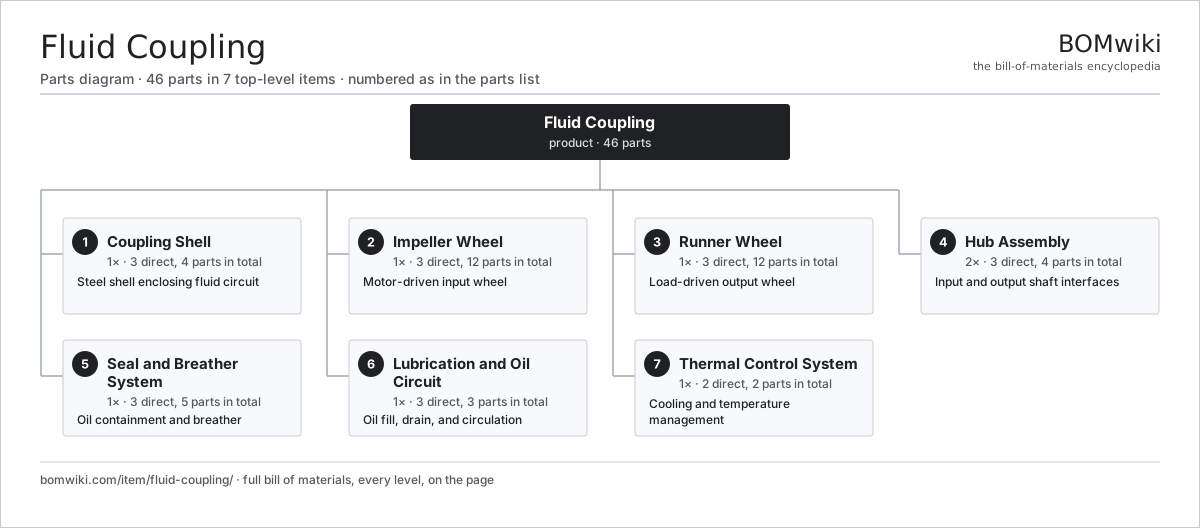
| # | Part | Qty | What it does |
|---|---|---|---|
| 1 | Coupling Shell 3 parts | 1× | Steel shell enclosing fluid circuit |
| 2 | Impeller Wheel 3 parts | 1× | Motor-driven input wheel |
| 3 | Runner Wheel 3 parts | 1× | Load-driven output wheel |
| 4 | Hub Assembly 3 parts | 2× | Input and output shaft interfaces |
| 5 | Seal and Breather System 3 parts | 1× | Oil containment and breather |
| 6 | Lubrication and Oil Circuit 3 parts | 1× | Oil fill, drain, and circulation |
| 7 | Thermal Control System 2 parts | 1× | Cooling and temperature management |
3D model
No 3D model yet. Have a CAD file of this? Add a 3D model. STL renders right on this page; STEP, FreeCAD, and OpenSCAD sources are welcome too (openly licensed, like all 3D models on BOMwiki).
Build & assembly graph
expand / collapse · shared sub-assemblies converge · links to related products · est. labourTap an assembly to expand/collapse · tap a part to open it · use “Open page” for any node · drag to pan, scroll to zoom.
Bill of materials for Fluid Coupling
7 top-level lines · 27 rows shown · 46 parts total · indented to 3 levels| # | Item / sub-assembly | Part no. | Qty/assy | Ext. qty | Parts | Type |
|---|---|---|---|---|---|---|
| 1 | Coupling Shell 3 parts | fluid-coupling-shell | 1× | 1 | 4 | assembly |
| 1.1 | Shell Section | fluid-coupling-shell-halves | 2× | 2 | · | part |
| 1.2 | Center Flange Ring | fluid-coupling-flange-ring | 1× | 1 | · | part |
| 1.3 | Fastener Set | fastener-set | 1× | 1 | · | part |
| 2 | Impeller Wheel 3 parts | fluid-coupling-impeller-wheel | 1× | 1 | 12 | assembly |
| 2.1 | Impeller Blade | fluid-coupling-impeller-blade | 10× | 10 | · | part |
| 2.2 | Impeller Hub | fluid-coupling-impeller-hub | 1× | 1 | · | part |
| 2.3 | Shaft Key | fluid-coupling-shaft-key | 1× | 1 | · | part |
| 3 | Runner Wheel 3 parts | fluid-coupling-runner-wheel | 1× | 1 | 12 | assembly |
| 3.1 | Runner Blade | fluid-coupling-runner-blade | 10× | 10 | · | part |
| 3.2 | Runner Hub | fluid-coupling-runner-hub | 1× | 1 | · | part |
| 3.3 | Runner Spacer Ring | fluid-coupling-runner-spacer | 1× | 1 | · | part |
| 4 | Hub Assembly 3 parts | fluid-coupling-hub-assembly | 2× | 2 | 4 | assembly |
| 4.1 | Hub Shaft | fluid-coupling-hub-shaft | 1× | 2 | · | part |
| 4.2 | Coupling Flange | fluid-coupling-coupling-flange | 1× | 2 | · | part |
| 4.3 | Ball Bearing | ball-bearing | 2× | 4 | · | part |
| 5 | Seal and Breather System 3 parts | fluid-coupling-seal-system | 1× | 1 | 5 | assembly |
| 5.1 | Oil Seal | oil-seal | 2× | 2 | · | part |
| 5.2 | Shell Gasket | fluid-coupling-gasket | 2× | 2 | · | part |
| 5.3 | Breather Element | fluid-coupling-breather | 1× | 1 | · | part |
| 6 | Lubrication and Oil Circuit 3 parts | fluid-coupling-lubrication | 1× | 1 | 3 | assembly |
| 6.1 | Fill and Breather Plug | fluid-coupling-fill-plug | 1× | 1 | · | part |
| 6.2 | Drain Plug | fluid-coupling-drain-plug | 1× | 1 | · | part |
| 6.3 | Bleed Valve | fluid-coupling-bleed-valve | 1× | 1 | · | part |
| 7 | Thermal Control System 2 parts | fluid-coupling-thermal-control | 1× | 1 | 2 | assembly |
| 7.1 | Cooler Mounting Boss | fluid-coupling-oil-cooler-boss | 1× | 1 | · | part |
| 7.2 | Thermal Sensor Port | fluid-coupling-temperature-sensor | 1× | 1 | · | part |
Something wrong in this list? Report a problem with this BOM.
Related products
same domain, ranked by shared parts Blow Molding Machine
83 parts · shares 2 with this page
Blown Film Extrusion Line
436 parts · shares 2 with this page
Blow Molding Machine
83 parts · shares 2 with this page
Blown Film Extrusion Line
436 parts · shares 2 with this page
Sourcing: possible vendors
Browse the supplier directory → Prices, MOQ, and lead times are algorithmic estimates, not quotes, and not claims about these companies. Company mappings are curated by keyword; est. price band $5k–$2M. How estimates work| Vendor | HQ | Specialty | MOQ | Lead time |
|---|---|---|---|---|
| atlascopco.com ↗ | Stockholm, SE | Compressors & industrial | 10 units | 12–20 wks |
|
🇦🇹Andritz
andritz.com ↗
|
Graz, AT | Process plants & machinery | 10 units | 12–20 wks |
| buhlergroup.com ↗ | Uzwil, CH | Food & materials processing | 10 units | 12–20 wks |
| gea.com ↗ | Düsseldorf, DE | Process technology | 10 units | 12–20 wks |
| mhi.com ↗ | Tokyo, JP | Heavy machinery | 10 units | 12–20 wks |
835-word article