Concert Flute
ProductOverview
The modern concert flute is Theobald Boehm's 1847 design: a cylindrical metal tube with large tone holes placed where acoustics dictates, valved by an interlinked key mechanism that lets nine fingers manage sixteen holes. Earlier flutes put small holes where fingers could reach them and accepted the intonation cost; Boehm reversed the priority and built a mechanism to span the correct hole spacing.
The instrument disassembles into three joints, the Headjoint, the Body, and the Footjoint, connected by sliding Tenon Joint joints, plus the Key Mechanism and Pads and Springs that ride on the body. Assembled it is about 67 cm long and 440 g.
Tone generation
The flute is an air-jet (edge-tone) instrument: nothing vibrates but air. The player directs a flat jet across the embouchure hole in the Lip Plate so it strikes the far edge of the Riser. The jet is unstable; pressure oscillations in the tube flip it alternately into and out of the bore, and the tube resonance synchronizes this flipping into a sustained tone. Jet speed and the covered fraction of the hole are the player's controls: faster air and a smaller aperture favor the upper registers, which is why the flute has no octave key, the second register is produced entirely by the embouchure.
The Head Tube is not cylindrical. It contracts from 19 mm at the body joint to about 17 mm near the Head Cork, a taper Boehm introduced to bring the octaves into agreement across the range. The cork position is critical at 17.3 mm from the embouchure center, most Cleaning Rods carry a gauge mark for checking it, because a few millimetres of drift skews the upper register noticeably. The Crown caps the cork stem.
Bore and keywork
The Body Tube is drawn tubing with a wall of roughly 0.4 mm, in silver-plated nickel silver on student instruments and sterling silver (or gold) on professional ones. Sixteen Tone Holes interrupt the bore: on most production flutes the holes are drawn, pulled up from the tube wall and rolled over into a smooth rim, while handmade instruments often solder on separate rings, which allows a sharper seat edge but adds joints.
The Key Mechanism is the heart of the Boehm system. Keys are soldered to Hinge Tubes rotating on hardened Key Steels between Posts, which stand on Ribs so the thin tube wall never takes a point load. Long axles couple keys: fingers resting on one Key Cup can close others elsewhere on the tube, giving every note a fully vented hole lattice. French-model flutes use open-centered cups under five fingers, demanding precise finger placement but allowing quarter-tone and glissando effects. Adjustment Screws regulate the couplings; Trill Keys open dedicated upper vents; the two Thumb Keys implement the Briccialdi B-flat lever. The Footjoint hangs the lowest notes on the right little finger through stacked Foot Keys with Foot Rollers easing the C–C♯ slide; a B footjoint adds a semitone and about 5 cm.
Pads, springs, regulation
Each hole seals with a Pad: wool felt on a card back, faced with two layers of fish skin (goldbeater's membrane). Flute pads are the most demanding in the woodwind family because the tone-hole rims are narrow and the sealing forces light, a pad must meet its seat evenly to within about 10 µm, achieved with paper Pad Shims of 0.01–0.1 mm behind the pad and a Pad Washer holding it in the cup. Needle Springs return the keys with a few tens of grams; gold-plated springs resist the corrosion that breath humidity causes. The Key Felt Set set fixes open key heights near 3 mm, lower chokes the tone, higher spoils intonation and feel.
A flute in regular use needs its mechanism regulated roughly yearly and a full repad every five to ten years. Between sessions it is swabbed dry with the Cleaning Rod, wiped with the Polishing Cloth, and stored in the blocked Case Shell, since fish-skin pads that stay wet distort and leak.
Concert Flute parts and their functions
6 top-level parts · 185 parts in total · full bill of materials below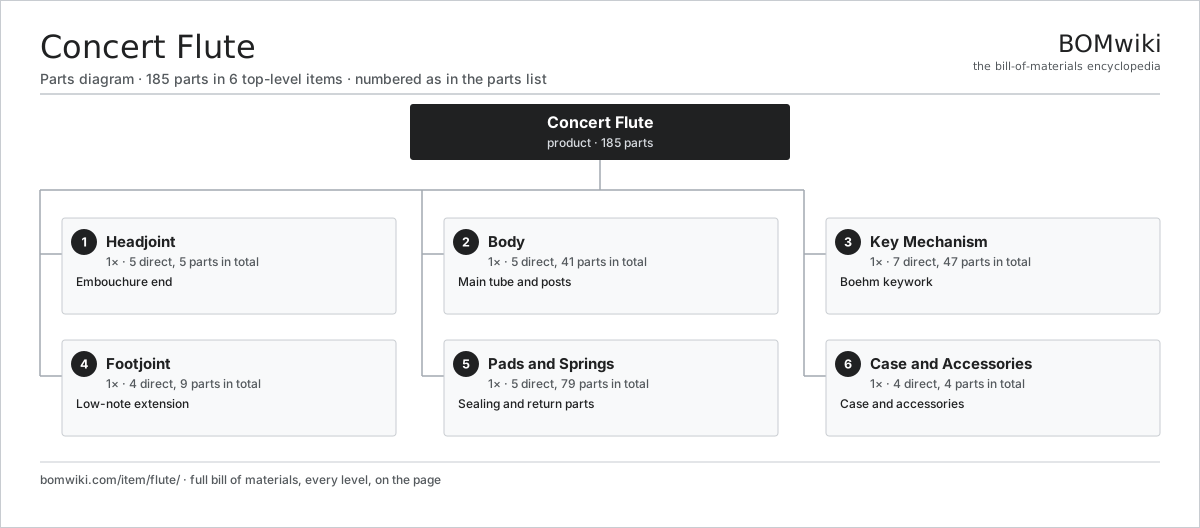
| # | Part | Qty | What it does |
|---|---|---|---|
| 1 | Headjoint 5 parts | 1× | Embouchure end |
| 2 | Body 5 parts | 1× | Main tube and posts |
| 3 | Key Mechanism 7 parts | 1× | Boehm keywork |
| 4 | Footjoint 4 parts | 1× | Low-note extension |
| 5 | Pads and Springs 5 parts | 1× | Sealing and return parts |
| 6 | Case and Accessories 4 parts | 1× | Case and accessories |
3D model
No 3D model yet. Have a CAD file of this? Add a 3D model. STL renders right on this page; STEP, FreeCAD, and OpenSCAD sources are welcome too (openly licensed, like all 3D models on BOMwiki).
Build & assembly graph
expand / collapse · shared sub-assemblies converge · links to related products · est. labourTap an assembly to expand/collapse · tap a part to open it · use “Open page” for any node · drag to pan, scroll to zoom.
Bill of materials for Concert Flute
6 top-level lines · 36 rows shown · 185 parts total · indented to 3 levels| # | Item / sub-assembly | Part no. | Qty/assy | Ext. qty | Parts | Type |
|---|---|---|---|---|---|---|
| 1 | Headjoint 5 parts | flute-headjoint | 1× | 1 | 5 | assembly |
| 1.1 | Head Tube | flute-head-tube | 1× | 1 | · | part |
| 1.2 | Lip Plate | flute-lip-plate | 1× | 1 | · | part |
| 1.3 | Riser | flute-riser | 1× | 1 | · | part |
| 1.4 | Head Cork | flute-head-cork | 1× | 1 | · | part |
| 1.5 | Crown | flute-crown | 1× | 1 | · | part |
| 2 | Body 5 parts | flute-body | 1× | 1 | 41 | assembly |
| 2.1 | Body Tube | flute-body-tube | 1× | 1 | · | part |
| 2.2 | Tone Hole | flute-tone-hole | 13× | 13 | · | part |
| 2.3 | Rib | flute-rib | 3× | 3 | · | part |
| 2.4 | Post | flute-post | 22× | 22 | · | part |
| 2.5 | Tenon Joint | flute-tenon | 2× | 2 | · | part |
| 3 | Key Mechanism 7 parts | flute-key-mechanism | 1× | 1 | 47 | assembly |
| 3.1 | Key Cup | flute-key-cup | 13× | 13 | · | part |
| 3.2 | Key Steel | flute-key-steel | 6× | 6 | · | part |
| 3.3 | Hinge Tube | flute-hinge-tube | 8× | 8 | · | part |
| 3.4 | Pivot Screw | flute-pivot-screw | 10× | 10 | · | part |
| 3.5 | Trill Key | flute-trill-key | 2× | 2 | · | part |
| 3.6 | Thumb Key | flute-thumb-key | 2× | 2 | · | part |
| 3.7 | Adjustment Screw | flute-adjustment-screw | 6× | 6 | · | part |
| 4 | Footjoint 4 parts | flute-footjoint | 1× | 1 | 9 | assembly |
| 4.1 | Foot Tube | flute-foot-tube | 1× | 1 | · | part |
| 4.2 | Foot Key | flute-foot-key | 3× | 3 | · | part |
| 4.3 | Foot Roller | flute-foot-roller | 2× | 2 | · | part |
| 4.4 | Tone Hole | flute-tone-hole | 3× | 3 | · | part |
| 5 | Pads and Springs 5 parts | flute-pads-springs | 1× | 1 | 79 | assembly |
| 5.1 | Pad | flute-pad | 16× | 16 | · | part |
| 5.2 | Pad Shim | flute-pad-shim | 32× | 32 | · | part |
| 5.3 | Pad Washer | flute-pad-washer | 16× | 16 | · | part |
| 5.4 | Needle Spring | flute-needle-spring | 14× | 14 | · | part |
| 5.5 | Key Felt Set | flute-key-felt | 1× | 1 | · | part |
| 6 | Case and Accessories 4 parts | flute-case-kit | 1× | 1 | 4 | assembly |
| 6.1 | Case Shell | flute-case-shell | 1× | 1 | · | part |
| 6.2 | Case Lining | flute-case-lining | 1× | 1 | · | part |
| 6.3 | Cleaning Rod | flute-cleaning-rod | 1× | 1 | · | part |
| 6.4 | Polishing Cloth | flute-polishing-cloth | 1× | 1 | · | part |
Something wrong in this list? Report a problem with this BOM.
Sourcing: possible vendors
Browse the supplier directory → Prices, MOQ, and lead times are algorithmic estimates, not quotes, and not claims about these companies. Company mappings are curated by keyword; est. price band $50–$5k. How estimates work| Vendor | HQ | Specialty | MOQ | Lead time |
|---|---|---|---|---|
| yamaha.com ↗ | Hamamatsu, JP | Audio & instruments | 200 units | 8–14 wks |
|
🇺🇸Fender
fender.com ↗
|
Los Angeles, US | Guitars & amps | 200 units | 8–14 wks |
|
🇺🇸Gibson
gibson.com ↗
|
Nashville, US | Guitars | 200 units | 8–14 wks |
|
🇯🇵Roland
roland.com ↗
|
Hamamatsu, JP | Electronic instruments | 200 units | 8–14 wks |
| steinway.com ↗ | New York, US | Pianos | 200 units | 8–14 wks |
726-word article