Foot Pressure Scanner
ProductOverview
A foot pressure scanner (also called a force plate array or pressure-sensitive mat) is a diagnostic instrument that measures the distribution of pressure beneath a subject's foot during standing and walking. The device comprises a large sensor array (typically 64×64 or 96×64 cells) embedded in a rigid frame, with each sensor cell responding to local pressure changes. Real-time software displays the pressure distribution as a color-coded heatmap and computes gait metrics such as peak pressure, center-of-pressure (COP) trajectory, stance time, and pressure asymmetry. These measurements are valuable for multiple clinical applications: diabetic foot ulcer risk assessment, orthopedic gait analysis, prosthetic and orthotic fitting optimization, and rehabilitation monitoring.
The Foot Pressure Scanner differs from a traditional force plate, which measures only total ground reaction force and its point of application. A pressure scanner reveals the spatial distribution of force, which regions of the foot bear the most load and in what sequence. This granular information is essential for identifying localized high-pressure hotspots that may precede ulcer formation in neuropathic diabetic feet, or for detecting asymmetry caused by stroke, amputation, or other unilateral conditions.
Sensor Technology and Capacitive Measurement
The Pressure Sensor Matrix uses capacitive pressure transducers, typically organized in a 64×64 grid with 8–10 mm spacing, covering a 400×400 mm measurement area. Each sensor cell consists of:
- Top Electrode Conductive Layer: A top conductive electrode made from patterned conductive polymer or metal-coated elastomer, forming row conductors.
- Flexible Substrate Material: A flexible polyimide or polyester film (100–200 μm thick) supporting internal wiring.
- Bottom Reference Electrode: A bottom conductive reference electrode forming column conductors.
- Pressure Sensor Cell Array: When the user's foot presses down, the distance between top and bottom electrodes decreases, increasing the capacitance of the cell. The cell capacitance ranges from ~1 pF (no load) to ~10 pF (500 kPa load), a ten-fold change over the measurement range.
This capacitive approach offers several advantages:
- No moving parts: The sensor is purely passive and resistant to fatigue.
- Large dynamic range: 0–500 kPa is more than sufficient for gait analysis; peak plantar pressure during normal walking is 200–400 kPa, and only jumping or running exceeds 500 kPa.
- Low cost to manufacture: Capacitive sensors can be mass-produced as thin, flexible films, enabling high-resolution arrays.
- Hysteresis-free: Capacitive measurement is linear and stable, avoiding mechanical drift common in resistive sensors.
Signal Conditioning and Digitization
The Signal Acquisition and Conditioning converts the tiny capacitance changes (picofarads) into voltage and then digital values. The signal chain operates as follows:
Multiplexing: The Analog Multiplexer (a 64:1 or 128:1 analog multiplexer) sequentially connects each sensor cell to the conditioning circuit. For a 64×64 array, all 4096 cells are scanned repeatedly at 100+ Hz, meaning each cell is sampled roughly 25 times per second.
Capacitance-to-voltage conversion: The Capacitance-to-Voltage Converter (a transimpedance amplifier) converts the 0–10 pF capacitance change to a 0–10 V output signal. This conversion is non-trivial: a dedicated capacitance-to-digital converter (CDC) chip like the FDC1004 or TDK CP2200 uses charge-balancing to linearize the response.
Analog-to-digital conversion: The Analog-to-Digital Converter (a 16-bit SAR ADC like the ADS1256) digitizes the 0–10 V signal at >100 kHz, producing 16-bit digital words representing 0–65536 digital units.
FPGA sequencing: The FPGA Control Logic controls the multiplexer scanning sequence, handles range switching (autoranging between 0–10 pF and 0–100 pF if fine resolution is needed), and packages digitized values into USB packets.
Power supply: The Power Supply Module provides isolated 5 V and ±15 V rails from USB power, with isolation preventing ground loops that would introduce 60 Hz mains noise.
Real-Time Data Acquisition and Visualization
The scanner samples the entire 64×64 sensor array every 10 milliseconds (100 Hz refresh), producing approximately 40 MB/sec raw data throughput (4096 cells × 2 bytes/cell × 100 Hz). This data streams over USB 3.0 to a host PC, where the USB Data Acquisition Engine buffers the incoming data and makes it available to analysis and visualization threads.
The Real-Time Visualization renders a real-time heatmap, updating at 100 Hz on-screen. Each pixel of the heatmap represents one sensor cell; pixel color encodes pressure in the 0–500 kPa range (typically blue = 0 kPa, green = 150 kPa, red = 300+ kPa). During a footstep, users observe the pressure distribution evolving: initial contact appears as a red spot at the heel, then progresses (as weight transfers) across the lateral foot toward the metatarsal heads, and finally exits at the hallux (great toe) during toe-off. This visual feedback allows clinicians to immediately spot asymmetries or abnormal loading patterns.
Gait Metrics and Clinical Interpretation
The Gait Metric Extraction extract several key metrics:
Peak pressure: The maximum pressure anywhere on the foot during a single stance phase, typically 200–400 kPa in normal walking. Diabetic neuropathy patients often show localized peaks >500 kPa (e.g., under the metatarsal head in Charcot arthropathy), a risk factor for ulcer formation.
Center of pressure (COP) trajectory: The weighted centroid of pressure across all cells, computed at each sample time. As the user walks, COP traces a path from heel → lateral mid-foot → metatarsal heads → great toe, roughly following the natural progression of weight. Abnormalities (e.g., inversion stress, lateral foot dominance) appear as deviations in this trajectory.
Pressure distribution asymmetry: Comparing left and right feet (or comparing current assessment to previous baseline), asymmetry indices quantify gait imbalance. An amputee or stroke patient often shows >20% asymmetry; normal individuals show <10%.
Contact time and cadence: By detecting when any sensor cell crosses a pressure threshold (typically 50 kPa), the scanner identifies stance phase onset and offset, computing single-limb support time and step cadence.
Loading rate: The rate at which pressure increases at initial contact (dP/dt). High loading rates (>2 N/kg/msec) are associated with impact injury risk in runners; low loading rates suggest cautious or asymmetric gait.
Pressure-time integral (PTI): The cumulative pressure across time and space, quantifying total force-time exposure. This metric is sensitive to gait modifications like toe-walking or lateral weight shifting.
Clinical Applications
Diabetic foot ulcer prevention: Neuropathic diabetics cannot feel foot pressure and are at risk of chronic ulceration. Pressure scanning identifies hotspots (peak pressure >250 kPa persistently) where ulcers are likely to develop. Therapeutic interventions (orthotic unloading, gait training, activity modification) are then monitored via repeated pressure scans to verify that peak pressures have normalized.
Prosthetic and orthotic optimization: When fitting a new prosthetic foot or AFO, pressure scans confirm that load is distributed evenly and that no localized high-pressure areas create socket discomfort. Adjustments (padding, shoe modification, orthosis tuning) are validated objectively before the patient leaves the clinic.
Gait retraining after stroke or injury: A patient learning to walk after stroke or ACL repair often exhibits asymmetric loading. Real-time pressure feedback during walking (displayed on a screen in the clinic) cues the patient to equalize weight distribution, accelerating motor learning.
Pediatric orthopedic assessment: Children with cerebral palsy, flat feet, or toe-walking habits can be assessed objectively. Serial scans document whether interventions (Botox injection, AFO wear, gait training) normalize pressure distribution.
Calibration and Accuracy
The Calibration Reference Block is essential for accuracy. Before clinical use, the scanner must be calibrated using a known Calibration Weight (typically 10–20 kg) applied uniformly via a Pressure Application Jig. This establishes the sensor-to-pressure mapping and verifies linearity. Typical accuracy is ±5% of full-scale pressure and ±5 mm center-of-pressure localization.
Temperature drift is a concern: the sensor capacitance and electronics shift slightly with temperature (±2% per 10 °C). Clinical systems include temperature compensation, either via thermistor feedback or regular recalibration.
Data Export and Clinical Reporting
The Clinical Report Generator exports results to PDF and CSV formats, allowing integration with patient records. Typical clinical reports include:
- Bilateral pressure heatmaps and summary statistics (peak pressure, contact time, COP path).
- Asymmetry indices and comparison to age/weight-matched normative database.
- Trend analysis if multiple scans are available (e.g., "peak pressure decreased from 450 kPa to 280 kPa over 6 months of conservative treatment").
- Recommendations (e.g., "High pressure under metatarsal head 1 (320 kPa) suggests Morton's neuroma risk; consider metatarsal offloading pad").
Some advanced systems integrate video gait analysis: synchronized video and pressure data allow clinicians to correlate observable gait deviations (e.g., hip Trendelenburg sign) with pressure abnormalities.
Limitations and Future Directions
Current limitations:
- Limited anatomical detail: A 64×64 grid at 8 mm spacing misses pressure gradients at scales smaller than 8 mm. The pressure peak under a metatarsal head may be missed if it falls between grid points.
- Measurement footprint: The 400×400 mm mat covers typical adult feet but is undersized for larger feet or oversized for children. Older patients with wider feet may not fit entirely on the mat.
- Temperature stability: Outdoor or non-climate-controlled environments can affect calibration.
- Cost: High-end pressure scanning systems cost $50–100k, limiting availability to specialty clinics and research institutions.
Future directions include:
- Wearable insole pressure sensors: Wireless insole-based sensors enable long-term monitoring outside the clinic, capturing naturalistic gait patterns.
- Higher resolution: Thinner sensors and higher density arrays (128×128) could reveal finer pressure details.
- Integration with motion capture: Synchronized pressure and 3D kinematic data enable inverse dynamics modeling, relating joint forces to pressure patterns.
Foot Pressure Scanner parts and their functions
5 top-level parts · 18 parts in total · full bill of materials below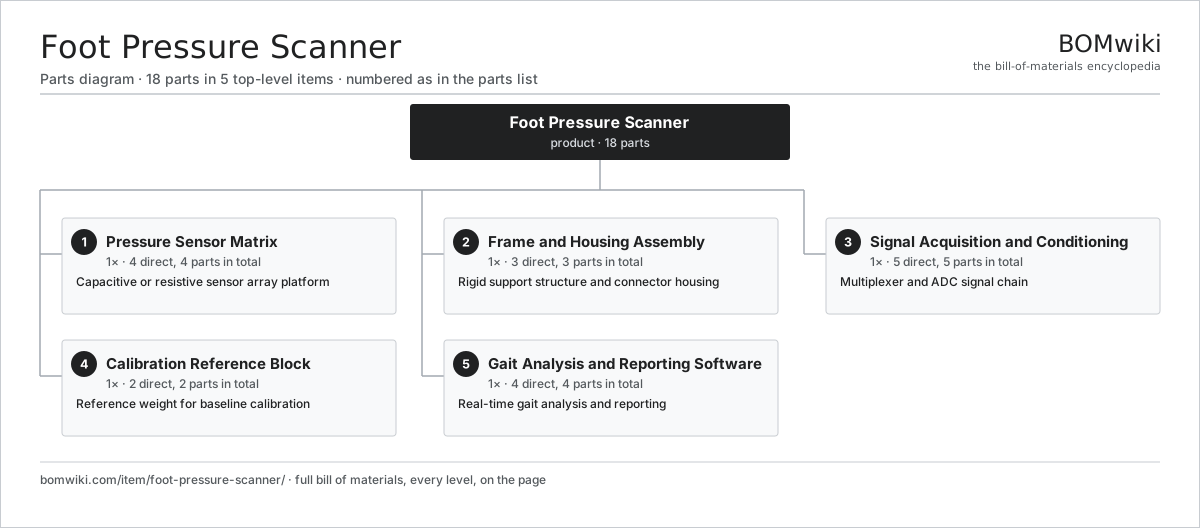
| # | Part | Qty | What it does |
|---|---|---|---|
| 1 | Pressure Sensor Matrix 4 parts | 1× | Capacitive or resistive sensor array platform |
| 2 | Frame and Housing Assembly 3 parts | 1× | Rigid support structure and connector housing |
| 3 | Signal Acquisition and Conditioning 5 parts | 1× | Multiplexer and ADC signal chain |
| 4 | Calibration Reference Block 2 parts | 1× | Reference weight for baseline calibration |
| 5 | Gait Analysis and Reporting Software 4 parts | 1× | Real-time gait analysis and reporting |
3D model
No 3D model yet. Have a CAD file of this? Add a 3D model. STL renders right on this page; STEP, FreeCAD, and OpenSCAD sources are welcome too (openly licensed, like all 3D models on BOMwiki).
Build & assembly graph
expand / collapse · shared sub-assemblies converge · links to related products · est. labourTap an assembly to expand/collapse · tap a part to open it · use “Open page” for any node · drag to pan, scroll to zoom.
Bill of materials for Foot Pressure Scanner
5 top-level lines · 23 rows shown · 18 parts total · indented to 3 levels| # | Item / sub-assembly | Part no. | Qty/assy | Ext. qty | Parts | Type |
|---|---|---|---|---|---|---|
| 1 | Pressure Sensor Matrix 4 parts | foot-pressure-scanner-sensor-mat | 1× | 1 | 4 | assembly |
| 1.1 | Pressure Sensor Cell Array | foot-pressure-scanner-sensor-cells | 1× | 1 | · | part |
| 1.2 | Top Electrode Conductive Layer | foot-pressure-scanner-top-electrode-grid | 1× | 1 | · | part |
| 1.3 | Flexible Substrate Material | foot-pressure-scanner-substrate | 1× | 1 | · | part |
| 1.4 | Bottom Reference Electrode | foot-pressure-scanner-bottom-reference | 1× | 1 | · | part |
| 2 | Frame and Housing Assembly 3 parts | foot-pressure-scanner-frame-base | 1× | 1 | 3 | assembly |
| 2.1 | Aluminum Support Frame | foot-pressure-scanner-aluminum-frame | 1× | 1 | · | part |
| 2.2 | Interface Connector Block | foot-pressure-scanner-connector-block | 1× | 1 | · | part |
| 2.3 | Protective Acrylic Dome | foot-pressure-scanner-protective-cover | 1× | 1 | · | part |
| 3 | Signal Acquisition and Conditioning 5 parts | foot-pressure-scanner-acquisition-electronics | 1× | 1 | 5 | assembly |
| 3.1 | Analog Multiplexer | foot-pressure-scanner-mux-ic | 1× | 1 | · | part |
| 3.2 | Capacitance-to-Voltage Converter | foot-pressure-scanner-capacitance-converter | 1× | 1 | · | part |
| 3.3 | Analog-to-Digital Converter | foot-pressure-scanner-adc-module | 1× | 1 | · | part |
| 3.4 | FPGA Control Logic | foot-pressure-scanner-fpga-fabric | 1× | 1 | · | part |
| 3.5 | Power Supply Module | foot-pressure-scanner-power-supply | 1× | 1 | · | part |
| 4 | Calibration Reference Block 2 parts | foot-pressure-scanner-calibration-block | 1× | 1 | 2 | assembly |
| 4.1 | Calibration Weight | foot-pressure-scanner-weight-block | 1× | 1 | · | part |
| 4.2 | Pressure Application Jig | foot-pressure-scanner-calibration-jig | 1× | 1 | · | part |
| 5 | Gait Analysis and Reporting Software 4 parts | foot-pressure-scanner-software-suite | 1× | 1 | 4 | assembly |
| 5.1 | USB Data Acquisition Engine | foot-pressure-scanner-capture-engine | 1× | 1 | · | part |
| 5.2 | Real-Time Visualization | foot-pressure-scanner-display-engine | 1× | 1 | · | part |
| 5.3 | Gait Metric Extraction | foot-pressure-scanner-analysis-algorithms | 1× | 1 | · | part |
| 5.4 | Clinical Report Generator | foot-pressure-scanner-reporting-module | 1× | 1 | · | part |
Something wrong in this list? Report a problem with this BOM.
Sourcing: possible vendors
Browse the supplier directory → Prices, MOQ, and lead times are algorithmic estimates, not quotes, and not claims about these companies. Company mappings are curated by keyword; est. price band $500–$3M. How estimates work| Vendor | HQ | Specialty | MOQ | Lead time |
|---|---|---|---|---|
| gehealthcare.com ↗ | Chicago, US | Medical imaging & devices | 100 units | 12–20 wks |
| siemens-healthineers.com ↗ | Erlangen, DE | Medical systems | 100 units | 12–20 wks |
|
🇳🇱Philips
philips.com ↗
|
Amsterdam, NL | Health technology | 100 units | 12–20 wks |
| medtronic.com ↗ | Minneapolis, US | Medical devices | 100 units | 12–20 wks |
|
🇨🇳Mindray
mindray.com ↗
|
Shenzhen, CN | Medical devices | 100 units | 12–20 wks |
1,632-word article