Self-Loading Forage Wagon
ProductOverview
The self-loading forage wagon integrates pickup, chopping, and loading operations into a single tractor-towed implement, eliminating the need for separate equipment and labor. A tractor PTO (Power-Take-Off) shaft drives the pickup reel, knife drum, and loading auger; hydraulic power (supplied by a pump also driven from PTO) controls the auger discharge motor and supplementary functions. The machine is engineered for dairy and beef operations harvesting fresh forage (grass, legume, or mixed swards) for silage or high-moisture hay production.
Modern self-loading forage wagons achieve 30–50 tonnes per hour loading rates with particle lengths optimized for ruminant digestibility (25–50 mm for dairy, 40–60 mm for beef). Capacity ranges from 13–16 m³ (2500–3500 kg dry matter, or 7000–9000 kg fresh forage at 65% moisture typical of silage).
How it works
Ground Pickup: The Pickup Reel is a horizontal drum (600 mm diameter, 1200 mm wide) mounted ahead of the wagon with tine bars (25 mm diameter, 100 mm spacing) rotating at 180 rpm. As the tractor moves forward at 8–12 km/h, the rotating tines lift cut forage from the ground swath and push it up into the fixed pickup throat (300 mm opening height). The throat convergence and floor slope (directing forage toward the wagon center) concentrates the material flow.
Reel speed is critical: too slow and fine material is kicked back to the ground; too fast and the machine tears or leaves foliage behind. PTO-driven reduction gearbox (3:1 ratio) steps 540 rpm PTO down to 180 rpm, matching forward speed for typical grass swaths 80–120 mm tall.
Chopping Mechanism: Forage is chopped by a Chopping Knife System assembly as it enters the wagon. A rotating knife drum (400 mm diameter, 1500 rpm, driven by an electric motor from wagon-mounted electrical system or a dedicated PTO-driven cutter head) impacts forage against fixed counter-knives, shattering it into 25–50 mm segments. Eight cutting knives on the rotating drum engage the fixed counter-knives in rapid succession, producing 200–400 chop events per second. Chop length is adjustable by changing the number/position of counter-knife bars or through knife drum speed modulation (variable-frequency drive).
Loading Auger: Chopped forage drops into a Loading Auger, a vertical spiral conveyor (350 mm OD tube, 3.5 m tall, 250 rpm speed) powered by a 25 cc/rev hydraulic motor. As fresh-cut forage continuously enters the auger inlet (at the base of the vertical tube), the helical flight (200 mm pitch) accelerates the material upward, compacting it against the wagon bed walls and ceiling. The auger discharge is directed into the wagon top center; rotating auger discharge pattern (achieved via deflector vanes or by the natural trajectory of the high-velocity discharge) distributes forage evenly across wagon length, preventing bridging and achieving uniform density.
Wagon Bed Filling: Forage accumulates in the wagon bed (2000 mm × 2500 mm internal dimensions, 1500 mm tall steel walls) with a sloped floor (5° toward discharge) and a hinged top gate held closed by a latch. As the wagon fills, the loading auger discharge point deepens relative to the forage surface; operator must monitor fill level (typically every 30–60 seconds for a full wagon) and engage the top gate latch when approaching maximum capacity.
Unloading: The discharge system includes a hydraulic bottom gate (2000 mm × 600 mm) hinged at the rear axle and operated by a hydraulic cylinder. When the gate is opened, chopped forage slides down the sloped floor toward the discharge opening, assisted by a side-mounted discharge auger (300 mm diameter, 5.5 kW electric motor) that conveys material horizontally out of the wagon into a silage pile (floor silo) or into a stationary forage chopper for further processing.
Hydraulic Power: A 60 cc/rev gear pump (directly driven by PTO at 540 rpm through a shear-pin coupling) supplies pressurized fluid to the auger drive motor (25 cc/rev displacement, load-sensing compensated). The pump is sized to match the auger torque demand; excess flow is returned to the tank. Pressure relief valve (210 bar setting) protects the circuit from over-pressurization during gate engagement or auger jam. The same pump can also power an optional cab-mounted joystick for remote gate control.
Electrical System: Forage wagons typically rely on tractor PTO for main drive functions (pickup reel, knife drum) but include onboard electric motors for loading auger drive (if electric-motor-driven rather than hydraulic) and discharge auger. A battery box mounted on the wagon tongue provides 24 V DC via tractor hookup (SAE connector); motors are soft-started to limit inrush current and protect the charging system.
Chassis and Suspension: The wagon frame is welded low-carbon steel (80×80 mm tubing) with two tandem axles (100 mm OD tubes, roller bearing hubs). Agricultural radial tires (13.6/65) are standard for road and field use; bias-ply tires are typical on older equipment. Leaf spring suspension (8–10 plies per spring, rate 40 kN/m) with hydraulic dampers isolates wagon from field impacts and road roughness, critical for minimizing forage breakage and operator comfort during transport.
Forage Quality Preservation: Particle size uniformity is critical for ruminant digestion and silage fermentation (uniform particles pack more densely, reducing oxygen infiltration). Knife drum chopping produces particle size distribution centered at 25–50 mm (dairy silage specification per ASABE S424). Incomplete chopping results in long fiber that is rejected during feed-out; over-chopping to fine dust (fines <2 mm exceed 10%) reduces digestibility and creates sorting/dust problems.
Harvest Operations
Typical day: a 35–50 kW tractor pulls the forage wagon and makes 8–12 field passes, harvesting 8–12 tonnes fresh forage per hectare (yield varies by crop growth stage and sward quality; early bloom grass yields 8–10 t/ha, late bloom 10–14 t/ha). Each wagon loads in 30–45 minutes of harvesting; tractor returns to farm, discharges forage into a silo or chopper, and returns to field. Two wagons rotating (one filling, one unloading) accelerate throughput.
Maintenance: After 20 operating hours, inspect knife sharpness and replace dull knives (6–8 knives replaced per season typical). Check reel tine condition; bent or broken tines are brazed back or replaced. Drive belt tension on knife drum motor is adjusted weekly. Hydraulic oil change (60 cc/rev pump) is recommended annually or every 500 operating hours.
Silage Fermentation: Chopped forage loaded into a floor silo or bunker must be compacted to <50 mm oxygen layer; the uniform chop length and high bulk density from the loading auger facilitate rapid settling and oxygen exclusion, improving silage fermentation and reducing mold/heat damage during feed-out.
Self-Loading Forage Wagon parts and their functions
7 top-level parts · 99 parts in total · full bill of materials below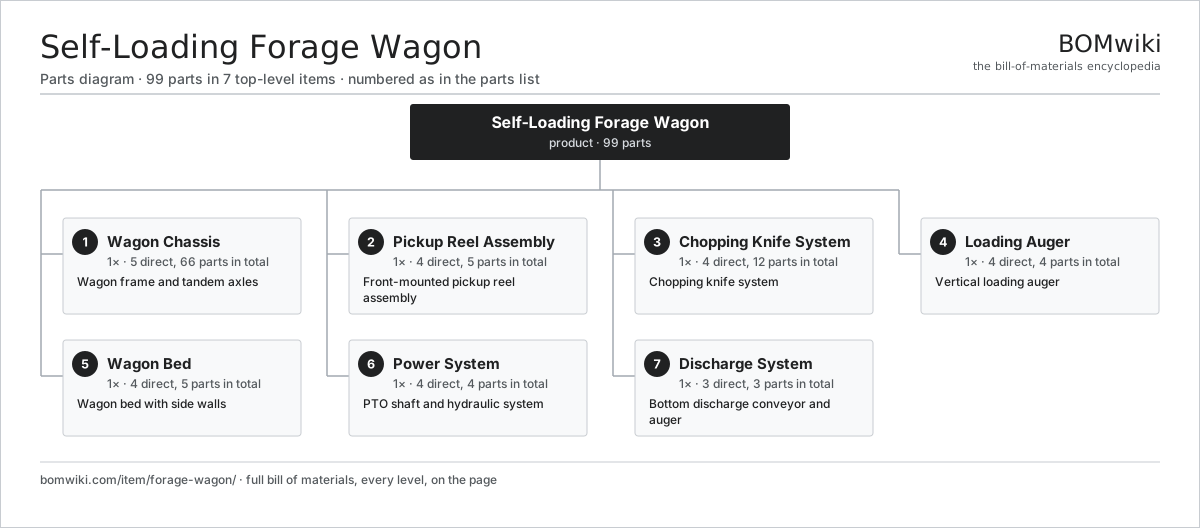
| # | Part | Qty | What it does |
|---|---|---|---|
| 1 | Wagon Chassis 5 parts | 1× | Wagon frame and tandem axles |
| 2 | Pickup Reel Assembly 4 parts | 1× | Front-mounted pickup reel assembly |
| 3 | Chopping Knife System 4 parts | 1× | Chopping knife system |
| 4 | Loading Auger 4 parts | 1× | Vertical loading auger |
| 5 | Wagon Bed 4 parts | 1× | Wagon bed with side walls |
| 6 | Power System 4 parts | 1× | PTO shaft and hydraulic system |
| 7 | Discharge System 3 parts | 1× | Bottom discharge conveyor and auger |
3D model
No 3D model yet. Have a CAD file of this? Add a 3D model. STL renders right on this page; STEP, FreeCAD, and OpenSCAD sources are welcome too (openly licensed, like all 3D models on BOMwiki).
Build & assembly graph
expand / collapse · shared sub-assemblies converge · links to related products · est. labourTap an assembly to expand/collapse · tap a part to open it · use “Open page” for any node · drag to pan, scroll to zoom.
Bill of materials for Self-Loading Forage Wagon
7 top-level lines · 49 rows shown · 99 parts total · indented to 3 levels| # | Item / sub-assembly | Part no. | Qty/assy | Ext. qty | Parts | Type |
|---|---|---|---|---|---|---|
| 1 | Wagon Chassis 5 parts | forage-wagon-chassis | 1× | 1 | 66 | assembly |
| 1.1 | Main Frame | forage-wagon-chassis-frame | 1× | 1 | · | part |
| 1.2 | Tandem Axle 2 parts | forage-wagon-chassis-axle | 2× | 2 | 10 | assembly |
| 1.2.1 | Axle Tube | forage-wagon-chassis-axle-tube | 2× | 4 | · | part |
| 1.2.2 | Axle Bearing | forage-wagon-chassis-axle-bearing | 8× | 16 | · | part |
| 1.3 | Wheel Assembly 5 parts | wheel-assembly | 4× | 4 | 9 | assembly |
| 1.3.1 | Alloy Wheel | alloy-wheel | 1× | 4 | · | part |
| 1.3.2 | Tire | tire | 1× | 4 | · | part |
| 1.3.3 | TPMS Sensor | tpms-sensor | 1× | 4 | · | part |
| 1.3.4 | Lug Nut | lug-nut | 5× | 20 | · | part |
| 1.3.5 | Valve Stem | valve-stem | 1× | 4 | · | part |
| 1.4 | Suspension System 2 parts | forage-wagon-chassis-suspension | 1× | 1 | 6 | assembly |
| 1.4.1 | Leaf Spring Pack | forage-wagon-chassis-suspension-leaf | 4× | 4 | · | part |
| 1.4.2 | Damper Unit | forage-wagon-chassis-suspension-damper | 2× | 2 | · | part |
| 1.5 | Drawbar Hitch 3 parts | forage-wagon-chassis-hitch | 1× | 1 | 3 | assembly |
| 1.5.1 | Drawbar Tube | forage-wagon-chassis-hitch-drawbar | 1× | 1 | · | part |
| 1.5.2 | Hitch Coupler | forage-wagon-chassis-hitch-coupler | 1× | 1 | · | part |
| 1.5.3 | Safety Chain | forage-wagon-chassis-hitch-safety | 1× | 1 | · | part |
| 2 | Pickup Reel Assembly 4 parts | forage-wagon-pickup | 1× | 1 | 5 | assembly |
| 2.1 | Pickup Reel | forage-wagon-pickup-reel | 1× | 1 | · | part |
| 2.2 | Reel Tine Bar | forage-wagon-pickup-reel-tines | 1× | 1 | · | part |
| 2.3 | Pickup Throat 2 parts | forage-wagon-pickup-throat | 1× | 1 | 2 | assembly |
| 2.3.1 | Throat Opening | forage-wagon-pickup-throat-opening | 1× | 1 | · | part |
| 2.3.2 | Pickup Floor | forage-wagon-pickup-throat-floor | 1× | 1 | · | part |
| 2.4 | Pickup Gearbox | forage-wagon-pickup-gear | 1× | 1 | · | part |
| 3 | Chopping Knife System 4 parts | forage-wagon-knives | 1× | 1 | 12 | assembly |
| 3.1 | Knife Drum | forage-wagon-knives-drum | 1× | 1 | · | part |
| 3.2 | Cutting Knife | forage-wagon-knives-knife | 8× | 8 | · | part |
| 3.3 | Counter-Knife | forage-wagon-knives-stationary | 2× | 2 | · | part |
| 3.4 | Knife Motor | forage-wagon-knives-motor | 1× | 1 | · | part |
| 4 | Loading Auger 4 parts | forage-wagon-auger | 1× | 1 | 4 | assembly |
| 4.1 | Auger Flighting | forage-wagon-auger-screw | 1× | 1 | · | part |
| 4.2 | Auger Tube | forage-wagon-auger-tube | 1× | 1 | · | part |
| 4.3 | Auger Motor | forage-wagon-auger-motor | 1× | 1 | · | part |
| 4.4 | Auger Gearbox | forage-wagon-auger-gearbox | 1× | 1 | · | part |
| 5 | Wagon Bed 4 parts | forage-wagon-bed | 1× | 1 | 5 | assembly |
| 5.1 | Wagon Floor | forage-wagon-bed-floor | 1× | 1 | · | part |
| 5.2 | Side Wall | forage-wagon-bed-sides | 2× | 2 | · | part |
| 5.3 | Front Bulkhead | forage-wagon-bed-front | 1× | 1 | · | part |
| 5.4 | Top Gate Latch | forage-wagon-bed-latch | 1× | 1 | · | part |
| 6 | Power System 4 parts | forage-wagon-drive | 1× | 1 | 4 | assembly |
| 6.1 | PTO Shaft | forage-wagon-drive-pto | 1× | 1 | · | part |
| 6.2 | Hydraulic Pump | forage-wagon-drive-pump | 1× | 1 | · | part |
| 6.3 | Auger Drive Motor | forage-wagon-drive-motor | 1× | 1 | · | part |
| 6.4 | Hydraulic Tank | forage-wagon-drive-tank | 1× | 1 | · | part |
| 7 | Discharge System 3 parts | forage-wagon-discharge | 1× | 1 | 3 | assembly |
| 7.1 | Discharge Gate | forage-wagon-discharge-gate | 1× | 1 | · | part |
| 7.2 | Discharge Auger | forage-wagon-discharge-auger | 1× | 1 | · | part |
| 7.3 | Discharge Motor | forage-wagon-discharge-motor | 1× | 1 | · | part |
Something wrong in this list? Report a problem with this BOM.
Related products
same domain, ranked by shared parts Agricultural Tractor
306 parts · shares 6 with this page
Agricultural Tractor
306 parts · shares 6 with this page
 Airblast Orchard Sprayer
58 parts · shares 6 with this page
Airblast Orchard Sprayer
58 parts · shares 6 with this page
 Boom Sprayer
356 parts · shares 6 with this page
Boom Sprayer
356 parts · shares 6 with this page
 Carrot Harvester
93 parts · shares 6 with this page
Carrot Harvester
93 parts · shares 6 with this page
 Combine Harvester
203 parts · shares 6 with this page
Combine Harvester
203 parts · shares 6 with this page
 Cotton Picker
2,623 parts · shares 6 with this page
Cotton Picker
2,623 parts · shares 6 with this page
Sourcing: possible vendors
Browse the supplier directory → Prices, MOQ, and lead times are algorithmic estimates, not quotes, and not claims about these companies. Company mappings are curated by keyword; est. price band $5k–$800k. How estimates work| Vendor | HQ | Specialty | MOQ | Lead time |
|---|---|---|---|---|
| deere.com ↗ | Moline, US | Agriculture & turf | made to order | 14–24 wks |
| cnh.com ↗ | Basildon, GB | Agriculture (Case IH, New Holland) | made to order | 14–24 wks |
|
🇺🇸AGCO
agcocorp.com ↗
|
Duluth, US | Agriculture (Fendt, Massey Ferguson) | made to order | 14–24 wks |
|
🇩🇪Claas
claas.com ↗
|
Harsewinkel, DE | Harvesters & tractors | made to order | 14–24 wks |
|
🇯🇵Kubota
kubota.com ↗
|
Osaka, JP | Compact tractors & equipment | made to order | 14–24 wks |
1,124-word article