Forestry Mulcher
ProductOverview
The forestry mulcher is a boom-mounted attachment that grinds wood, tree stumps, and brush into uniform chips or mulch. It combines a rotating Rotor Drum studded with replaceable hardened teeth, a powered Hydraulic Pushbar for feeding material, and a Discharge Hood discharge chute with adjustable mesh screening. Forestry mulchers are deployed in land clearing, biomass recycling, and post-harvest site rehabilitation.
The device is typically mounted on the boom of a tracked excavator or wheel loader, receiving hydraulic power from the carrier machine's main pump. The operator positions timber or brush in front of the mulcher using the boom, then activates the pushbar to feed it into the high-speed rotor, which shears the material into chips falling through the discharge hood.
How it works
The forestry mulcher is positioned on a harvester or excavator boom via the Boom Mounting Bracket quick-coupler bracket. The carrier machine operator connects the Hose Bundle to the machine's auxiliary hydraulic outlet (typically 40–80 liters/min @ 280 bar) and activates proportional control circuits on the machine's joystick.
To process material, the operator maneuvers the boom and mulcher positioning it over a stump or log. The Rotor Motor is engaged, spinning the Rotor Drum at 350–450 rpm. The rotor is studded with 16 Tooth Insert hardened steel teeth mounted in Tooth Holder Block blocks around the drum's 800 mm diameter. At operating speed, these teeth create a series of high-impact crushing and shearing events.
Once the rotor is running, the operator engages the Pushbar Cylinder, extending the Pushbar Arm which drives the Pushbar Cutting Shoe against the material. The pushbar gradually feeds the stump or timber into the rotor's envelope, where the teeth impact and fragment it. Reduced material (chips, mulch) falls through the Discharge Hood and exits via the Discharge Chute chute, either into a truck or onto a ground pile.
The Mesh Screen in the hood can be set for different output sizes: 10 mm mesh for fine mulch (landscaping), 20 mm for standard wood chips (energy), or 30 mm for coarse chips (compost). The mesh is replaceable without disassembling the rotor.
Once the material is reduced, the operator retracts the pushbar via the return spring, the boom is repositioned, and the next load is processed. Processing rate is 15–30 tonnes per hour depending on wood density and target chip size.
Rotor and Tooth Design
The Rotor Drum is a heavy-walled steel drum 800 mm diameter and 1000 mm wide, welded with a Drum Shell from 20 mm steel plate. The Drum Axle is a 80 mm hardened steel shaft running through the center, supported on both ends by heavy-duty Drum Bearing tapered roller bearings that absorb the radial and bending loads from the grinding process.
The drum is studded with 16 Tooth Insert hardened steel teeth spaced evenly around the circumference. Each tooth is approximately 150×80 mm and is mounted in a Tooth Holder Block block bolted to the drum shell via hardened fasteners. Teeth are replaceable; a dulled tooth is unbolted and a new one installed, allowing field maintenance without specialized tools.
Tooth material is typically heat-treated alloy steel or tungsten-carbide faced steel, rated for impact loading. As the rotor spins and material enters, the teeth impact at high velocity, shattering wood fiber and breaking down cellulose structure. The cumulative grinding action of multiple impact cycles reduces a solid log into consistent chips.
Pushbar and Hood
The Hydraulic Pushbar is a powered advance mechanism that forces material into the rotor. The Pushbar Arm is a welded steel beam 2.0 m long, pivoted at its base. A Pushbar Cylinder (100 mm bore, 800 mm stroke) extends the arm forward, pushing the Pushbar Cutting Shoe (a hardened steel blade 1.0 m wide) against logs or stumps. The pushbar advance force at 280 bar is approximately 70 tonne, sufficient to feed dense hardwoods.
A Return Spring return mechanism (heavy coil spring or spring-loaded cylinder) withdraws the pushbar after each advance stroke, resetting for the next load cycle.
The Discharge Hood surrounds the rotor discharge zone, containing chips and dust. The hood is a Hood Frame welded steel structure with a removable Mesh Screen controlling chip size. Material exiting the rotor strikes the mesh; particles smaller than the mesh openings fall through to the Discharge Chute chute, while larger particles bounce back into the rotor for further grinding.
The hood angle is adjustable via a Hood Angle Hinge, allowing discharge at 0° (horizontal) to 90° (vertical down), optimizing material flow into trucks or piles.
Hydraulic Integration
The Rotor Motor is a bent-axis fixed-displacement unit (200 cc/rev) receiving proportional flow from the carrier machine's main pump via proportional directional control spool valves. At full flow, the motor spins the rotor at 350–450 rpm, depending on pump displacement and system pressure (typically 280 bar).
The Hose Bundle comprises three circuits: rotor motor drive, pushbar advance/retract, and hood rotation (optional). All lines are spiral-wrapped and routed along the boom arm to minimize abrasion and snagging on timber.
The entire system is pilot-operated from the carrier machine operator's proportional joystick, allowing infinitely variable rotor speed and pushbar advance rate. Load-check relief valves protect each circuit against overpressure if the rotor binds on a large log or rock.
Performance and Maintenance
A forestry mulcher can process 15–30 tonnes of timber per hour, depending on wood density and desired chip size. Softwoods (pine, spruce) process faster than hardwoods (oak, maple), and coarse chips (30 mm) are faster to produce than fine mulch (10 mm).
Key maintenance:
- Replace worn teeth every 40–80 hours of operation (hardwoods wear teeth faster).
- Replace mesh screen annually or when perforated.
- Inspect drum bearings and rotor shaft for runout/wobble quarterly.
- Flush hydraulic system annually to remove wood dust contamination.
Common applications:
- Land clearing (stumps and roots ground in place, then chipped)
- Biomass recycling (pallets, construction waste converted to fuel chips)
- Forestry waste reduction (tree tops, branches from harvesting converted to mulch)
- Post-harvest site rehabilitation (clearing debris for replanting)
Manufacturers like Fermont, Quadco, and Tyrone produce forestry mulchers ranging from compact excavator-mounted units (60 kW, 8 tonnes/hour) to large wheel-loader-mounted models (300+ kW, 50 tonnes/hour).
Forestry Mulcher parts and their functions
6 top-level parts · 47 parts in total · full bill of materials below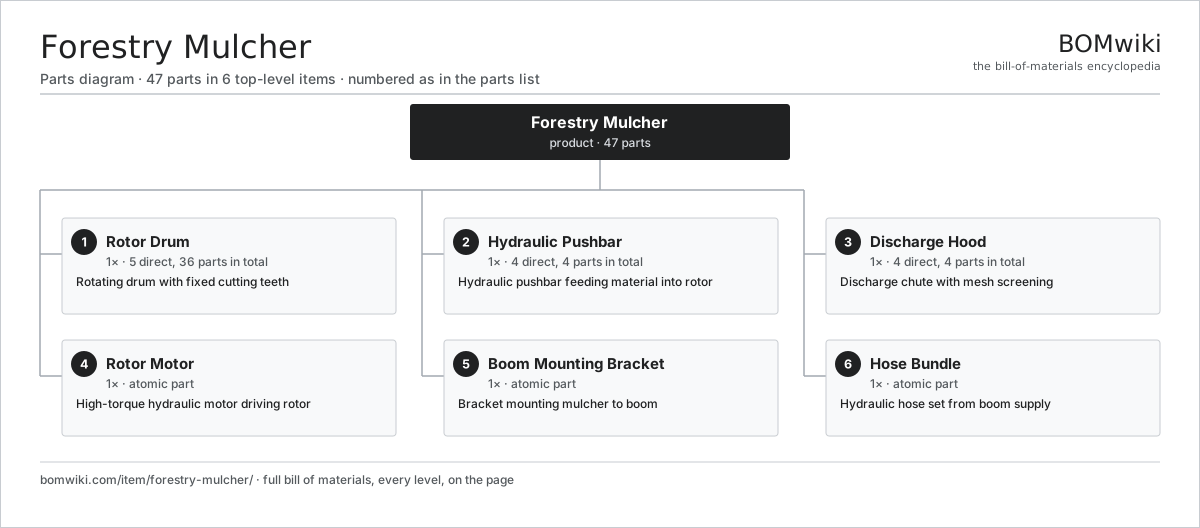
| # | Part | Qty | What it does |
|---|---|---|---|
| 1 | Rotor Drum 5 parts | 1× | Rotating drum with fixed cutting teeth |
| 2 | Hydraulic Pushbar 4 parts | 1× | Hydraulic pushbar feeding material into rotor |
| 3 | Discharge Hood 4 parts | 1× | Discharge chute with mesh screening |
| 4 | Rotor Motor | 1× | High-torque hydraulic motor driving rotor |
| 5 | Boom Mounting Bracket | 1× | Bracket mounting mulcher to boom |
| 6 | Hose Bundle | 1× | Hydraulic hose set from boom supply |
3D model
No 3D model yet. Have a CAD file of this? Add a 3D model. STL renders right on this page; STEP, FreeCAD, and OpenSCAD sources are welcome too (openly licensed, like all 3D models on BOMwiki).
Build & assembly graph
expand / collapse · shared sub-assemblies converge · links to related products · est. labourTap an assembly to expand/collapse · tap a part to open it · use “Open page” for any node · drag to pan, scroll to zoom.
Bill of materials for Forestry Mulcher
6 top-level lines · 19 rows shown · 47 parts total · indented to 3 levels| # | Item / sub-assembly | Part no. | Qty/assy | Ext. qty | Parts | Type |
|---|---|---|---|---|---|---|
| 1 | Rotor Drum 5 parts | forestry-mulcher-rotor-drum | 1× | 1 | 36 | assembly |
| 1.1 | Drum Shell | forestry-mulcher-drum-shell | 1× | 1 | · | part |
| 1.2 | Drum Axle | forestry-mulcher-drum-axle | 1× | 1 | · | part |
| 1.3 | Tooth Insert | forestry-mulcher-teeth-insert | 16× | 16 | · | part |
| 1.4 | Tooth Holder Block | forestry-mulcher-tooth-holder | 16× | 16 | · | part |
| 1.5 | Drum Bearing | forestry-mulcher-drum-bearing | 2× | 2 | · | part |
| 2 | Hydraulic Pushbar 4 parts | forestry-mulcher-pushbar | 1× | 1 | 4 | assembly |
| 2.1 | Pushbar Arm | forestry-mulcher-pushbar-arm | 1× | 1 | · | part |
| 2.2 | Pushbar Cylinder | forestry-mulcher-pushbar-cylinder | 1× | 1 | · | part |
| 2.3 | Pushbar Cutting Shoe | forestry-mulcher-pushbar-shoe | 1× | 1 | · | part |
| 2.4 | Return Spring | forestry-mulcher-pushbar-spring | 1× | 1 | · | part |
| 3 | Discharge Hood 4 parts | forestry-mulcher-hood | 1× | 1 | 4 | assembly |
| 3.1 | Hood Frame | forestry-mulcher-hood-frame | 1× | 1 | · | part |
| 3.2 | Mesh Screen | forestry-mulcher-mesh-screen | 1× | 1 | · | part |
| 3.3 | Discharge Chute | forestry-mulcher-discharge-opening | 1× | 1 | · | part |
| 3.4 | Hood Angle Hinge | forestry-mulcher-hood-hinge | 1× | 1 | · | part |
| 4 | Rotor Motor | forestry-mulcher-motor | 1× | 1 | · | part |
| 5 | Boom Mounting Bracket | forestry-mulcher-boom-mount | 1× | 1 | · | part |
| 6 | Hose Bundle | forestry-mulcher-hose-bundle | 1× | 1 | · | part |
Something wrong in this list? Report a problem with this BOM.
Sourcing: possible vendors
Browse the supplier directory → Prices, MOQ, and lead times are algorithmic estimates, not quotes, and not claims about these companies. Company mappings are curated by keyword; est. price band $5k–$800k. How estimates work| Vendor | HQ | Specialty | MOQ | Lead time |
|---|---|---|---|---|
| deere.com ↗ | Moline, US | Agriculture & turf | made to order | 14–24 wks |
| cnh.com ↗ | Basildon, GB | Agriculture (Case IH, New Holland) | made to order | 14–24 wks |
|
🇺🇸AGCO
agcocorp.com ↗
|
Duluth, US | Agriculture (Fendt, Massey Ferguson) | made to order | 14–24 wks |
|
🇩🇪Claas
claas.com ↗
|
Harsewinkel, DE | Harvesters & tractors | made to order | 14–24 wks |
|
🇯🇵Kubota
kubota.com ↗
|
Osaka, JP | Compact tractors & equipment | made to order | 14–24 wks |
1,108-word article