Fourdrinier Paper Machine
ProductOverview
The Fourdrinier paper machine is the workhorse of modern paper production, capable of producing commodity grades (newsprint, packaging, tissue) at 1000+ m/min across widths from 2 to 10 meters. Named after the Fourdrinier brothers who commercialized it in the 1800s, this machine type remains the dominant architecture for bleached kraft, coated, and fine papers globally. The machine converts dilute pulp slurry (>99% water) into finished sheet via sequential zones: formation on a moving wire, pressing to remove bulk water, drying via contact with heated cylinders, and calendering for surface finish.
A typical installation for commodity grades occupies a floor space 30–80 m long and 8–12 m wide, consumes 50–300 kW of electric power, and requires 0.6–1.0 MPa steam for drying. The machine operates 24/7 at constant speed, with basis weights from 30 to 300 g/m² achieved by adjusting consistency, headbox jet velocity, and draw. Modern systems achieve coating weight uniformity within ±2% across the width via closed-loop controls on consistency, tension, and nip pressure.
How It Works
Headbox and Formation
Pulp arrives at the Headbox as a 0.5–1.0% suspension in water. The Consistency Controller maintains density by metering dilution water; the Headbox Pump pressurizes the slurry to 0.5–2.0 bar and delivers it through the Headbox Diffuser. The diffuser chamber slows the jet and dampens turbulence before the slurry exits the Slice Lip, a gap typically 5–25 mm tall that distributes the jet evenly across the full machine width.
The jet lands on the Forming Wire, a moving polyamide or stainless steel mesh screen traveling at 1000–1200 m/min. As the wire carries the wet slurry forward, gravity and suction-assisted drainage (via the Foil Box) remove water downward through the mesh. Fibers interlock and begin bonding, building a mat 1–5 mm thick. The Wire Tensioner maintains constant tension (5000–10000 N/m) to keep the wire flat and prevent wrinkles or deflection.
Pressing
Once the sheet has sufficient green strength, it transfers to the Press Section, typically a single hard-nip roller pair or dual-stage press. The Upper Press Roll and Lower Press Roll converge under 500–3000 kPa load, with Press Nip Bearings carrying the separating forces. The Press Felt (a wool/synthetic blend) carries the wet web through the nip, protecting it from roll damage and channeling expelled water downward. Pressing reduces moisture from 80% to 50–60%, allowing the sheet to survive drying and reducing steam load.
Drying
The pressed web enters the Dryer Section, a series of 40–60 Dryer Can cylinders, each 1–2 m in diameter and heated to 130–150°C by low-pressure steam. The sheet contacts each cylinder in turn, wrapping partway around as it travels. Steam at 0.6–1.0 MPa flows through the Steam Manifold into the cylinder internals via rotary joints at each end, then returns as condensate via the fouldrinier-paper-machine-condensate-return system. Evaporation progresses from ~50% moisture after pressing to ~5% by the dryer exit, a reduction of 50 tonnes of water per day for a 100 t/day machine.
Dryer layout alternates between heated and unheated cylinders; some machines use a "shoe press" (a high-temperature elastomer blade pressing against a cylinder) to intensify water removal without increasing nip force. The drying section consumes 70–80% of the machine's thermal energy budget, making steam efficiency critical to paper mill economics.
Calendering and Reeling
The still-warm sheet exits the dryer at ~5–7% moisture and passes through the Calender Stack stack, typically 3 Calender Roll cylinders loaded to 100–200 kN/m under 80–150°C. The Gap Adjuster maintains ±0.01 mm nip thickness using hydraulic positioning. Calendering densifies and smooths the sheet surface, improving gloss, smoothness, and printability. Temperature softens the fibers slightly, allowing mechanical closure of internal voids without chemical damage.
The finished sheet enters the Reel Section, where it winds around a rotating Reel Drum. A Reel Nip Roll presses the sheet against the drum at constant tension (10–50 kPa air pressure) maintained by a load cell and proportional solenoid valve. Once the parent roll reaches diameter (1–2 m), the Width Trimmer reciprocating blade trims both edges, a hydraulic core-ejection system removes the wound roll, and a new mandrel loads automatically.
Drive and Control
The Drive System provides motion: a Main Drive Motor (50–300 kW, 1500 rpm) feeds a Primary Gearbox reducing to 10–50 m/s at the wire. A AC Variable Drive (VFD) allows ramp-up from rest, speed matching during threading, and energy-efficient low-speed operation during grade changes. Flexible Coupling elements absorb shock and misalignment.
The Control Panel houses a Industrial PLC (Siemens S7-1200 or Beckhoff TwinCAT) running closed-loop control on multiple streams: consistency (via dilution valve), tension (via nip air pressure), nip load (hydraulic valve feedback), dryer temperature (steam valve trimming), and speed. A Sensor Array provides 4/20 mA input from pressure transducers (0–5 bar), thermocouples (0–200°C), humidity probes, and level floats. The fouldrinier-paper-machine-hmi-terminal displays real-time alarms, historical trends, and roll-change sequences.
Variants and Applications
Tissue machines omit the calender and use lower pressures, softer felt, and less drying to produce tissue grades (60–200 gsm). Newsprint and packaging machines include longer drier sections and sometimes a soft-nip press for bulk. Coated paper lines add a size press or curtain coater after drying before calendering. Modern retrofit machines integrate microfibrillated cellulose (MFC) headboxes or advanced retention aids for improved drainage and strength at target basis weight reductions.
Economics and Reliability
A 100 t/day machine producing 80 gsm coated paper costs €20–40 million installed. Operating margins depend on steam cost (often the single largest variable cost at 40% of operating expenses), power efficiency, and product yield. Mean time between planned maintenance is typically 5–7 days (weekly trim changes, felt cleaning); mean time to unplanned maintenance is 200–500 hours (bearing, seal, or drive failures drive downtime). Closed-loop control systems have reduced moisture variability from ±5% (1980s) to ±0.5% today, enabling lighter basis weights and lower fiber cost.
Fourdrinier Paper Machine parts and their functions
8 top-level parts · 61 parts in total · full bill of materials below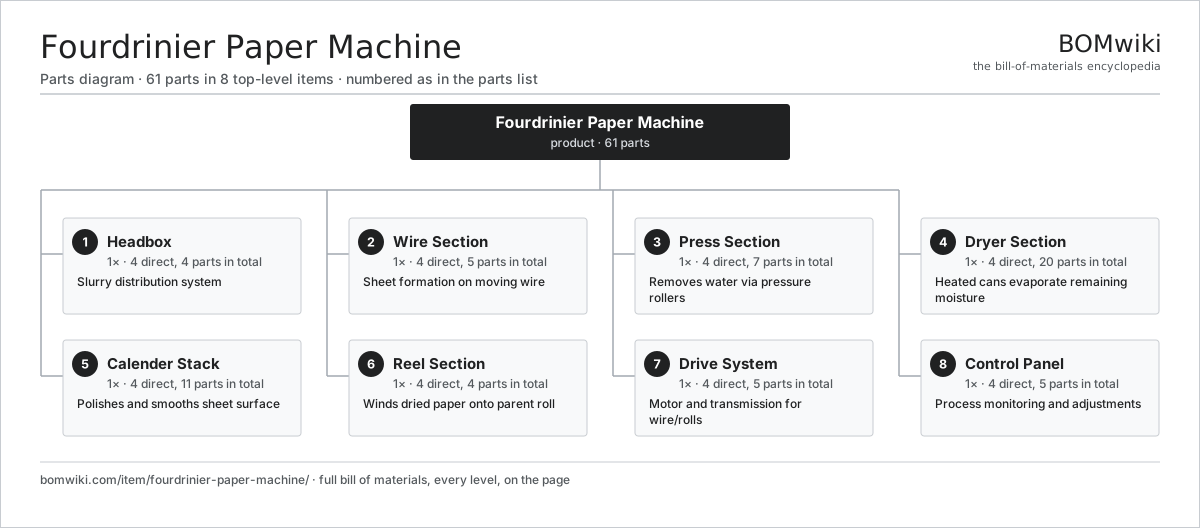
| # | Part | Qty | What it does |
|---|---|---|---|
| 1 | Headbox 4 parts | 1× | Slurry distribution system |
| 2 | Wire Section 4 parts | 1× | Sheet formation on moving wire |
| 3 | Press Section 4 parts | 1× | Removes water via pressure rollers |
| 4 | Dryer Section 4 parts | 1× | Heated cans evaporate remaining moisture |
| 5 | Calender Stack 4 parts | 1× | Polishes and smooths sheet surface |
| 6 | Reel Section 4 parts | 1× | Winds dried paper onto parent roll |
| 7 | Drive System 4 parts | 1× | Motor and transmission for wire/rolls |
| 8 | Control Panel 4 parts | 1× | Process monitoring and adjustments |
3D model
No 3D model yet. Have a CAD file of this? Add a 3D model. STL renders right on this page; STEP, FreeCAD, and OpenSCAD sources are welcome too (openly licensed, like all 3D models on BOMwiki).
Build & assembly graph
expand / collapse · shared sub-assemblies converge · links to related products · est. labourTap an assembly to expand/collapse · tap a part to open it · use “Open page” for any node · drag to pan, scroll to zoom.
Bill of materials for Fourdrinier Paper Machine
8 top-level lines · 40 rows shown · 61 parts total · indented to 3 levels| # | Item / sub-assembly | Part no. | Qty/assy | Ext. qty | Parts | Type |
|---|---|---|---|---|---|---|
| 1 | Headbox 4 parts | fourdrinier-paper-machine-headbox | 1× | 1 | 4 | assembly |
| 1.1 | Slice Lip | fourdrinier-paper-machine-slice-lip | 1× | 1 | · | part |
| 1.2 | Headbox Diffuser | fourdrinier-paper-machine-diffuser | 1× | 1 | · | part |
| 1.3 | Headbox Pump | fourdrinier-paper-machine-pump | 1× | 1 | · | part |
| 1.4 | Consistency Controller | fourdrinier-paper-machine-consistency-controller | 1× | 1 | · | part |
| 2 | Wire Section 4 parts | fourdrinier-paper-machine-wire-section | 1× | 1 | 5 | assembly |
| 2.1 | Forming Wire | fourdrinier-paper-machine-forming-wire | 1× | 1 | · | part |
| 2.2 | Wire Drive Rolls | fourdrinier-paper-machine-wire-rolls | 2× | 2 | · | part |
| 2.3 | Foil Box | fourdrinier-paper-machine-foil-box | 1× | 1 | · | part |
| 2.4 | Wire Tensioner | fourdrinier-paper-machine-wire-stretch | 1× | 1 | · | part |
| 3 | Press Section 4 parts | fourdrinier-paper-machine-press-section | 1× | 1 | 7 | assembly |
| 3.1 | Upper Press Roll | fourdrinier-paper-machine-press-roll-a | 1× | 1 | · | part |
| 3.2 | Lower Press Roll | fourdrinier-paper-machine-press-roll-b | 1× | 1 | · | part |
| 3.3 | Press Nip Bearings | fourdrinier-paper-machine-press-nip-bearings | 4× | 4 | · | part |
| 3.4 | Press Felt | fourdrinier-paper-machine-press-felt | 1× | 1 | · | part |
| 4 | Dryer Section 4 parts | fourdrinier-paper-machine-dryer-section | 1× | 1 | 20 | assembly |
| 4.1 | Dryer Can | fourdrinier-paper-machine-dryer-can | 6× | 6 | · | part |
| 4.2 | Dryer Gas Seals | fourdrinier-paper-machine-dryer-gas-seals | 12× | 12 | · | part |
| 4.3 | Steam Manifold | fourdrinier-paper-machine-steam-manifold | 1× | 1 | · | part |
| 4.4 | Condensate Return System | fourdrinier-paper-machine-condensate-return | 1× | 1 | · | part |
| 5 | Calender Stack 4 parts | fourdrinier-paper-machine-calender | 1× | 1 | 11 | assembly |
| 5.1 | Calender Roll | fourdrinier-paper-machine-calender-roll | 3× | 3 | · | part |
| 5.2 | Calender Spindle Bearings | fourdrinier-paper-machine-calender-bearings | 6× | 6 | · | part |
| 5.3 | Heating Element | fourdrinier-paper-machine-heating-element | 1× | 1 | · | part |
| 5.4 | Gap Adjuster | fourdrinier-paper-machine-gap-adjuster | 1× | 1 | · | part |
| 6 | Reel Section 4 parts | fourdrinier-paper-machine-reel-section | 1× | 1 | 4 | assembly |
| 6.1 | Reel Drum | fourdrinier-paper-machine-reel-drum | 1× | 1 | · | part |
| 6.2 | Reel Nip Roll | fouldrinier-paper-machine-nip-roll | 1× | 1 | · | part |
| 6.3 | Width Trimmer | fourdrinier-paper-machine-width-control | 1× | 1 | · | part |
| 6.4 | Web Tensioner | fourdrinier-paper-machine-web-tension | 1× | 1 | · | part |
| 7 | Drive System 4 parts | fourdrinier-paper-machine-drive-system | 1× | 1 | 5 | assembly |
| 7.1 | Main Drive Motor | fourdrinier-paper-machine-main-motor | 1× | 1 | · | part |
| 7.2 | Primary Gearbox | fourdrinier-paper-machine-gearbox | 1× | 1 | · | part |
| 7.3 | AC Variable Drive | fourdrinier-paper-machine-variable-drive | 1× | 1 | · | part |
| 7.4 | Flexible Coupling | fourdrinier-paper-machine-coupling | 2× | 2 | · | part |
| 8 | Control Panel 4 parts | fourdrinier-paper-machine-control-panel | 1× | 1 | 5 | assembly |
| 8.1 | Industrial PLC | fourdrinier-paper-machine-plc | 1× | 1 | · | part |
| 8.2 | Sensor Array | fourdrinier-paper-machine-sensor-suite | 1× | 1 | · | part |
| 8.3 | HMI Terminal | fourdrinier-paper-machine-hmi-terminal | 1× | 1 | · | part |
| 8.4 | Relay | relay | 2× | 2 | · | part |
Something wrong in this list? Report a problem with this BOM.
Sourcing: possible vendors
Browse the supplier directory → Prices, MOQ, and lead times are algorithmic estimates, not quotes, and not claims about these companies. Company mappings are curated by keyword; est. price band $5k–$2M. How estimates work| Vendor | HQ | Specialty | MOQ | Lead time |
|---|---|---|---|---|
| atlascopco.com ↗ | Stockholm, SE | Compressors & industrial | 10 units | 12–20 wks |
|
🇦🇹Andritz
andritz.com ↗
|
Graz, AT | Process plants & machinery | 10 units | 12–20 wks |
| buhlergroup.com ↗ | Uzwil, CH | Food & materials processing | 10 units | 12–20 wks |
| gea.com ↗ | Düsseldorf, DE | Process technology | 10 units | 12–20 wks |
| mhi.com ↗ | Tokyo, JP | Heavy machinery | 10 units | 12–20 wks |
1,122-word article