Freight Elevator
ProductOverview
A freight elevator moves goods, pallets and loaded industrial trucks between floors of warehouses, factories and loading docks. It differs from a passenger elevator less in principle than in proportion: the platform is larger, the structure is built for concentrated wheel loads and impact rather than distributed standing passengers, and the entrances are vertical bi-parting doors that open the full width and height of the car. Loading class matters more than rated capacity alone. Under ASME A17.1, Class A covers distributed general freight, Class B motor vehicles, and Class C powered trucks, Class C2 permits a loaded forklift to drive onto the Car Platform, which means the platform, Car Sling and Door Sill must take transient loads well above the rated capacity.
A typical mid-size unit carries 5,000 kg at 0.5 m/s over four landings. Speed is deliberately low: freight cycles are dominated by loading time, not travel time, and slower contract speeds let the same machine handle far more mass.
How it works
Suspension and drive follow standard traction practice. The Geared Traction Machine is a worm-geared hoist machine: a 30 kW induction motor turns a hardened steel worm meshing with a bronze gear wheel inside the Gearbox Housing, giving roughly 30:1 reduction and a self-locking drivetrain that cannot be back-driven by an unbalanced load. The output shaft carries the Traction Sheave, whose undercut U-grooves grip eight 16 mm steel Hoist Ropes by friction alone. The Roping System is arranged 2:1, the ropes pass under Deflector Sheaves on the car and counterweight and dead-end at the machine beams, which doubles available traction force at the cost of running the ropes at twice car speed. The Machine Brake is spring-applied and electrically released: two lined Brake Shoes clamp a drum on the worm shaft whenever the Brake Coil is de-energised, so any power loss stops and holds the car.
The Counterweight balances the empty car plus about 45% of rated load. Its Counterweight Frame stacks two dozen cast Filler Weight weights and rides its own rail set on Guide Shoes. Both car and counterweight run on the Guide Rail System: machined T127-2 Guide Rail Sections spliced with Fishplates and held to the hoistway structure by Rail Brackets every 2–2.5 m. Freight rails are heavier than passenger rails of similar duty because eccentric platform loading, a forklift parked at one end of a 3 m platform, puts sustained bending moments into the rail-and-shoe system.
Doors and loading
The signature of a freight elevator is the Bi-Parting Door System system. Each entrance has two steel-faced Door Panels that part vertically: the upper panel rises into the header and the lower panel drops into a pocket below the sill, the two linked by the Door Chain & Counterbalance so that each counterbalances the other. A Door Operator Motor above the entrance drives the chain; when open, the top edge of the lower panel sits flush with the floor and forms part of the truckable threshold along with the Door Sill. A separate vertical-rising Car Gate closes the car opening. Every landing entrance carries a Door Interlock, the car cannot run unless all hoistway doors are mechanically locked, and a locked door cannot be opened unless the car is at that landing. Inside the car, Bumper Rails along the walls absorb cart impacts, and the Car Operating Panel provides floor selection and door control.
Safety system
Overspeed protection is fully mechanical. The Overspeed Governor in the machine room spins with a continuous Governor Rope loop attached to the car; if car speed exceeds roughly 115% of rated, centrifugal flyweights trip and the governor grips its rope, which pulls the lift rod of the Progressive Safety Gear under the sling. Spring-loaded wedges clamp both rail blades and bring the car to a progressive stop at less than 1 g. Oil-hydraulic Pit Buffers in the pit arrest either the car or the counterweight in a terminal overrun, and cam-operated Final Limit Switch switches remove machine power before a buffer strike.
Control
The Motion Controller is a microprocessor cabinet supervising the safety chain, the door operators and the drive. Six IGBT Power Modules form the variable-frequency inverter that ramps the hoist motor through a jerk-limited speed profile, with Relay contactors providing the code-required redundant means of removing power. Landing calls, gate and interlock states, and load-weighing inputs arrive over the Traveling Cable, the flat multi-conductor umbilical that loops from mid-hoistway to the moving car. Freight controllers commonly add key-switched modes, independent service, attendant operation and a hoistway-access mode for maintenance, because freight cars often run under the control of a single operator rather than general passengers.
Freight Elevator parts and their functions
8 top-level parts · 229 parts in total · full bill of materials below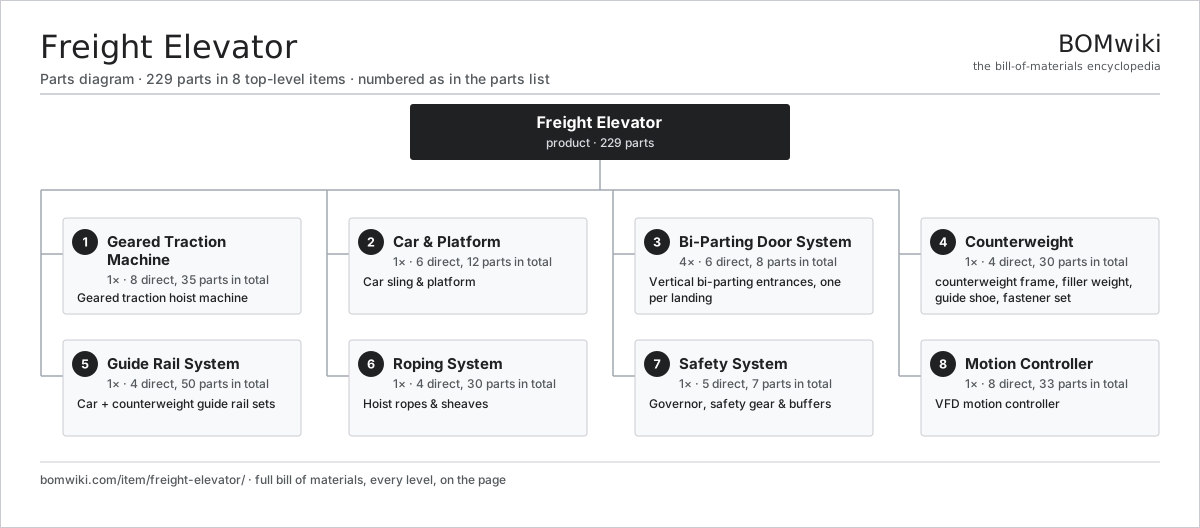
| # | Part | Qty | What it does |
|---|---|---|---|
| 1 | Geared Traction Machine 8 parts | 1× | Geared traction hoist machine |
| 2 | Car & Platform 6 parts | 1× | Car sling & platform |
| 3 | Bi-Parting Door System 6 parts | 4× | Vertical bi-parting entrances, one per landing |
| 4 | Counterweight 4 parts | 1× | Steel frame stacked with cast filler weights equal to the car weight plus about 45% of rated load, riding its own guide rails. |
| 5 | Guide Rail System 4 parts | 1× | Car + counterweight guide rail sets |
| 6 | Roping System 4 parts | 1× | Hoist ropes & sheaves |
| 7 | Safety System 5 parts | 1× | Governor, safety gear & buffers |
| 8 | Motion Controller 8 parts | 1× | VFD motion controller |
3D model
No 3D model yet. Have a CAD file of this? Add a 3D model. STL renders right on this page; STEP, FreeCAD, and OpenSCAD sources are welcome too (openly licensed, like all 3D models on BOMwiki).
Build & assembly graph
expand / collapse · shared sub-assemblies converge · links to related products · est. labourTap an assembly to expand/collapse · tap a part to open it · use “Open page” for any node · drag to pan, scroll to zoom.
Bill of materials for Freight Elevator
8 top-level lines · 63 rows shown · 229 parts total · indented to 3 levels| # | Item / sub-assembly | Part no. | Qty/assy | Ext. qty | Parts | Type |
|---|---|---|---|---|---|---|
| 1 | Geared Traction Machine 8 parts | freight-elevator-machine | 1× | 1 | 35 | assembly |
| 1.1 | Stator Assembly 3 parts | stator-assembly | 1× | 1 | 3 | assembly |
| 1.1.1 | Stator Core (laminations) | stator-core | 1× | 1 | · | part |
| 1.1.2 | Copper Winding | copper-winding | 1× | 1 | · | part |
| 1.1.3 | Slot Insulation | stator-insulation | 1× | 1 | · | part |
| 1.2 | Rotor Assembly 4 parts | rotor-assembly | 1× | 1 | 19 | assembly |
| 1.2.1 | Rotor Shaft | rotor-shaft | 1× | 1 | · | part |
| 1.2.2 | Rotor Core | rotor-core | 1× | 1 | · | part |
| 1.2.3 | Neodymium Magnet | neodymium-magnet | 16× | 16 | · | part |
| 1.2.4 | Ball Bearing | ball-bearing | 1× | 1 | · | part |
| 1.3 | Motor Housing | motor-housing | 1× | 1 | · | part |
| 1.4 | Helical Gear Pair | gear-pair | 1× | 1 | · | part |
| 1.5 | Gearbox Housing | gearbox-housing | 1× | 1 | · | part |
| 1.6 | Ball Bearing | ball-bearing | 4× | 4 | · | part |
| 1.7 | Traction Sheave | freight-elevator-sheave | 1× | 1 | · | part |
| 1.8 | Machine Brake 3 parts | freight-elevator-brake | 1× | 1 | 5 | assembly |
| 1.8.1 | Brake Shoe | freight-elevator-brake-shoe | 2× | 2 | · | part |
| 1.8.2 | Brake Coil | freight-elevator-brake-coil | 1× | 1 | · | part |
| 1.8.3 | Coil Spring | coil-spring | 2× | 2 | · | part |
| 2 | Car & Platform 6 parts | freight-elevator-car | 1× | 1 | 12 | assembly |
| 2.1 | Car Platform | freight-elevator-platform | 1× | 1 | · | part |
| 2.2 | Car Sling | freight-elevator-sling | 1× | 1 | · | part |
| 2.3 | Sheet Metal Panel | sheet-panel | 6× | 6 | · | part |
| 2.4 | Bumper Rail | freight-elevator-bumper-rail | 2× | 2 | · | part |
| 2.5 | Car Gate | freight-elevator-car-gate | 1× | 1 | · | part |
| 2.6 | Car Operating Panel | freight-elevator-cop | 1× | 1 | · | part |
| 3 | Bi-Parting Door System 6 parts | freight-elevator-doors | 4× | 4 | 8 | assembly |
| 3.1 | Door Panel | freight-elevator-door-panel | 2× | 8 | · | part |
| 3.2 | Door Operator Motor | freight-elevator-door-motor | 1× | 4 | · | part |
| 3.3 | Door Chain & Counterbalance | freight-elevator-door-chain | 1× | 4 | · | part |
| 3.4 | Door Interlock | freight-elevator-interlock | 1× | 4 | · | part |
| 3.5 | Door Sill | freight-elevator-door-sill | 1× | 4 | · | part |
| 3.6 | Hall Sensor | hall-sensor | 2× | 8 | · | part |
| 4 | Counterweight 4 parts | freight-elevator-counterweight | 1× | 1 | 30 | assembly |
| 4.1 | Counterweight Frame | freight-elevator-cwt-frame | 1× | 1 | · | part |
| 4.2 | Filler Weight | freight-elevator-cwt-filler | 24× | 24 | · | part |
| 4.3 | Guide Shoe | freight-elevator-guide-shoe | 4× | 4 | · | part |
| 4.4 | Fastener Set | fastener-set | 1× | 1 | · | part |
| 5 | Guide Rail System 4 parts | freight-elevator-rails | 1× | 1 | 50 | assembly |
| 5.1 | Guide Rail Section | freight-elevator-rail-section | 12× | 12 | · | part |
| 5.2 | Rail Bracket | freight-elevator-rail-bracket | 24× | 24 | · | part |
| 5.3 | Fishplate | freight-elevator-fishplate | 10× | 10 | · | part |
| 5.4 | Fastener Set | fastener-set | 4× | 4 | · | part |
| 6 | Roping System 4 parts | freight-elevator-roping | 1× | 1 | 30 | assembly |
| 6.1 | Hoist Rope | freight-elevator-hoist-rope | 8× | 8 | · | part |
| 6.2 | Rope Termination | freight-elevator-rope-termination | 16× | 16 | · | part |
| 6.3 | Deflector Sheave | freight-elevator-deflector-sheave | 2× | 2 | · | part |
| 6.4 | Ball Bearing | ball-bearing | 4× | 4 | · | part |
| 7 | Safety System 5 parts | freight-elevator-safety | 1× | 1 | 7 | assembly |
| 7.1 | Overspeed Governor | freight-elevator-governor | 1× | 1 | · | part |
| 7.2 | Progressive Safety Gear | freight-elevator-safety-gear | 1× | 1 | · | part |
| 7.3 | Governor Rope | freight-elevator-governor-rope | 1× | 1 | · | part |
| 7.4 | Pit Buffer | freight-elevator-buffer | 2× | 2 | · | part |
| 7.5 | Final Limit Switch | freight-elevator-final-limit | 2× | 2 | · | part |
| 8 | Motion Controller 8 parts | freight-elevator-controller | 1× | 1 | 33 | assembly |
| 8.1 | Bare PCB | pcb-bare | 2× | 2 | · | part |
| 8.2 | Microcontroller | mcu | 1× | 1 | · | part |
| 8.3 | Relay | relay | 6× | 6 | · | part |
| 8.4 | IGBT Power Module | igbt-module | 6× | 6 | · | part |
| 8.5 | Power Supply | power-supply | 1× | 1 | · | part |
| 8.6 | Connector | connector | 12× | 12 | · | part |
| 8.7 | Wire Bundle | wire-bundle | 4× | 4 | · | part |
| 8.8 | Traveling Cable | freight-elevator-traveling-cable | 1× | 1 | · | part |
Something wrong in this list? Report a problem with this BOM.
Related products
same domain, ranked by shared parts Moving Walkway
1,050 parts · shares 17 with this page
Moving Walkway
1,050 parts · shares 17 with this page
 Dumbwaiter
128 parts · shares 17 with this page
Dumbwaiter
128 parts · shares 17 with this page
 Home Elevator
133 parts · shares 15 with this page
Home Elevator
133 parts · shares 15 with this page
 Escalator
2,337 parts · shares 15 with this page
Pneumatic Vacuum Elevator
122 parts · shares 13 with this page
Escalator
2,337 parts · shares 15 with this page
Pneumatic Vacuum Elevator
122 parts · shares 13 with this page
 Passenger Elevator
334 parts · shares 13 with this page
Passenger Elevator
334 parts · shares 13 with this page
Sourcing: possible vendors
Browse the supplier directory → Prices, MOQ, and lead times are algorithmic estimates, not quotes, and not claims about these companies. Company mappings are curated by keyword; est. price band $10k–$200k. How estimates work| Vendor | HQ | Specialty | MOQ | Lead time |
|---|---|---|---|---|
|
🇺🇸Otis
otis.com ↗
|
Farmington, US | Elevators & escalators | 20 units | 14–24 wks |
| schindler.com ↗ | Ebikon, CH | Elevators & escalators | 20 units | 14–24 wks |
|
🇫🇮KONE
kone.com ↗
|
Espoo, FI | Elevators & escalators | 20 units | 14–24 wks |
| tkelevator.com ↗ | Düsseldorf, DE | Elevators | 20 units | 14–24 wks |
| mitsubishielectric.com ↗ | Tokyo, JP | Elevators & electronics | 20 units | 14–24 wks |
860-word article